Follow a three-day dumbbell plan with sets, reps, technique checks, easier options and a free training log. No workout bench required.
- Three nonconsecutive sessions, with a two-day starting option.
- Exact work sets, rep ranges and practical substitutions.
- Log each set before changing the weight.
Bottom line Choose the starting version, rehearse the movements and record your first Day A before adding difficulty.
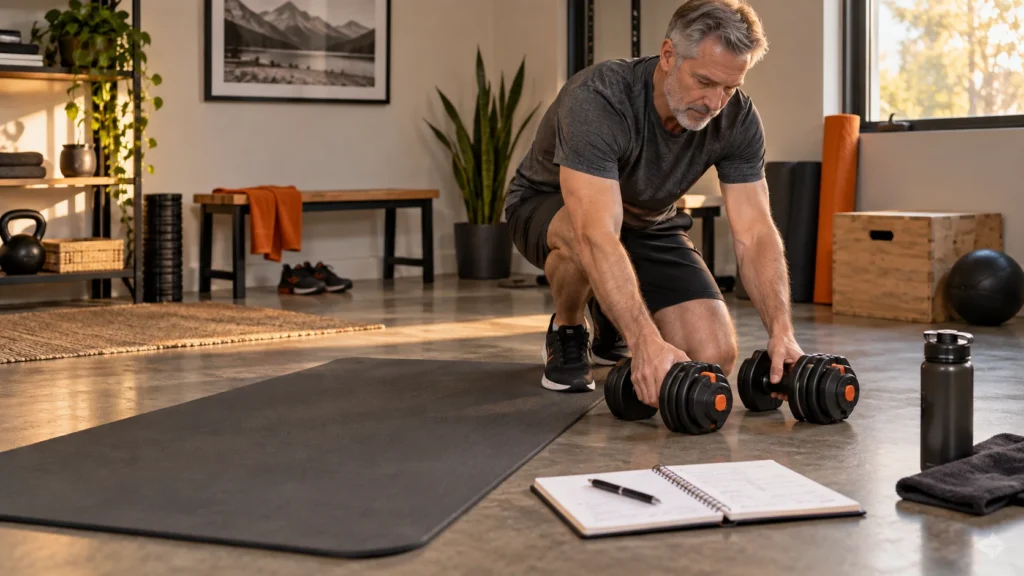
A dumbbell-only home workout plan works best when you can repeat a few useful movements and see what changed. This guide gives you a complete three-day example, a two-day starting option, technique cues and a progression rule for the weights you actually own.
Quick Summary: Dumbbell-Only Home Workout Plan
- Three nonconsecutive sessions, with a two-day starting option.
- Exact work sets, rep ranges and practical substitutions.
- Log each set before changing the weight.
The Prime Perspective
The value of dumbbells is not unlimited exercise variety. It is a manageable setup that lets you train consistently. Buy more equipment only when you can identify a movement or loading problem your current setup cannot solve.
For help with an individual movement, use the supported row guide, floor and bench press guide, shoulder press and raise guide or curl and triceps guide. Use their technique detail within the sessions here; replace comparable work when changing a block rather than adding every full routine.
A Complete Three-Day Plan You Can Actually Follow
This editorial example is for adults already able to perform the movements comfortably. Train on nonconsecutive days, such as Monday, Wednesday and Friday. Allow about 35–50 minutes, including warm-up and rest. Returning exercisers can use only Days A and B for the first two weeks, with one work set per exercise. You do not need a four-day split to make this useful.
Warm up with five minutes of easy movement, then rehearse the first squat or hinge and press with a lighter load. The table lists work sets, not warm-up sets. Leave approximately two or three controlled repetitions available at the end of each strength set. Rest 90–120 seconds between sets, and longer if breathing or setup needs it. For one-sided exercises, complete both sides before the main rest, with a short reset between sides.
On small screens, swipe the table sideways to see every column.
| Day | Exercise and work sets | What to record |
|---|---|---|
| A | Goblet squat 2 × 8–10; floor press 2 × 8–12; supported one-arm row 2 × 8–12 each side; glute bridge 2 × 10–15; heel slide 2 × 6 each side. | Load, reps for every set and remaining effort. |
| B | Dumbbell Romanian deadlift 2 × 8–10; wall or stable incline push-up 2 × 6–12; supported row 2 × 8–12 each side; supported split squat 2 × 6–8 each side; suitcase hold 2 × 15–25 seconds each side. | Support used, range and duration of holds. |
| C | Repeat Day A. Use the same starting loads unless the progression rule below is met. | Compare the repeated exercises under the same conditions. |
Repeating a session makes progress easier to interpret than introducing five new movements every day. This schedule is an example, not a requirement to increase weekly training regardless of recovery. If you already follow another program, replace comparable sessions rather than adding this one on top.
Choose a starting weight separately for each exercise
Try a light rehearsal set, then a small trial set in the target range. If you could comfortably do several more controlled repetitions, the load may be suitable for learning. If you cannot reach the bottom of the range without straining or changing position, use a lighter weight or easier movement. Do not force one pair to serve every exercise when it is too heavy for pressing or too light for the legs.
For adjustable dumbbells, check that the plates and selector mechanism are securely engaged before lifting. Change the weight only as instructed by the manufacturer. Do not hold an adjustable model by a removable plate unless its instructions explicitly allow that grip. Set weights down under control; protective flooring does not make dropping them safe.
Six Technique Checks for a No-Bench Setup
- Goblet squat: hold a suitable weight close to the chest, keep feet grounded and lower only as far as you can control. A stable chair can be a sit-to-stand alternative. Do not balance on a soft cushion.
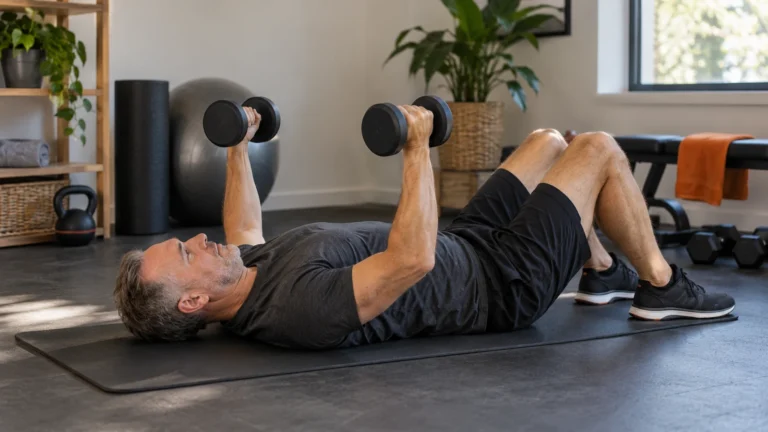
- Floor press: lie with knees bent and feet planted. Lower upper arms gently toward the floor, then press without bouncing. Use only weights you can position and set down safely. Wall push-ups are the alternative if getting onto the floor is difficult.
- One-arm row: brace your free hand on a fixed, stable support, keep the trunk steady and draw the weight toward your torso. Avoid a large twist or shrug. Complete both sides with the same setup.
- Romanian deadlift: soften the knees, move the hips back and keep weights close. Stop before your back position changes. The weights do not need to reach the floor.
- Supported split squat: both feet remain on the floor, rear heel free to rise, with light hand support. Lower through a comfortable range. Use sit-to-stands if balance or positioning is the limiting factor.
- Suitcase hold: stand with one manageable weight at your side, breathe normally and avoid leaning. Put it down before changing hands. A hold is easier to fit in a small room than a walking carry.
For bridges, lift and lower the hips without forcing a back arch. For heel slides, lie with knees bent and slowly extend one heel along the floor while keeping the trunk steady. Use a comfortable wall plank instead if floor transfers are impractical. The apartment-friendly plan provides those easier variations in more detail.
Worked Progression: A Row With Limited Weight Increments
Suppose one dumbbell allows 10 and 9 controlled repetitions across two sets. Keep that weight and work toward 10/10, then 11/10 and eventually 12/12 over repeated sessions. These are illustrative numbers, not a required session-by-session improvement. Keep the support, range and rest similar.
After reaching the top of the range on two comfortable exposures, try the smallest available increase and return toward eight repetitions. If the next dumbbell is too heavy, remain at the old load rather than shortening the movement to force progress. A heavier pair may eventually be more useful than endlessly slowing every repetition. Reducing rest changes the task and is not interchangeable with increasing strength load.
The 2026 ACSM resistance-training guidance supports accessible home-based training and emphasizes matching the plan to the goal. It does not require training to failure or a complicated split for the average healthy adult. Our exact exercises and volumes are an editorial application, not an ACSM-prescribed program.
When This Plan Fits—and When It Needs Changing
This is a general strength routine for someone who can already perform the selected movements comfortably. The point is to cover the main patterns with limited equipment. It is not a specialist bodybuilding split, a rehabilitation plan or a promise that every muscle gets an optimal training dose. If learning the movements and managing two sessions is already challenging, start with the first-session beginner guide and return here when the setup feels familiar.
If you have only one dumbbell, use it for goblet squats, supported rows and suitcase holds. A wall push-up can replace the two-dumbbell floor press. An unloaded hinge can be rehearsal, but it is not equivalent to a heavily loaded hinge for building strength. Record substitutions rather than treating every exercise name as interchangeable.
What to do when the legs outgrow your weights
First check whether you are actually reaching the top of the prescribed range with consistent depth and control. If you are, consider a manageable load increase. A supported split squat can make a smaller load demanding, but it changes balance, skill and the distribution of work. Learn it separately rather than adding it on top of all the existing leg work. Our unilateral training guide explains that tradeoff.
Slower repetitions and pauses can make a set harder, but they do not turn a light pair into unlimited resistance. Keep the goal clear. If heavier loading becomes necessary, compare your options using the home gym equipment guide before buying a larger kit. A bench is optional for this program; space and safe handling may matter more.
Make Missed Sessions and Plateaus Manageable
If you miss Wednesday, do the next planned session on an appropriate day rather than squeezing two sessions together. Keep the sequence moving without trying to recover every missed set. After a longer break, use a lighter or smaller starting dose and check your response. The old log is context, not a debt.
If one exercise stalls, review that movement’s load jump, rest and setup. If every exercise feels worse, look at the whole week, including sleep, other activity and workload. The progressive overload examples distinguish repeating a load from changing the plan. Use an easy recovery session only if it stays easy; extra circuits are not a substitute for reducing excessive work.
Watch the Supported Row Setup
This BarBend demonstration is a technique reference for the supported dumbbell row, not the entire program. Watch how the support and trunk position are established before copying the movement. Use a load and a stable support appropriate to you.
Read BarBend’s accompanying row instructions.
Download the Practical Worksheet
Use the one-page reference and three fillable fields to record your setup, what you completed and the next decision. Print it or save a filled copy using a PDF reader that supports forms. Read the full instructions and adaptations above before using the summary.
Download the free dumbbell-only home workout plan worksheet (PDF)
Optional Equipment: Buy for a Specific Job
The links below open Amazon category searches, not tested product recommendations. Compare the actual product instructions, dimensions and compatibility. Use equipment you already own when it fits the task.
As an Amazon Associate, PrimeForMen earns from qualifying purchases.
Conclusion: Make the Next Session Clear
Choose the starting version, rehearse the movements and record your first Day A before adding difficulty. Use the worksheet to make that decision visible. Repeating a manageable session is a valid choice; the calendar alone does not require a harder workout.
Frequently Asked Questions
Can I follow the plan with one dumbbell?
Yes, with deliberate substitutions. Use one weight for goblet squats, rows and holds, and use wall push-ups instead of a two-dumbbell floor press. Choose a manageable hinge variation. Record what you changed; the one-weight version is not identical to the original plan.
Do I need a bench?
No. The program uses a floor press and allows a fixed, stable support for rows. Wall push-ups can replace floor pressing if floor transfers or positioning the weights are difficult. Do not use unstable furniture as a substitute.
Should every set reach failure?
No. The starting example leaves approximately two or three controlled repetitions available. That is an effort guide, not an exact measurement. Stop sooner if technique changes or symptoms appear.
What if my next dumbbell is much heavier?
Stay at the previous load if the next step prevents controlled repetitions in the prescribed range. Improve within the current range or consider equipment with smaller increments. Do not shorten the movement simply to claim a heavier lift.
Is two days enough to start?
Two nonconsecutive days are a practical starting option. Use Days A and B and begin with one work set if returning to exercise. Add work only when the existing schedule is manageable; Day C is not a compulsory upgrade.
Medical Disclaimer
This is general fitness education, not diagnosis, rehabilitation or an individualized exercise prescription. Choose movements appropriate to your situation. Stop for pain, dizziness or unusual symptoms and seek appropriate guidance. New or severe concerning symptoms warrant prompt medical assessment.
Our editorial policy explains our approach to sources and commercial independence. Exercise examples and illustrations do not represent individual coaching or product testing.
Affiliate Disclosure
Some links are affiliate links. We may receive a commission from qualifying purchases at no additional cost to you. Optional equipment is not a condition of benefiting from the guidance above.