Core Workout for Men: Build Strength, Stability, and Carryover
A core workout for men should train more than visible abs. The goal is to brace, resist unwanted motion, transfer force, and keep the trunk organized while the hips, shoulders, and lungs work hard.
Anti-rotation
Carries
Rollout safety
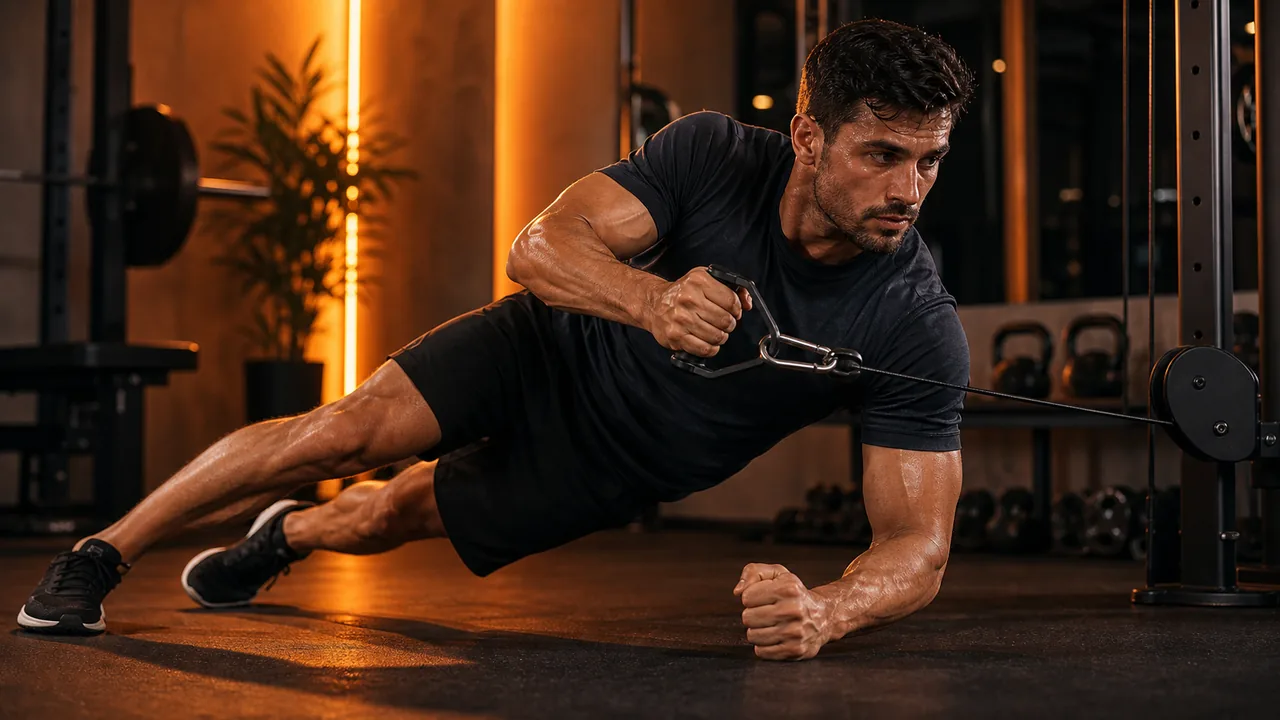
Quick Summary: Core Workout for Men
- Train anti-extension, anti-rotation, anti-lateral flexion, controlled rotation, bracing, and carries.
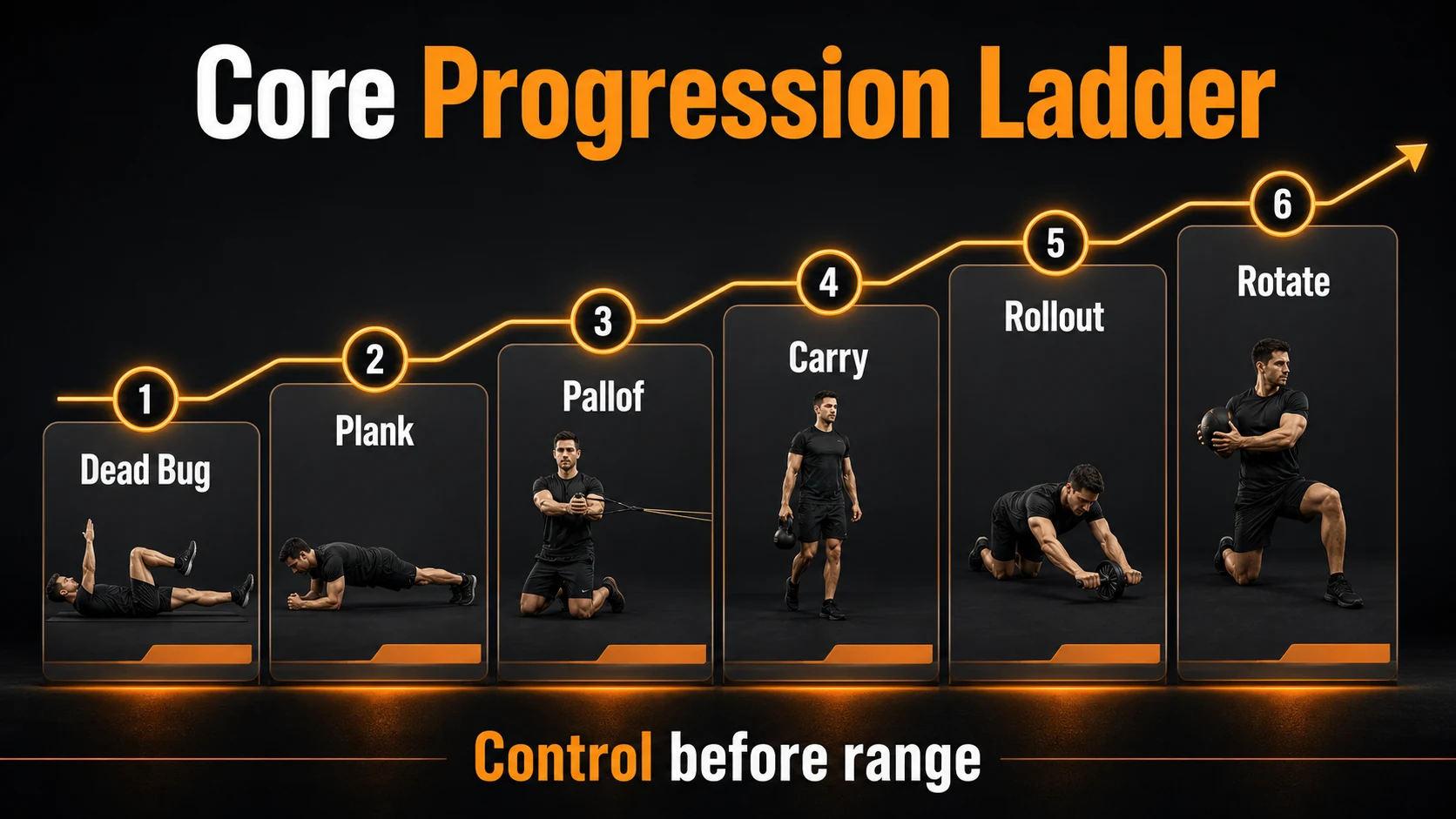
- Start with dead bugs, side planks, Pallof presses, bird dogs, and suitcase carries before aggressive rollouts.
- Progress core work with cleaner control, longer holds, slower tempo, load, distance, leverage, or complexity.
- For men over 40, use short high-quality sessions two to four times per week instead of daily ab burnout.
The core is a control system, not an ab contest.
The best core workout is not the hardest circuit you can survive. It is the one that teaches your trunk to stay organized while your arms and legs create force. That is why dead bugs, side planks, Pallof presses, loaded carries, reverse crunches, chops, and careful rollouts beat random sit-up volume for most men.
This page turns core training into a practical system: define the job, choose the right exercise level, train it consistently, and progress only when control stays clean.
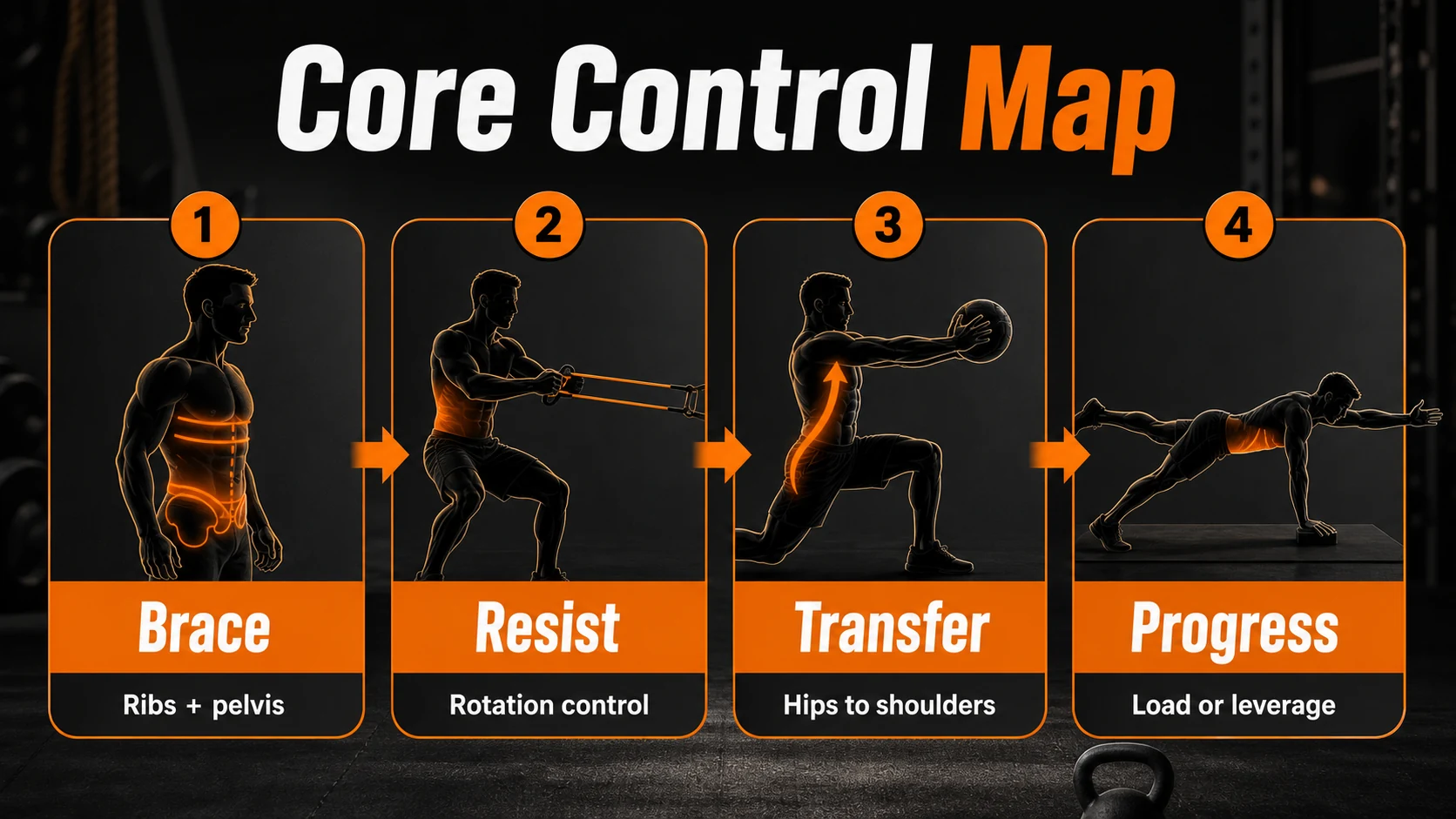
Build core training around brace, resist, transfer, and progress.
The first infographic is the operating system for this page. Brace before you add speed. Resist before you chase rotation. Transfer force only after the trunk can hold position.
Share & embed
Share this infographic with your readers. Please keep the graphic intact and include a visible source link to this guide. This sharing option applies only to this infographic, not to product photos or third-party media.
Suggested credit: Infographic by PrimeForMen. The embed uses the original image and a source link, with no script or tracking code.
You may add rel="nofollow" to the source link. No followed link is required.
Core muscles do more than flex the spine.
The core includes the rectus abdominis, obliques, transverse abdominis, spinal erectors, diaphragm, pelvic floor, hips, and glutes. A useful program trains the trunk to create stiffness when needed, control movement, breathe under tension, and transfer force between the lower and upper body.
| Core Function | What It Means | Best Exercises |
|---|---|---|
| Anti-extension | Prevent low-back arching and rib flare. | Dead bug, front plank, long-lever plank, ab wheel regression |
| Anti-rotation | Resist twisting when force pulls you off line. | Pallof press, Pallof hold, plank row |
| Anti-lateral flexion | Prevent side bending under uneven load. | Side plank, suitcase carry, farmer carry |
| Bracing | Organize ribs, pelvis, and breath before force. | Bear breathing hold, plank, loaded carry |
| Controlled flexion | Move through spinal flexion without yanking from the hips. | Reverse crunch, hanging knee raise regression |
| Controlled rotation | Rotate through the right places with control. | Band chop, cable chop, med-ball throw progression |
| Force transfer | Link feet, hips, trunk, shoulders, and hands. | Carries, lifts, chops, athletic drills |
Core workouts for men by level and goal.
Use one of these routines for four weeks before judging it. Put easier activation work before lifting, and put harder core work after your main strength work or on a short standalone day.
Beginner Core Stability
- Dead bug: 2-3 sets of 6-10 per side.
- Side plank: 2-3 sets of 15-30 seconds per side.
- Bird dog: 2-3 sets of 6-10 per side.
- Suitcase carry: 2-4 sets of 20-40 steps per side.
Best for beginners, men returning after a break, and anyone who needs cleaner trunk control before load.
Strength Carryover Core
- Pallof press: 3 sets of 8-12 per side.
- Farmer carry: 3-4 carries of 30-60 steps.
- Plank row: 2-3 sets of 6-10 per side.
- Reverse crunch: 2-3 sets of 8-12 controlled reps.
Best for lifters who want core work that supports squats, deadlifts, pressing, and loaded movement.
Athletic Core Transfer
- Band chop: 3 sets of 8-12 per side.
- Lift pattern: 3 sets of 8-12 per side.
- Med-ball throw or low-impact alternative: 3 sets of 4-6 per side.
- Suitcase carry: 3 carries of 20-40 steps per side.
Best for sport, running, golf, swimming, tennis, basketball, and rotational carryover after control is reliable.
Home Core Workout
- Dead bug: 3 sets of 8 per side.
- Side plank: 3 sets of 20-40 seconds per side.
- Band Pallof press: 3 sets of 10 per side.
- Slow mountain climber or marching plank: 2-3 sets of 8-12 per side.
- Farmer carry with dumbbells or bags: 3 carries of 30-60 seconds.
Best for small-space training and readers using effective home workout routines.
Core exercise library: regression, standard, progression.
Every core exercise has a job. If your low back arches, ribs flare, hips twist, or breathing disappears, the exercise is too advanced for that day. Regress the movement and keep the core job the same.
| Core Job | Regression | Standard | Progression |
|---|---|---|---|
| Anti-extension | Dead bug arms only | Dead bug | Ab wheel rollout from knees |
| Anti-rotation | Tall-kneeling Pallof hold | Pallof press | Plank row or Pallof walkout |
| Anti-lateral flexion | Short-lever side plank | Side plank | Suitcase carry or side plank row |
| Bracing | Bear breathing hold | Front plank | Weighted plank or long-lever plank |
| Rotation control | Half-kneeling band chop | Cable or band chop | Med-ball throw |
| Flexion control | Reverse crunch with bent knees | Reverse crunch | Hanging knee raise |
| Carryover | Light farmer carry | Farmer carry | Suitcase or front-rack carry |
For deeper beginner work, use the core workout for beginners guide. For more challenge, move toward advanced core workouts only when the basics stay clean.
Progress core training without turning it into chaos.
The second infographic is the safety filter. Rollouts and rotation belong after control, not before it. If the trunk leaks movement, the progression is too early.
Share & embed
Share this infographic with your readers. Please keep the graphic intact and include a visible source link to this guide. This sharing option applies only to this infographic, not to product photos or third-party media.
Suggested credit: Infographic by PrimeForMen. The embed uses the original image and a source link, with no script or tracking code.
You may add rel="nofollow" to the source link. No followed link is required.
Longer Holds
Side plank 20 seconds becomes 40 seconds only if shoulder, ribs, and hips stay organized.
Slower Tempo
Reverse crunch lowering should be controlled. Momentum is not progression.
More Load
Heavier carries work only when posture does not collapse into side bending.
More Complexity
Plank rows and rotation patterns come after the trunk can resist movement.
Core workouts for men over 40 should be back-friendly and repeatable.
For an age-specific two-session progression, use the core workouts for men over 50 guide with bracing, anti-rotation, carries, and back-aware regressions.
Men over 40 usually need better core control, not more random ab volume. Start with dead bugs, side planks, Pallof presses, carries, and controlled reverse crunches. Add rollouts, hanging work, and rotational power only after the basics stay clean under fatigue.
| Issue | Better Rule | Good Choices |
|---|---|---|
| Low-back comfort | Anti-extension and anti-rotation before aggressive sit-ups. | Dead bug, Pallof hold, side plank |
| Hip flexors | Do not yank reverse crunches from the hips. | Slow reverse crunch, hollow regression |
| Shoulders | Earn ab wheel range with stable planks first. | Front plank, long-lever plank, stability-ball rollout |
| Breathing | Do not make every core exercise a breath-holding test. | Dead bug breathing, carry breathing |
| Recovery | Use 2-4 short quality sessions instead of daily fatigue. | 10-15 minute core slots |
| Pain signals | Sharp pain, numbness, radiating symptoms, or worsening pain should not be trained through. | Stop, regress, and consider a qualified clinician |
For broader age-smart programming, connect this page with fitness for different ages and recovery between core sessions.
The ab wheel is an anti-extension progression, not a beginner toy.
The ab wheel is useful only when you can prevent lumbar sag. If your low back drops, ribs flare, or you cannot control the return, shorten the range or go back to planks and dead bugs.
When should you train core?
Core training should support the rest of the week. If it ruins your main lifts, running mechanics, or recovery, the timing or volume is wrong.
| Timing | What Fits | What to Avoid |
|---|---|---|
| Before lifting | Dead bug, breathing, light Pallof hold. | Hard rollouts or fatigue circuits. |
| After lifting | Carries, Pallof press, side plank, reverse crunch. | So much volume that recovery suffers. |
| On rest days | Easy core control plus mobility. | Aggressive ab circuits. |
| Before running or sport | Light bracing and hip control. | Fatiguing the trunk before speed or skill. |
| Home workout day | Short core finisher after strength work. | Random 20-minute burnouts. |
The CDC recommends adults include muscle-strengthening work at least two days per week, while MedlinePlus describes the core as the muscles around the abdomen, back, and hips that help balance and stability. Use core training as part of that bigger strength and activity structure, not as a replacement for it.
Core Training Setup Kit
These are broad categories, not magic products. Buy the minimum equipment that makes your core training more repeatable, safer, and easier to progress.
Ab Wheel
Best when you already own a stable plank and need a harder anti-extension progression.
- Use only after dead bugs and planks stay clean.
- Start from knees with short range.
- Stop before low-back sag or uncontrolled return.
Exercise Mat
Best for dead bugs, side planks, reverse crunches, mobility, and floor-based home sessions.
- Protects elbows, knees, and floors.
- Makes short home sessions easier to repeat.
- Useful across core, mobility, and recovery work.
Resistance Bands
Best for Pallof presses, chops, lifts, anti-rotation holds, and travel-friendly core work.
- Trains anti-rotation without a cable machine.
- Works in small spaces and door-anchor setups.
- Scales from activation to harder walkouts.
* As an Amazon Associate, PrimeForMen may earn from qualifying purchases. Product categories are included only when they support the training use case.
Core workout myths that make programs worse.
Abs do not spot-reduce belly fat.
Core work can build muscle and control, but fat loss still depends on the broader nutrition and activity picture.
Crunches are incomplete.
They are not automatically evil, but they do not cover bracing, anti-rotation, carries, or force transfer by themselves.
Daily burnouts are not required.
Many men do better with two to four short, high-quality sessions that recover well.
Rollouts are not the starting line.
The ab wheel is a progression after planks, dead bugs, and bracing stay controlled.
For related context, see core workouts for weight loss, core workouts for runners, and bodyweight core workouts.
Use core training inside a larger strength and activity plan.
CDC adult activity guidance recommends weekly aerobic activity plus muscle-strengthening activities that train the major muscle groups. MedlinePlus notes that core muscles around the abdomen, back, and hips support balance and stability, and also advises starting slowly and stopping when pain, extreme shortness of breath, or dizziness occurs.
Structured data is included as JSON-LD because Google Search Central explains that structured data helps Google understand page content, while its general structured-data guidelines require markup to describe user-visible content accurately.
Frequently asked questions about core workouts for men.
What is the best core workout for men?
The best core workout for men trains anti-extension, anti-rotation, anti-lateral flexion, controlled flexion, carries, and controlled rotation. A simple starting point is dead bug, side plank, Pallof press, bird dog, and suitcase carry.
What are the best beginner core exercises?
Dead bugs, short-lever side planks, bird dogs, Pallof holds, and light suitcase carries are strong beginner choices because they teach control before fatigue.
Are planks enough for core training?
Planks are useful, but they are not the whole plan. Add side planks, Pallof presses, carries, reverse crunches, and controlled rotation to cover more core jobs.
When should I start ab wheel rollouts?
Start rollouts only after you can hold a clean plank without lumbar sag or rib flare. Begin from knees with short range and control the return.
How often should men over 40 train core?
Two to four short sessions per week is enough for many men over 40. Quality, recovery, and clean positions matter more than daily ab fatigue.
Can core training help squats and deadlifts?
It can support better bracing and force transfer, but it does not replace proper technique, loading, and recovery. Carries, Pallof presses, side planks, and dead bugs are good support work.
Why does my lower back hurt during planks?
Common causes include sagging hips, rib flare, excessive hold time, poor breathing, or choosing a version that is too hard. Shorten the set, regress the exercise, and stop if pain is sharp or worsening.
What equipment do I need for core training at home?
You can start with a mat and bodyweight. Bands add Pallof presses and chops, dumbbells add carries, and an ab wheel is useful only after basic bracing is solid.
Medical Disclaimer: This guide is general fitness education, not medical advice. If you have persistent back pain, radiating symptoms, numbness, dizziness, recent injury, surgery history, or a medical condition, work with a qualified clinician before changing training.
Affiliate Disclosure: Some product links may be affiliate links. If you buy through them, PrimeForMen may earn a commission at no extra cost to you. Recommendations stay based on fit, practicality, and reader use case.