Effective Home Workout Routines for Men: Build Strength Without a Gym
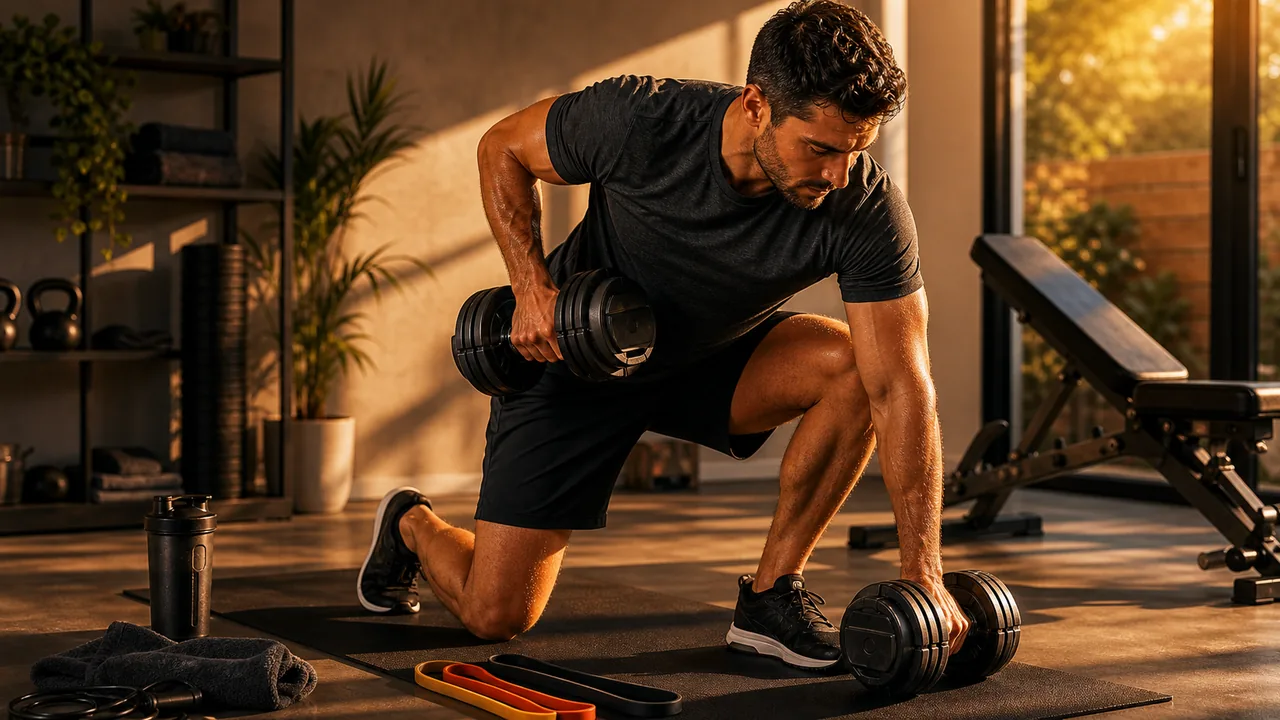
Effective home workout routines are built around movement patterns, progression, and recovery, not random exercise lists. Use bodyweight, dumbbells, resistance bands, and a mat to train squat, hinge, push, pull, carry, core, and conditioning in a way you can repeat.
Quick Summary: Effective Home Workout Routines
Use this page as a home training system. Pick a routine type, plug in the right exercises, then progress the same plan for four weeks before chasing novelty.
- 1Train squat, hinge, push, pull, carry, core, and conditioning patterns every week.
- 2Choose a 3-day full-body plan first unless you already recover well from more volume.
- 3Progress at home with reps, sets, tempo, range of motion, shorter rest, load, or harder variations.
- 4Buy equipment only when it solves a bottleneck: load, pulling, floor work, or low-impact conditioning.
The Prime Perspective: A home workout should be built, not collected. The goal is not to save one hundred exercise videos. The goal is to repeat a simple structure long enough that strength, control, conditioning, and recovery can actually improve.
Build home workouts around the system, not the room.
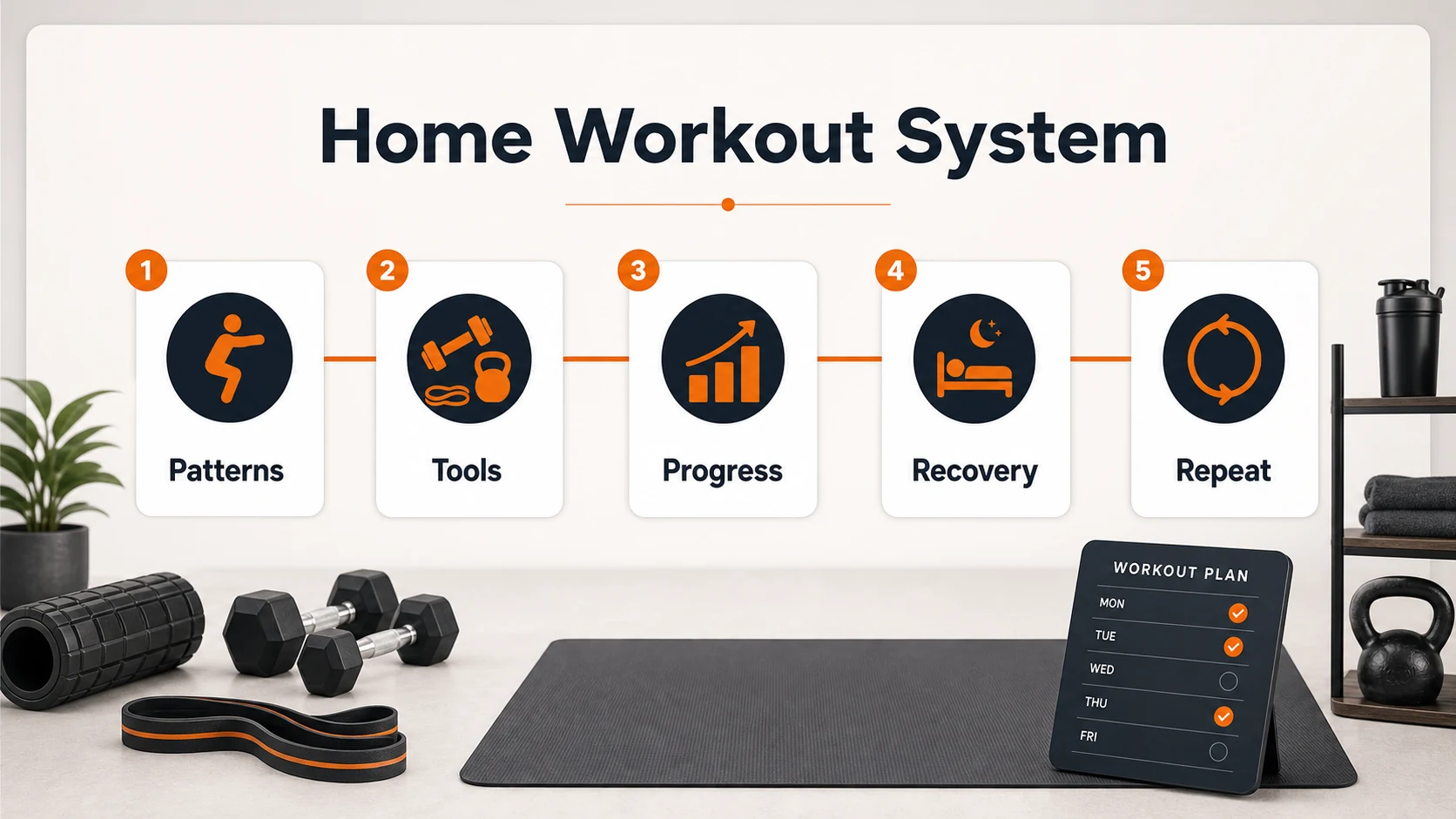
A small space can still support serious training if the routine has the right logic. The infographic below is the operating model: patterns first, tools second, progression third, recovery fourth, and repetition long enough to know whether the plan works.
Share & embed
Share this infographic with your readers. Please keep the graphic intact and include a visible source link to this guide. This sharing option applies only to this infographic, not to product photos or third-party media.
Suggested credit: Infographic by PrimeForMen. The embed uses the original image and a source link, with no script or tracking code.
You may add rel="nofollow" to the source link. No followed link is required.
Choose your routine type before choosing exercises.
The right routine depends on recovery, equipment, noise, schedule, and training age. Most men should start with three full-body sessions, then move to more weekly structure only when recovery and consistency are stable.
| Routine Type | Best For | Weekly Setup | Main Risk |
|---|---|---|---|
| 3-day full body | Beginners, busy men, men returning after a layoff. | Monday, Wednesday, Friday strength plus walking or easy conditioning. | Doing every set to failure and ruining the next session. |
| 4-day upper/lower | Intermediate trainees with dumbbells or a small bench setup. | Upper, lower, rest, upper, lower, then easy activity. | Too much volume for joints, sleep, or schedule. |
| Apartment-friendly | Upstairs apartments, shared walls, knee-sensitive conditioning. | Tempo strength, low-impact circuits, walking, step-ups, carries. | Replacing smart intensity with noisy jumping. |
| Minimal equipment | Travel, tight budgets, small rooms, restart phases. | Bodyweight, bands, dumbbells, mat, and progression by reps/tempo. | Never tracking a progression variable. |
3 effective home workout routines by level.
Use one of these routines for four weeks. Keep the movement patterns stable, then progress only one or two variables at a time.
Beginner Full-Body
- Chair squat or goblet squat: 2-3 sets of 8-12.
- Incline push-up: 2-3 sets of 6-10.
- Band row: 2-3 sets of 10-15.
- Glute bridge or dumbbell RDL: 2-3 sets of 8-12.
- Dead bug or plank: 2-3 sets of 20-40 seconds.
Best next link: beginner home workouts.
Intermediate Dumbbell
- Goblet squat: 3-4 sets of 8-12.
- One-arm dumbbell row: 3-4 sets of 8-12 per side.
- Dumbbell floor press: 3 sets of 8-12.
- Romanian deadlift: 3 sets of 8-12.
- Suitcase carry: 3-4 rounds of 20-40 steps per side.
Best next link: dumbbell-only home workout plan.
Apartment-Friendly Quiet
- Tempo squat: 3 sets of 8-12.
- Slow push-up or incline push-up: 3 sets of 6-12.
- Band row: 3 sets of 12-15.
- Split squat: 2-3 sets of 8-10 per side.
- Quiet march or low step-up: 5-10 minutes easy.
Best next link: quiet apartment workouts.
Home workout exercise library: easier and harder options.
The best home workout is adjustable. If an exercise is too hard, choose an easier version and keep the pattern. If it is too easy, add reps, tempo, range of motion, load, density, or a harder variation.
| Pattern | Easier | Standard | Harder |
|---|---|---|---|
| Squat | Chair squat | Goblet squat | Split squat or tempo squat |
| Hinge | Glute bridge | Dumbbell RDL | Single-leg RDL |
| Push | Wall push-up | Incline push-up | Floor push-up or dumbbell press |
| Pull | Light band row | Dumbbell row | Band pulldown or pull-up progression |
| Carry | Light farmer carry | Farmer carry | Suitcase carry or front rack carry |
| Core | Dead bug | Plank | Side plank or body saw |
| Conditioning | Walk | Step-ups | Low-impact intervals |
For core-specific progressions, use the core workout hub. For equipment-free fallback sessions, keep no-equipment home workouts ready.
How to progress home workouts without machines.
Home workout progression is not limited by the absence of machines. First add clean reps. Then add sets, tempo, range of motion, shorter rest, or a harder variation. Add load when the movement still looks controlled.
| Step | Progression Variable | Example |
|---|---|---|
| 1 | Cleaner technique | Same exercise, better control and range. |
| 2 | More reps | 8 to 10 to 12 clean reps. |
| 3 | More sets | 2 to 3 to 4 sets when recovery allows. |
| 4 | Slower tempo | Three-second lowering on squats or push-ups. |
| 5 | More range | Deeper squat or longer split squat. |
| 6 | Shorter rest | 90 seconds to 75 seconds without form loss. |
| 7 | More load | Heavier dumbbell or stronger band. |
| 8 | Harder variation | Goblet squat to split squat. |
For the broader training principle, read progressive overload at home.
Run the same home workout long enough to measure it.
Random novelty is not progression. Run the same routine for four weeks before changing everything.
Week 1
Learn the routine. Use three full-body sessions and leave 1-3 reps in reserve.
Week 2
Add 1-2 reps per exercise when form stays clean.
Week 3
Add one set, slower tempo, or a harder variation to key movements.
Week 4
Hold the same structure and prove better control, consistency, or load.
Home workout routines for men over 40.
Men restarting after 50 can follow the complete three-day dumbbell workout for men over 50 with clear load and progression rules.
For a complete three-day schedule with sets, reps, substitutions, and a low-recovery fallback, follow the workout plan for men over 50.
Men over 40 do not need a softer home workout. They need a more repeatable one. Start with three full-body sessions, use low-impact conditioning, keep one or two reps in reserve, and progress only when joints, sleep, and next-session performance stay stable.
| Issue | Better Home-Workout Rule |
|---|---|
| Warm-up | Use a 5-8 minute ramp-up before loaded strength work. |
| Joints | Use low-impact conditioning before jumping or high-volume burpees. |
| Recovery | Start with three full-body days before adding more weekly volume. |
| Progression | Use small jumps instead of ego workouts. |
| Mobility | Include hips, T-spine, ankles, and shoulder prep in small doses. |
For age-smart context, read fitness for different ages. For recovery structure, use recovery between home workouts.
Apartment-friendly home workouts can still be effective.
Apartment-friendly does not mean easy. It means low-noise and repeatable. Replace jumps with step-ups, burpees with controlled circuits, and loud conditioning with tempo strength, carries, walking, stairs, or bike work.
Quiet swaps
- Step-ups instead of jump squats.
- Slow mountain climbers instead of sprint climbers.
- Tempo squats instead of plyometric circuits.
- Walking intervals instead of high-impact HIIT.
Small-space setup
- Mat for floor work and noise control.
- Bands for pulling when no machine exists.
- Adjustable dumbbells for progressive loading.
- One clear lane for carries, lunges, and step-ups.
For a dedicated version, use apartment-friendly workouts. For budget constraints, read budget home workout setup.
What should you buy first for home workouts?
Buy the tool that solves your current bottleneck. If you cannot progress load, buy adjustable dumbbells. If you cannot train your back, buy bands. If mobility and floor work are inconsistent, buy a mat.
| Problem | Best First Buy | Why It Helps |
|---|---|---|
| No load progression | Adjustable dumbbells | Load can rise in a measurable way. |
| No pulling option | Resistance bands | Rows, pulldowns, warm-ups, and travel work. |
| Floor work hurts consistency | Exercise mat | Core, mobility, stretching, and low-impact training. |
| Small space | Bands plus mat | Low footprint and easy storage. |
| Long-term strength goal | Dumbbells before machines | More versatile and easier to fit. |
For more comparisons, use the essential fitness gear guide.
Home Workout Starter Kit
These are broad categories, not magic products. Buy the minimum gear that lets you repeat a strength routine cleanly.
Adjustable Dumbbells
Best when your current routine stalls because bodyweight exercises no longer provide enough loading.
- Supports squats, rows, presses, hinges, carries, and lunges.
- Lets you track load instead of guessing effort.
- Saves space compared with a full dumbbell rack.
Resistance Bands
Best for pulling patterns, warm-ups, joint-friendly accessory work, and travel sessions.
- Adds rows and pulldown-style movements without a machine.
- Useful for shoulder, hip, and glute activation.
- Easy to store and cheap enough to keep as a backup tool.
Exercise Mat
Best for core work, mobility, stretching, quiet circuits, and making floor work repeatable.
- Makes dead bugs, planks, bridges, and mobility work easier to repeat.
- Helps reduce floor contact noise in apartment setups.
- Supports warm-ups and cooldowns without extra equipment.
* As an Amazon Associate, PrimeForMen earns from qualifying purchases.
Build your own home workout in 5 steps.
Pick movement patterns.
Use squat, hinge, push, pull, core, and carry or conditioning.
Choose a tool for each pattern.
Bodyweight, dumbbells, bands, a bench, a mat, or a low-impact cardio option.
Set a rep range.
Most strength moves fit 2-4 sets of 6-15 reps. Carries and planks can use time or distance.
Pick one progression variable.
Reps, sets, tempo, range, load, density, or variation difficulty.
Repeat for four weeks.
Keep the routine stable long enough to see what actually changes.
When to modify or stop a home workout.
Home training gives you control, but it also removes live coaching feedback. Stop a set when pain, dizziness, joint irritation, or technique breakdown appears. A modified session is better than a forced session that makes next week impossible.
| Signal | Do Not Do This | Better Move |
|---|---|---|
| Sharp pain | Push through the set. | Stop, regress the exercise, or choose another pattern option. |
| Dizziness or fainting | Call it normal fatigue. | Stop the session and consider medical guidance. |
| Chest pain or pressure | Treat it as a fitness challenge. | Seek urgent medical evaluation. |
| Joint pain | Add more reps anyway. | Reduce range, load, or choose a joint-friendlier variation. |
| Technique breakdown | Finish with chaotic reps. | Stop the set and reduce load or fatigue. |
| Recovery worsens for several sessions | Add more HIIT. | Deload, reduce volume, or add easier conditioning. |
Why strength plus activity belongs in a home routine.
The CDC adult activity guidance recommends aerobic activity plus at least two days of muscle-strengthening activity per week. The practical home-training translation is simple: pair repeatable strength sessions with walking, cycling, step-ups, carries, or low-impact intervals.
The ACSM resistance-training update also supports the idea that home-based routines, elastic bands, and bodyweight work can be useful when the program is structured and progressive.
Match Home-Workout Gear to the Routine
A tool belongs in the room only when it improves a movement or progression you already plan to use. These decision guides help you check fit, floor space and training value before checkout.
Frequently asked questions about home workout routines.
What is the best home workout routine for beginners?
A 3-day full-body routine is the best starting point for most beginners. Use a squat, hinge, push, pull, core, and easy conditioning pattern each week.
Can I build muscle at home with only dumbbells?
Yes, if the dumbbells are heavy enough for your current level and you track progression. Rows, presses, squats, hinges, carries, and lunges can all be loaded with dumbbells.
Can resistance bands build muscle at home?
Bands can help, especially for rows, pulldown-style movements, warm-ups, and accessories. They work best when tension is controlled and sets are taken close enough to fatigue.
Should I do full-body or split routines at home?
Use full-body training first if you train three days per week. Use an upper/lower split when you train four days and recover well between sessions.
How do I progress home workouts without more equipment?
Add clean reps, sets, slower tempo, range of motion, shorter rest periods, harder variations, or unilateral versions before buying more gear.
What is the best quiet apartment workout?
Use tempo squats, split squats, push-ups, band rows, dumbbell hinges, carries, dead bugs, and low-impact step-ups. Avoid jumping if noise, knees, or recovery become limiting.
How long should a home workout be?
Most effective home workouts can fit into 30-50 minutes. The session should be long enough for quality sets and short enough that you can repeat it consistently.
What equipment should I buy first for home workouts?
Start with adjustable dumbbells, resistance bands, and an exercise mat. Add a bench or larger gear only after the routine is proven.
Medical Disclaimer: This guide is general fitness education, not medical advice. If you have chest pain, dizziness, severe pain, a known medical condition, or a recent injury, speak with a qualified clinician before starting or changing training.
Affiliate Disclosure: Some product links may be affiliate links. If you buy through them, PrimeForMen may earn a commission at no extra cost to you. Recommendations are based on use case, not hype.