
Testosterone Boosters for Men Over 40: What Actually Helps
Testosterone boosters for men over 40 should not start with a pill. They should start with a better question: what is actually limiting energy, libido, strength, recovery, or bloodwork?
Low libido, fatigue, weak training, belly fat, poor sleep, medication effects, mood changes, and clinically low testosterone can overlap. Test first, fix the big rocks, then use supplements only when they match a real gap.
Symptoms alone are not proof of low testosterone.
Sleep, lifting, alcohol, body fat, and recovery change the picture.
Use one support category only when the bottleneck is clear.
Start with the cause, not the label.
Most over-the-counter testosterone boosters do not reliably raise testosterone in healthy men. After 40, the smarter path is morning bloodwork, sleep and training basics, body-fat control, and targeted nutrients only when intake, labs, or safety context support them.
Quick Summary: testosterone boosters for men over 40.
Use this page as a buying filter, not a diagnosis. The useful question is not “which booster is strongest?” It is “which bottleneck should I verify before I spend money?”
- Start with symptoms, sleep, training, medication context, and morning bloodwork before buying a testosterone booster.
- Vitamin D, zinc, and magnesium are targeted support tools, not universal hormone switches.
- Ashwagandha and fenugreek can be context-specific, but safety, dose, and product quality matter.
- TRT and testosterone boosters are not the same category; confirmed hypogonadism needs medical evaluation.
- Skip products with proprietary blends, extreme male-enhancement claims, or drug-like promises.
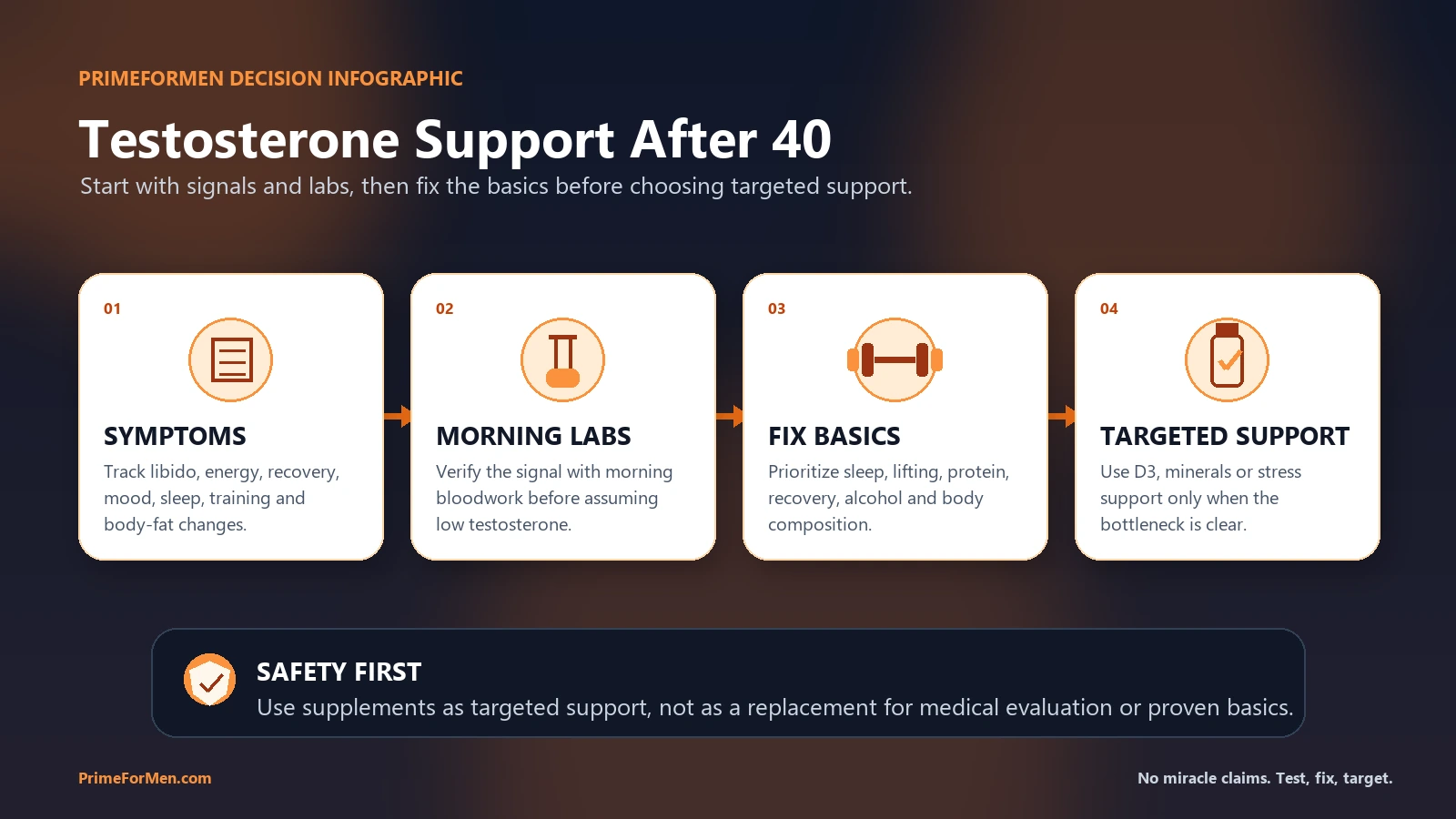
Most men do not need a bigger stack first.
The PrimeForMen position is simple: supplements should solve a defined problem. If the problem is short sleep, no progressive strength training, high alcohol intake, inconsistent protein, or excess body fat, a testosterone label is usually a distraction. For the broader buying framework, compare this page with PrimeForMen’s supplement recommendations.
That does not mean symptoms are fake. It means symptoms are not specific. A man can feel flat from stress, depression, medication, sleep apnea, under-recovery, low calories, thyroid issues, metabolic health, or actual hypogonadism. The point of testing is to stop guessing.
What changes after 40?
- Recovery margin gets smaller, so poor sleep and hard training collide faster.
- Body-fat, alcohol, and metabolic health can become stronger levers than another capsule.
- Total testosterone, free testosterone, and SHBG can tell different stories.
- Medication changes, stress, and sleep apnea can mimic low-T symptoms.
Low-T symptoms are not always a testosterone problem.
Low libido, erectile dysfunction, fatigue, strength loss, mood changes, and belly-fat gain are real signals. They are not proof that a booster will help. Use the symptom to choose the next check, not to justify an impulse buy.
| Symptom | Other common explanations | Better next question |
|---|---|---|
| Low libido | Sleep debt, stress, relationship strain, depression, alcohol, medication effects. | Is testosterone actually low, or is another driver stronger? |
| ED | Blood pressure, diabetes, vascular health, medication, stress, alcohol. | Should this be medically checked before supplement shopping? |
| Fatigue | Sleep apnea, low calories, anemia, thyroid issues, overtraining, depression. | Which basic marker or habit is missing? |
| Strength loss | No progressive lifting, low protein, poor recovery, inconsistent training. | Is the training plan actually progressing? |
| Belly-fat gain | Calorie drift, lower activity, alcohol, insulin resistance, sleep loss. | Would body-fat control move more than a booster label? |
Before you buy: test the signal.
If symptoms persist, talk with a clinician about morning testosterone testing before buying a booster. The Endocrine Society guideline frames diagnosis around symptoms plus consistently low testosterone, confirmed with reliable morning testing.
This is not about making the decision complicated. It is about knowing whether you are dealing with a lifestyle bottleneck, a nutrient gap, medication context, sleep problem, or a medical issue.
Document symptoms
Track libido, ED, fatigue, strength, mood, sleep, alcohol, medication changes, and training load.
Check morning total T
Use a reliable lab and repeat if low, because one number can mislead.
Add context when needed
Free T, SHBG, LH/FSH, thyroid, metabolic markers, and vitamin D status can change the interpretation.
Choose the path
Target a lifestyle or nutrient bottleneck, or move to medical evaluation when labs and symptoms point there.
Do you actually need a testosterone booster?
Run the idea through this filter before buying. The more vague the answer, the more likely the purchase should wait.
1. Symptoms?
If there are no persistent symptoms, do not buy a booster for vague optimization.
2. Bloodwork?
If symptoms are real but labs are missing, test before stacking pills.
3. Basics?
If sleep, lifting, body fat, alcohol, and protein are weak, fix those first.
4. Target?
If a real gap exists, use one targeted support tool and track the response.
Practical rule: if bloodwork suggests true hypogonadism, the next step is not a stronger Amazon stack. It is medical evaluation.
Which ingredients deserve attention, and which should wait?
The right question is not only “does this boost testosterone?” It is “which bottleneck does this address, in which men, at what dose, with what safety tradeoff?”
| Ingredient | Best use case | Evidence reality | Verdict |
|---|---|---|---|
| Vitamin D | Low status, little sun, diet context. | More relevant when status is low; not a universal testosterone switch. | Targeted |
| Zinc | Low intake, restrictive diet, high sweat, deficiency context. | Normal-function nutrient; too much can create problems. | Targeted |
| Magnesium | Low intake, sleep and recovery context. | Useful for normal function, not a guaranteed hormone lift. | Targeted |
| Ashwagandha | Stress and recovery context, carefully selected product. | Some human data, but product quality and safety matter. See the dedicated ashwagandha and testosterone guide. | Caution |
| Fenugreek | Libido or metabolic-support claims. | Mixed and modest; not a foundation. Use the fenugreek testosterone guide before treating it as a main lever. | Maybe |
| Tongkat Ali | Libido/stress claims with high product-quality concern. | Interesting, but quality and safety questions remain. | Caution |
| Boron | Mineral/free-T claims. | Not a first-line decision; long-term context matters. | Not first |
| DHEA | Hormone pathway context. | Not a casual supplement decision. | Clinician context |
| Tribulus | Heavily marketed booster stacks. | Often stronger in marketing than outcome quality. | Usually skip |
Why most booster pages skip the hard part.
Many testosterone-booster pages jump from symptoms to products. That is where the trust problem starts. Symptoms can be real, but the cause can sit in sleep, training, medication, metabolic health, or confirmed hormone deficiency.
The useful content does not promise one capsule. It separates lifestyle levers, lab interpretation, supplement context, and medical evaluation.
Lifestyle levers that beat most labels
Training, conditioning, adequate food, and recovery are the controllable foundation. The fitness for men over 50 hub shows how to dose those pieces without presenting exercise or supplements as hormone treatment.
- Sleep long enough and screen for sleep apnea when symptoms fit.
- Lift progressively instead of chasing random intensity.
- Reduce excess body fat without crash dieting.
- Moderate alcohol and protect recovery days.
- Eat enough protein and total calories for the training goal.
Testosterone booster safety: what the label may not tell you.
Testosterone boosters sit in one of the noisiest supplement categories. The risk is not only that a product may fail to work. The bigger risk is unclear dosing, hidden drug-like ingredients, stimulant-heavy blends, medication interactions, or hormone-like claims.
Label red flags
Proprietary blend, “TRT-like” wording, extreme male-enhancement claims, or no clear dose.
Health context
Blood pressure, diabetes, thyroid, autoimmune, liver, fertility, surgery, or sedative-medication context changes the decision.
Ashwagandha caution
The NCCIH safety page flags surgery, thyroid, autoimmune, and medication-interaction concerns.
Claim hygiene
Responsible copy says “may support normal function when a relevant gap exists,” not “restores manhood.”
Better buys than a blind booster stack.
These are not testosterone cures. They are support categories to compare only when the context fits: low status, low intake, recovery stress, or a specific lifestyle bottleneck. If you want the broader category view first, read the testosterone booster buyer guide.
Vitamin D3 support
Best fit: low sun exposure, low dietary intake, or clinician-confirmed low vitamin D status.
- Choose only after status and dose context are clear.
- Check IU/mcg per serving and avoid casual mega-dosing.
- Prefer simple labels over hormone-heavy marketing claims.
Zinc and magnesium support
Best fit: low intake, high sweat, restrictive diet, or recovery context where minerals are a plausible gap.
- Count zinc from multivitamins, ZMA, and other stacks.
- Check elemental magnesium and avoid assuming more is better.
- Use minerals as normal-function support, not as a hormone shortcut.
Ashwagandha stress support
Best fit: stress and recovery context, with no thyroid, autoimmune, surgery, sedative, blood-pressure, or diabetes-medication conflict.
- Look for clear extract, serving size, and third-party testing.
- Skip products that promise steroid-like or TRT-like results.
- Stop and reassess if side effects, sedation, or unusual symptoms appear.
* Affiliate disclosure: PrimeForMen may earn from qualifying Amazon purchases. Prices are not shown here and can change on Amazon.
TRT and testosterone boosters are not the same decision.
One is medical therapy for a diagnosed condition under monitoring. The other is a supplement category that may or may not address a lifestyle, stress, or nutrient bottleneck. Do not place them in the same mental category.
| Category | OTC booster | TRT / medical therapy |
|---|---|---|
| Goal | Support a specific gap. | Treat confirmed deficiency under care. |
| Prerequisite | Plausible bottleneck and safety check. | Symptoms plus consistently low values. |
| Monitoring | Mostly self-tracked. | Clinician-led labs and risk review. |
| Risk | Interactions, hidden ingredients, overdosing. | Medical side effects and fertility/prostate/hematology context. |
What to do before buying anything this week.
Write the symptom list
Libido, ED, fatigue, strength, mood, sleep, alcohol, medication, body-fat change, and training consistency.
Fix one basic
Pick sleep, progressive lifting, protein, alcohol moderation, or recovery. Track it for seven days.
Plan labs if symptoms persist
Ask about morning total testosterone and follow-up markers when the first result is low or unclear.
Buy only one category
If support is justified, choose one targeted product type. Do not stack because the label feels comprehensive.
Bottom line: test, then target.
Testosterone boosters for men over 40 can make sense only when they address a real bottleneck. If the issue is training, recovery, alcohol, body fat, sleep, medication, or clinically low testosterone, a generic booster stack does not solve the problem.
Use PrimeForMen’s nutrition and supplements guide for a broader food-first framework, check strength training basics if lifting is the weak link, and compare creatine options when the goal is performance support rather than hormone claims.
Frequently Asked Questions About Testosterone Boosters for Men Over 40
Do testosterone boosters really work for men over 40?
Some ingredients may support normal function when a real gap exists, but most over-the-counter boosters do not reliably raise testosterone in healthy men. The better first step is testing, sleep, training, body-fat control, and safety review.
What blood tests should I ask about before taking a testosterone booster?
Ask a clinician about morning total testosterone first. If results are low or unclear, follow-up may include repeat testing, free testosterone, SHBG, LH/FSH, thyroid and metabolic markers, medication review, and vitamin D status.
What time of day should testosterone be tested?
Morning testing is usually preferred because testosterone varies across the day. A low result often needs confirmation rather than immediate supplement shopping.
Is vitamin D a testosterone booster?
Vitamin D is better treated as a normal-function nutrient. It is most relevant when status is low or intake/sun exposure is limited. More vitamin D is not automatically better when status is already adequate.
Can too much zinc be harmful?
Yes. Zinc can add up quickly across multivitamins, ZMA products, and booster stacks. Long-term high intake can create mineral-balance problems, so total intake matters.
Is ashwagandha safe for men over 40?
It depends on health context, product quality, and medication use. Men with thyroid, autoimmune, surgery, sedative, blood-pressure, or diabetes-medication context should be especially cautious and ask a professional first.
What is the difference between TRT and a testosterone booster?
TRT is medical therapy for confirmed deficiency under clinician monitoring. A booster is a supplement category and should not be treated as a replacement for diagnosis, treatment, or medical follow-up.
Medical disclaimer: This article is for educational purposes only and does not replace medical advice, diagnosis, or treatment. Talk with a qualified clinician if symptoms are persistent, severe, or linked to medication, fertility, cardiovascular, prostate, endocrine, or mental-health concerns.
Affiliate disclosure: This page includes Amazon affiliate links. PrimeForMen may earn from qualifying purchases at no additional cost to you. Product categories are included only when they fit the reader decision; they are not medical recommendations.