
Sport-Specific Training for Men: Build Strength, Speed, Conditioning, and Carryover
Sport-specific training for men should start with the sport, not the gym. Map the movement demands, energy systems, injury risks, skill priorities, season phase, and recovery budget before choosing drills.
Sport profiles
Energy systems
Season timing

Quick Summary: Sport-Specific Training for Men
- Start with a needs analysis: movement demands, energy system, injury risk, skill priority, season phase, recovery budget, and testing.
- Separate acceleration, max speed, deceleration, planned change of direction, and reactive agility instead of calling every cone drill agility.
- Match conditioning to the sport engine: alactic power, repeated sprint ability, glycolytic capacity, aerobic base, or mixed demands.
- Adjust training by season. Off-season builds capacity, pre-season transfers it, and in-season preserves performance with minimal fatigue.
Hard is not the same as specific.
A brutal leg day, a random ladder circuit, or a conditioning finisher can be hard without making you better at your sport. Specific training earns its place when it supports the sport’s limiting factor without stealing from practice quality.
If gym work improves your lifts but makes shooting, striking, sprinting, swimming, riding, running, or recovery worse, the plan is not specific enough.
Use a 10-minute needs analysis before choosing exercises.
NSCA guidance on sport needs analysis emphasizes looking at the demands and injury risks of the sport, the athlete’s profile, and the training methods that fit those risks. That is the starting point here: define the sport before building the workout.
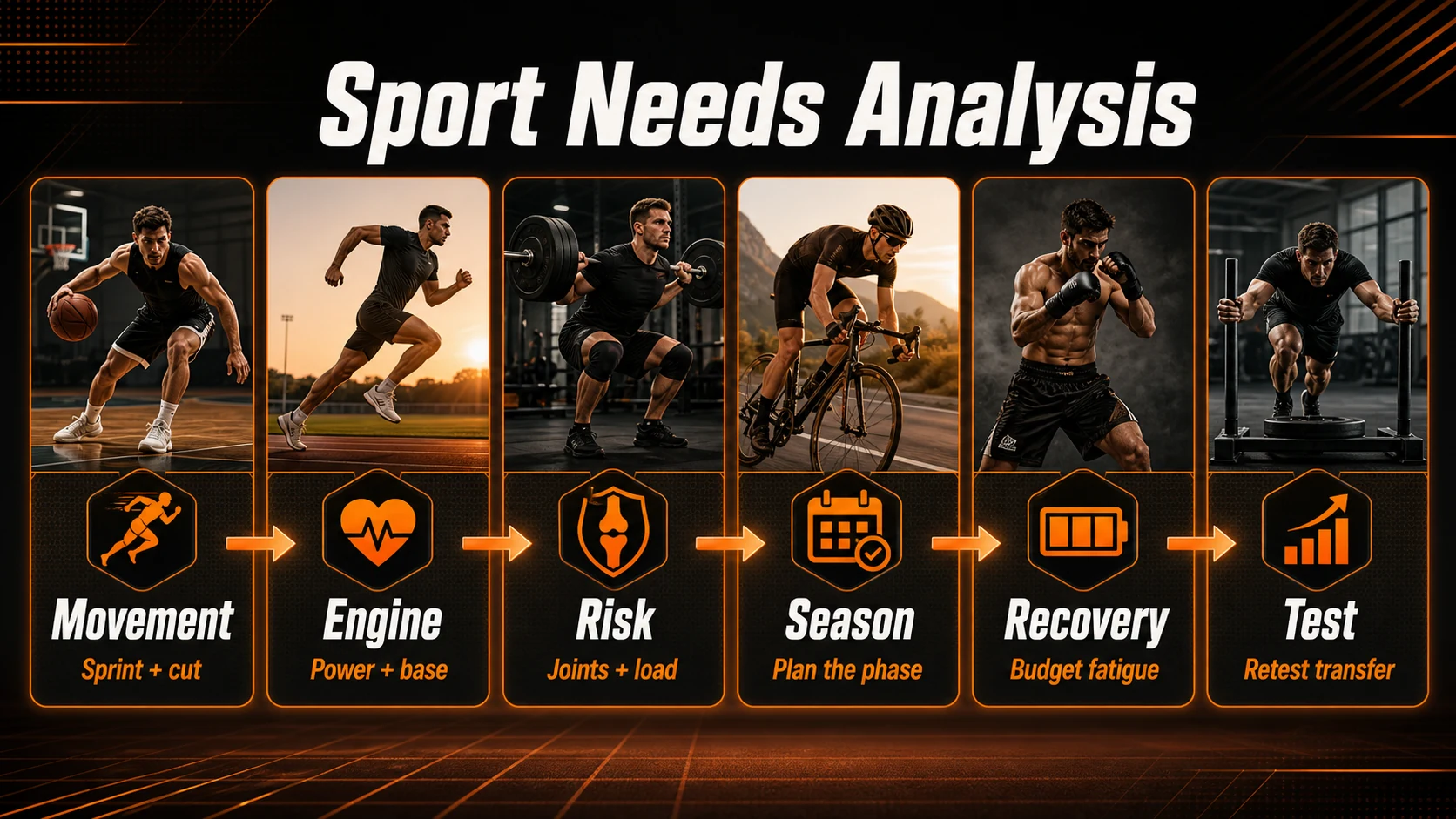
| Analysis Field | Question | Training Decision |
|---|---|---|
| Movement demands | Does the sport sprint, jump, rotate, brake, carry, cut, or repeat contact? | Speed, COD, jumps, rotational work, carries, or tissue capacity. |
| Energy system | Short explosive actions, repeated bursts, long output, or mixed demands? | Power, repeated sprint ability, glycolytic intervals, or aerobic base. |
| Injury risks | Which areas are commonly stressed: knees, shoulders, back, Achilles, neck? | Prehab, load management, progressive exposure, and strength support. |
| Skill priority | What must stay fresh: shooting, striking, swimming technique, running form? | Keep fatigue away from high-skill work. |
| Season timing | Post-season, off-season, pre-season, in-season, or return-to-play? | Adjust volume, intensity, and specificity. |
| Recovery budget | How many practices, games, rides, rounds, or long runs already exist? | Dose strength and conditioning around the real workload. |
| Limiting factor | Is the athlete limited by strength, speed, engine, mobility, durability, or body composition? | Train the bottleneck, not every quality at once. |
| Testing | How will progress be measured? | Use baseline and retest data instead of soreness as proof. |
Sport-specific training profiles show what should change.
A good hub should route men quickly. Basketball needs brakes and repeated jumps. Running needs tissue capacity and economy. Combat sports need power that survives fatigue. Cycling needs an engine and posture durability. The sport decides the emphasis.
| Sport | Primary Demands | Training Priorities | Common Mistake |
|---|---|---|---|
| Basketball | Acceleration, deceleration, jumping, lateral movement, repeated efforts. | Single-leg strength, landing mechanics, COD, repeated sprint ability. | Only jump and ladder drills without braking strength. |
| Running | Aerobic capacity, tissue tolerance, stride economy. | Strength basics, calf and hip capacity, zone work, mobility. | Adding strength only after pain starts. |
| Swimming | Technique endurance, shoulder durability, trunk control. | Pulling strength, shoulder care, core, aerobic intervals. | Gym fatigue that destroys water quality. |
| Cycling | Aerobic and threshold engine, hip endurance, posture. | Posterior chain, core, mobility, intervals. | Only adding more miles instead of strength and position work. |
| Boxing / MMA | Power, grip, trunk, neck, repeat high-intensity efforts. | Rotational power, carries, intervals, mobility, recovery around sparring. | Treating fight camp like bodybuilding. |
| Rugby | Collision tolerance, sprint repeatability, power, neck and trunk capacity. | Strength, power, carries, sleds, repeated sprint work. | Too much conditioning without a strength base. |
| Rowing | Aerobic engine, posterior chain, trunk endurance. | Hinge strength, aerobic base, core, mobility. | Overloading back and hips without technique management. |
| Triathlon | Long-duration engine, transition durability. | Strength maintenance, mobility, aerobic structure. | Making every discipline hard every week. |
Use the related guides when the sport is already clear: basketball training drills, training for runners, swimming training plans, cycling-specific training, boxing and combat training, MMA training, rugby-specific training, and rowing-specific training.
Speed, change of direction, and agility are not the same.
Planned cone drills can improve footwork, braking, and change-of-direction mechanics, but real agility requires a cue, opponent, ball, or decision. Research indexed in PubMed Central also distinguishes agility and change-of-direction speed as different abilities.
| Quality | What It Trains | Examples |
|---|---|---|
| Acceleration | First step, horizontal force, start mechanics. | 5-20-yard sprints, sled pushes. |
| Max speed | Top-end mechanics, stiffness, rhythm. | Flying sprints, wicket-style rhythm drills. |
| Deceleration | Braking force, angles, control. | Stop drills, snap-downs, landing mechanics. |
| Change of direction | Planned cuts and direction changes. | 5-10-5, cone cuts, L-drill. |
| Reactive agility | Reaction to cue, opponent, ball, or tactical decision. | Partner call, visual cue, ball-response drills. |
| Footwork | Rhythm, contact quality, positioning. | Ladders, mini hurdles, court steps. |
For a drill-level example, see the agility ladder drills guide. Treat ladders and cones as preparation, then add exits, decisions, and sport cues.
Match conditioning to the sport engine.
A runner, basketball player, boxer, cyclist, and rugby player should not all do the same finisher. The work-to-rest ratio, impact, fatigue cost, and skill interference matter.
Alactic Power
0-10 second explosive actions: jumps, throws, short sprints, explosive shots. Use full-rest sprints, jumps, and med-ball throws.
Repeated Sprint Ability
Repeated 2-10 second bursts in basketball, soccer, rugby, and combat flurries. Train sprint repeats and recovery between efforts.
Glycolytic Capacity
20 seconds to 2 minutes of hard output: combat rounds, rowing pieces, climbs. Use targeted intervals, not random fatigue.
Aerobic Base
Long-duration output and recovery support for running, cycling, swimming, triathlon, and team-sport repeatability.
Mixed Engine
Most field, court, and combat sports need base, power, and repeat-effort work arranged by season and recovery.
Skill Interference
If conditioning makes technique worse, reduce volume, move it away from skill work, or make it more specific.
The season decides how much training you can afford.
Off-season is where you can build capacity. Pre-season is where that capacity becomes more specific. In-season is where the gym must support performance instead of competing with practice.
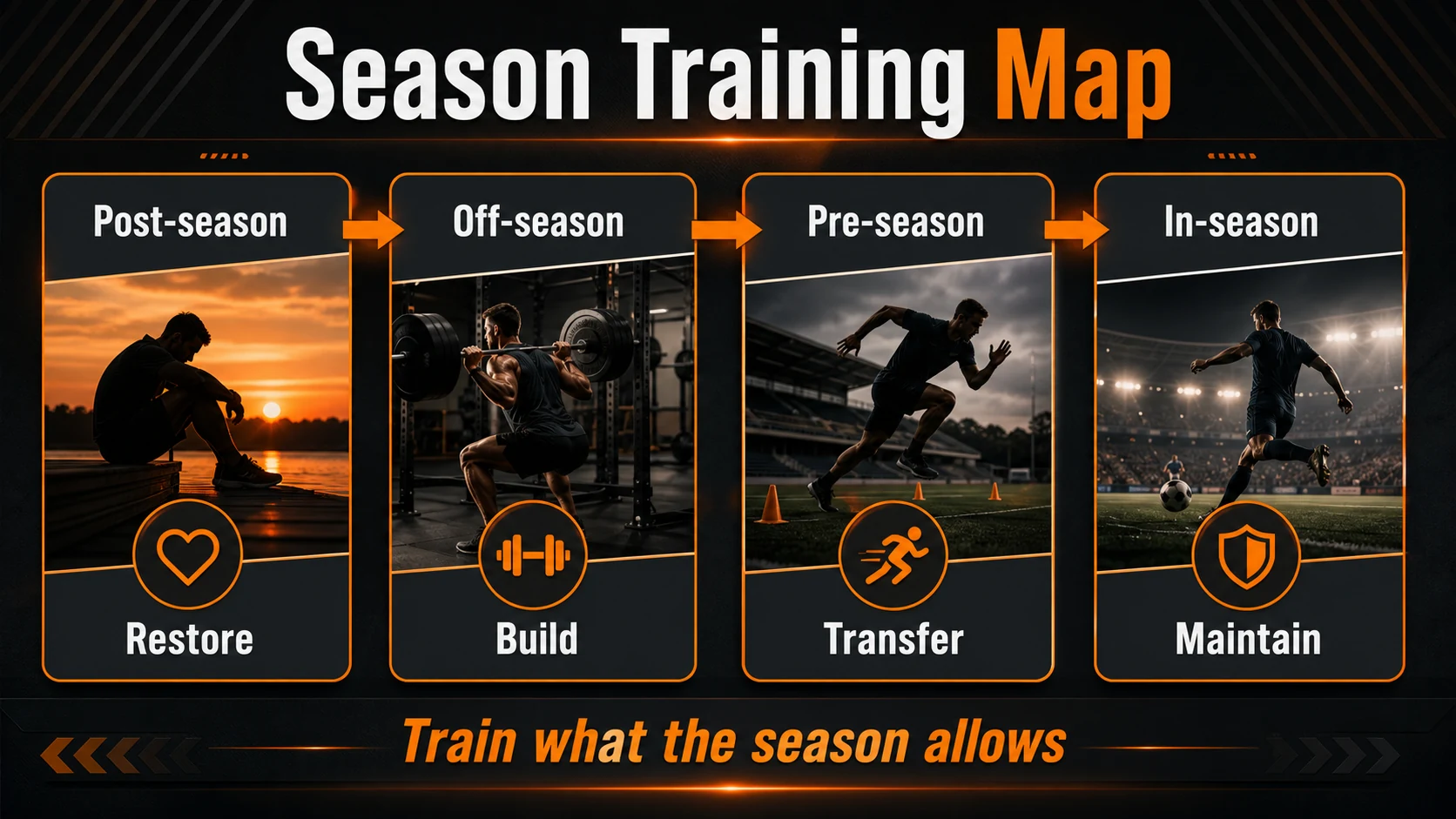
| Phase | Main Goal | Strength | Speed / Power | Conditioning | Recovery |
|---|---|---|---|---|---|
| Post-season | Recover and clean up pain points. | Light to moderate. | Low. | Easy base. | High priority. |
| Off-season | Build capacity. | Higher volume strength base. | Technique and power base. | Aerobic or general conditioning. | Planned. |
| Pre-season | Prepare transfer. | Less volume, more intent. | Power, COD, sport-speed. | Sport-specific intervals. | Monitor closely. |
| In-season | Maintain performance. | Minimal effective dose. | Short priming doses. | Only targeted work. | Highest priority. |
| Return-to-play | Rebuild safely. | Clinician or coach guided. | Progressive. | Sport-specific. | Symptom-guided. |
Sport-specific training for men over 40 needs sharper dosing, not softer goals.
Men over 40 do not need sport training to become soft. They need it to become better budgeted. Practices, games, sparring, long rides, and long runs count as stress. The gym should sharpen the sport, not steal the recovery needed to play it.
| Topic | Better Rule | Practical Move |
|---|---|---|
| Recovery budget | Practice and games count as load. | Reduce gym volume when sport load rises. |
| Joint history | Progress COD, jumps, and sprints gradually. | Use low-dose speed with full recovery. |
| Strength | Two to three planned sessions often work. | Prioritize repeatable compound work. |
| Power | Low dose, high quality, full rest. | Medicine ball throws, jumps, short sprints. |
| Conditioning | More engine, fewer death-march finishers. | Use aerobic base and targeted intervals. |
| Medical context | Chest pain, dizziness, unexplained breathlessness, recent injury, or chronic conditions deserve professional clearance. | Stop guessing and get qualified help. |
For broader age-smart planning, pair this with fitness for different ages and overtraining syndrome.
Measure transfer, not soreness.
A sport program should be tested by transfer. Pick one or two sport-relevant tests, record a baseline, train for four to eight weeks, then retest. If gym lifts improve but sprint speed, skill quality, conditioning, or recovery gets worse, adjust the plan.
Sport Training Setup Kit
These are categories, not magic products. Buy tools only when they solve a training job: speed/COD practice, rotational power, or recovery support.
Agility Cones and Ladder
Best for planned footwork, acceleration setup, deceleration positions, and change-of-direction mechanics.
- Use for short, crisp drills before fatigue.
- Add exits and cues before calling it agility.
- Keep quality higher than sweat volume.
Medicine Ball
Best for rotational power, throws, slams, and hip-to-shoulder force transfer.
- Useful for combat, throwing, racket, and rotational sports.
- Keep reps low and intent high.
- Choose weight that stays fast, not maximal.
Recovery Tools
Best when practices, games, and training create tightness or soreness that needs simple self-management.
- Use after training, not as a substitute for sleep.
- Keep pressure tolerable and repeatable.
- Pair with better load planning, not more random volume.
* As an Amazon Associate, PrimeForMen may earn from qualifying purchases. Product categories are included only when they support the training use case.
Common sport-specific training mistakes.
Confusing hard with useful.
A workout can be exhausting and still fail to transfer.
Training every quality at once.
Strength, speed, power, engine, mobility, and recovery need priority, not chaos.
Ignoring the season.
In-season training should preserve performance, not compete with practices and games.
Skipping retests.
If you never measure transfer, you are guessing whether the plan works.
Good sport-specific training is structured, tested, and bounded.
NSCA needs-analysis guidance supports starting with sport demands and injury risks, while CDC adult activity guidance sets the baseline expectation for weekly aerobic activity and muscle-strengthening work. Research indexed in PubMed Central also supports treating agility and change-of-direction speed as distinct abilities.
Structured data is included because Google Search Central Article guidance describes how Article markup can clarify title, image, and date information, while Google’s structured-data policies require markup to match visible page content.
Frequently asked questions about sport-specific training for men.
What is sport-specific training?
Sport-specific training is strength, speed, power, conditioning, mobility, and recovery work built from the demands of a sport. It starts with needs analysis, not a random exercise list.
How do I know what my sport needs?
Map movement demands, energy systems, injury risks, skill priorities, season phase, recovery budget, limiting factors, and tests. The biggest bottleneck should drive the block.
What is the difference between speed, agility, and change of direction?
Speed is moving fast. Change of direction is a planned cut or direction change. Reactive agility adds a cue, opponent, ball, or decision.
Should sport-specific training change in-season?
Yes. In-season training usually needs lower volume and a minimal effective dose so it supports performance instead of adding fatigue.
How should men over 40 train for sports?
Men over 40 should keep power and speed work high-quality and low-dose, maintain strength, build an aerobic base, manage joint history, and reduce gym volume when sport workload is high.
What is repeated sprint ability?
Repeated sprint ability is the capacity to produce short high-intensity efforts repeatedly with useful recovery between efforts. It matters in many field, court, and combat sports.
Are agility ladders useful for sports?
They can be useful for rhythm, contacts, and foot placement, but they are not full agility by themselves. Add exits, cues, and sport decisions.
What equipment is worth buying first?
Start with tools that solve a real job: cones or a ladder for COD practice, a medicine ball for power transfer, and basic recovery tools if workload is high.
Medical Disclaimer: This guide is general fitness education, not medical advice. If you have chest pain, dizziness, unexplained breathlessness, a recent injury, a chronic condition, or return-to-play concerns, work with a qualified clinician or coach before changing training.
Affiliate Disclosure: Some product links may be affiliate links. If you buy through them, PrimeForMen may earn a commission at no extra cost to you. Recommendations stay based on fit, practicality, and reader use case.