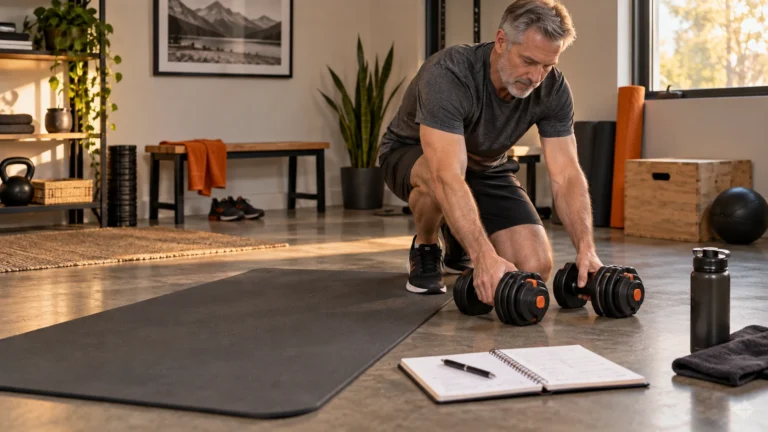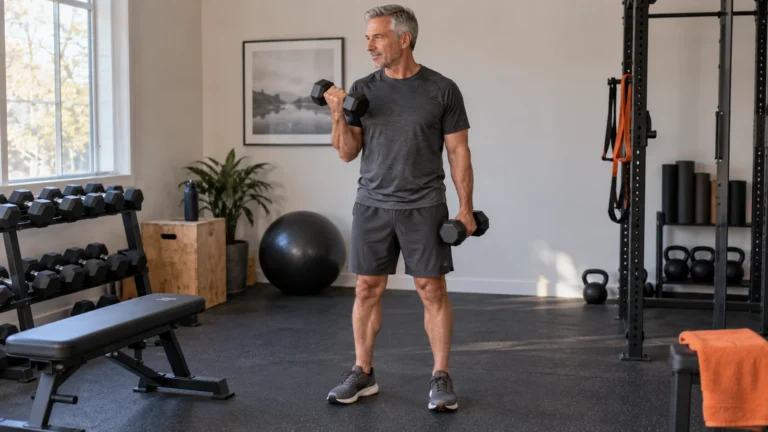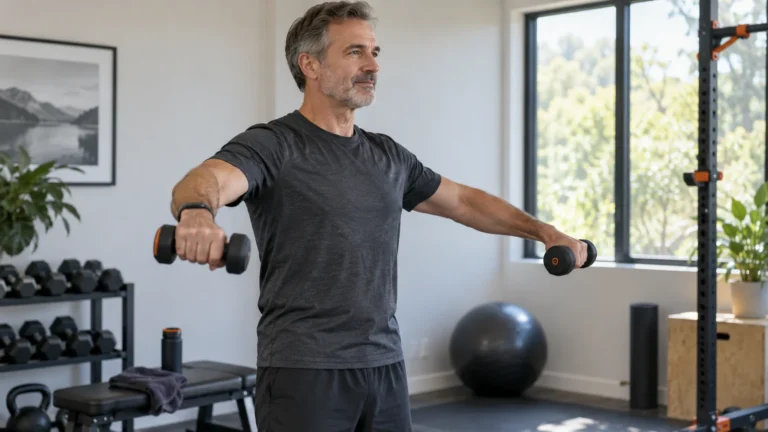
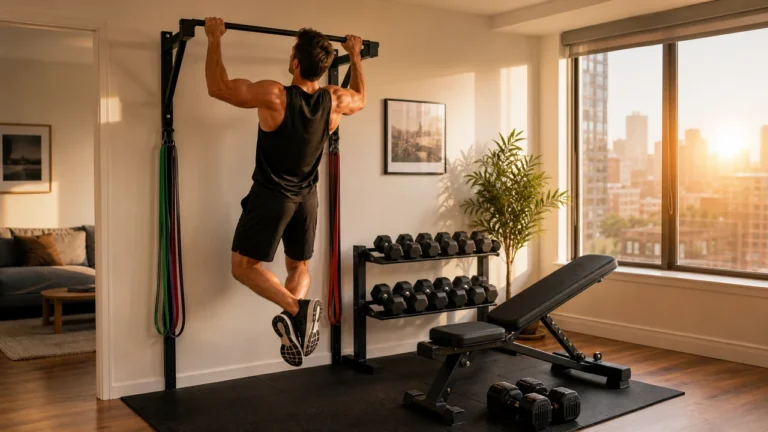
Upper body home workouts built around push-pull balance, useful equipment, and progressive strength.
- Match every push pattern with a pull pattern: push-ups need rows, presses need pull-ups or band pulls.
- Train upper body 2 to 4 times per week depending on recovery, equipment, and current ability.
- Use tempo, range of motion, harder angles, added load, and extra sets for progression.
Bottom line Use upper body home workouts as a repeatable training filter: clear purpose, clean execution, and progression matter more than doing more.
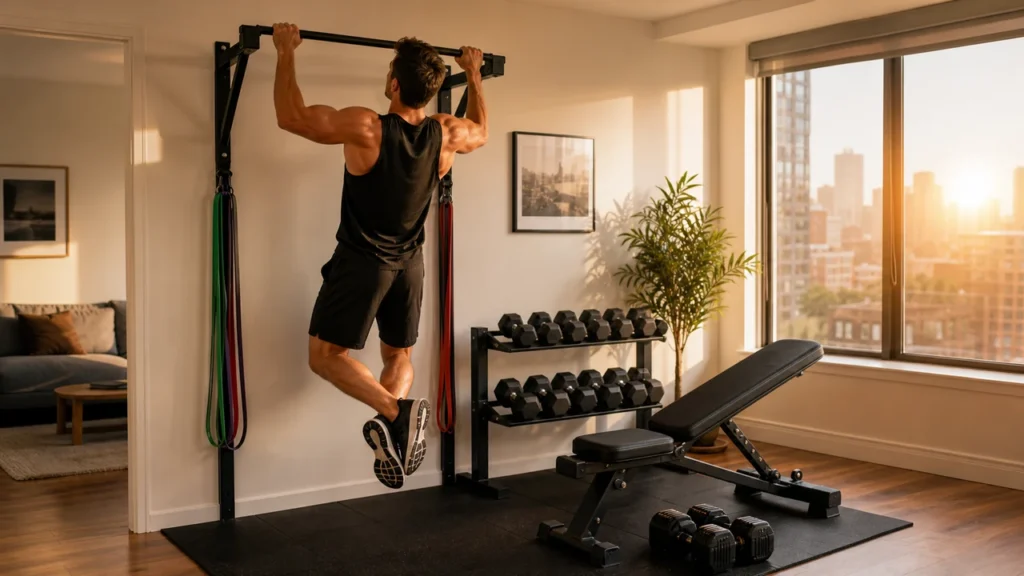
Upper body home workouts work best when they train your chest, back, shoulders, and arms as a system, not as a daily push-up challenge. The common mistake is simple: men hammer pressing muscles, skip pulling work, and then wonder why their shoulders feel cranky and their posture looks folded forward. This guide gives you a balanced push and pull plan you can run at home with minimal equipment.
- Match every push pattern with a pull pattern: push-ups need rows, presses need pull-ups or band pulls.
- Train upper body 2 to 4 times per week depending on recovery, equipment, and current ability.
- Use tempo, range of motion, harder angles, added load, and extra sets for progression.
- A pull-up bar, resistance bands, and adjustable dumbbells cover most home upper-body needs.
- Stop sets with clean reps left in reserve; pain, numbness, or joint instability is a reason to back off.
Balance Comes Before Burnout
A smart home plan is not judged by how exhausted your chest feels. It is judged by whether your pressing, pulling, shoulder control, and arm work move forward together.
- Push: chest, front shoulders, triceps, and pressing strength.
- Pull: lats, upper back, rear shoulders, biceps, and posture support.
- Stability: shoulder blades, rotator cuff area, core brace, and clean joint positions.
If you are building a broader home setup, pair this plan with the broader guide to strength training at home so your lower body, core, and conditioning do not fall behind.
Push-vs-Pull Balance Meter
The target is not a perfect 50/50 split every single workout. The target is a week that does not let pushing dominate pulling.
48%
52%
- If your week has 12 pressing sets, aim for about 12 to 16 pulling sets.
- If your shoulders roll forward, bias toward rows, pull-aparts, face pulls, and controlled pull-up work.
- If your back work is weak, make pulling the first movement of the session instead of the afterthought.
Small Home Gym, Big Upper-Body Return
Why these products here? They solve the exact push/pull gap most upper body home workouts create: vertical pulling, scalable resistance, and load that can progress beyond bodyweight.
- Train back and biceps without needing a cable machine.
- Make easy movements harder without turning every set into 40 reps.
- Support progression across chest, shoulders, arms, and upper back.
Amazon Product Shortlist
These are practical product starting points, not medical or performance guarantees. Use the images, sizing, labels, reviews, and return policy to compare the real item before buying.

Pull-Up Bar
A practical buying option for the pull up bar use case in this article.
- Matches the article's specific pull up bar recommendation.
- Gives readers a concrete product page and image to compare.
- Worth checking for size, dose, fit, reviews, and return policy before buying.

Resistance Bands
The easiest low-friction tool for warm-ups, anti-rotation work, and travel training.
- Scales from rehab-style activation to hard accessory sets.
- Supports push, pull, and core patterns without much space.
- Useful when cables or machines are not available.

Adjustable Dumbbells
The strongest space-saving upgrade when progression matters more than collecting equipment.
- Lets you increase load without filling a room with pairs.
- Works for strength, carries, presses, rows, and core loading.
- Keeps home training measurable week to week.
*Affiliate disclosure: PrimeForMen may earn from qualifying purchases. Product images are loaded from Amazon media URLs and product availability can change.
*Affiliate disclosure: PrimeForMen may earn a commission from qualifying purchases through these links, at no extra cost to you.
The Upper-Body Pattern You Actually Need
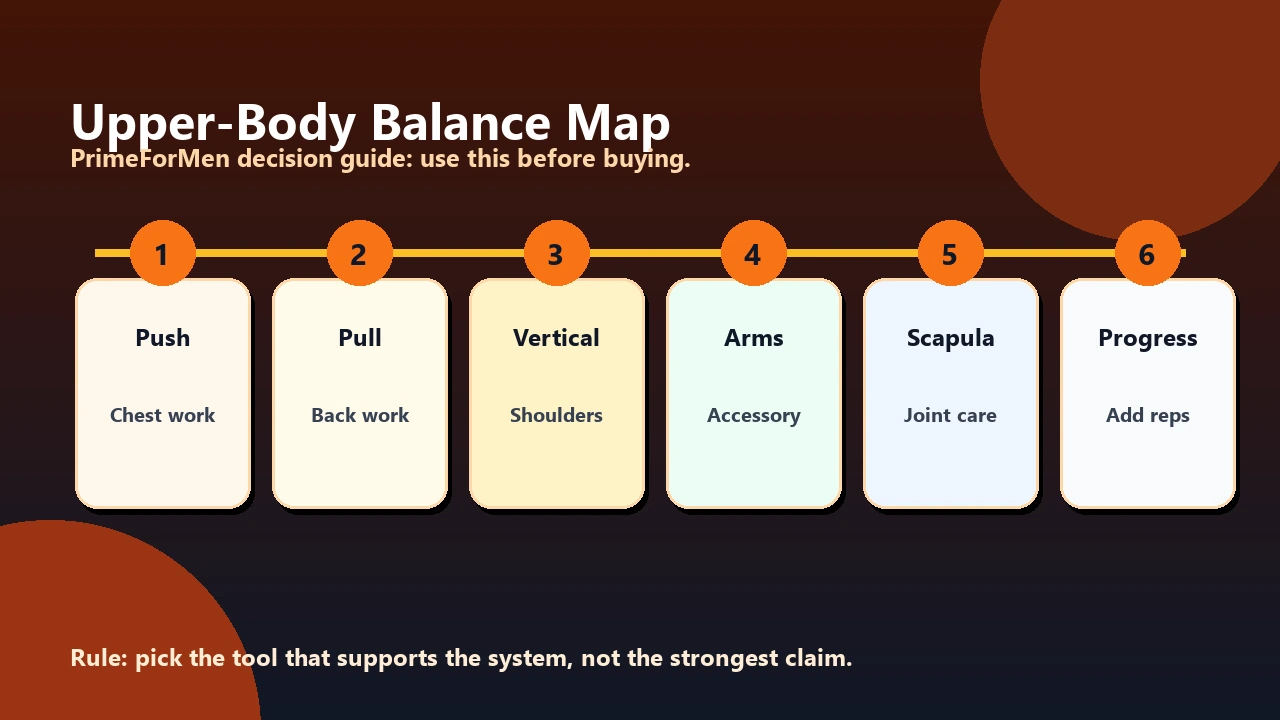
The best home workouts are built from movement patterns, not random exercises. For the upper body, your weekly plan should include these categories.
Push-ups, dumbbell floor presses, incline push-ups, and close-grip push-ups.
One-arm dumbbell rows, band rows, table rows, and towel rows when safely anchored.
Pike push-ups, dumbbell shoulder presses, landmine-style band presses, and controlled overhead work.
Pull-ups, chin-ups, band-assisted pull-ups, negatives, and band pulldowns.
Band pull-aparts, face pulls, external rotations, rear-delt raises, and scapular push-ups.
Curls, hammer curls, triceps extensions, diamond push-ups, and loaded carries.
If vertical pulling is the missing piece, start with the dedicated guide to pull-up bars. If you need scalable pulling without mounting equipment, the guide to resistance bands will be more useful.
Push vs Pull: What Each Exercise Adds
| Pattern | Home Exercise Examples | Main Muscles | Common Mistake | Better Rule |
|---|---|---|---|---|
| Horizontal push | Push-up, floor press, close-grip push-up | Chest, triceps, front delts | Only chasing more reps | Progress angle, tempo, load, or range of motion |
| Horizontal pull | Band row, dumbbell row, inverted row | Lats, rhomboids, mid traps, biceps | Letting the shoulder glide forward | Pause with shoulder blade back and rib cage down |
| Vertical push | Pike push-up, dumbbell shoulder press | Shoulders, triceps, upper chest | Arching the low back to finish reps | Brace first, then press through a clean path |
| Vertical pull | Chin-up, pull-up, band pulldown | Lats, biceps, lower traps, grip | Skipping it because it is hard | Use assistance, negatives, or pulldowns until reps build |
Most Home Plans Ignore the Shoulder Blade
The missing detail is not another chest variation. It is scapular control: your shoulder blade needs to move, rotate, and stabilize while your arm presses or pulls.
- Before pressing, use 1 to 2 light sets of band pull-aparts or scapular push-ups.
- During rows, pull the elbow back without shrugging the shoulder toward your ear.
- During push-ups, let the shoulder blades glide instead of pinning them rigidly.
- After hard pressing, finish with rear-delt or upper-back work so the session does not end in a rounded position.
A Practical 3-Day Upper Body Home Workout Block
This block is built for men who want visible upper-body progress without turning home training into guesswork. Run it for 4 to 6 weeks, then adjust volume or difficulty.
Day 1: Chest and Back Base
- Push-up or dumbbell floor press: 3 to 5 sets of 6 to 15 reps.
- One-arm dumbbell row or band row: 3 to 5 sets of 8 to 15 reps per side.
- Incline or deficit push-up: 2 to 4 sets of 8 to 15 reps.
- Band face pull: 2 to 3 sets of 12 to 20 reps.
- Hammer curl plus triceps extension: 2 to 3 paired sets.
Day 2: Shoulders and Pulling Strength
- Pull-up, assisted pull-up, chin-up, or band pulldown: 4 to 6 quality sets.
- Pike push-up or dumbbell shoulder press: 3 to 4 sets of 6 to 12 reps.
- Rear-delt raise or band pull-apart: 3 sets of 12 to 20 reps.
- Lateral raise: 2 to 4 sets of 10 to 20 reps.
- Slow eccentric curl: 2 to 3 sets of 8 to 12 reps.
Day 3: Volume, Arms, and Cleanup
- Close-grip push-up or dumbbell press: 3 sets of 8 to 15 reps.
- Chest-supported dumbbell row or seated band row: 3 to 4 sets of 10 to 15 reps.
- Band external rotation: 2 sets of 12 to 18 reps per side.
- Curl variation: 3 sets of 8 to 15 reps.
- Overhead triceps extension or band pressdown: 3 sets of 10 to 18 reps.
If you prefer a broader weekly structure, use this as the upper-body portion of your effective home workout routines plan.
How to Progress Without a Full Gym
Progress is not only adding heavier weights. At home, you can overload the same movement in several ways.
- Add reps: move from 8 clean reps to 12 or 15 before changing the exercise.
- Add sets: increase from 3 sets to 4 or 5 when recovery stays good.
- Slow the lowering phase: use a 3-second eccentric on push-ups, rows, curls, and presses.
- Increase range of motion: use deficit push-ups, deeper rows, or full pull-up negatives.
- Add load: use a backpack, dumbbells, or stronger bands.
- Choose a harder angle: feet-elevated push-ups and lower-body-angle rows are simple upgrades.
The principle is the same as any gym plan: apply progressive overload slowly enough that joints and connective tissue can keep up.
Equipment Decisions: What to Buy First
You do not need everything at once. Buy according to the bottleneck in your current training.
Start with a pull-up bar or bands. Pulling options matter more than another push-up handle.
Adjustable dumbbells make the work heavier before sets turn into endurance tests. Compare options in the guide to adjustable dumbbells.
Use bands for warm-ups, face pulls, and low-stress volume before adding more pressing.
Recovery and Safety Rules
The CDC adult activity overview notes that adults need muscle-strengthening activity at least 2 days per week and that those activities should include major muscle groups such as the back, chest, shoulders, and arms. The broader CDC adult activity guidance also keeps aerobic work in the weekly picture, so do not let upper-body training replace walking, cycling, or conditioning entirely.
The Physical Activity Guidelines for Americans, 2nd edition PDF frames muscle-strengthening by intensity, frequency, sets, and repetitions. That is useful for home training because it reminds you that a harder variation is not always better if total weekly stress jumps too quickly.
- Leave 1 to 3 clean reps in reserve on most sets.
- Warm up shoulders, elbows, and wrists before high-effort pressing.
- Use pain-free range of motion; discomfort from effort is different from sharp joint pain.
- Repeat a workout only when performance and joints feel recovered.
- Take an easier week when reps, sleep, mood, and joint comfort all trend down.
Bottom Line
Upper body home workouts are effective when they are balanced. Do not let push-ups become the whole plan. Build each week around pressing, rowing, vertical pulling, shoulder control, and direct arm work. Keep the first goal simple: for every hard push, give your upper back a serious pull.
Next Step
Use this article as your upper-body template, then connect it to full-body programming through PrimeForMen workout planning. The right next step is a weekly routine that also covers legs, core, conditioning, and recovery.
Frequently Asked Questions About Upper Body Home Workouts
Can I build a bigger upper body with home workouts?
Yes, if you train close enough to effort, progress exercises over time, and include both pushing and pulling. Bodyweight alone can work at first, but bands, dumbbells, and a pull-up option make long-term progress easier.
How many days per week should I train upper body at home?
Most men do well with 2 to 4 upper-body sessions per week. Start with 2 or 3 if you are rebuilding consistency, then add frequency only when recovery and performance stay stable.
Are push-ups enough for upper body training?
No. Push-ups are useful, but they mainly train pressing muscles. A complete plan also needs rows, pull-ups or pulldowns, rear-delt work, and shoulder control drills.
What equipment matters most for upper body workouts at home?
The most useful trio is a pull-up bar, resistance bands, and adjustable dumbbells. Together they cover vertical pulling, rows, presses, curls, triceps work, and shoulder accessories.
How do I know if my plan is too push-heavy?
If your weekly plan has far more push-ups and presses than rows, pull-ups, band pulls, or rear-delt work, it is probably too push-heavy. A simple fix is to match pressing sets with equal or slightly higher pulling volume.