
Build safer kettlebell complexes with smart exercise order, bell weight, progression, rest rules, and technique-first templates.
- Time-efficient strength and conditioning when you already know the core kettlebell lifts.
- Core rule: choose 4-5 moves, use the same bell, and rest after each full round.
- Load rule: the bell must be light enough for your weakest movement, usually the press, snatch, or clean.
Bottom line Use them for focused density, not random punishment. Start lighter, keep the sequence short, progress one lever at a time, and let technique decide when the session is over.

Kettlebell complexes are short sequences of kettlebell exercises performed back-to-back without putting the bell down. They can build strength, conditioning, grip endurance, and movement skill, but only when the complex is built around clean technique, the right bell weight, and enough recovery between rounds.
Quick Summary: Kettlebell complexes
- Best use: time-efficient strength and conditioning when you already know the core kettlebell lifts.
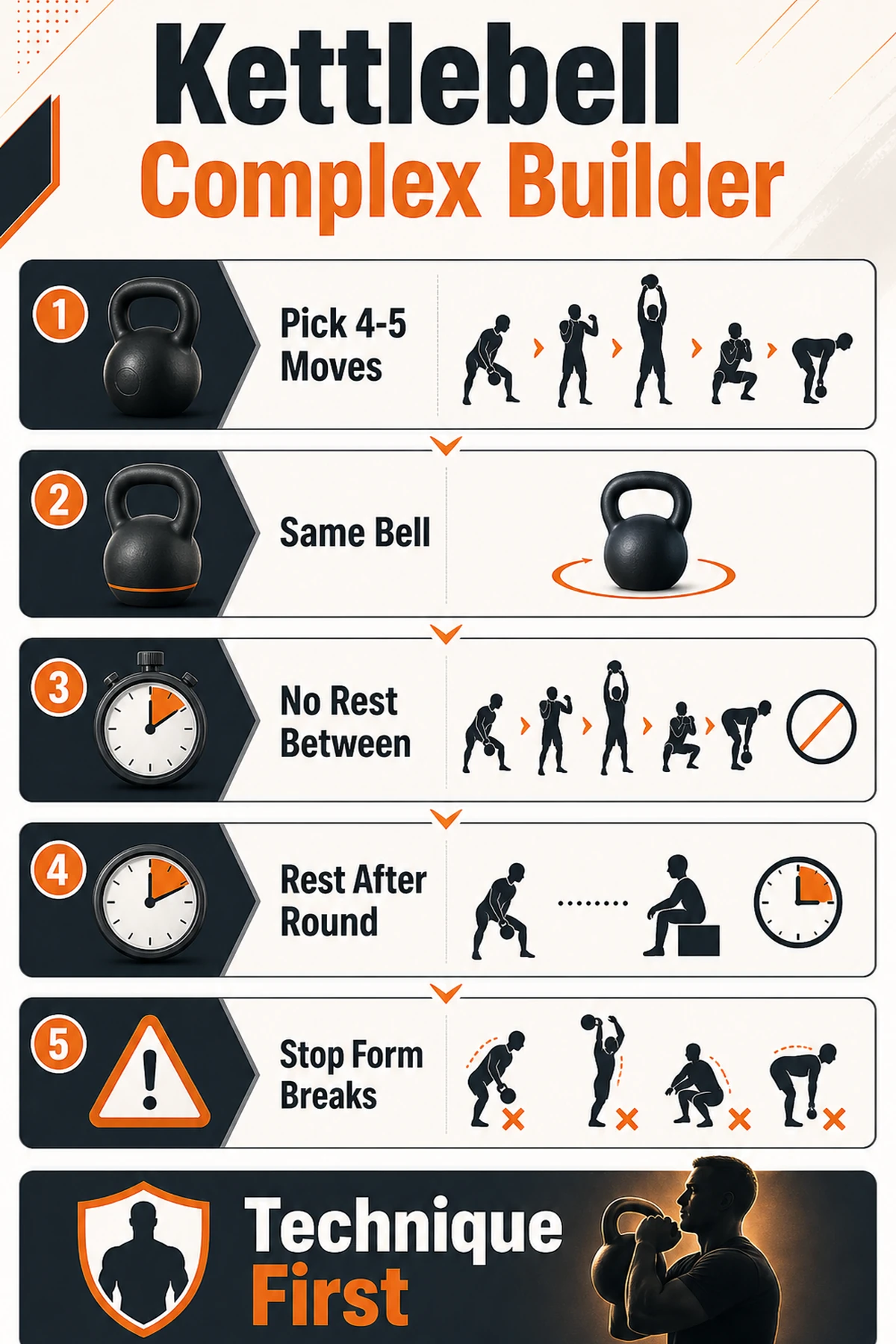
- Core rule: choose 4-5 moves, use the same bell, and rest after each full round.
- Load rule: the bell must be light enough for your weakest movement, usually the press, snatch, or clean.
- Safety rule: stop the complex when grip, hinge position, breathing, or overhead control breaks.
- Progression rule: add rounds, reps, or load one at a time, not all at once.
The Prime Perspective
A good kettlebell complex is not a random list of hard exercises. It is a controlled sequence where every rep still looks like training, not survival.
The goal is density: more useful work in less time. The mistake is using a complex to hide poor technique, too much fatigue, or a bell that is too heavy for the weakest lift.
What Is a Kettlebell Complex?
A kettlebell complex is a chain of exercises performed in sequence with the same kettlebell. For example: clean, front squat, press, swing. You complete the prescribed reps for each movement before resting.
This is different from a circuit. In a circuit, you usually move between stations or tools. In a complex, the same bell stays in your hand or rack position until the round is complete. That creates a high training density and makes exercise order, grip, and technique more important.
If you are still learning the basics, start with kettlebells and strength training basics before chasing advanced density work.
Who Should Use Kettlebell Complexes?
Kettlebell complexes work best for men who already understand the hinge, clean, front rack, squat, press, and breathing under load. They are not the best first exposure to kettlebells because fatigue makes sloppy reps show up fast.
Use complexes when you want one or more of these outcomes:
Conditioning
You want a short session that raises heart rate without turning every workout into a sprint.
Strength Endurance
You want repeated quality reps under fatigue, especially with hinge, rack, and press patterns.
Time Efficiency
You want a compact session that fits home training and still feels structured.
The 5 Rules for Building a Kettlebell Complex
The builder is simple, but the execution is not casual. Keep the rules tight so the complex stays useful.
| Rule | Why It Matters | Practical Example |
|---|---|---|
| Pick 4-5 moves | Enough variety to train the body, not so many that technique collapses. | Swing, clean, front squat, press. |
| Use the same bell | The weakest movement determines the safe load. | If your press is weak, choose the bell you can press cleanly. |
| No rest between moves | This is what makes it a complex, not a normal set list. | Move from cleans into squats without putting the bell down. |
| Rest after the round | Recovery protects technique and makes rounds repeatable. | Rest 60-120 seconds before the next round. |
| Stop when form breaks | Bad reps under fatigue train bad positions. | End the round if your back rounds or rack position collapses. |
A small study indexed on PubMed found that kettlebell swing training improved several physical performance measures in recreational athletes. That does not mean every complex is automatically safe or superior, but it supports the idea that kettlebells can be a serious conditioning and performance tool when programmed well. See the PubMed kettlebell training study for context.
Beginner, Intermediate, and Advanced Kettlebell Complexes
Start lower than your ego wants. The right complex should feel crisp for the first round, challenging by the last round, and technically repeatable across the session.
| Level | Complex | Prescription |
|---|---|---|
| Beginner | Deadlift, two-hand swing, goblet squat, suitcase carry. | 3-4 rounds, 5 reps each, carry 20-30 seconds. |
| Intermediate | Swing, clean, front squat, push press. | 4-5 rounds, 4-6 reps each side where needed. |
| Advanced | Clean, snatch, front squat, press, reverse lunge. | 3-5 rounds, 3-5 reps, strict technique cap. |
If your current setup is mostly home-based, pair complexes with a balanced full body home workout rather than letting them replace all strength work.
Useful Gear for Kettlebell Complexes
You can train complexes with one bell. These categories help when they solve a real programming problem: smoother loading, better timing, or safer tracking.
Adjustable Kettlebell
Best fit if you train at home and need several loads without a full kettlebell rack.
- Lets you match load to the weakest movement in the complex.
- Useful for gradual progression without buying every bell size.
- Works well for compact home gym setups.
Competition-Style Kettlebell
Best fit if you want a consistent handle and bell shape across different weights.
- Consistent dimensions make cleans, racks, and presses easier to repeat.
- Useful for technique practice across multiple loads.
- Better fit for lifters who care about repeatable positions.
Workout Timer or Training Log
Best fit if your rest periods and rounds drift during hard sessions.
- Keeps rest honest between rounds.
- Makes progression visible across weeks.
- Helps stop the workout before fatigue ruins technique.
*Affiliate disclosure: PrimeForMen may earn a commission if you buy through these links, at no extra cost to you. Recommendations are based on use-case fit for this article.
Common Kettlebell Complex Mistakes
Most mistakes come from treating complexes like a toughness test. They are demanding, but the point is still repeatable training quality.
Too Heavy
If you cannot press, rack, or stabilize the bell cleanly, the complex is too heavy even if your swing feels fine.
Too Many Moves
Longer does not mean better. Four or five movements are usually enough.
No Recovery
Short rest can be useful. No meaningful rest turns technique into guesswork.
Random Exercise Order
Sequence matters. Put the most technical or limiting movement where you can still perform it well.
Safety and Recovery Rules
If complexes are too advanced for your current skill base, start with the kettlebell workout for men over 50 and earn ballistic work through clear technique gates.
Kettlebell complexes are high-density training. That means recovery has to be part of the plan. The American Council on Exercise has highlighted that kettlebell workouts can be demanding enough to create a serious cardiovascular and muscular challenge. Their summary of ACE-sponsored kettlebell research is a useful reminder that light-looking tools can still create heavy systemic stress.
Use complexes 1-3 times per week depending on your training age, total program volume, and recovery. If you also run, lift heavy, or do HIIT, start with one complex session per week. Add more only if performance, joints, and sleep stay stable.
Stop the Complex If This Happens
- Your grip starts opening or the bell feels unstable.
- Your back rounds during hinges, cleans, or swings.
- Your overhead lockout becomes shaky or painful.
- Your breathing cannot recover between rounds.
- You can no longer repeat the same technique on both sides.
How to Progress Kettlebell Complexes
Progress one lever at a time. Add a round, add one rep per movement, shorten rest slightly, or increase the bell only after the current version stays clean. Do not add all four at once.
For broader strength development, keep normal strength work in the program. Complexes can support strength training at home, but they should not replace all slower, heavier, technically focused lifting.
| Progression Lever | Use It When | Watch Out For |
|---|---|---|
| Add rounds | Technique stays consistent but work capacity needs more challenge. | Grip failure and sloppy final rounds. |
| Add reps | The load is right but the set is too easy. | Turning a clean complex into a long grind. |
| Add load | Every movement, including the weakest one, is clean. | Presses, snatches, and front rack position. |
| Reduce rest | Technique and breathing stay controlled between rounds. | Making conditioning the only goal. |
If recovery is the limiting factor, use active recovery workouts or reduce weekly density before adding more kettlebell work.
Conclusion
Kettlebell complexes are powerful when they are built with discipline: a few movements, one appropriate bell, no rest between moves, real rest after rounds, and a hard stop when technique breaks.
Use them for focused density, not random punishment. Start lighter, keep the sequence short, progress one lever at a time, and let technique decide when the session is over.
Medical Disclaimer: This article is for general fitness education only. It is not medical advice, diagnosis, or treatment. If you have pain, injury symptoms, cardiovascular concerns, or a medical condition, talk with a qualified professional before changing training intensity.
Affiliate Disclosure: Some product links may earn PrimeForMen a commission at no extra cost to you. Recommendations are based on practical fit for the training problem discussed.
Frequently Asked Questions About Kettlebell Complexes
Are kettlebell complexes good for building muscle?
They can support muscle and strength endurance, especially when volume and load are progressed. For maximum hypertrophy, pair them with slower strength work and enough recovery.
How many exercises should be in a kettlebell complex?
Most useful complexes use 4-5 exercises. More than that often becomes hard to recover from and harder to perform cleanly.
How heavy should the kettlebell be?
Use a bell you can control in the weakest movement of the sequence. If the press, snatch, or rack position breaks down, the bell is too heavy.
Are kettlebell complexes safe for beginners?
They are not ideal for complete beginners. Learn the hinge, swing, clean, squat, and press first, then start with short low-load complexes.
How often should I do kettlebell complexes?
Start with one session per week. Well-trained lifters may use two or three, but only if recovery, joints, and technique stay consistent.