

Learn when to add reps, weight or sets with worked examples, a plateau checklist and a free progression log for repeatable strength training.
- Compare the same exercise under similar conditions.
- Add reps before a manageable increase in load.
- Repeat or reduce a session when performance calls for it.
Bottom line Pick one exercise and record load, each set, rest and effort across your next three sessions.

Progressive overload means increasing the training demand over time as your capacity improves. It does not mean adding weight at every workout. Start by making sessions comparable, then choose one change that fits your goal and your current performance.
Quick Summary: Progressive Overload
- Compare the same exercise under similar conditions.
- Add reps before a manageable increase in load.
- Repeat or reduce a session when performance calls for it.
The Prime Perspective
A training log should help you make the next decision, not pressure you into beating every previous number. Better control at the same load can be useful progress even when the weight stays unchanged.
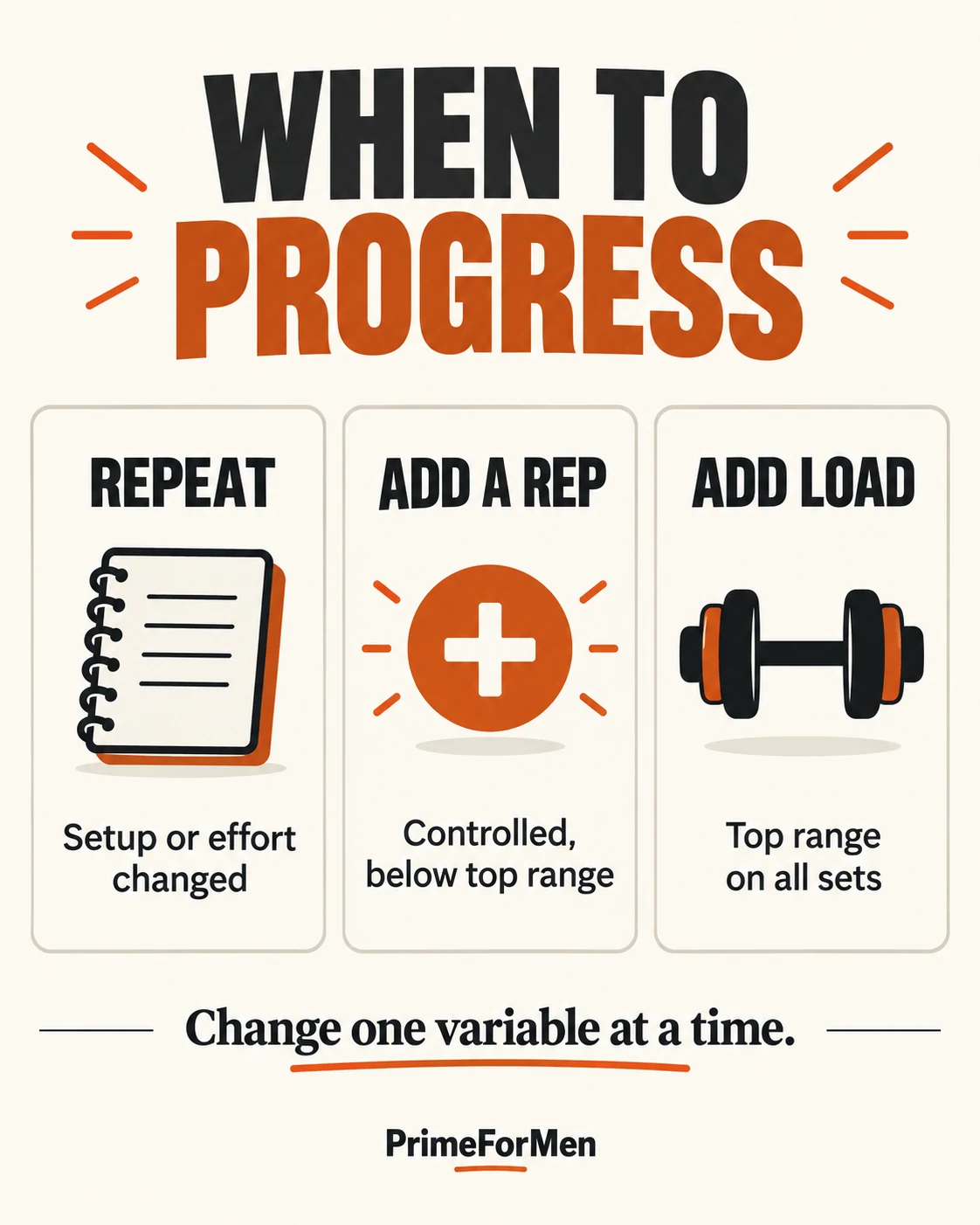
A Worked Progression Log: Reps Before Load
Progressive overload is a long-term process, not an instruction to make every workout harder. Start with a repeatable exercise and setup. For this example, use two work sets of a supported dumbbell row in an 8–12 repetition range, resting about 90–120 seconds after both sides. Finish with roughly two controlled repetitions still available. That effort estimate is a practical coaching aid, not an exact measurement.
On small screens, swipe the table sideways to see every column.
| Exposure | Illustrative result per side | Next decision |
|---|---|---|
| 1 | Same load: 9 and 8 reps, setup stable. | Repeat the load; aim for one additional controlled rep. |
| 2 | 10 and 9 reps at similar effort. | Keep building within the range. |
| 3 | 10 and 8 after poor sleep; last rep was slower. | Repeat rather than forcing an increase. |
| 4 | 12 and 12 with consistent range and effort. | Confirm on another exposure before a load increase. |
| Later | 12 and 12 repeated comfortably. | Try the smallest suitable load increase; return toward 8 reps. |
The exposures do not have to occur in consecutive weeks, and the numbers are not a predicted response. Some exercises progress quickly; others need several repeats. A lower result after a stressful day does not by itself establish a plateau. Keep actual results, not only the target you hoped to reach.
What stays the same while you compare sessions?
Record the exercise variation, support height, working load, set count, approximate rest and range of movement. For a band row, record the band and anchor setup too. Twelve partial repetitions with a different stance are not directly comparable to ten full repetitions in the previous session. Improvements in control matter, but they should be described accurately.
For dumbbells, specify whether the logged weight is per dumbbell or the combined total. For a barbell, include the bar. For one-sided work, log each side rather than silently adding the repetitions together. A useful entry reads: “Row, 10 kg in working hand, left 10/10, right 10/10, same support, about two reps available.”
Choose the Next Change by the Actual Limitation
On small screens, swipe the table sideways to see every column.
| Situation | Reasonable action | Avoid |
|---|---|---|
| Below the top of a suitable rep range | Add one controlled repetition when ready. | Changing several variables at once. |
| Top range is repeatable and the next load is manageable | Try a small load increase and lower the reps. | Assuming every available weight jump is appropriate. |
| The next weight is too large a jump | Repeat or use smaller increments if available. | Forcing a shortened range solely to claim a heavier lift. |
| Sessions are too long or recovery is poor | Review workload; hold or reduce the plan. | Adding sets automatically because progress is slow. |
| Pain changes movement | Stop that progression and seek appropriate assessment if persistent or concerning. | Using a traffic-light score to diagnose an injury. |
A bodyweight example
For wall push-ups, first build repetitions at the same foot position and comfortable hand height. If that becomes easy, use a modestly harder position or a fixed, suitable incline surface. Check that it cannot slide or tip. Changing the angle increases the challenge, so reset the repetition target instead of also doubling the sets.
A fixed-weight example
If a fixed dumbbell is comfortably below the needed resistance, adding a few reps may be useful. A pause or slower lowering can alter the challenge, but neither guarantees the same adaptation as a heavier load. When the goal requires more resistance than your equipment can provide, acknowledge that limit. A different tool or training location may be the practical next step.
How to Respond to a Stall Without Rebuilding Everything
Review at least several comparable sessions. Ask whether you were actually consistent, whether the exercise and range changed, and whether the load increment was too large. Check whether extra conditioning, sport, poor sleep or new exercises increased overall fatigue. Fix one plausible issue and observe the next sessions.
A short reduction in work may help when fatigue has accumulated, but there is no universal deload date for every reader. One example is temporarily doing one work set instead of two while retaining familiar easy technique practice. This is not treatment for unexplained pain or illness. Persistent deterioration needs a broader assessment.
The 2026 ACSM summary emphasizes consistency and goal-specific prescription rather than mandatory advanced techniques. Age alone does not define the best progression method. Use your training history, capacity and response. For a complete application, connect this log to the dumbbell home program rather than designing a new routine after every session.
Choose the Progression That Matches the Goal
Different changes create different demands. Adding weight, adding sets and shortening rest should not be treated as equivalent ways to make a strength program better. Before changing the logbook, decide what you are trying to improve and what must stay comparable.
On small screens, swipe the table sideways to see every column.
| Change | Useful role | What to watch |
|---|---|---|
| More repetitions at the same load | Build within an established rep range before a load step. | Keep range and control similar; do not add partial repetitions just to increase the count. |
| A small increase in load | Increase resistance when the current range is manageable. | Expect fewer reps initially; the new weight must still fit the bottom of the range. |
| Another work set | Add volume when more work is appropriate. | It also adds fatigue and time. Review the whole week first. |
| A harder bodyweight variation | Progress when external load is unavailable. | Changing leverage changes the task. Establish a new baseline. |
| Less rest | Increase density when conditioning or time efficiency is the goal. | It may reduce subsequent strength performance and makes comparisons harder. |
Age alone does not tell you which lever is safe or productive. Training history, health, technique, available equipment and current workload matter. A man returning after a long break may need a different starting dose from an experienced older lifter. Avoid using an age threshold as a substitute for those details.
Use the Same Principle Across Your Training Setup
For a dumbbell home program, record whether a number means one dumbbell or the combined pair. For band training, record the anchor, stance and starting stretch. A different distance from the anchor can change the resistance even though the band color is unchanged.
For a full-body home workout, keep the support height consistent when comparing incline push-ups. Moving from a high support to a lower one is a new variation; fewer repetitions can still represent a harder task. Do not compare the two counts as if nothing else changed.
If you use one-sided exercises, log both sides rather than only the stronger side. Use a manageable variation and controlled range for each. A small difference on one day is not a diagnosis or a reason to double the weaker side’s volume.
Review a week, not a single disappointing set
One lower performance can reflect ordinary variation, a rushed warm-up or a different rest period. Repeated decline across several movements is more useful information. Consider reducing optional work and reviewing recovery before buying equipment or switching programs. Our active-recovery decision guide explains why adding a recovery workout is not always the right answer.
Keep the review practical: what stayed the same, what changed, and what is the smallest adjustment worth testing next? If you cannot answer the first two questions, repeat the setup before drawing a strong conclusion.
Download the Practical Worksheet
Use the one-page reference and three fillable fields to record your setup, what you completed and the next decision. Print it or save a filled copy using a PDF reader that supports forms. Read the full instructions and adaptations above before using the summary.
Optional Equipment: Buy for a Specific Job
The links below open Amazon category searches, not tested product recommendations. Compare the actual product instructions, dimensions and compatibility. Use equipment you already own when it fits the task.
As an Amazon Associate, PrimeForMen earns from qualifying purchases.
Conclusion: Make the Next Session Clear
Pick one exercise and record load, each set, rest and effort across your next three sessions. Use the worksheet to make that decision visible. Repeating a manageable session is a valid choice; the calendar alone does not require a harder workout.
Frequently Asked Questions
Do I have to add weight every week?
No. Progress is not guaranteed on a weekly schedule. Repeat the load while repetitions, control and effort become consistent. A busy or tiring week may call for less work rather than an increase.
Does better technique count as progress?
Better execution is useful, although it is not necessarily an increase in external training load. Establish the improved technique as your baseline before comparing numbers. A larger count with less range is not a like-for-like improvement.
Should I add sets before weight?
It depends on the goal and the existing workload. Another set increases volume and fatigue. In the worked example, build repetitions within the range first, then try a manageable load step. Do not add sets automatically after one disappointing workout.
Can I progress using only bodyweight?
Yes. Repetitions, range, support height or leverage can change the task. Change one variable and establish a new baseline. A harder variation may initially produce fewer repetitions without representing a loss of capacity.
How long should I wait before changing a stalled plan?
There is no universal number of sessions. First verify comparable setup, rest, effort and attendance. Look for a repeated pattern and review the whole week. Persistent pain or unusual fatigue needs assessment rather than a more aggressive progression rule.
Medical Disclaimer
This is general fitness education, not diagnosis, rehabilitation or an individualized exercise prescription. Choose movements appropriate to your situation. Stop for pain, dizziness or unusual symptoms and seek appropriate guidance. New or severe concerning symptoms warrant prompt medical assessment.
Our editorial policy explains our approach to sources and commercial independence. Exercise examples and illustrations do not represent individual coaching or product testing.
Affiliate Disclosure
Some links are affiliate links. We may receive a commission from qualifying purchases at no additional cost to you. Optional equipment is not a condition of benefiting from the guidance above.