Try a 15-minute family movement session with age-appropriate options, quiet swaps and a free planner. Keep activity playful and supervised.
- Use a 3 + 5 + 5 + 2 minute session structure.
- Adapt each station to age, ability and available space.
- Keep supervision and enjoyment ahead of competition.
Bottom line Clear the space, let each person choose an option and try one short session without scoring anyone’s performance.
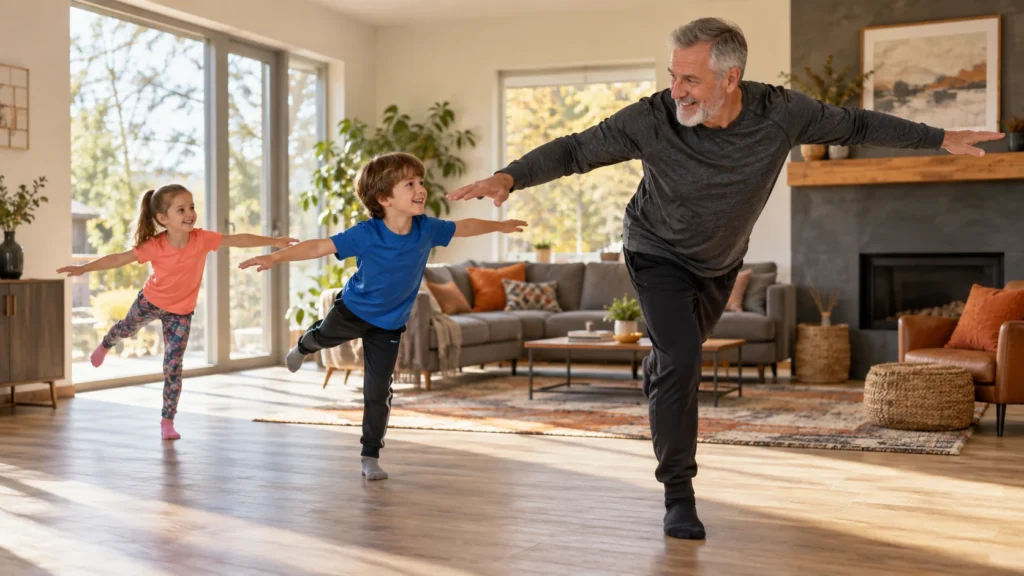
Family-friendly workouts work best as shared movement, with different versions for different people. This 15-minute example gives an adult and school-age children a simple sequence while leaving room for choice, rest and play.
Quick Summary: Family-Friendly Workouts
- Use a 3 + 5 + 5 + 2 minute session structure.
- Adapt each station to age, ability and available space.
- Keep supervision and enjoyment ahead of competition.
The Prime Perspective
Shared activity should make moving together easier to repeat. Children do not need to match an adult training target, and an adult does not need to turn every family game into a personal workout.
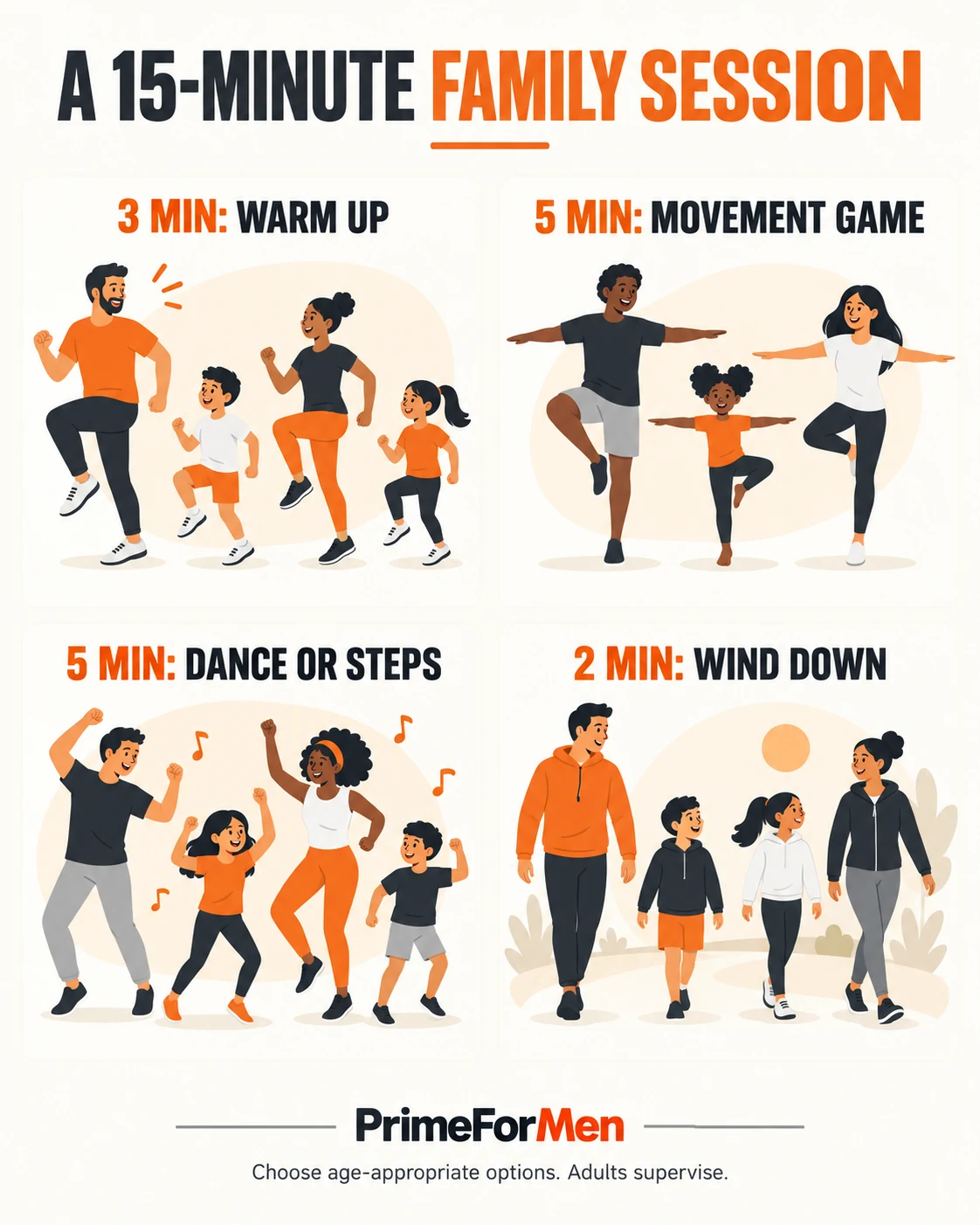
A Fifteen-Minute Session With Clear Game Rules
This example is shared movement time for adults and school-age children, not an adult workout imposed on children. A responsible adult supervises the space and chooses age-appropriate options. Preschoolers may join brief imitation play at their own pace, but should not be expected to complete timed work sets. Anyone may pause, change a movement or stop.
Clear separate movement zones, move breakable objects and choose footwear or footing that grips the surface. Do not run shuttles through a narrow hallway or ask children to move under a lifting adult. Put weights and stretched resistance bands away before the game. One adult should be able to watch the participating children rather than filming or doing maximal effort.
On small screens, swipe the table sideways to see every column.
| Time | Game | Exact starting rules |
|---|---|---|
| 0–3 minutes | Follow the leader | Use gentle steps, arm circles and reaches. Change leader each minute; everyone stays in their own space. |
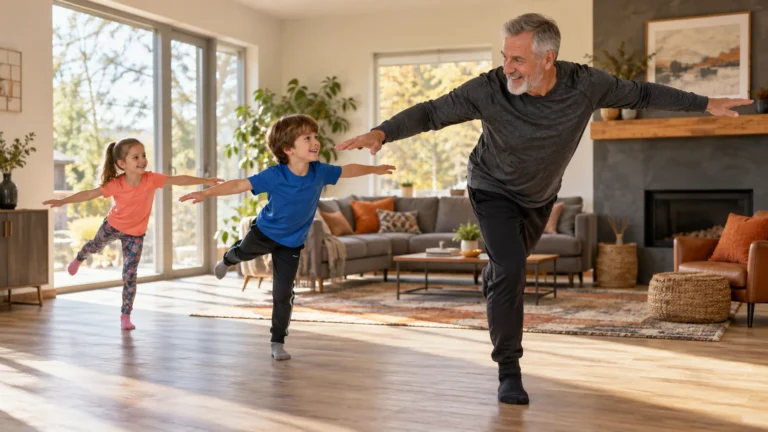
| 3–8 minutes | Three movement stations | Do 30 seconds of movement and 30 seconds to rest or switch. Use five rounds total: sit-to-stand, wall push-up, balance pose, then repeat two favorites. |
| 8–13 minutes | Dance or step-and-freeze | Alternate 30 seconds of dancing or step-touch with 30 seconds of an easy standing pause. Five rounds. No elimination. |
| 13–15 minutes | Walk and choose next time | Easy steps and relaxed breathing. Each person names one movement they would repeat. |
Timers organize turns, not effort. A child can do three comfortable repetitions and then watch, while an adult continues at a manageable pace. Use a visible clock or verbal cues rather than loud alarms. If attention fades, end with a positive finish instead of insisting on all fifteen minutes.
Give Each Person a Different Version of the Same Task
On small screens, swipe the table sideways to see every column.
| Task | Young child | Older child or teen | Adult |
|---|---|---|---|
| Sit-to-stand | Use an appropriately sized stable seat, or imitate a shallow squat. | Use a controlled comfortable range; choose when to pause. | Slow the lowering if appropriate, without holding a child or adding heavy weights. |
| Wall push-up | Stand close and gently push away. | Choose a comfortable foot distance. | Use a slightly harder angle if controlled. |
| Balance pose | Keep toes grounded or hold a stable support. | Try a brief one-foot stance if safe. | Use the same option; do not turn it into a fall-risk contest. |
| Dance or steps | Choose a simple movement and copy. | Choose music or lead a round. | Match space and noise limits instead of chasing intensity. |
For sit-to-stands, use nonrolling seats that do not slip. Wall push-ups need a clear solid wall. Balance support must be stable, not another child. Do not use siblings as weights, stack children into exercise positions or reward continuing through pain. Shared time can be useful even when family members perform different movements.
Three Scenarios That Often Derail the Plan
A preschooler joins midway
Offer a simple copying game next to the supervising adult, with no rep target or expectation to remain for the whole session. Keep small objects, bands and weights inaccessible. If supervising the younger child takes full attention, simplify or pause the older group’s activity.
A teenager does not want a group workout
Offer a genuine choice: select music, lead a short round, walk together later or do a separate activity. Do not make body weight, appearance or calories the price of participation. A shared routine should not become a public assessment of a teenager’s body or fitness.
The apartment is too noisy or crowded
Use step-touch, wall push-ups and seated or supported movements. Keep foot placement gentle and avoid chasing games indoors. If there is no clear space, a shared walk may be the better session. Our apartment guide explains why mats do not guarantee silence.
Progress by Enjoyment and Repeatability
In week one, try one short session and ask what worked. In week two, repeat the favorite version rather than adding new rules. In week three, let participants choose between two familiar games. In week four, decide whether a second weekly session or an outdoor activity fits. More minutes are optional; finishing willing to participate again is a useful observation.
The CDC child-activity guidance distinguishes active play throughout the day for ages three to five from the daily activity target for ages six to seventeen. This family session is only one possible contribution. It does not replace outdoor play, sport, school activity or the adult’s own training needs.
Use the planner to record preferences, adaptations and supervision needs—not weigh-ins or a leaderboard. A grandparent may need a seated option while an older child wants more movement; both can take part without identical workloads. For adult strength progression, use the beginner fitness guide separately.
Family Movement and Adult Training Have Different Jobs
A shared session can contribute to activity and make movement part of everyday life. It does not have to supply a complete adult strength program or meet a child’s full daily needs. Keep separate expectations for play, school sport, walks and individual training.
For children ages six to seventeen, CDC guidance includes at least 60 minutes of moderate-to-vigorous activity daily, with vigorous aerobic, muscle-strengthening and bone-strengthening activities on at least three days each week. Activities should be varied and appropriate to age and ability. Younger children need active play across the day rather than an adult-style weekly training prescription.
An adult who wants a more demanding strength session can schedule the full-body home routine separately. Do not add heavy dumbbells to a family station while children move nearby. The dumbbell training plan needs its own clear space and equipment handling.
Prepare the Room Before Starting the Timer
On small screens, swipe the table sideways to see every column.
| Check | Practical adjustment |
|---|---|
| Footing | Choose a surface and footwear combination that does not slip. Socks on smooth flooring may be unsuitable. |
| Supports | Use stable, nonrolling seats and a clear solid wall. Avoid furniture that tips or slides. |
| Personal space | Give each participant room to reach and step without collision. |
| Equipment | Put weights, bands and small loose objects outside the play area. |
| Attention | Keep the supervising adult able to watch and respond rather than filming or training hard. |
If you are organizing a shared exercise corner, the home gym equipment guide can help with adult equipment decisions. Storage matters here: gear that belongs in a supervised workout should not become an unsupervised toy.
Use choices that are real
Offer two acceptable options rather than a choice between joining and disappointing the group. Someone may prefer a walk, a seated version, selecting music or simply watching before trying. A short enjoyable session is more likely to be repeated than a long session built around reluctant participation.
A child with a disability, a health condition or specific movement needs may benefit from adaptations discussed with an appropriately qualified professional. Do not assume the age-based examples cover everyone. Likewise, a grandparent can join without matching the child’s balance or speed.
Use the easy-movement ideas for an adult who needs a gentler day, while keeping the family game itself flexible. Record preferences in the planner so the next session reflects what the participants actually enjoyed. Do not use calories, weight changes or a winner’s board as the measure of success.
Download the Practical Worksheet
Use the one-page reference and three fillable fields to record your setup, what you completed and the next decision. Print it or save a filled copy using a PDF reader that supports forms. Read the full instructions and adaptations above before using the summary.
Optional Equipment: Buy for a Specific Job
The links below open Amazon category searches, not tested product recommendations. Compare the actual product instructions, dimensions and compatibility. Use equipment you already own when it fits the task.
As an Amazon Associate, PrimeForMen earns from qualifying purchases.
Conclusion: Make the Next Session Clear
Clear the space, let each person choose an option and try one short session without scoring anyone’s performance. Use the worksheet to make that decision visible. Repeating a manageable session is a valid choice; the calendar alone does not require a harder workout.
Frequently Asked Questions
Can preschool children join?
They can join brief, supervised imitation play at their own pace. Do not require them to follow the timed work sets or complete the whole session. Active play throughout the day has a different structure from adult training.
What if one child does not want to participate?
Offer a real alternative, such as choosing music, watching first or walking together later. Avoid pressure based on appearance, calories or letting the family down. Participation should not become a public fitness test.
Does fifteen minutes meet the full activity target?
No. This is one contribution to a broader day of movement. Children and adults have different activity recommendations, and other play, walking, sport and individual training still matter.
Can adults use weights during the game?
Keep weights and stretched bands out of this shared play session. An adult strength workout needs separate space and attention so supervision and equipment handling are not competing tasks.
How should we make the session harder?
First make it enjoyable and repeatable. Let people select familiar games or choose a second suitable session. More intensity is not the default goal, and family members do not need identical progressions.
Medical Disclaimer
This is general fitness education, not diagnosis, rehabilitation or an individualized exercise prescription. Choose movements appropriate to your situation. Stop for pain, dizziness or unusual symptoms and seek appropriate guidance. New or severe concerning symptoms warrant prompt medical assessment.
Our editorial policy explains our approach to sources and commercial independence. Exercise examples and illustrations do not represent individual coaching or product testing.
Affiliate Disclosure
Some links are affiliate links. We may receive a commission from qualifying purchases at no additional cost to you. Optional equipment is not a condition of benefiting from the guidance above.