Choose home cardio exercises by space and balance. Build a 10-, 20- or 30-minute session with warm-up, easy recovery, cool-down and a log.
- Choose movements that fit space and balance.
- Use the talk test to adjust effort.
- Separate session time from moderate minutes.
Bottom line Clear the floor, choose two familiar movements and record the effort you actually reached before extending the session.
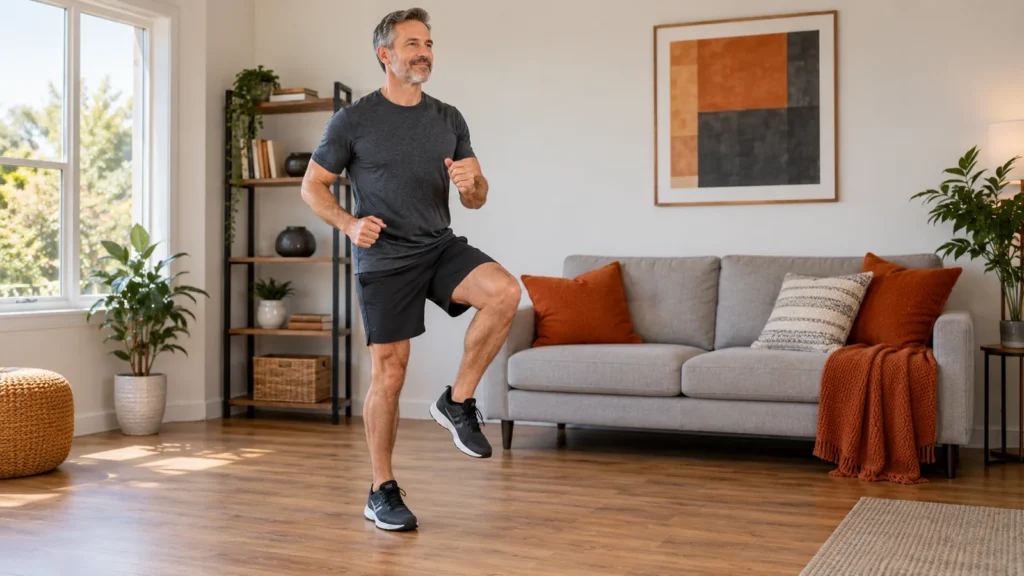
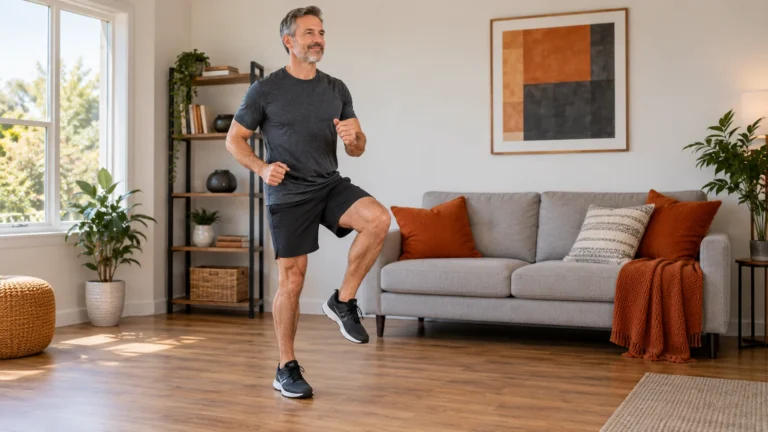
Home cardio exercises can be simple: marching, step-touches, controlled side steps and comfortable shadow boxing. Choose movements that fit your space and balance, then use pace and duration to create a manageable session. Jumping and a machine are optional.
This guide gives you 10-, 20- and 30-minute sessions with explicit warm-up and cool-down time. These are general starting templates for adults who can exercise comfortably, not cardiac rehabilitation or an individually prescribed intensity plan.
Quick Summary: Home Cardio Exercises
- Start with a movement you can repeat without losing balance or clipping furniture.
- Use an easy warm-up, manageable main blocks and an easy cool-down; their minutes add up to the selected session length.
- At moderate intensity, you can generally talk but not sing. Slow down if speaking becomes difficult.
- Increase total manageable time before making several sessions harder. Log actual activity and effort.
Prime Perspective
Choose movements you can sustain at an appropriate effort in your available room. A quiet march repeated for several minutes may fit your week better than a jumping circuit you avoid because of noise or balance concerns. Choose the movement first, then adjust pace.
Check space, balance and intensity before the timer
Clear a nonslip area so the feet and arms can move without touching furniture. Stay on the floor if there is no room for a secure step. Keep cables, rugs that slide, children and pets out of the movement path. For shared buildings, see our apartment-friendly workout guide for noise and setup choices; no exercise is guaranteed silent.
If balance is uncertain, use small supported movements beside a fixed surface. Support should not slide or tip. This is different from starting a fast sequence and trying to catch yourself. Get help selecting suitable exercise if standing safely is difficult.
The CDC talk test describes moderate activity as being able to talk but not sing. A pace that is moderate for one person may be easy or vigorous for another. Use that feedback rather than assuming a named exercise or machine speed guarantees an intensity.
Session minutes are not automatically moderate minutes
A 20-minute session includes easy preparation and recovery. Only activity that actually reaches a suitable moderate intensity counts as moderate work. Do not label the whole timer as moderate exercise or convert the timer into a calorie estimate.
Choose a movement you can sustain
| Exercise | How to begin | Space / balance consideration | Make it easier |
|---|---|---|---|
| March in place | Lift and replace each foot gently; keep shoulders relaxed. | Small footprint; use fixed hand support when needed. | Lower knee lift and slow the rhythm. |
| Step-touch | Step sideways and bring the other foot near it; alternate directions. | Needs lateral clearance; no jumping required. | Take smaller steps, omit arm movement. |
| Side step and return | One small step out, then return before changing sides. | Useful when a longer traveling sequence will not fit. | Use a hand on fixed support and very short steps. |
| Comfortable shadow boxing | Use short alternating arm reaches with soft elbows. | Needs arm clearance; avoid quick pivots if balance is uncertain. | Keep feet still and shorten the reach. |
| Low step-up | Step onto a stable exercise platform, then down under control. | Requires approved platform, clear approach and reliable balance. | Stay on the floor and march. |
| Walking pad | Follow the exact manual and start at a comfortable speed. | Check belt space, stopping method, clearance and whether support is needed. | Walk on the floor instead. |
These are options, not six required exercises. Keep the first session to two or three familiar movements. Begin step-ups at the lowest appropriate secure platform setting and use the manufacturer’s instructions. Do not use chairs, loose boxes or stacked objects as steps.
10-, 20- and 30-minute home cardio sessions
Warm up by marching or walking easily, then gradually add a little arm movement or wider steps. In the main section, repeat one-minute blocks: 45 seconds at your manageable working pace, followed by 15 seconds of easy movement. Beginners can use an easy pace throughout; the format does not require vigorous intervals. Finish by slowing to easy walking or marching.
| Total | Easy warm-up | Main section | Easy cool-down | Example movement rotation |
|---|---|---|---|---|
| 10 | 2 | 6 one-minute blocks | 2 | March, step-touch, short arm reaches; repeat twice |
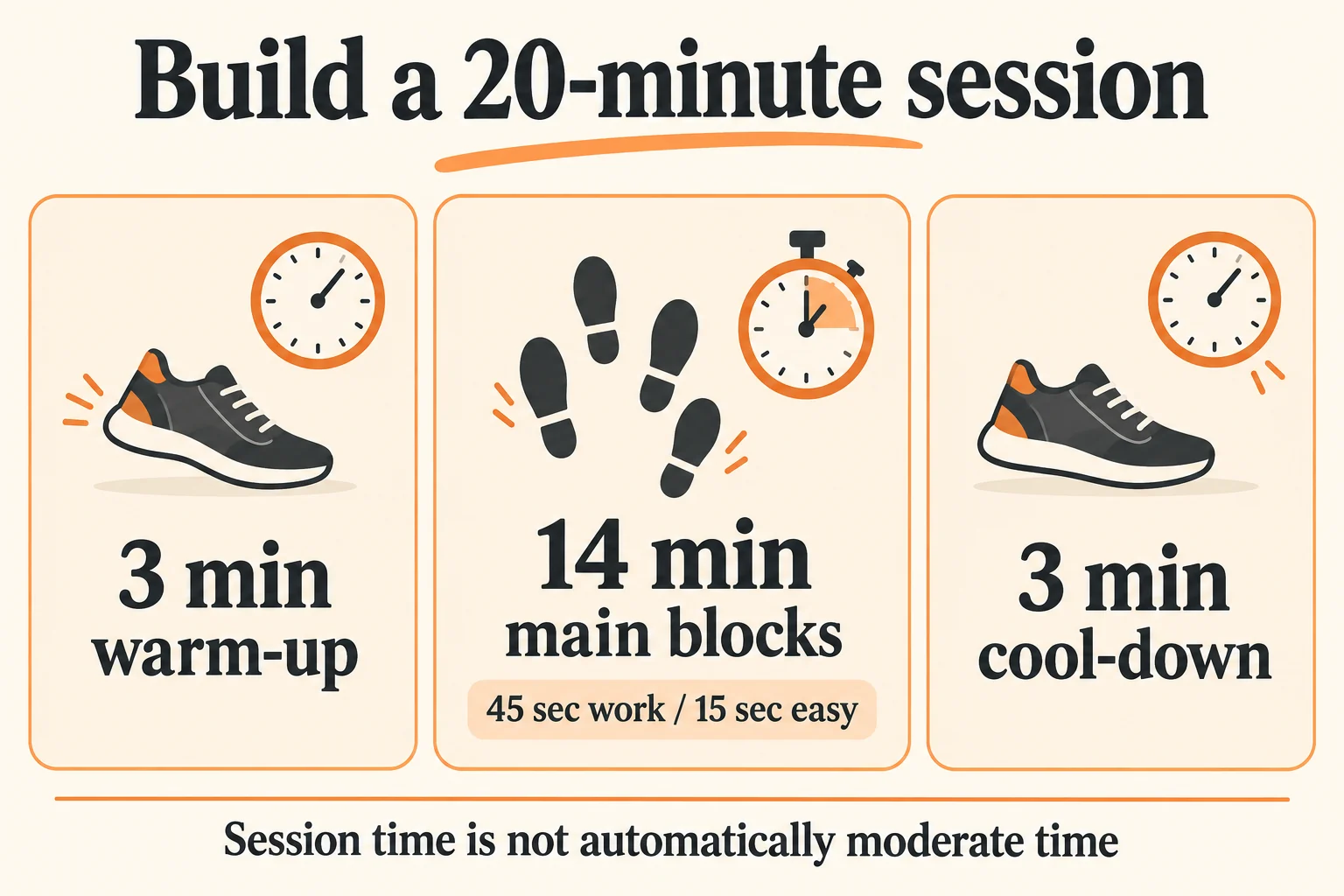
| 20 | 3 | 14 one-minute blocks | 3 | Alternate march and step-touch seven times |
| 30 | 5 | 20 one-minute blocks | 5 | March, step-touch, side step, arm reaches; repeat five times |
The 15-second period is a chance to check effort and regain rhythm. Take a longer easy period or stop when needed, even if that changes the planned timer. For the smallest space, use marching and short arm reaches only. If you need hand support, use supported marching and small side steps; avoid boxing that requires both hands away from support.
How to adjust a session while doing it
If you can sing comfortably, your pace may be below moderate intensity; that can still be an appropriate starting effort. If you want moderate work and are comfortable, gradually increase rhythm or arm movement. If you can speak only a few words before catching your breath, reduce pace rather than finishing the interval at any cost.
Stop for chest pain or pressure, faintness, severe or unusual breathlessness, or feeling suddenly unwell. Seek urgent help for severe symptoms. With a heart or lung condition, recent health event, unexplained symptoms or an existing exercise restriction, use professional guidance before starting or changing a routine. The timer and talk test do not provide medical clearance.
Build the week gradually
The CDC adult guideline is at least 150 minutes of moderate aerobic activity weekly, or 75 minutes vigorous, plus muscle-strengthening activity on at least two days. That is a public-health target, not a requirement to reach on your first week. Some activity is better than none, and shorter bouts can contribute.
For a starting week, try three comfortable 10-minute sessions if that is manageable. In the next week, repeat them and add a few minutes to one session only if recovery and effort remain comfortable. This is an example of building a habit, not a guaranteed progression timetable. Everyday brisk walking can also contribute.
See the 20-minute session split
The bar uses the exact time proportions: 3 + 14 + 3 = 20 minutes. The main section includes 45-second working and 15-second easy periods; its minutes are not a measured intensity or calorie total.
Silent, 8.5 seconds. Open the animation directly. Playback pauses offscreen; reduced-motion preferences keep playback manual. Essential instructions are in the article text.
Record the actual total time, movements, easy periods and talk-test observation. Count moderate minutes only when the effort really reached that level; the helper deliberately does not infer them from duration. If fatigue accumulates, keep the earlier duration or use easier work.
Pair cardio with the home strength plan. Arrange harder leg work from the lower-body home workouts around recovery. For age-specific context, our fitness guide for men over 50 covers broader planning concerns.
Choose your starting session and keep a log
This helper adapts the article’s starting template to your choices. It does not assess health, prescribe a training load or guarantee that an exercise is suitable.
Choose the 10-minute template above: 2 minutes easy, 6 one-minute main blocks and 2 minutes easy. March and use short comfortable movements. With hand support, use small supported steps and omit two-arm boxing.
The tables and downloadable log work without JavaScript.
Watch a BHF low-intensity home demonstration
British Heart Foundation exercise physiologist Hara Markos demonstrates marching, side taps and other home movements. The video is a separate routine, about 8 minutes 20 seconds despite its 10-minute title, with standing or seated options and optional harder exercises, including star jumps. Those harder options are not required here. Preview it and follow its suitability and stop instructions; if you have a heart or circulatory condition, high blood pressure or diabetes, BHF advises checking with your doctor first. This general video does not replace an individually prescribed rehabilitation program.
Watch this demonstration on YouTube if the embed does not play.
Keep a session log away from the screen
Download the one-page home cardio session and effort log (fillable PDF). Its eight editable fields record setup, actual work, rest or effort, and the next decision. It also works for handwritten notes. The helper’s print button creates a separate record with your current selections, notes and checkmarks.
Equipment options for the exercises you use
Keep suitable equipment you already own. These options serve different needs; you do not need the whole list to follow the starting plan. Check the exact model, selected size, package, seller and current manual before ordering.
As an Amazon Associate, PrimeForMen earns from qualifying purchases. Prices and offers can change.
Best for: For controlled low step-ups when you have clear space and reliable balance. Skip it when floor marching is a better starting choice. Current Amazon listing: Amazon Basics Aerobic Exercise Step Platform, Adjustable Workout Stepper for Home Fitness, 27", Black/Grey Best for: For indoor walking when its belt, clearance and controls fit your needs. Skip it if you require a handrail or cannot use a moving belt comfortably. Current Amazon listing: WALKINGPAD C2 Folding Treadmill Foldable Walking Pad Ultra Slim Smart Fold Free Installation Gym Running Device for Home Office Under Desk 0.5-3.72MPH S1(White) * As an Amazon Associate, PrimeForMen earns from qualifying purchases.Recommended Products

Amazon Basics aerobic step platform
View on Amazon

WalkingPad C2 folding walking pad
View on Amazon
Frequently asked questions
Can marching count as cardio?
Yes, marching can raise effort enough to provide aerobic activity. Whether it reaches moderate intensity depends on your pace and fitness; use the talk test rather than the exercise name.
Do I need to jump?
No. Marching, step-touches, controlled side steps and walking can create a useful session. They still need clear space and a suitable effort.
Does a 20-minute session count as 20 moderate minutes?
Not automatically. The template includes easy warm-up, easy recovery periods and cool-down. Record the activity that actually reached moderate intensity separately.
Should I buy a stepper or walking pad?
Only if the format solves a real need and fits your space, balance and the model’s manual. Neither is necessary for the no-equipment sessions, and an unsupported moving belt may be unsuitable if you need a handrail.
Can I follow the video instead of these intervals?
Yes, if its movements and effort are suitable for you. The video is a separate routine with its own length and instructions. Do not combine it with a full interval session by default.
Choose one session for this week
Clear the room, pick familiar movements and begin with a comfortable duration. Save your actual effort and time in the log before deciding what to change. Our editorial policy describes our evidence and recommendation standards.
Exercise and affiliate notes
This is general education for adults, not diagnosis, rehabilitation or an individually assessed program. Stop for pain, dizziness, faintness or unusual breathlessness. Seek urgent help for severe symptoms, including chest pain. If you have a medical condition, recent surgery or an exercise restriction, get appropriate guidance before changing your routine.
Equipment recommendations are based on documented listings and fit, not hands-on testing. Generated editorial imagery and diagrams are illustrative and do not establish technique, product performance or results.
As an Amazon Associate, PrimeForMen earns from qualifying purchases.