
Advanced Fitness Techniques for Men: Train Hard, Progress Smart, Recover Better
Advanced fitness techniques are not proof that you train harder. They are tools for specific programming problems: more hypertrophy stimulus, better control, weak-link correction, power transfer, work capacity, or time efficiency. Use one method at a time, place it where technical risk is low, and judge it by the next session.

Quick Summary: Advanced Fitness Techniques for Men
- Advanced methods work best after the base program already works: consistent training, stable technique, predictable recovery, and clear goals.
- Match the method to the job. Drop sets are not tempo work. Plyometrics are not conditioning. Density blocks are not max strength training.
- Track the rebound: next-session performance, soreness, joint feedback, sleep, motivation, and whether the main lifts still move well.
- Men over 40 can use advanced methods, but the safest start is usually tempo, pauses, moderate unilateral work, and controlled density blocks.
- Use one new stressor at a time for 2-4 exposures, then keep it, modify it, or cut it based on results.
The Prime Perspective: Know What the Pain Is Buying
Advanced training should make your program more precise, not more chaotic. A hard set can feel productive while quietly damaging the next session. A smart method solves a limiter: more local muscle stimulus, better positions, cleaner power, stronger side-to-side balance, or denser work when time is short.
The 2026 ACSM resistance training update is useful context here: for most healthy adults, consistency and regular resistance training matter more than chasing complexity. Advanced techniques are optional tools, not the foundation of fitness. That is why this guide starts with readiness and recovery cost before it talks about harder methods.
Are You Ready for Advanced Fitness Techniques?
Before using advanced methods, prove the basics. You should know your working loads, train consistently, recover predictably, and keep technique stable under normal fatigue. If your program still changes every week, the advanced move is not a drop set. It is consistency.
Green lights
- You train consistently for months, not days.
- You can estimate 1-3 reps in reserve.
- Your main lifts have stable form under normal fatigue.
- You track loads, reps, and recovery signals.
Red lights
- Unexplained joint, tendon, or back pain is present.
- Sleep, appetite, motivation, or performance is already sliding.
- You cannot repeat technique from week to week.
- You want punishment more than a specific adaptation.
Technique Fit Matrix: Match the Method to the Job
Drop sets solve a different problem than tempo work. Eccentric training creates a different recovery bill than unilateral work. Pick the method that matches the missing adaptation, then set a stop rule before the set starts.
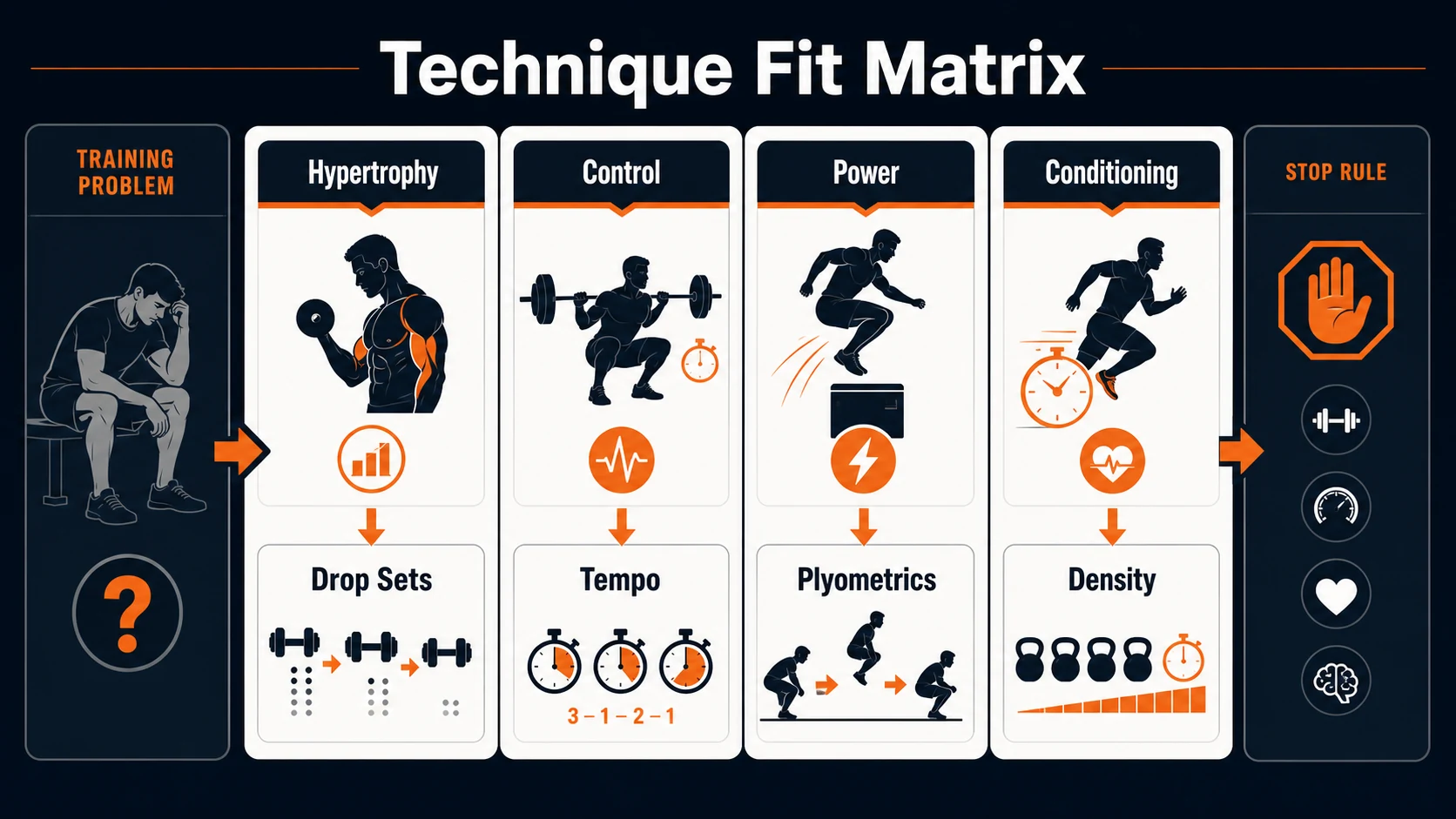
| Method | Best use | Best exercises | Start dosage | Stop rule |
|---|---|---|---|---|
| Drop sets | Time-efficient hypertrophy | Machines, cables, dumbbell isolations | One exercise, 1-2 drops | Stop when technique collapses or reps become joint-driven. |
| Rest-pause | Hypertrophy with limited time | Stable presses, rows, curls, triceps work | One top set plus 2-3 mini-clusters | Stop when mini-clusters turn into slow grinders. |
| Tempo reps | Control, positions, lighter-load challenge | Squat, hinge, push, pull patterns | 2-3 second eccentric | Stop if tempo becomes slow suffering without better positions. |
| Eccentric training | Controlled overload, tendon tolerance, hypertrophy | Pull-ups, RDLs, split squats, calf work | 1-2 exercises per week | Stop if soreness kills the next session. |
| Unilateral training | Side-to-side gaps and athletic transfer | Split squats, step-ups, single-arm rows | 2-3 sets per side | Stop if balance destroys the target muscle or pattern. |
| Plyometrics | Power, landing skill, sport transfer | Jumps, bounds, throws | Low reps while fresh | Stop when snap, height, landing, or rhythm declines. |
| Density blocks | Work capacity and short sessions | Accessories and simple circuits | 8-15 minutes | Stop if output per round drops hard or main lifts suffer. |
Recovery Cost Score: Signal vs. Debt
Do not judge an advanced method only by how hard it feels during the set. Judge the rebound. If sleep, soreness, joint feedback, motivation, or next-session performance gets worse, the method is more expensive than the result.
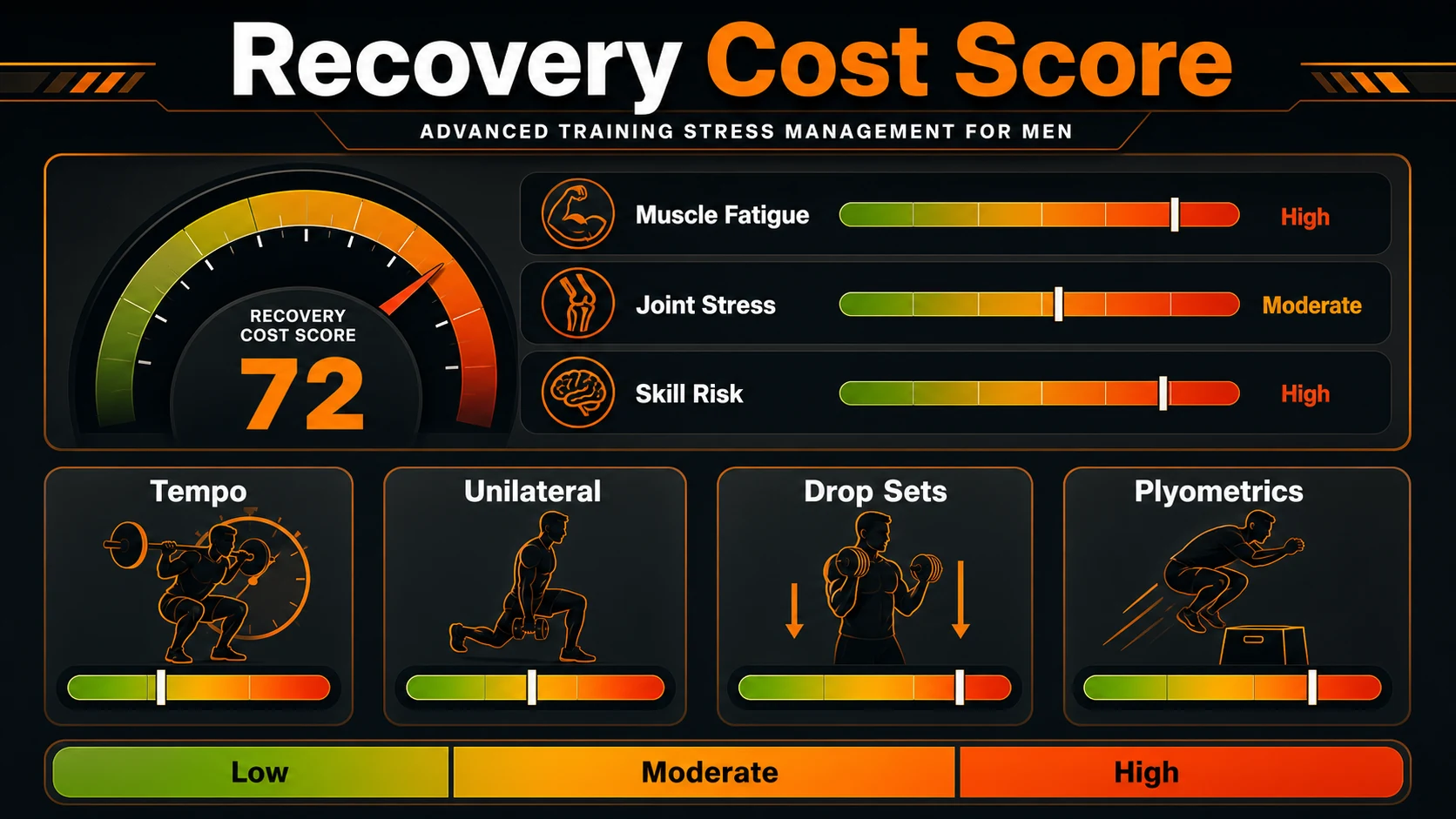
| Method | Muscle fatigue | Joint/tendon stress | Skill risk | Overall cost |
|---|---|---|---|---|
| Tempo practice | Low to moderate | Low | Low | Low if load stays honest. |
| Paused reps | Low to moderate | Low to moderate | Low | Low to moderate. |
| Unilateral work | Moderate | Moderate | Moderate | Moderate. |
| Density blocks | Moderate to high | Low to moderate | Moderate | Moderate if exercises stay simple. |
| Drop sets | High local fatigue | Low to moderate | Low to moderate | Moderate to high. |
| Rest-pause | High | Moderate | Moderate | Moderate to high. |
| Eccentric overload | High | High | Moderate | High if stacked carelessly. |
| Plyometrics | Low to moderate | High if volume is abused | High | High when quality drops. |
Intensity, Control, Transfer, and Optional Advanced Methods
Intensity methods
Use drop sets, rest-pause, supersets, and density blocks when the problem is local hypertrophy or time efficiency. Keep them away from high-skill heavy lifts until the risk is justified.
Control methods
Use tempo, paused reps, isometrics, and eccentric training when positions, range, or load tolerance need work. These are often the cleanest first advanced methods.
Transfer methods
Use unilateral training, carries, plyometrics, and medicine ball throws when the goal is power, landing, side-to-side balance, or sport carryover.
Cluster sets
Best for strength or power quality when short intra-set rests keep bar speed cleaner.
BFR
Blood flow restriction training can create low-load hypertrophy stress, but it needs conservative setup and medical caution.
Myo-reps
A dense hypertrophy cluster option for stable accessories, not a replacement for basic progression.
Lengthened partials
An optional accessory tool for long-muscle-length stimulus. Keep it away from angry tendons.
Advanced Fitness Techniques for Men Over 40
Men over 40 do not need to avoid advanced training. They need to manage the bill. The best methods usually add stimulus or control without creating sloppy high-skill fatigue.
| Goal | Better method | Use caution with | Practical rule |
|---|---|---|---|
| More muscle stimulus | Tempo, pauses, drop sets on stable accessories | Failure on heavy compounds | Chase the target muscle, not a heroic set. |
| Joint-friendly challenge | Bands, unilateral work, controlled range | Aggressive forced reps | Pain is a stop signal, not feedback to ignore. |
| Power maintenance | Low-volume jumps, throws, fast concentric reps | High-contact plyometric fatigue | End the drill when snap disappears. |
| Conditioning | Submaximal density blocks | Death-march finishers | Leave enough recovery for the next strength session. |
For a broader age-smart framework, pair this page with Fitness for Different Ages and keep recovery constraints visible instead of pretending the same fatigue cost fits every decade.
How to Place Advanced Methods in a Training Week
Advanced techniques should sit where they solve a problem without corrupting the rest of the week. Put high-skill power work early. Put high-fatigue hypertrophy work late. Put recovery-heavy methods far enough from the next key lift.
Hypertrophy week
- Main lift: straight sets first.
- Accessory: one drop set or rest-pause block.
- Recovery check: soreness should not reduce next-session output.
Strength week
- Main lift: clean heavy work, no failure.
- Control: paused reps or tempo back-off sets.
- Optional: cluster sets only when bar speed stays crisp.
Power week
- Fresh start: jumps or medicine ball throws.
- Low reps: quality over burn.
- Stop: height, speed, or landing quality declines.
Time-limited week
- Keep the first lift simple.
- Add an 8-12 minute density block.
- Choose easy-to-transition movements, not technical chaos.
For the base strength layer underneath advanced work, use Strength Training Basics, Progressive Overload, and Rest and Recovery as the foundation.
The 2-4 Exposure Trial
Is the problem hypertrophy stimulus, position control, weak-link correction, power transfer, conditioning, or limited time?
Choose one method for one job. Do not add drop sets, plyometrics, and density work in the same week just because motivation is high.
Use low-risk exercises first: machines, cables, dumbbells, bodyweight control, throws, or simple accessory circuits.
After 2-4 exposures, keep, modify, or cut the method based on performance, soreness, joint feedback, sleep, and motivation.
Advanced Training Support Kit
Buy tools that remove bottlenecks, not tools that make training look more advanced. These are broad categories that support clean execution, warm-ups, and power practice.
Lifting Straps
Best when grip limits rows, RDLs, shrugs, or back work before the target muscles are actually challenged.
- Useful for higher-rep pulling blocks.
- Helps separate grip fatigue from back stimulus.
- Skip when the goal is grip-specific training.
Resistance Bands
Best for warm-ups, joint-friendly tension, assisted reps, and controlled accessory work.
- Good for shoulder, hip, and glute activation.
- Useful for accommodating resistance when appropriate.
- Easy to over-stack without a plan.
Medicine Ball
Best when you want power transfer, throws, slams, rotational work, and a lower-load way to train intent.
- Supports athletic power without heavy barbell fatigue.
- Works well before strength work while fresh.
- Needs safe floor, wall, and space setup.
*Product links may be affiliate links. PrimeForMen may earn a commission at no extra cost to you.
Common Mistakes That Make Advanced Methods Backfire
Stacking stressors
Failure, long eccentrics, short rest, high volume, and plyometrics all in one week can bury progress. Add one lever, then observe.
Using pain as proof
Burn and soreness are not the same as productive stimulus. If the next session is worse, the method failed the rebound test.
Confusing power with conditioning
Plyometrics need crisp contacts and recovery. Turning them into a sweaty finisher changes the adaptation and raises risk.
Skipping the base
CDC activity guidance still puts regular aerobic work and muscle-strengthening activity at the center of adult fitness. Advanced methods sit on top of that base, not instead of it.
Where to Go Next
If you want the broader training map, start with the PrimeForMen Fitness Hub. If your goal is athletic transfer, use Sport-Specific Training for Men. If your goal is resilience under load, pair advanced methods with Core Workout for Men and Muscle Recovery Techniques.
External evidence used for this update includes the ACSM 2026 resistance training guideline summary, CDC adult physical activity guidance, and Google Search Central guidance on Article structured data.
Frequently Asked Questions About Advanced Fitness Techniques for Men
What are advanced fitness techniques?
Advanced fitness techniques are training methods that change load, tempo, density, range, rest, fatigue, or skill demand to solve a specific programming problem. Examples include drop sets, rest-pause, supersets, tempo reps, paused reps, eccentric training, unilateral work, plyometrics, density blocks, cluster sets, BFR, myo-reps, and lengthened partials.
When should I start using advanced training methods?
Start after the basic program is consistent. You should know your working loads, estimate reps in reserve, recover predictably, and keep technique stable under normal fatigue. If the program changes every week, the advanced move is consistency first.
Are drop sets better than straight sets?
Drop sets are not automatically better. They can add time-efficient hypertrophy stimulus on stable exercises, especially machines, cables, and dumbbell isolations. Straight sets are usually better for learning lifts, managing strength work, and keeping fatigue cleaner.
What is the safest advanced method for men over 40?
Usually the safest starting points are tempo reps, paused reps, moderate unilateral work, and controlled density blocks. These add stimulus or control without forcing constant failure. Aggressive eccentric overload, high-volume plyometrics, and failure-heavy compounds should be earned slowly.
How often should I use plyometrics?
Use plyometrics when fresh, keep reps low, and stop when jump height, landing quality, or snap declines. For general training, one or two low-volume exposures per week is often plenty unless a qualified coach has built a sport-specific plan.
Can advanced techniques cause overtraining?
They can contribute to recovery debt if stacked carelessly. Watch sleep, soreness, joint feedback, motivation, and next-session performance. If the next main session gets worse, the method is costing more than it returns.
Should I use advanced methods on squats or deadlifts?
Be careful. Heavy squats and deadlifts already carry high technical and recovery costs. Most lifters should put drop sets, rest-pause, and failure work on safer accessory movements instead of high-skill heavy compounds.
What advanced method is best when I have limited time?
Density blocks, supersets, rest-pause, and carefully placed drop sets are the most time-efficient. Use them after the main lift or on accessories so the session gets denser without turning technical lifts into sloppy conditioning.
Medical Disclaimer: This guide is general fitness education, not medical advice. If you have chest pain, dizziness, unexplained breathlessness, persistent joint or tendon pain, a recent injury, a chronic condition, or return-to-training concerns, work with a qualified clinician before changing training.
Affiliate Disclosure: Some product links may be affiliate links. If you buy through them, PrimeForMen may earn a commission at no extra cost to you. Recommendations stay based on fit, practicality, and reader use case.