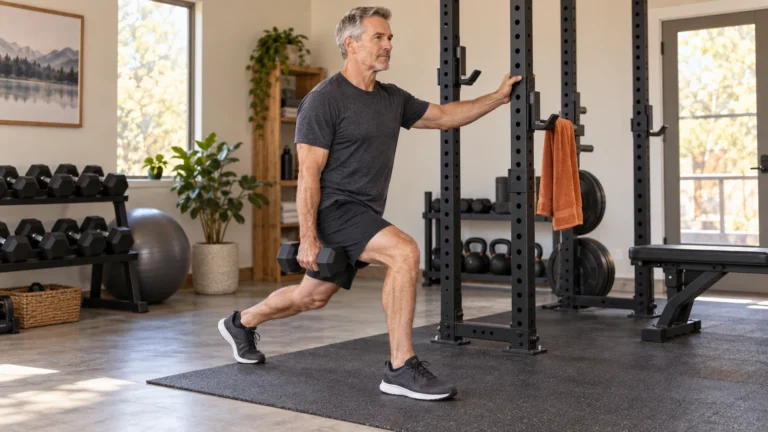
Build single-side strength with six exercise options, a two-day plan, clear progression, equipment guidance and a free left-right training log.
- Choose supported exercises that fit your goal.
- Count work sets and repetitions per side clearly.
- Progress a repeatable setup instead of chasing symmetry.
Bottom line Start with one manageable single-side movement and record both sides before changing the load.
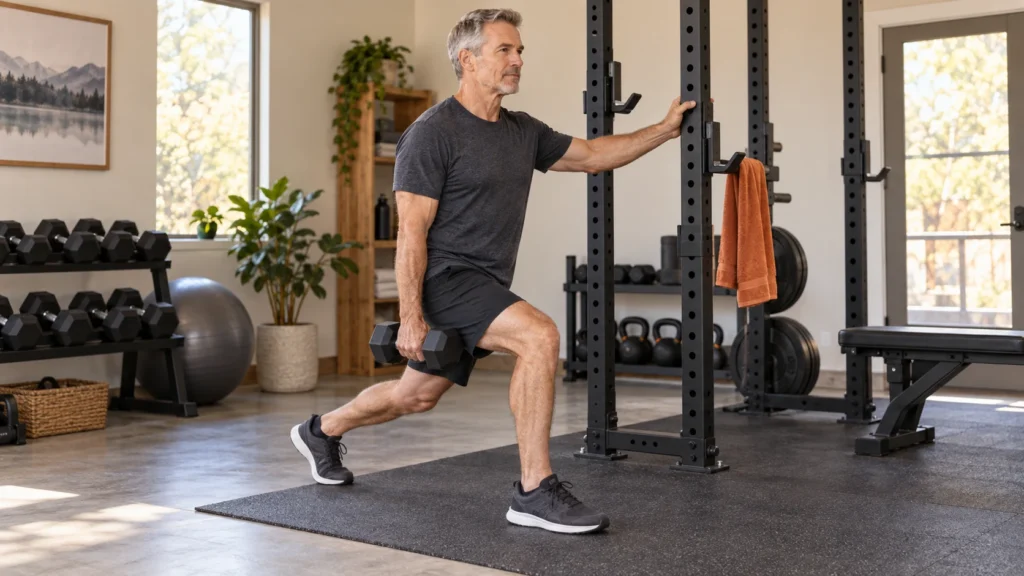
Unilateral training emphasizes one arm or leg at a time. It helps you practice side-specific strength and can make modest home weights challenging. It does not automatically build more muscle than bilateral training or diagnose an imbalance. Use support when needed, choose exercises for a clear goal and combine them with two-sided lifts when those remain useful.
Quick Summary: Unilateral Training
- Strength gains are specific: bilateral training improves bilateral tests; unilateral work improves unilateral tests.
- Available comparisons have not established a muscle-growth advantage for either style.
- Start with the weaker side and match quality reps.
- Use support when balance prevents the target muscle from working.
- Persistent pain, sudden weakness, or neurological symptoms need assessment.
The Prime Perspective
Your body does not need mirror-image numbers. It needs reliable force, confidence, and control for the tasks you actually perform.
A split squat is often grouped with unilateral exercises even though the rear foot still contributes support. A suitcase carry loads one side but trains the trunk as well as the working arm. These labels describe emphasis; they do not mean the rest of the body switches off.
This is an editorial training example for generally healthy adults, including men over 50. It is not an individualized assessment or a tested PrimeForMen intervention. Returning exercisers can start with the reduced version below.
Where Each Style Fits
| Option or variable | What it changes | Decision rule |
|---|---|---|
| Bilateral squat/press | High total force and efficient loading | General strength |
| Split squat/step-up | Leg-specific force and control | Stairs, sport, side differences |
| One-arm row/press | Independent shoulder and trunk work | Upper-body asymmetry |
| Suitcase carry | Lateral trunk control and grip | Daily carrying |
| Single-leg hinge | Hip control with lighter load | Balance plus posterior chain |
What the Evidence Supports
A 2025 systematic review and meta-analysis included nine studies. It found no statistically significant difference in muscle growth between unilateral and bilateral training, while strength changes tended to favor the style used in the strength test. The studies had moderate risk of bias and the muscle-growth estimate was imprecise. That is a reason to avoid declaring a universal winner, not proof that every program is interchangeable.
Swipe sideways on a small screen to read every column.
| Your goal | Reasonable choice | Limit of the claim |
|---|---|---|
| Improve a two-leg squat or two-arm press | Keep relevant bilateral practice. | Unilateral accessories do not reproduce every demand of the tested lift. |
| Improve a single-side movement | Practice a suitable unilateral version. | Better performance on that exercise does not guarantee sport performance. |
| Build muscle with limited weights | Use supported single-side work when it provides an appropriate challenge. | More wobbling is not evidence of more muscle stimulus. |
| Address an observed side difference | Use consistent technique and track repeated sessions. | A single difference is not an injury diagnosis. |
Six Useful Unilateral Patterns
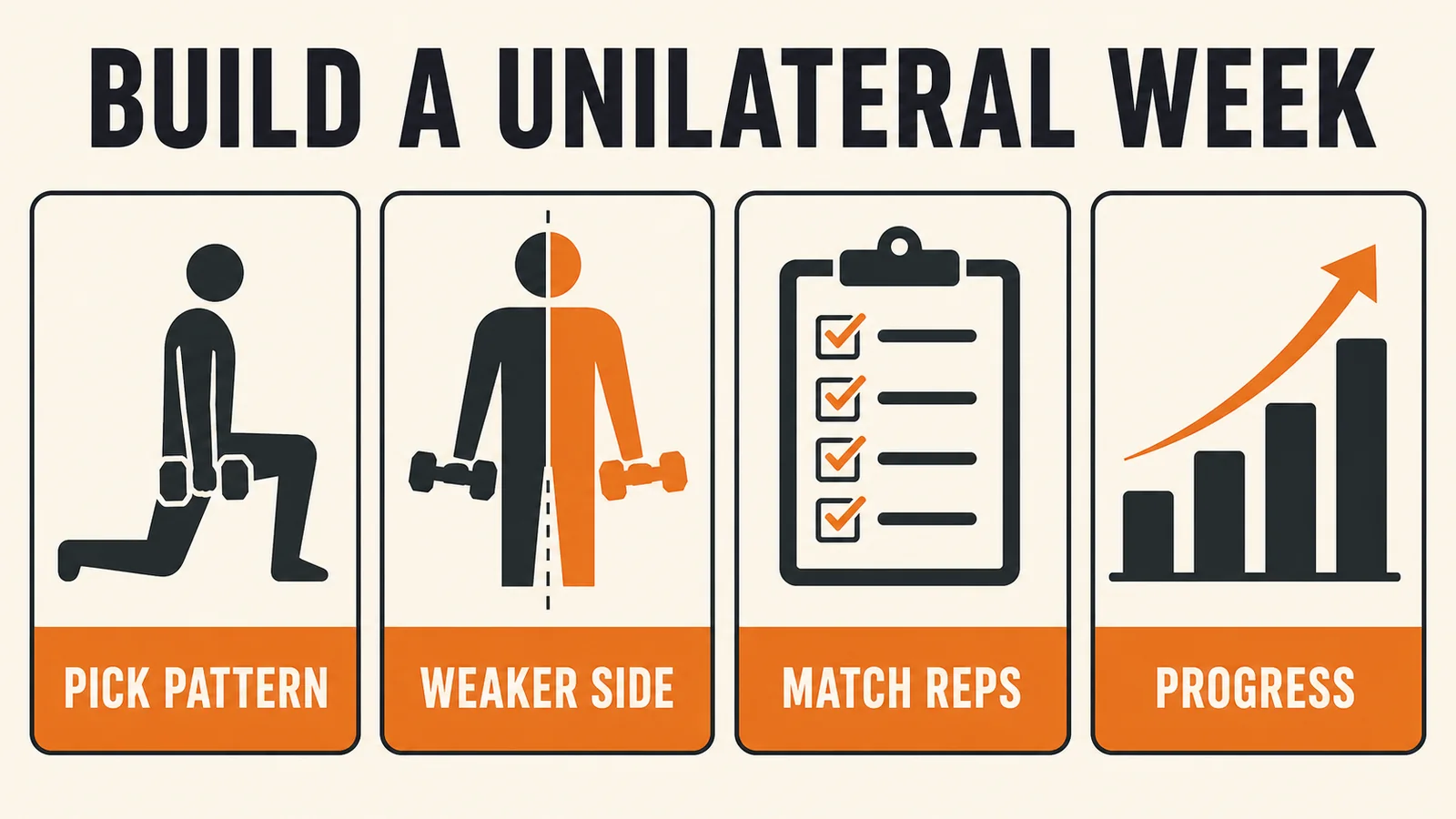
Choose one or two of these to complement your current program, or use the sample week below. You do not need all six in every session. A stable support should be fixed, nonslip and able to handle the force you apply; do not lean on rolling chairs or lightweight furniture.
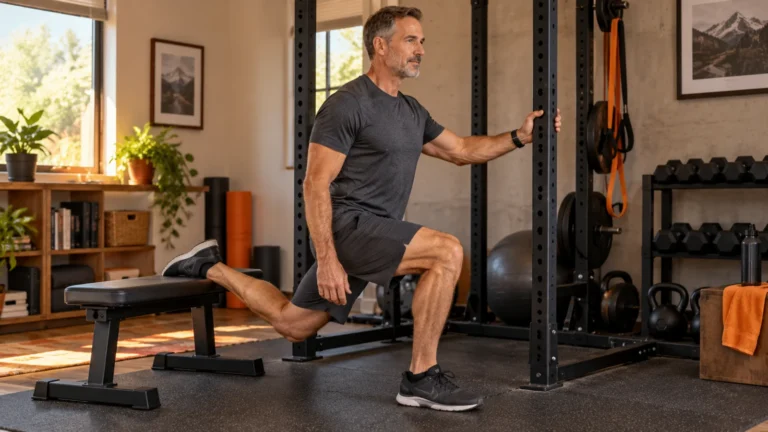
1. Supported split squat
Stand with feet in a split stance, keeping both feet on the floor and allowing the rear heel to rise. Use light hand support. Lower through a comfortable range while the front foot remains planted, then stand under control. Let the knee follow the direction of the toes rather than forcing a single universal knee angle.
Begin with bodyweight if positioning is new. Hold a light weight only after the stance feels repeatable. If you lose balance, shorten the range and use support rather than immediately elevating the rear foot. The Bulgarian split squat guide covers the rear-foot-elevated variation separately.
2. Low step-up
Use a stable platform low enough that you can place the whole working foot on it and rise without launching off the trailing leg. Step up under control, then lower slowly. Keep a fixed rail or wall within reach if appropriate. Complete repetitions on one side before changing sides.
Start without added weight. A taller box changes the task; it is not automatically a better progression. Avoid soft ottomans, unstable stools and improvised stacks. Check the platform instructions, secure footing and suitability before use.
3. Supported single-leg hip hinge
Hold a stable support with one hand. Keep a small bend in the working knee and send your hips back while the other leg moves behind you. Keep the pelvis as steady as you can and stop the descent before your back position or balance changes. Return by standing tall, not by leaning backward.
If that is too demanding, use a kickstand stance: keep the rear toes lightly grounded for support and emphasize the front leg. This is a transition option rather than a pure one-leg lift. The weight does not need to reach the floor.
4. One-arm row
Brace your free hand on a stable support and choose a stance you can hold. Pull the weight toward the side of your torso without a large twist or shrug, then lower under control. Use a weight that allows the same range on both sides. A chest-supported or appropriately anchored band row is an alternative when the bent-over setup is uncomfortable.
The video below comes from BarBend’s dumbbell-row technique guide. It demonstrates setup and execution. Use it to understand the movement, then follow the modest volume in the sample plan rather than combining multiple programs.
5. One-arm floor press
Lie with knees bent and feet grounded. Use a weight you can position and set down safely. Lower the upper arm gently toward the floor, then press without rolling the torso. Keep your free hand on the floor for additional stability if helpful. Do not struggle through the transition to the floor with a heavy dumbbell.
If floor transfers are difficult, use a familiar standing band press with a correctly rated, secure anchor, or keep bilateral incline push-ups. Our resistance-band training guide explains how to plan band work. You do not need to force every exercise into a unilateral format.
6. Suitcase carry or stationary hold
Stand with one weight at your side, shoulders relaxed, and breathe normally. Walk slowly along a clear route without leaning substantially toward or away from the load. Turn carefully, put the weight down under control and change hands. In a small room, use a stationary hold instead.
Start with a load you can grip comfortably for the whole interval. If balance or grip fails first, shorten the time or reduce the weight. Do not use an uneven floor or unstable cushion to make the task artificially harder.
How to Handle Side Differences
When one side consistently feels less capable on a familiar, comfortable exercise, begin there and use the same controlled repetitions and load on the other side. This is a starting convention, not a diagnosis or a rule to undertrain the other side indefinitely. If the difference appears only once, repeat the setup before deciding it represents a pattern.
Record the same range, hand support, stance, load and rest. Six controlled repetitions with support and six unsupported repetitions are different tasks. Avoid calculating an alarming percentage from a single informal set; fatigue, coordination and order of testing affect the result.
If the difference persists and limits a meaningful task, ask a qualified professional to assess the context. Pain, sudden unexplained weakness, numbness or other neurological symptoms need appropriate medical assessment. New abrupt neurological symptoms can require urgent care. Do not add extra sets to self-treat them.
A percentage difference measured on one exercise is not a diagnosis. Limb dominance, previous sport, anatomy, pain, and measurement noise all matter.
A Balanced Two-Day Week
Use two nonconsecutive days, such as Monday and Thursday. Allow roughly 35–50 minutes per session. Begin with five to eight minutes of easy movement, unloaded practice of the day’s patterns and lighter rehearsal sets. The exact duration depends on transitions and rest; unilateral work takes time because both sides need attention.
Start with two work sets per exercise, leaving about two or three good repetitions available. Returning exercisers can use one set for the first week. Rest about 90–120 seconds after completing both sides of a strength exercise, or longer if needed. Take a short reset between sides when breathing or positioning requires it. Use 60–90 seconds after comfortable holds.
Swipe sideways on a small screen to read every column.
| Slot | Day A | Day B |
|---|---|---|
| Lower body | Supported split squat: 2 × 6–8 per side | Bilateral dumbbell Romanian deadlift: 2 × 8–10 |
| Upper push | Incline push-up: 2 × 6–10 | One-arm floor press: 2 × 6–10 per side |
| Upper pull | Supported one-arm row: 2 × 8–12 per side | Supported one-arm row: 2 × 8–12 per side |
| Additional lower body | Glute bridge: 2 × 8–12 | Low step-up: 2 × 6–8 per side |
| Trunk / carry | Suitcase hold: 2 × 15–25 seconds per side | Suitcase carry or hold: 2 × 15–25 seconds per side |
The supported single-leg hinge is an alternative for a later block, not an extra exercise to add to Day B. This example deliberately mixes unilateral and bilateral work. If you already have a complete routine, replace a comparable accessory rather than stacking this whole plan on top.
What “two sets per side” actually means
For rows, do eight controlled left-arm repetitions and eight right-arm repetitions, then take the main rest. Repeat for the second round. Each arm has completed two sets; the session contains four individual arm efforts. Do not accidentally do four sets per arm because the table says two sides.
Likewise, a 20-second hold on the left plus 20 seconds on the right gives 40 seconds of loaded holding before rest. Include that time when planning a short workout. If you only have 20 minutes, warm up and use one set each of a lower-body movement, a push and a row, then finish with a short hold if time allows. This is a reduced session, not the full prescribed volume.
A Four-Week Progression You Can Track
Swipe sideways on a small screen to read every column.
| Week | Focus | Example |
|---|---|---|
| 1 | Learn a repeatable stance and range. | Split squat: 2 × 6 each side with support, or one set for returners. |
| 2 | Add a rep when the previous session was controlled. | Progress toward 2 × 8 while keeping the same support and range. |
| 3 | Increase load only when the top range is comfortable on two exposures. | Try the smallest practical increase and return toward 6 reps. Otherwise repeat. |
| 4 | Review at the same setup and effort. | More controlled work at similar effort is useful; do not require a max test. |
If you reach eight on one side but only six controlled repetitions on the other, keep the matched working sets at six for now. Repeat the same conditions next time. If progress stalls, consider load, fatigue and technique before prescribing extra weaker-side work.
Keep the support if the goal is muscle loading. Removing it creates a different balance challenge and may reduce the weight you can control. Changing support, load and range at the same time makes progress harder to interpret. Our strength-training basics explain the wider progression principles.
Log Both Sides Without Turning It Into a Diagnosis
Record the actual variation, load, repetitions on each side, support used and what changed afterward. The free worksheet gives separate fields for both sides and a decision area. Save a copy in a PDF reader that supports forms; your entries stay in your file.
Download the left-right training log (fillable PDF)
A useful note is “Row: same weight, left 8/8, right 8/8; hand support unchanged; add one rep next time if controlled.” A score declaring your body “balanced” or “broken” is not needed. For a complete home routine, see our four-week full-body home workout.
What to Do This Week
- Choose one unilateral pattern that serves a real goal.
- Use support if balance limits muscle effort.
- Start with the weaker side and match clean reps.
- Progress load or range – not both in the same week.
- Recheck function after four to six weeks.
Equipment Matched to the Exercise
Choose the tool that covers your actual exercise gap; these are alternatives, not a four-item shopping requirement. PrimeForMen has not independently tested these products. Existing suitable equipment may be enough.

PowerBlock Elite EXP Dumbbells
A versatile loading option for rows, presses and split squats. Skip the purchase if existing dumbbells provide suitable increments.
- Pairs support both unilateral and bilateral work.
- Small increments improve progression.
- Choose loads you can control.

Amazon Basics Cast Iron Kettlebell
A fixed-weight alternative for carries and supported hinges. Skip it if one suitable dumbbell already covers those tasks.
- Wide textured handle.
- Fixed weight keeps setup simple.
- One weight may not fit every pattern.

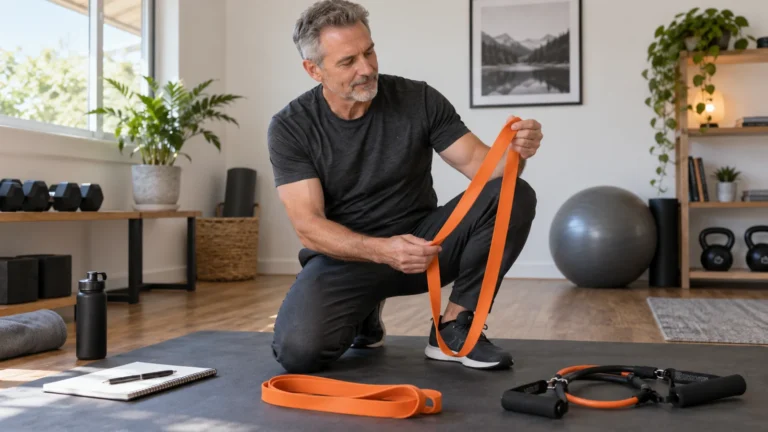
WHATAFIT Resistance Bands
A portable option for one-arm rows or presses with a secure, appropriate anchor. It is not a substitute for a stable hand support.
- Stackable resistance levels.
- Portable home-gym option.
- Anchor safety is essential.

Amazon Basics Aerobic Step
For low step-ups when you lack a suitable stable step. Start at the lowest appropriate height; skip it if an existing safe step serves the task.
- Adjustable platform height.
- Supports repeatable step patterns.
- Use beside a wall or rail if balance is limited.
*As an Amazon Associate, PrimeForMen earns from qualifying purchases. Availability and prices can change.
Conclusion
Use unilateral exercises to train side-specific force, balance, and range while keeping bilateral lifts when they fit your goals and joints.
Next Step: Use the Full PrimeForMen Guide
Use the advanced fitness techniques guide to place single-side work within a broader strength plan.
Frequently Asked Questions About Unilateral Training
Is unilateral training better for muscle growth?
Not consistently. Comparable volume and effort generally produce similar hypertrophy.
Should I always train the weaker side more?
Start there and match quality reps. Extra volume is a targeted tool, not a permanent rule.
Can unilateral training replace squats and deadlifts?
It can cover many goals, but bilateral lifts remain efficient when tolerated and relevant.
Does unilateral training improve balance?
Some exercises challenge balance, but supported versions may build more target-muscle force. Choose based on the goal.
What side difference is too large?
No single percentage diagnoses a problem. Sudden weakness, pain, or declining function warrants professional assessment.
This educational training example is not rehabilitation or individualized medical advice. Persistent pain, sudden unexplained weakness or neurological symptoms need appropriate assessment. The featured image is AI-generated and does not document a tested program.
Some links are affiliate links. PrimeForMen may earn a commission at no extra cost to you. Product inclusion does not override evidence, fit, or safety.