
Does melatonin decrease testosterone? Human data do not show a reliable drop at typical use, but dose, timing, fertility, and long-term limits matter.
- Typical melatonin use has not shown a reliable testosterone decrease.
- High-dose and animal findings do not equal normal human use.
- Sleep problems and low-T symptoms need separate evaluation.
Bottom line Use melatonin for a specific sleep-timing problem—not as a hormone tool—and reassess ongoing use instead of assuming it is harmless forever.
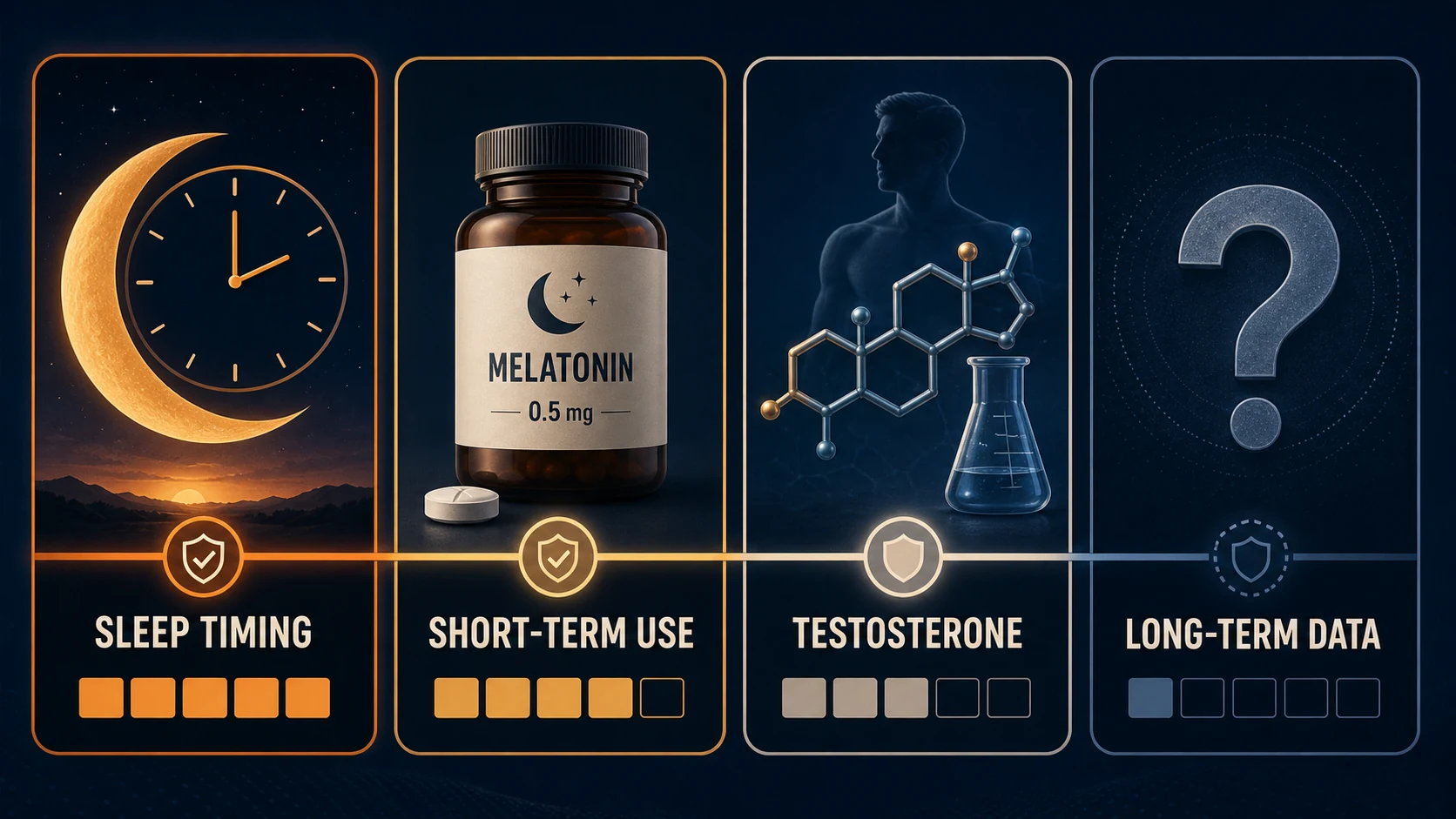
Does melatonin decrease testosterone? Current human evidence does not support a consistent testosterone-lowering effect from typical short-term melatonin use. One small randomized crossover study even used an unusually high 100 mg dose for 14 days and found no significant testosterone change during the first treatment week.
That does not prove that every dose, product, fertility context, or year of use is risk-free. It means the popular claim “melatonin kills testosterone” is stronger than the human evidence.
Quick Summary: Does Melatonin Decrease Testosterone?
- Human evidence is limited, but a reliable testosterone decrease has not been demonstrated.
- Animal and cell findings help generate hypotheses; they cannot answer normal-dose human use by themselves.
- Melatonin is a timing signal, not a sedative hammer—more is not automatically better.
- Poor sleep itself can harm recovery, mood, libido, and hormone interpretation.
- Persistent low-T symptoms require morning labs and clinical context, not supplement guesswork.
The Prime Perspective
The practical question is not whether melatonin touches reproductive signaling somewhere in biology. It does. The practical question is whether the amount you take, for the reason you take it, produces a meaningful adverse hormone effect in humans. That has not been shown reliably.
What the Human Evidence Actually Shows
The often-cited human experiment involved 12 healthy men and 100 mg of melatonin—far above common supplement doses. During the first week, investigators reported no significant effect on testosterone, LH, FSH, or prolactin. Read the randomized crossover study. Its small sample, short duration, and pharmacologic dose make it a useful clue, not a final answer.
| Evidence type | What it can tell us | Main limitation | Practical weight |
|---|---|---|---|
| Small human trial | Short-term hormone response under controlled dosing | Only 12 men; unusual 100 mg dose | Reassuring but limited |
| Animal studies | Possible reproductive mechanisms | Species, dose, and physiology differ | Hypothesis only |
| Cell studies | Direct pathway effects | No whole-body metabolism or real dosing | Mechanism only |
| Sleep research | Benefits and safety for certain sleep problems | Not designed around testosterone | Useful for reason-to-use |
| Long-term supplement use | What readers most want to know | Strong data are sparse | Uncertain |
Amazon Product Shortlist
The first purchase should solve the sleep barrier with the fewest new variables. Do not stack multiple sedating products.

Contoured Sleep Mask
Best when light exposure—not hormone chemistry—is the obvious sleep barrier.
- Supports a darker sleep environment.
- Adds no active ingredient or dose.
- Useful for travel and early daylight.

Medication and Supplement Log
Best for tracking dose, timing, sleep latency, and next-day grogginess before changing products.
- Separates patterns from one bad night.
- Creates useful notes for appointments.
- Discourages random dose escalation.

Low-Dose Melatonin
Only for a defined sleep-timing use after checking medications and contraindications.
- Lower doses reduce needless escalation.
- Single-ingredient labels are easier to judge.
- Short trials are easier to reassess.
*As an Amazon Associate, PrimeForMen earns from qualifying purchases. Availability and prices can change.
Why the Testosterone Question Gets Confused
Melatonin is produced at night and interacts with the hypothalamic-pituitary-gonadal axis. Testosterone also follows daily rhythms and is influenced by sleep, illness, energy availability, obesity, medications, and age. A biological connection is therefore plausible—but plausibility is not the same as a clinically meaningful decrease from a supplement.
The National Center for Complementary and Integrative Health notes that short-term melatonin appears safe for most people, while long-term safety remains insufficiently characterized and medicine interactions matter. See the NCCIH melatonin overview.
Bad sleep can lower training quality, libido, mood, and next-day energy without proving low testosterone. Conversely, a better night’s sleep can make you feel hormonally “better” without changing a laboratory value. Symptoms and hormones overlap; they are not interchangeable.
Who Should Be More Cautious?
| Situation | Why it matters | Better next step |
|---|---|---|
| Blood thinners or epilepsy medication | Interaction and supervision concerns | Ask a clinician or pharmacist first |
| Fertility evaluation | Reproductive questions need specific context | Discuss all supplements with the specialist |
| Persistent insomnia | Melatonin may mask the need for sleep evaluation | Use evidence-based insomnia care |
| Loud snoring or witnessed apnea | Sleep apnea affects health and hormone symptoms | Seek sleep assessment |
| Low libido, ED, fatigue, low mood | Symptoms are nonspecific | Use repeat morning testosterone testing when indicated |
If the main goal is improving natural hormone health, focus on the bigger levers in our natural testosterone guide, rest and recovery guide, testosterone booster safety review, and supplements for men over 50.
A Smarter 14-Night Test
- Define the problem: sleep timing, jet lag, or occasional sleep-onset difficulty.
- Keep caffeine, alcohol, bedtime, and wake time stable.
- Use the lowest practical dose and one ingredient only.
- Track sleep onset, awakenings, morning grogginess, mood, and training.
- Stop and reassess if benefit is unclear or side effects appear.
Dose, Timing, and Product Quality Matter More Than Marketing
Melatonin is a darkness signal. Taking it at the wrong time can shift circadian timing in an unwanted direction, while taking a large dose does not guarantee faster sleep. Many U.S. supplements contain more melatonin than a physiologic signal requires, and labels do not always communicate the practical difference between immediate-release and extended-release forms.
Use timing to match the problem. Jet lag, delayed sleep timing, and occasional sleep-onset difficulty are not the same as chronic insomnia or repeated nighttime awakenings. If the problem is loud snoring, gasping, restless legs, pain, alcohol, or medication effects, melatonin may be aimed at the wrong mechanism.
Do Not Use Symptoms as a Testosterone Test
Low energy, reduced libido, poor gym performance, and low mood can occur with sleep loss, depression, calorie restriction, medication effects, thyroid problems, anemia, and many other conditions. Testosterone assessment generally requires symptoms plus properly timed laboratory testing, often confirmed on another morning. A single bad week—or a good night after melatonin—does not settle the question.
Stop-Use Signals
Reassess if you develop persistent next-day grogginess, vivid or disturbing dreams, worsening mood, headaches, dizziness, or no clear benefit. Urgent symptoms or suspected interactions need professional guidance, not another dose adjustment.
Conclusion: Reassuring, Not Absolute
Melatonin has not been shown to reliably decrease testosterone in men at typical short-term use. The stronger concerns are poor reason-to-use, unnecessary high doses, interactions, next-day impairment, and indefinite use without reassessment. If low testosterone is the real concern, test it properly rather than reading sleep quality as a hormone assay.
Next Step: Separate Sleep Support From Hormone Claims
Use the PrimeForMen testosterone evidence hub to compare supplements, lifestyle levers, testing, and medical boundaries.
Frequently Asked Questions About Melatonin and Testosterone
Can melatonin lower testosterone in men?
A consistent clinically meaningful decrease has not been demonstrated in the limited human evidence. Long-term and fertility-specific data remain incomplete.
Does melatonin affect sperm?
Animal and mechanistic research raises questions, but human fertility conclusions are not clear. Men in fertility care should disclose melatonin use.
What melatonin dose is safest for hormones?
No dose is proven hormone-neutral for every person. Use the lowest practical dose for a defined sleep-timing goal and review medications.
Can better sleep increase testosterone?
Adequate sleep supports normal hormone regulation, but feeling better after sleep does not prove a testosterone increase.
Should I stop melatonin before a testosterone test?
Do not change prescribed or routine products solely for a test without guidance. Tell the clinician what you take and follow preparation instructions.
This article is educational and does not replace individualized medical advice, diagnosis, or treatment. Discuss persistent symptoms, medications, hormone concerns, cardiovascular risk, or exercise restrictions with a qualified clinician.
Some links are affiliate links. PrimeForMen may earn a commission at no extra cost to you. Product inclusion does not override evidence, fit, or safety.