
Drop sets explained: learn how they work, what meta-analyses show for muscle and strength, the best exercises, safe load drops, and a practical plan.
- Drop sets are a time-efficiency tool, not a secret muscle-growth mechanism.
- Pooled long-term hypertrophy and strength outcomes are comparable with traditional sets.
- Use them mainly on stable machine, cable, band, or isolation exercises—not technical heavy compounds.
Bottom line Keep most training conventional, place one controlled drop set at the end of a suitable exercise, and count its fatigue rather than treating it as free volume.

Quick Summary: Drop Sets Explained
- A single drop set can replace some straight-set time when the exercise is easy to unload safely.
- Reducing load by about 10–30% is a practical start; make the next drop large enough to continue with clean repetitions.
- Stopping one repetition before technique failure is often sufficient.
- Drop sets are a poor fit when unloading requires unsafe plate changes or a spotter.
- Joint irritation, prolonged performance loss, or worsening recovery means the technique is costing more than it returns.
PrimeForMen Perspective
The burn is feedback, not proof. Higher lactate and perceived exertion explain why drop sets feel productive; long-term results still depend on progressive training, recoverable volume, protein, and sleep.
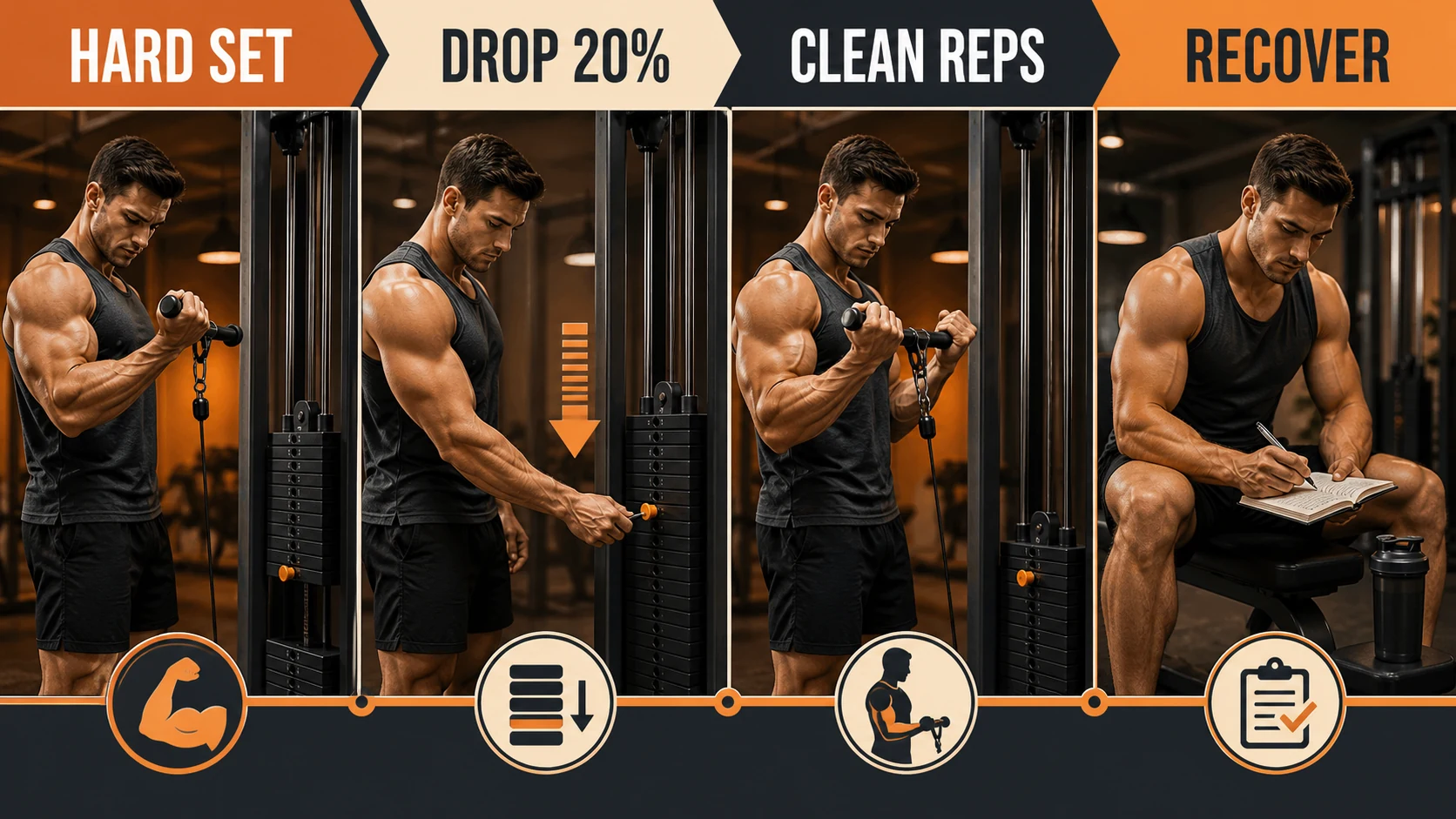
Perform a hard set, lower the resistance quickly, and continue the same exercise. A double drop repeats the reduction once more. The method increases work density and local fatigue; it does not make progressive overload or total recoverable training volume irrelevant.
How Drop Sets Work
| Step | Example | Rule |
|---|---|---|
| Initial set | Dumbbell curl x 10 | Stop with 0–1 clean rep in reserve |
| First drop | Reduce 20%, continue x 6–10 | Transition in 0–20 seconds |
| Optional second drop | Reduce another 15–25% | Use only if technique remains stable |
| Finish | Rest fully | Count the fatigue before adding more work |
A 2023 systematic review and meta-analysis found that both drop-set and traditional training increased muscle size, with no significant between-group difference. Some included drop-set protocols took roughly half to one-third as much time, which makes efficiency the most defensible benefit.
What the 2026 drop-set meta-analysis actually found
Drop sets caused more immediate fatigue, but the pooled long-term hypertrophy and strength estimates sat close to zero versus traditional sets. Standardized effects make different scales comparable, but acute and chronic outcomes still answer different questions.
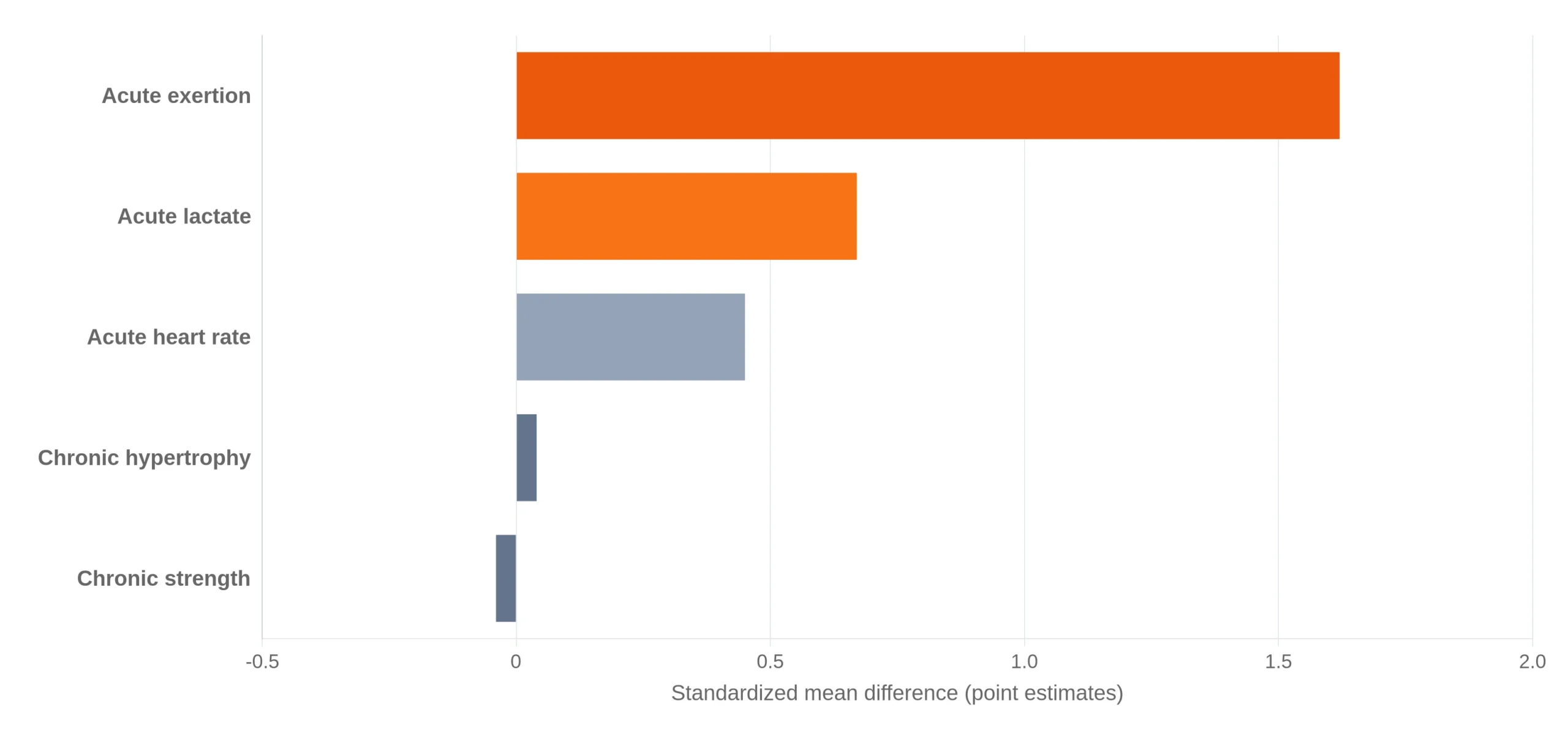
Rendered with Chart.js from the stated values. The table below preserves the exact data in accessible text.
Open the meta-analysis values and interpretation
| Outcome | SMD (95% CI) | Interpretation |
|---|---|---|
| Acute perceived exertion | +1.62 (0.33 to 2.91) | Higher with drop sets |
| Acute blood lactate | +0.67 (0.20 to 1.14) | Higher with drop sets |
| Acute heart rate | +0.45 (-0.12 to 1.02) | Uncertain difference |
| Chronic hypertrophy | +0.04 (-0.29 to 0.36) | Comparable |
| Chronic strength | -0.04 (-0.34 to 0.26) | Comparable |
The chart uses point estimates and confidence intervals reported in a 2026 systematic review and meta-analysis of 12 studies. Higher acute exertion and lactate do not translate into superior long-term growth: pooled hypertrophy and strength effects were essentially equivalent.
Amazon Product Shortlist
These tools can simplify planned resistance changes, but safe setup matters more than transition speed. PrimeForMen has not independently tested them. Confirm bar diameter, load rating, current listing, and band condition.

Yes4All Fractional Weight Plates
For small, preplanned barbell or adjustable-dumbbell load changes when the equipment and exercise allow safe handling.
- Several small plate increments are listed.
- Useful for measured progression as well as load reductions.
- Do not change loose plates while a loaded bar is in an unsafe position.

Quick-Release 30 mm Barbell Clamps
For standard-compatible bars where faster securing of a planned load change reduces transition friction.
- Four-clamp quick-release set.
- Check the bar diameter before ordering.
- Collars secure plates; they do not make rushed unloading safe.

VEICK Resistance Bands with Handles
For band curls, presses, rows, and lateral raises where changing to a lighter band is simple.
- Multiple tube levels support clear drops.
- Handles and anchor broaden exercise choice.
- Inspect tubes and anchor placement before hard sets.
*As an Amazon Associate, PrimeForMen earns from qualifying purchases. Availability and prices can change.
Best and Worst Exercises for Drop Sets
| Better choices | Why | Use caution or skip | Why |
|---|---|---|---|
| Cable lateral raise | Pin changes are fast | Barbell back squat | Fatigue and unloading risk |
| Machine chest press | Stable path and easy reduction | Conventional deadlift | Grip, back, and technique degrade |
| Leg extension or curl | Target muscle and safe setup | Olympic lift | Speed and precision are essential |
| Band curl or pressdown | Step down resistance easily | Unsupported bent-over row | Fatigue changes trunk position |
| Dumbbell curl | Run the rack when space is clear | Anything painful | Intensity technique cannot fix irritation |
Three Practical Drop-Set Formats
Single mechanical drop
Perform incline push-ups, then immediately raise the hands to an easier surface and continue. Resistance changes without equipment handling.
Single load drop
Complete a machine or cable set, reduce resistance 15–25%, and perform one extension with clean tempo.
Double band drop
Use a heavy band, switch to medium, then optional light. Pre-position all bands and inspect them before starting.
The first segment can finish near failure, but true momentary failure is not mandatory. Stop the extension when technique changes, range shortens, or joint discomfort replaces target-muscle fatigue.
A 2023 meta-analysis on proximity to failure did not find evidence that momentary muscular failure is superior for hypertrophy. That supports a cleaner stop rule instead of forcing ugly final repetitions.
How Often to Use Drop Sets After 40
Start with one drop set on one exercise once per week. If joint comfort, sleep, soreness, and next-session performance remain stable, use up to one or two drop-set exercises across the week. Avoid stacking them on every movement or during a high-stress, low-sleep period.
- Count the first set and extension as meaningful work, not a free finisher.
- Give the trained muscle time to recover before another hard session.
- Deload or remove intensifiers when performance declines for more than one session.
- Use conventional sets for the lifts whose load progression matters most.
Fit Drop Sets Into a Complete Program
Keep the main lifts aligned with powerlifting basics or the decision in powerlifting versus bodybuilding after 40. Use drop sets after stable unilateral training or Bulgarian split squats, then manage recovery with the post-workout supplement guide and foam-roller guide.
What to Do This Week
- Choose one stable accessory exercise at the end of a session.
- Perform a hard set with one repetition in reserve, reduce the load 15–25%, and complete one clean extension.
- Track next-session performance and soreness before using the method more than once or twice per week.
Conclusion
Keep most training conventional, place one controlled drop set at the end of a suitable exercise, and count its fatigue rather than treating it as free volume.
Next Step: Turn the Answer Into a Measured Plan
Use the linked PrimeForMen guides to connect this decision with training, nutrition, and recovery instead of treating one method, mineral, or device as a complete system.
Frequently Asked Questions About Drop Sets Explained
What is a drop set?
It is an extended set in which you reduce the load after a hard set and continue with little or no rest. One or two reductions are usually enough.
Are drop sets better for muscle growth?
Current meta-analyses find similar hypertrophy to traditional sets, not a clear advantage. Their main benefit is fitting challenging volume into less time.
How much weight should I drop?
Start by reducing the load about 10–30%. Use a larger reduction if repetitions or technique collapse; the exact percentage depends on the exercise and equipment.
Should beginners use drop sets?
Beginners usually gain more from learning stable technique and progressive straight sets. Add drop sets later, after you can judge effort and recover from normal training.
Can I use drop sets on squats or deadlifts?
They are usually a poor choice for heavy technical free-weight lifts because fatigue and plate changes increase risk. Machines, cables, bands, and isolation exercises are easier to manage.
This article is educational and does not replace individualized medical advice, diagnosis, or treatment. Discuss persistent symptoms, hormone concerns, cardiovascular risk, digestive problems, medications, or exercise restrictions with a qualified clinician.
Some links are affiliate links. PrimeForMen may earn a commission at no extra cost to you. Product inclusion does not override evidence, fit, or safety.