
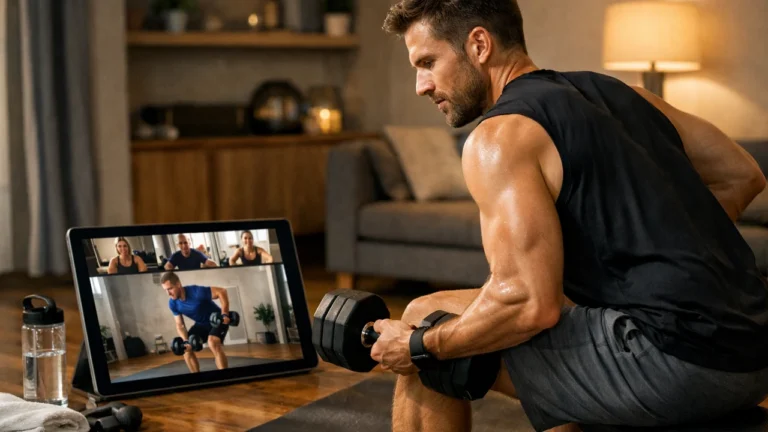
Virtual fitness classes are no longer a backup option. For many men, they are now the most practical way to train consistently around work, family, and travel constraints. The key is choosing the right class format and setup so online training actually drives results.
If you have tried virtual classes before and felt underwhelmed, the issue usually is not the format itself. It is mismatch: wrong class type, wrong schedule, or no progression framework. This guide fixes that.
TL;DR
- Virtual fitness classes can deliver strong results when paired with clear progression and routine consistency.
- Choose classes by goal: fat loss, strength, mobility, conditioning, or recovery.
- Your home setup matters: camera angle, space, audio, and equipment directly affect adherence.
- Hybrid strategy (online classes + self-directed sessions) is often best for long-term results.
- Track output and session completion weekly to avoid random program hopping.
Train Anywhere, But Train With Structure
Virtual classes work when they reduce friction and increase consistency, not when they become random workout entertainment.
No commute, faster session starts.
More class types for specific goals.
Better adherence with fixed time blocks.
For related planning, see online personal training, home gym equipment, and hybrid gyms.
The Prime Perspective
Most men quit online training because they treat classes like random content. Treat them like programmed sessions with clear goals, and results change fast.
Why Virtual Fitness Classes Are Growing Fast
The appeal is clear: flexible scheduling, lower access barriers, and broad program variety. But convenience alone is not the full value. Virtual training also improves skill repetition because you can run the same class structures consistently without commute fatigue.
| Factor | In-Person Limitation | Virtual Advantage | Performance Impact |
|---|---|---|---|
| Time efficiency | Commute and fixed slots | Instant start at home | Higher weekly completion rate |
| Program access | Local class availability | Global trainer options | Better goal-fit class choice |
| Cost flexibility | Often higher monthly fees | Broader pricing tiers | Sustainable long-term participation |
| Environment control | Shared gym constraints | Custom home setup | Lower friction and better adherence |
Best Virtual Fitness Class Types by Goal
| Goal | Class Type | Weekly Frequency | Best Add-On | Common Mistake |
|---|---|---|---|---|
| Fat loss support | Interval + strength circuits | 3-4 sessions | Zone-2 walk days | Too much HIIT, no recovery |
| Strength and muscle | Dumbbell/barbell classes | 3 sessions | Progressive load tracking | No rep/load progression |
| Mobility and recovery | Yoga/mobility flows | 2-5 sessions | Short daily mobility resets | Only stretching, no strength work |
| Athletic conditioning | Hybrid metcon formats | 2-3 sessions | Skill or power day | Random class hopping |
Evidence Reality Check for Virtual Fitness Classes
Physical activity guidance emphasizes consistent aerobic and muscle-strengthening activity as core health and performance drivers (CDC physical activity basics). National medical guidance also supports exercise as a practical lever for fitness, health, and long-term function when applied consistently (MedlinePlus exercise and physical fitness guidance).
The takeaway: virtual training can work very well when program structure and accountability are in place.
Amazon.com Picks
Virtual Class Home Setup Kit
Why these categories: they improve class quality, progression options, and training consistency at home.
Adjustable Dumbbells
Core equipment for strength-focused virtual classes and measurable progression.
- Progressive overload
- Space-efficient setup
- Works across class styles
Resistance Bands
Great for activation, mobility classes, and low-impact training sessions.
- Joint-friendly options
- Travel-ready training
- Useful warm-up tool
Exercise Mats
Improves comfort and safety during floor-based virtual sessions.
- Better floor traction
- Knee/wrist comfort
- Higher session quality
* As an Amazon Associate, we earn from qualifying purchases.
How to Build a Weekly Virtual Fitness Classes Schedule
Most men do best with a simple weekly split that balances training stress and recovery.
| Day | Class Focus | Duration | Intensity | Purpose |
|---|---|---|---|---|
| Monday | Strength class | 40-50 min | Moderate to hard | Load progression |
| Tuesday | Mobility/recovery class | 20-30 min | Low | Tissue quality and reset |
| Wednesday | Conditioning class | 25-35 min | Moderate | Work capacity |
| Friday | Strength class | 40-50 min | Moderate to hard | Performance carryover |
| Weekend | Optional yoga or zone-2 session | 20-40 min | Low to moderate | Recovery and adherence |
Biggest Mistakes with Virtual Fitness Classes
- Program hopping every week: no progression, no measurable outcome.
- No equipment baseline: class quality drops without basic tools.
- Poor camera and room setup: movement quality and motivation suffer.
- Too many hard classes: fatigue rises, consistency falls.
- No tracking: impossible to know if a class plan is working.
Home Setup Standards for Better Class Results
- Reserve a dedicated training zone with enough floor clearance.
- Use stable internet and visible screen placement.
- Keep equipment pre-staged before class start.
- Use a fan and water setup for high-output sessions.
- Set a repeatable start ritual to reduce missed sessions.
This setup work seems small, but it has major impact on adherence and session quality.
Live Classes vs On-Demand: Which Fits Better?
| Format | Biggest Advantage | Main Risk | Best For | PrimeForMen Recommendation |
|---|---|---|---|---|
| Live classes | Real-time accountability | Schedule rigidity | Men who need external structure | Use 2-3 fixed live sessions weekly |
| On-demand classes | Maximum flexibility | Easier to procrastinate | Busy and variable schedules | Pre-schedule sessions like appointments |
| Hybrid model | Flexibility plus accountability | Needs planning discipline | Most long-term users | Best default strategy for consistency |
Performance Tracking Scorecard for Virtual Training
| Metric | Target | Weekly Check | If Off-Track |
|---|---|---|---|
| Session completion | 80%+ planned classes | __ / __ sessions | Reduce plan complexity and lock times |
| Strength output | Gradual rep/load progression | Top sets improving? | Add progression rules per class type |
| Conditioning quality | Stable pacing and recovery | Heart rate/recovery trend | Adjust interval volume and rest |
| Recovery status | Manageable fatigue | Sleep + soreness trend | Swap one hard class for mobility day |
This scorecard keeps virtual classes outcome-driven. If a plan looks busy but metrics do not improve, simplify and rebuild from weekly consistency first.
Home Equipment Tiers for Virtual Classes
| Tier | Equipment | Class Range Covered | Who It Fits |
|---|---|---|---|
| Starter | Bands + mat | Mobility, light strength, conditioning basics | Beginners and travel-focused users |
| Growth | Starter + adjustable dumbbells | Full-body strength and hybrid classes | Most men training at home consistently |
| Performance | Growth + bench or kettlebell set | Advanced strength and power-focused formats | Long-term home training setups |
You do not need a full gym to win with virtual fitness classes. Most users get 80% of the result from a compact growth-tier setup and consistent weekly execution.
For next-step training architecture, continue with functional fitness training, group workout trends, and mma training.
What Most Guys Miss
Virtual classes are not inferior to gym classes by default. They are only inferior when you run them without progression, equipment readiness, and a weekly structure.
4-Week Virtual Classes Test Framework
| Week | Focus | Track This | Success Marker |
|---|---|---|---|
| Week 1 | Routine lock-in | Class completion count | 80%+ planned sessions done |
| Week 2 | Technique quality | RPE and movement control | Cleaner reps at same workload |
| Week 3 | Progression | Load/reps/density trend | Measured performance increase |
| Week 4 | Sustainability | Fatigue vs adherence balance | No major consistency drop |
Your 24-Hour Action Plan
- Step 1: Pick one primary class goal for the next 4 weeks.
- Step 2: Schedule 3 fixed virtual class slots in your calendar.
- Step 3: Track completion and one performance metric after every session.
Conclusion
Virtual fitness classes can produce serious results when they are treated like a training system, not random content consumption. Build a stable schedule, use basic equipment intelligently, and review progress weekly.
Do that, and virtual training becomes one of the highest-leverage fitness tools for modern life.
Frequently Asked Questions About Virtual Fitness Classes
Are virtual fitness classes effective for building muscle?
Yes, if classes include progressive resistance and you track load, reps, or effort trends consistently.
How many virtual fitness classes should I do per week?
Most men do well with 3-4 sessions per week, balanced with recovery or mobility sessions.
What equipment do I need for virtual fitness classes?
A solid baseline is adjustable dumbbells, resistance bands, and a stable exercise mat.
Can virtual fitness classes replace the gym completely?
For many goals, yes. Others may prefer a hybrid model combining virtual classes with occasional gym sessions.
How do I stay motivated with virtual fitness classes long term?
Use fixed weekly slots, track progress, and keep class formats aligned to your current training objective.
The information provided in this article is for educational purposes only and is not intended as a substitute for advice from your physician or other health care professional.
PrimeForMen may earn commissions from qualifying purchases when readers use product links. This does not change our editorial standards for evidence, fit, and safety.