Build a practical fitness biohacking plan: compare the evidence, use wearables wisely, and test one manageable habit before buying more gear.
- Start with training, sleep and adequate nutrition.
- Wearable trends are estimates, not diagnoses.
- Choose one manageable habit and review your own routine.
Bottom line Choose one change you can repeat, write down how you will track it, and decide whether you need any new equipment.
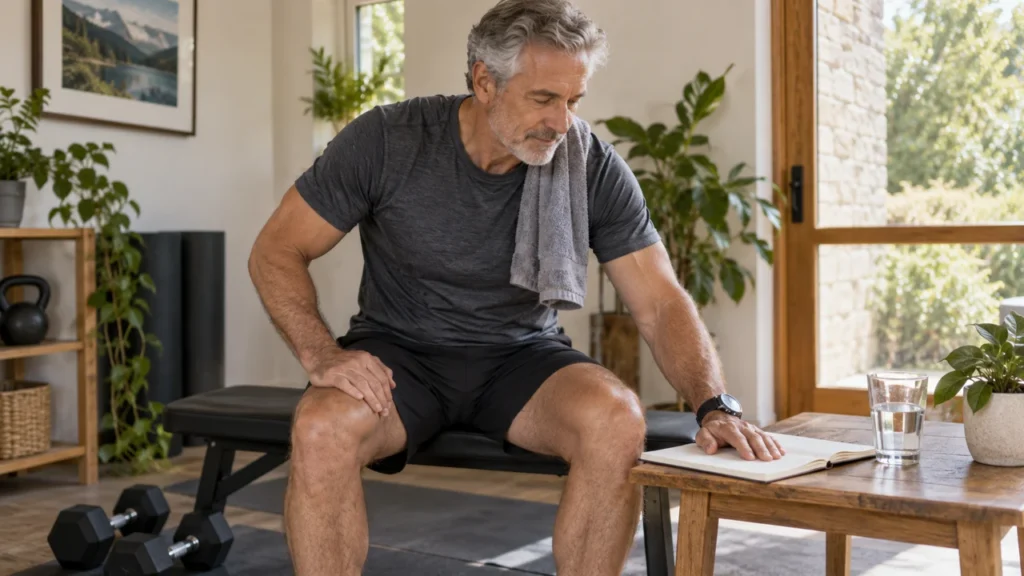
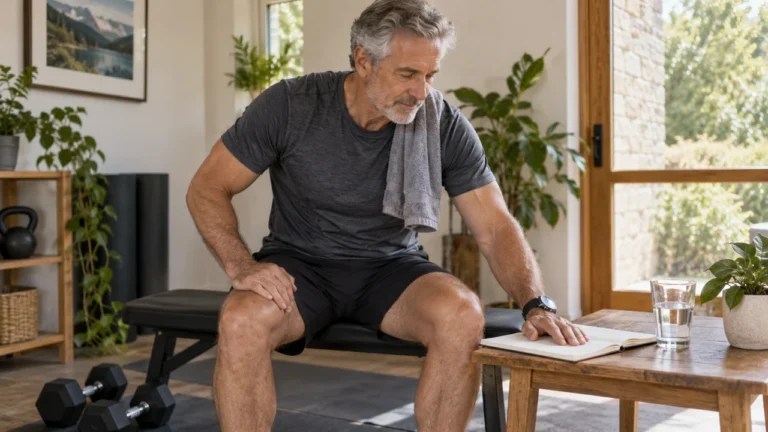
Biohacking for fitness means deliberately changing your habits, environment, or tools to improve how you train and recover. The label covers everything from a walking schedule to glucose sensors and cold plunges. It is not a standardized medical treatment or a guarantee that a new gadget will improve your health.
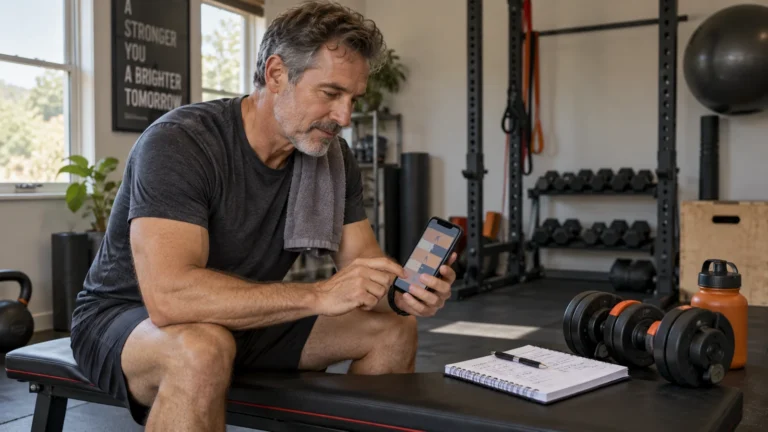
For men over 50, the useful version starts with a clear problem: building strength, fitting movement into a busy week, or getting more restorative sleep. Choose a change that addresses that problem, use a few relevant observations, and review whether the routine is worth keeping. You can do that with a notebook.
Quick Summary: Biohacking for Fitness
- Build the foundation: aerobic activity, resistance training, sufficient food, and sleep deserve priority.
- Measure selectively: workout logs and activity trends can help; wearable scores cannot diagnose illness.
- Match recovery to your goal: routine cold immersion immediately after lifting may limit muscle adaptation.
- Treat extras as optional: sauna, supplements, and glucose monitors have different evidence and safety limits.
- Try one manageable change: a 14-day habit pilot can reveal practical barriers, but cannot prove a treatment works.
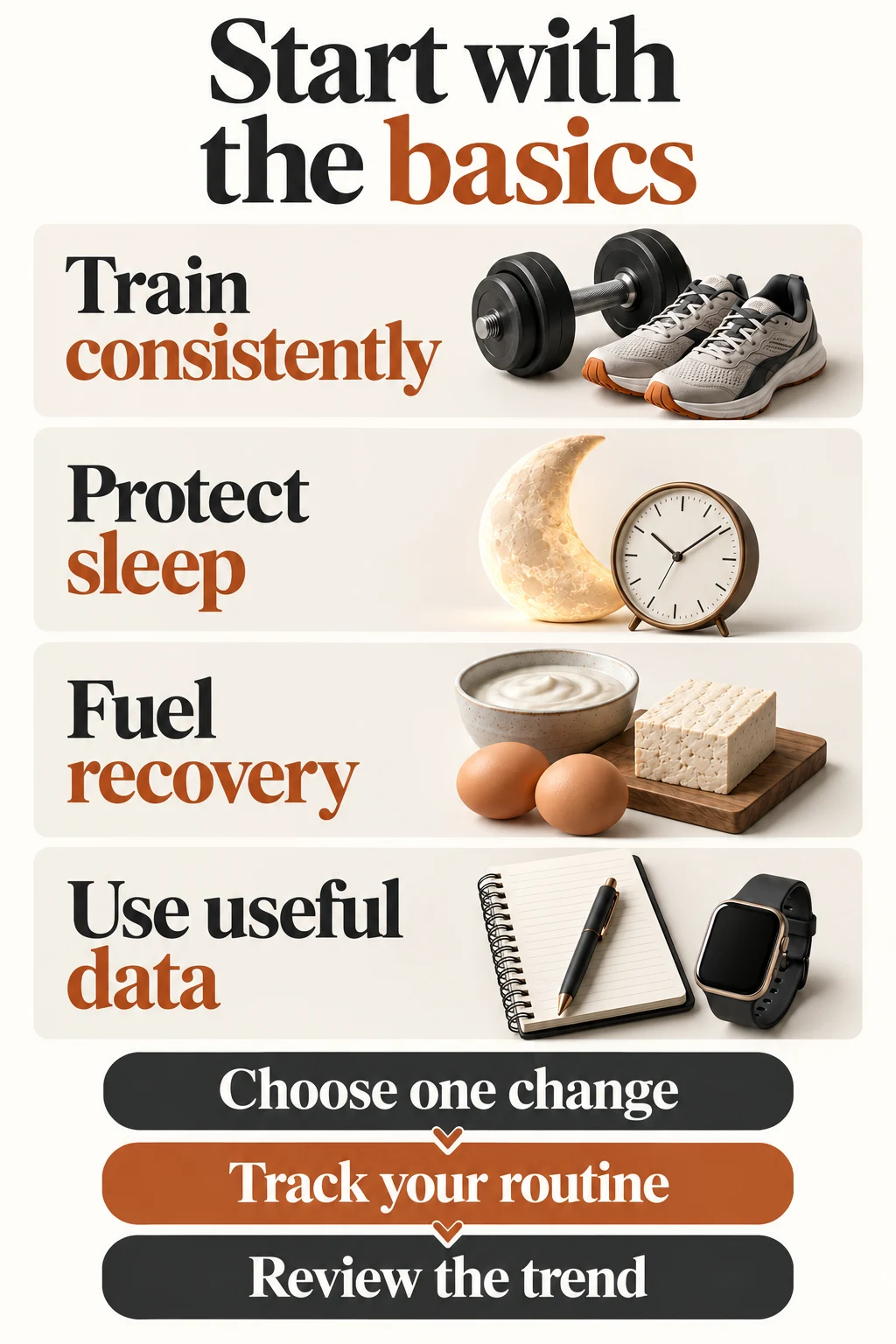
Biohacking vs. the fitness basics
Planning two strength sessions, keeping a training log, and arranging a protein-containing breakfast are practical ways to make fitness more deliberate. Their evidence is the same whether you call them biohacks or habits.
Before trying a more complicated method, check what it is supposed to improve, which outcomes the studies measured, and whether the participants resemble you. A short-term hormone change, a warmer skin temperature, or a better app score is not automatically evidence of greater strength or better long-term health.
| Approach | Useful role | Main limitation |
|---|---|---|
| Training and activity log | Record sessions, minutes, weights, and repetitions | A record helps only if you use it to adjust the plan |
| Sleep routine | Protect enough time for sleep and note daytime function | Persistent sleep problems may need clinical assessment |
| Wearable | Follow activity and selected personal trends | Device estimates and proprietary scores have uncertainty |
| Protein or creatine | Address a dietary gap or support suitable training | Neither replaces exercise, food, or individualized advice |
| Cold immersion or sauna | Optional practices with specific recovery or heat-exposure uses | Benefits depend on context; both have safety considerations |
| Continuous glucose monitor | Glucose monitoring for an appropriate clinical or specific learning purpose | Benefit for healthy people is uncertain; medical interpretation matters |
Watch: choose, log and review one habit
Start with one manageable change. Record what you do and review whether the routine fits your life.
Illustrative planning animation, under ten seconds. It does not show measured health improvements. Open the animation directly. Playback pauses outside the visible area; reduced-motion preferences keep playback manual.
Tools for a question you already have
Affiliate disclosure: As an Amazon Associate, PrimeForMen earns from qualifying purchases. The links below are affiliate links.
Start with what you already own. A heart-rate sensor can add training data, a journal can keep your sessions comparable, and a mask can help when unwanted light is the problem. We compared the product details and practical uses. We have not tested these products ourselves.
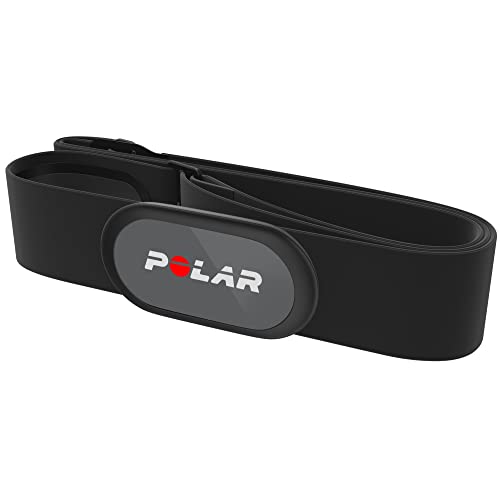
Polar H9 Heart Rate Sensor · M–XXL
Best for: Comparing heart-rate trends during repeatable cardio sessions with a compatible app or training device.
Who should skip: Keep your current sensor if it already provides usable data. Skip this purchase if you do not need heart-rate tracking, dislike a chest strap or cannot confirm device compatibility.
- Bluetooth LE and ANT+ connectivity let you pair it with supported training equipment and apps; check your exact setup.
- The verified listing includes a soft chest strap in M–XXL; measure your chest and check the current size chart before buying.
- Record pace or workload alongside heart rate so you have context for changes; this sensor is not a diagnostic ECG.
* Affiliate link. Check the current seller, selected model and package details on Amazon.

NewMe Fitness Journal · Workout Planner and Log Book
Best for: Keeping workouts and a small number of habit notes together when you prefer paper to an app.
Who should skip: Use a notebook or training app you already own if it works. Skip a dedicated journal if writing things down makes your routine harder to maintain.
- This listing is for a physical workout planner and log book.
- Use it to record exercise, weight, sets and repetitions so you can compare like-for-like sessions.
- Add one brief note on sleep or how the session felt; keep the log simple enough to complete consistently.
View workout journal on Amazon
* Affiliate link. Check the current seller, selected model and package details on Amazon.

MZOO Sleep Mask · Light-Blocking Design
Best for: Reducing light reaching your eyes when the room cannot easily be made darker.
Who should skip: Skip it if your room is already dark, your existing mask fits comfortably or you dislike wearing anything over your eyes. A mask does not treat insomnia or sleep apnea.
- The verified listing is a sleep mask with a light-blocking design; it does not measure or score sleep.
- Try the fit in your usual sleeping position; comfort and light leakage depend on your face and how you wear it.
- Use it alongside a regular sleep schedule and a suitable room environment, rather than expecting a change in deep-sleep scores.
* Affiliate link. Check the current seller, selected model and package details on Amazon.
Check the Polar H9 specifications for connectivity. None of these tools is required to benefit from a consistent training and sleep routine.
Build a week that improves fitness
The US Physical Activity Guidelines recommend 150–300 minutes of moderate-intensity aerobic activity, or 75–150 minutes of vigorous activity, or an equivalent combination each week. Adults should also do muscle-strengthening activity involving the major muscle groups on at least two days a week. Older adults should include balance activity within a varied routine.
Moderate activity raises breathing while still allowing conversation; vigorous activity makes conversation harder. You do not need to turn every walk into a strenuous workout. If you are inactive, start with an amount you can tolerate and increase gradually. Activity below the guideline range still has value.
An example week for someone already comfortable with regular exercise is five 30-minute brisk walks plus two strength sessions on separate days. That supplies 150 aerobic minutes and two strength days. It is an example, not a starting requirement for someone recovering from illness or new to training.
Weekly aerobic activity: two guideline ranges
Minutes per week for adults, including adults over 65 who can meet the guidance. Choose moderate activity, vigorous activity, or an equivalent mixture. These are health guidelines, not a starting prescription for every reader.
Shared scale: 0–300 minutes/week. Dark segment reaches the lower guideline value; lighter segment extends to the upper value. Strength training is separate: at least two days/week. Adults 65+ also need balance work. This chart does not compare the effectiveness of equal-length sessions.
Exact guideline values and source
| Intensity | Lower value | Upper value |
|---|---|---|
| Moderate | 150 min/week | 300 min/week |
| Vigorous | 75 min/week | 150 min/week |
Source: WHO physical activity guidance. Start with what you can manage and build gradually; clinical restrictions take priority.
For strength, choose movements you can perform comfortably and progressively: a squat or sit-to-stand, a hip-hinge movement, a push, a pull, and suitable trunk work. Record what you actually did. Increase difficulty gradually rather than changing exercises every time an app proposes a new “optimization.” Our strength-training basics and fitness guide for men over 50 can help you adapt the plan.
Sleep: match the target to your age
The CDC’s sleep recommendations distinguish age groups: adults aged 18–60 should generally get at least seven hours, ages 61–64 need seven to nine hours, and those 65 and older need seven to eight hours. These are population recommendations, not a reason to force everyone into one exact bedtime.
Look at sleep opportunity before chasing deep-sleep minutes. A late evening followed by an early alarm can leave too little time, even if your bedroom and tracker are excellent. Keep a regular schedule, make the room comfortable, and consider whether late caffeine or alcohol is affecting your sleep.
Note whether you feel refreshed and function well during the day. If a watch reports poor sleep but you feel well, review the trend calmly. If you repeatedly feel exhausted despite allowing enough time, do not let a favorable score dismiss the problem. Ongoing sleep trouble, loud snoring with breathing pauses, or significant daytime sleepiness warrants discussion with a healthcare professional.
Protein and creatine: useful for a specific job
A meal plan that supplies enough protein and energy supports training. A supplement can help when it solves a practical gap. Include protein sources such as dairy, eggs, fish, meat, soy, beans, and other foods you enjoy. Portions and the whole diet matter more than a “biohacking” label.
The ISSN position stand on protein and exercise gives a general daily range of 1.4–2.0 grams per kilogram of body weight for most healthy exercising people. Age, training, and health affect individual needs. This is a sports-nutrition reference range, not a prescription for every older adult.
Creatine monohydrate is a different tool: it can support repeated high-intensity effort and resistance-training adaptations. The NIH Office of Dietary Supplements describes common maintenance intakes of three to five grams daily, with other protocols also studied. It can increase body weight through water retention, so an early scale change does not establish fat gain or new muscle.
Neither a powder nor an amino-acid blend compensates for skipped meals or an inconsistent training plan. Discuss supplements and protein targets with your clinician when you have kidney disease, other relevant conditions, or take medication. Our creatine and protein guide for men over 50 explains the distinction and practical choices.
Use wearables as feedback, with room for error
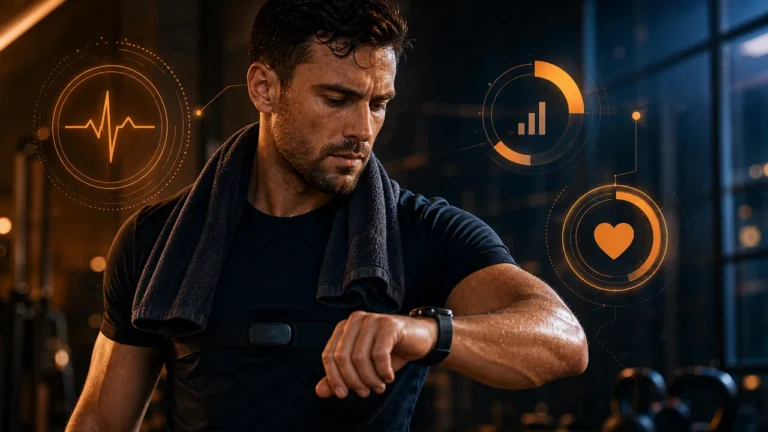
A fitness watch can make activity visible and remind you to move. It can also create a distracting stream of sleep stages, calorie estimates, readiness scores, and alerts. Pick the measurements that help with your actual goal.
Heart rate variability, or HRV, describes variation in the time between heartbeats. It is not the same as heart rate, and a single low reading cannot tell you that you are overtrained or ill. Measurement conditions and device methods matter. Compare your own patterns under similar conditions rather than treating somebody else’s number as a target.
In a laboratory validation of six wearable devices, researchers compared measurements with polysomnography and electrocardiography. Accuracy varied by device and measurement; sleep-stage estimates were less dependable than simply distinguishing sleep from wake. The study tested particular device generations in healthy young adults, so its results are not a current league table for every watch or ring.
Use the same device consistently if you want to observe trends. Note travel, poor sleep, illness, unusual training, and measurement gaps. Avoid changing a workout solely because one proprietary score changed. Symptoms, usual performance, and your training plan also belong in the decision.
Before upgrading, check subscriptions, phone compatibility, comfort, privacy controls, and whether you can export your data. Our wearable fitness technology guide and fitness tracker comparisons cover the buying questions. Existing equipment may be enough.
Watch: training, fitness data and choosing what to measure
Cleveland Clinic London’s Christopher Roughley, a general practitioner, and Mark Gillett, a consultant in sports and exercise medicine, discuss structured training and the role of health data. Their conversation includes wearable accuracy and choosing a question before choosing a tracker.
This is a longer clinical discussion of fitness and health, not a product test or a promise that tracking improves performance. A wearable reading cannot replace assessment of symptoms. Watch on YouTube · Read the official Cleveland Clinic transcript.
Build your 14-day habit pilot
Choose one routine to track. This planner organizes check-ins; it does not calculate a recovery score, diagnose symptoms or prove that a biohack works.
Example: walking routine, three check-ins per week
Choose a familiar, manageable walk and note when it fits your day. Increase activity gradually rather than treating this planner as an exercise prescription.
Over two weeks, six planned check-ins help you record whether the routine fits. Check-in days are not required workout days or a recommendation to sleep only on selected nights.
Without JavaScript, pick one routine and six review dates over the next two weeks. Write whether you followed it, what got in the way and one adjustment to try. Use your existing training or clinical plan.
Method: your chosen weekly check-ins × two weeks. This is an editorial planning template, not a validated treatment or efficacy test. Short-term changes can reflect sleep, workload, illness, measurement error or chance.
Cold plunges and sauna: recovery has trade-offs
Cold water immediately after lifting
Feeling less sore and gaining more muscle are separate outcomes. In Roberts and colleagues’ 2015 trial, regular cold-water immersion after strength sessions reduced some long-term muscle and strength adaptations compared with active recovery. The training intervention lasted 12 weeks and involved young physically active men.
This supports caution about making immediate post-lifting cold immersion routine when muscle growth is your priority. It does not prove that one cold shower ruins a workout, establish an exact safe waiting interval, or describe every cold-water protocol. Recovery between closely spaced competitions can involve different priorities.
Cold immersion also imposes physiological stress. The American Heart Association explains the cold-shock response, including rapid changes in breathing, heart rate, and blood pressure. Seek medical guidance if cardiovascular conditions or other health concerns could affect safety. Avoid unsupervised plunges, and do not use breath-holding or hyperventilation in water.
Sauna as an optional addition
A small eight-week randomized trial found that adding sauna after exercise improved some cardiovascular measures compared with exercise alone. It involved mostly women with low activity levels and cardiovascular risk factors. The trial does not establish that sauna replaces exercise, guarantees longevity, or improves every recovery measure in men over 50.
If you enjoy sauna and can use it safely, it can remain an optional part of your routine. Account for heat, dehydration, medications, and health conditions; leave if you feel unwell. More heat and longer sessions are not automatically better. Ask for medical advice if you are unsure about suitability.
Does a healthy person need a glucose monitor?
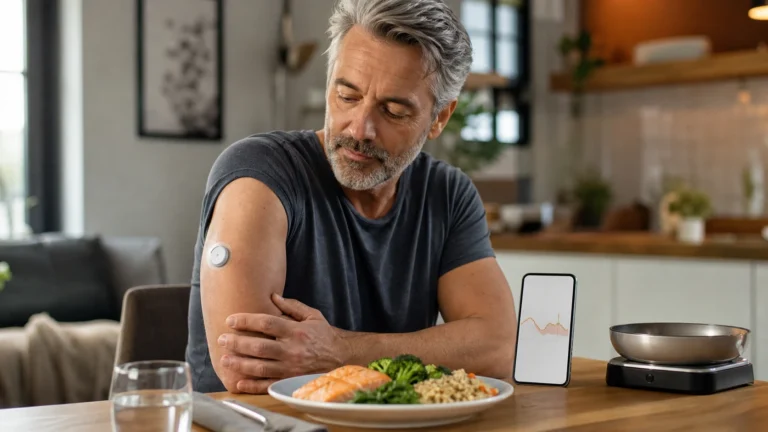
A continuous glucose monitor measures glucose in interstitial fluid and displays trends. It has important uses in diabetes care. That role should not be confused with proof that healthy exercisers need one to optimize meals.
The FDA’s first over-the-counter CGM clearance included eligible adults without diabetes, but also stated that users should not make medical decisions from the output without consulting a healthcare provider. Availability and a clinical benefit for your situation are different questions.
A 2026 systematic review in people without diabetes found no appreciable glycemic benefit in healthy normoglycemic populations, although findings differed in prediabetes. This leaves CGM as an optional, purpose-specific choice rather than a default fitness purchase. Do not remove nutritious foods simply to flatten every rise on a graph. If you have symptoms or concerns about diabetes, seek appropriate clinical assessment.
A 14-day habit pilot you can actually review
Fourteen days is an editorial planning window for trying a routine. It is not a validated efficacy test, enough time to prove muscle gain, or a guarantee that a habit will stick. Its purpose is to reveal whether a small change fits your life.
- Choose one problem and one change. For example, take a manageable walk after lunch, prepare a protein-containing breakfast, or reserve a consistent sleep window. Keep your other routines reasonably steady.
- Choose a simple record. Mark whether you completed the habit and note any barrier. If useful, add one relevant observation such as walk duration or how rested you felt.
- Review after the first week. Was the timing realistic? Did weather, work, pain, or appetite get in the way? Adjust the practical setup without piling on new interventions.
- Review at day 14. Decide whether to keep, simplify, change, or stop. A pattern you noticed is a starting point for learning; it does not establish that the change caused a health improvement.
Keep the habit small enough to repeat. A ten-minute walk can be a starting step toward a fuller activity week; it does not replace the guideline target. A training diary may tell you more about missed sessions than a new recovery subscription. Our fitness-on-a-budget guide can help you spend where it solves a real obstacle.
Take your habit pilot offline
The one-page worksheet has room for one change, an obstacle plan, daily notes and a review.
Conclusion
Biohacking for fitness is most useful when it makes a sound routine easier to follow. Establish movement, strength training, food, and sleep; add tools selectively. Measure progress toward your goal, leave room for uncertainty, and take persistent symptoms to a clinician. You do not need an expensive setup to begin.
Frequently Asked Questions
What is the best first biohack for fitness after 50?
Choose the biggest practical gap in your routine. A manageable exercise schedule, a protein-containing meal, or more time for sleep can be a sensible first step. The right choice depends on your needs and health, rather than a universal ranked list.
Do I need a smartwatch or smart ring?
No. A notebook and a clock can track workouts and routines. A wearable may help if its feedback changes useful behavior, but the data needs context and does not replace clinical assessment.
Should I cold plunge after every strength workout?
Routine immediate cold immersion may limit some muscle adaptations. If gaining muscle is your priority, reconsider making it your default after lifting. Evidence does not establish one waiting interval that guarantees no interference.
Can I trust a low HRV or readiness score?
Treat it as one observation. Check the trend, measurement conditions, how you feel, and your usual performance. A single reading does not diagnose overtraining, infection, or a heart problem.
Will a 14-day pilot prove that my routine works?
No. It can help you decide whether a habit is feasible and worth continuing. It cannot establish causality, long-term benefit, or a medical diagnosis. Meaningful training progress often needs a longer period of consistent work.
Medical Disclaimer: This guide provides general education, not individualized medical advice. Discuss new exercise, supplements, heat or cold exposure, and health-monitoring devices with a qualified professional when relevant to your health. Seek prompt care for concerning symptoms; consumer scores cannot rule out illness. See our editorial policy for our approach to evidence.