Choose the best exercise and yoga mats for men by thickness, grip, size, sweat control, shoe durability, and training style.
- A dense 5-6mm mat is the practical baseline for most men.
- Natural rubber usually wins on grip; closed-cell PVC wins on easy cleaning.
- Shoe-based HIIT needs a durable exercise mat, not a narrow yoga strip.
Bottom line Bottom line: buy the mat for how you train on the floor, not for how it looks rolled up in the corner.
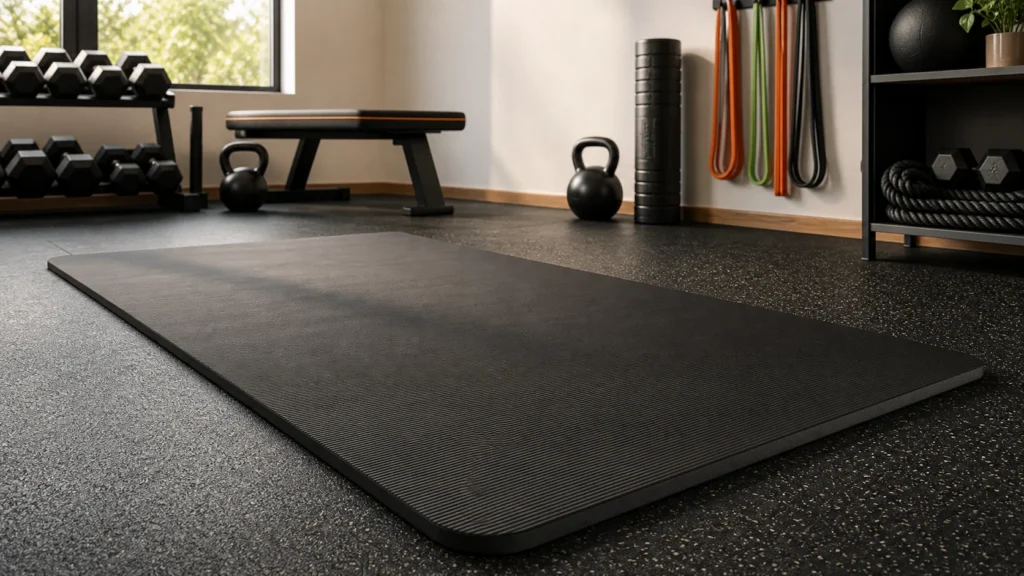
Best yoga mats for men are not pastel foam sheets with better marketing. For home workouts, the mat has to protect joints, stay planted under sweat, give enough room for broad shoulders, and survive the way men actually train.
If you use the floor for planks, push-ups, hip mobility, kettlebell warm-ups, stretching, or recovery work, the mat becomes the foundation of the session. A thin mat that bottoms out under your elbows or slides during lunges turns the floor into the limiting factor. This guide treats exercise and yoga mats as performance equipment: material, density, grip, size, cleaning, and training use first.
Quick Summary: best yoga mats for men
- 5-6mm dense mats are the practical baseline for most men doing floor training at home.
- Closed-cell PVC is durable and easy to clean; natural rubber usually wins on grip.
- Standard 68 x 24 inch mats are often too small for tall men and broad-shoulder push-up work.
- Shoe-based HIIT needs a durable exercise mat, not a barefoot yoga mat.
- Open-cell mats can grip well when wet, but they need more careful cleaning because they absorb sweat.
The Prime Perspective
A mat is not a spiritual accessory in this context. It is a load-bearing contact surface. Your elbows, knees, hands, feet, sweat, shoes, and floor all interact with it. If the mat is too soft, you wobble. If it is too thin, joints complain. If it is too slick, your form changes because you are trying not to slide.
For men over 40, that matters. You want a mat that makes mobility and floor strength easier to repeat, not one that creates a new reason to skip the work.
Best Exercise Mat by Training Style and Body Size
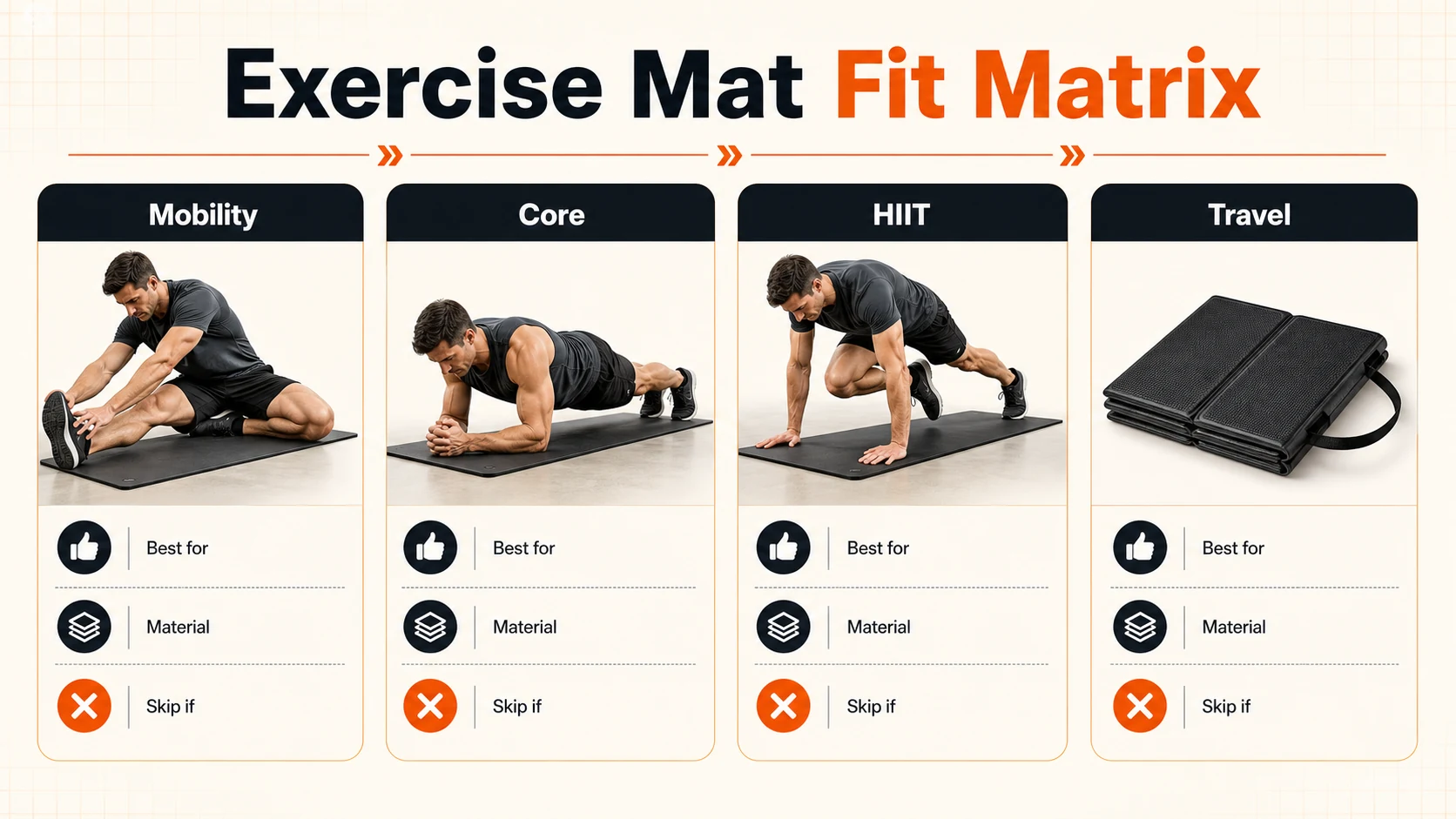
The right mat is not universal. A 220-pound man doing planks, dead bugs, and push-ups needs different support than someone using a thin travel mat over hotel carpet. Start with the problem you need the mat to solve.
| Training use | Best mat type | Material target | Skip if |
|---|---|---|---|
| Core, planks, mobility after lifting | Dense 5-6mm studio mat | Closed-cell PVC or dense rubber blend | It compresses flat under elbows or knees |
| Sweaty hands, dynamic mobility, yoga flows | High-grip rubber or PU-top mat | Natural rubber or polyurethane surface | You cannot clean it according to material rules |
| HIIT, shoes, lateral drills | Large exercise mat | Durable multi-layer exercise surface | The brand warns against shoes or impact movement |
| Travel, hotel rooms, compact storage | Thin foldable travel mat | Rubber or grip-focused thin layer | You need knee comfort or floor impact protection |
High-Quality Exercise and Yoga Mat Picks
These are direct product CTAs with different use cases. Match the mat to how you train, then confirm current size, color, price, and availability on Amazon.

Manduka PRO 6mm Yoga Mat
Best for dense, long-term floor work when you want a studio-grade mat that resists bottoming out under planks, kneeling, and mobility work.
- 6mm closed-cell build favors durability and easy wipe-down cleaning.
- Dense surface supports elbows and knees better than thin foam mats.
- Best for barefoot strength, stretching, and mobility, not shoe-heavy HIIT.

JadeYoga Harmony Mat
Best for men who prioritize natural rubber traction and need reliable grip for sweaty hands during mobility flows and bodyweight holds.
- Natural rubber surface gives strong mechanical grip.
- Useful for downward dog, lunges, push-up holds, and sweaty palms.
- Skip if you dislike rubber scent or need a shoe-durable HIIT mat.

Liforme Original Yoga Mat
Best when grip and body-position feedback matter, especially for mobility sessions where foot, knee, and hand placement need to stay repeatable.
- High-grip surface helps with controlled transitions and longer holds.
- Alignment markings make stance and hand placement easier to repeat.
- Better for barefoot practice than dumbbell drops or shoe abrasion.

Gorilla Mats Premium Large Exercise Mat
Best when the mat is a training zone, not a narrow yoga strip, especially for HIIT, push-ups, mobility circuits, and shoe-based home workouts.
- Large footprint gives room for lateral work and full-body movement.
- Designed for exercise use where shoes and sweat are realistic.
- Best for dedicated home-gym floor space, not travel storage.
* As an Amazon Associate, PrimeForMen earns from qualifying purchases.
The Thin-Mat Trap
The cheap mat problem is simple: low-density foam feels comfortable for a few seconds, then compresses under point pressure. A plank loads elbows. Bird dogs load knees and hands. Push-ups load wrists and palm contact. If the mat collapses, the floor takes over.
That is why thickness alone is not enough. A soft 12mm foam mat can be worse for push-ups than a dense 6mm mat because your hands sink and shift. For most men, the target is dense support, not pillow softness.
What most guys miss
Do not buy by thickness alone. Buy by density, grip, surface durability, size, and cleaning method. A mat that is great for barefoot stretching can be a poor choice for burpees, shoes, or dumbbell-heavy circuits.
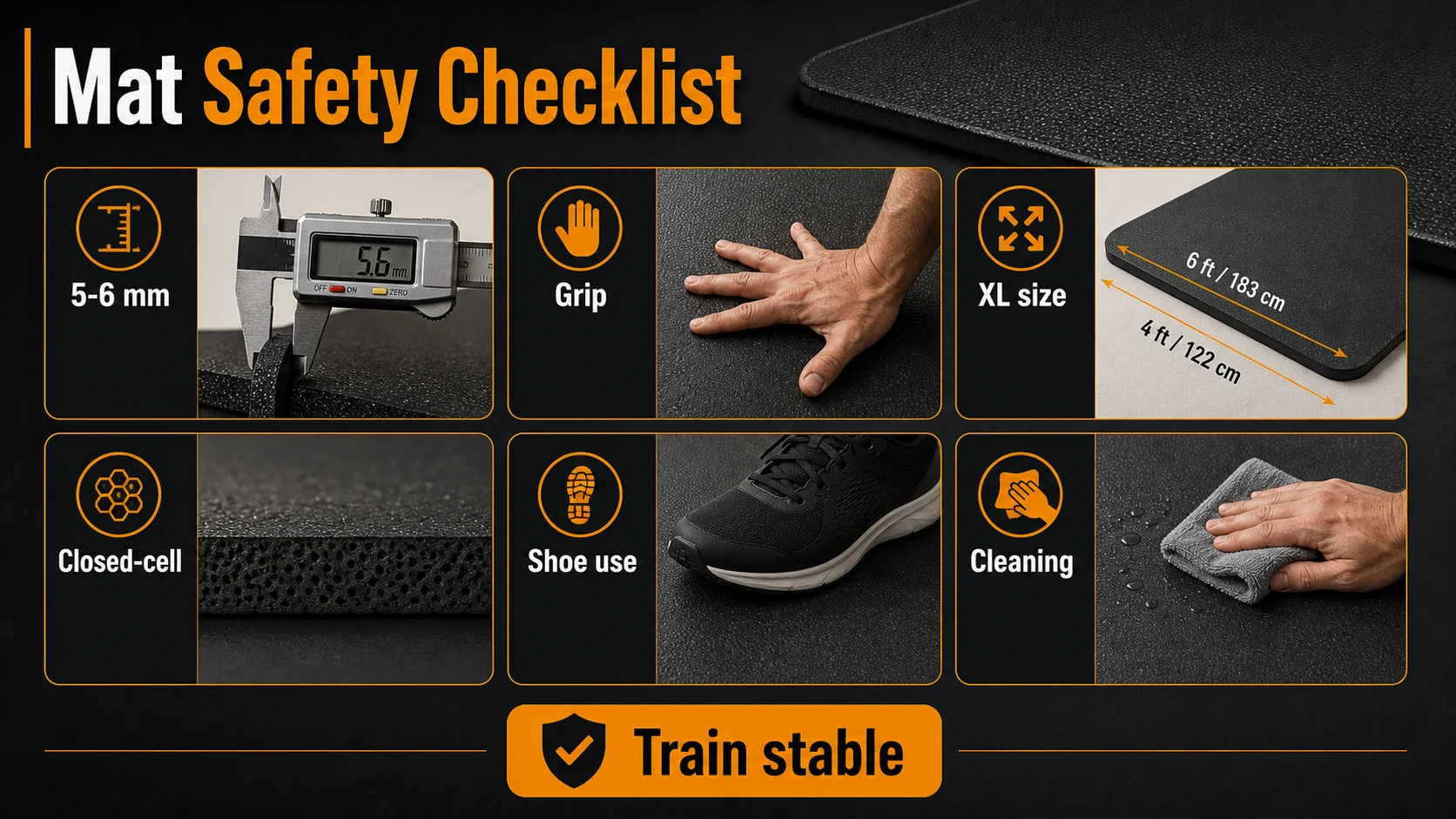
Closed-Cell vs Open-Cell: The Hygiene and Grip Tradeoff
Closed-cell mats
Closed-cell surfaces keep sweat on top of the mat. That usually makes them easier to wipe down and better for long-term hygiene, especially if the mat lives in a garage or home gym.
- Better for cleaning and durability.
- Can get slick if sweat pools.
- Strong fit for strength, core, stretching, and recovery work.
Open-cell or absorbent mats
Open-cell or absorbent top layers can grip well when wet because moisture moves into the surface. The cost is cleaning discipline.
- Often better for sweaty hands.
- Needs deeper cleaning and full drying.
- Can hold odor if rolled up damp.
Size Matters More Than Most Guides Admit
Many mats are roughly 68 inches long and 24 inches wide. That may work for smaller users and static stretching, but it is tight for tall men, broad shoulders, push-up variations, lateral hip work, and long plank positions.
If you are over 6 feet tall, look for at least 72 inches and consider 80-85 inches. If your shoulders spill off the sides during push-ups, look for 26-30 inches wide or a large exercise mat. This is especially relevant if the mat supports your core workout, flexibility and stretching, or broader home gym equipment setup.
Material Notes: PVC, Natural Rubber, TPE, PU, and Large Exercise Mats
| Material | Where it shines | Tradeoff | PrimeForMen verdict |
|---|---|---|---|
| High-density closed-cell PVC | Durability, support, easy cleaning | May need break-in for grip | Best all-rounder for strength and mobility |
| Natural rubber | Mechanical grip and floor traction | Rubber smell, heavier, sensitive to harsh cleaners | Best for sweaty hands and barefoot stability |
| PU top layer | Wet grip and controlled practice | May require careful cleaning and storage | Strong for mobility flows and precision work |
| TPE or soft foam | Lightweight, budget-friendly, easy storage | Can stretch, compress, or wear quickly | Fine for light use, weak for heavy men or hard training |
| Large exercise mat | HIIT, shoes, lateral movement, home-gym zone | Bulkier and more expensive | Best when you train on the mat, not just stretch on it |
Shoes, Sweat, and Cleaning: Buy for the Messy Reality
If you do burpees, mountain climbers, jump rope prep, or circuit training in shoes, do not assume a yoga mat can survive it. Shoe tread adds abrasion and lateral shear. Some mats are designed for barefoot work only.
Cleaning also depends on material. Natural rubber generally dislikes harsh alcohol cleaners, heavy sunlight, and heat. Closed-cell mats are easier to wipe but still need air-drying. If your mat smells after a week, the problem is usually not motivation. It is moisture management.
8-Week Mobility Plan for Strength-Focused Men
The mat earns its place when it gets used. Add short, repeatable floor sessions around your strength training basics, not as a separate lifestyle project.
| Phase | Weeks | Main work | Goal |
|---|---|---|---|
| Reset | 1-2 | Cat-cow, child pose breathing, bird dog | Comfortable knee and hand contact |
| Hips | 3-4 | 90/90 switches, couch stretch, deep squat holds | Better hip access before lower-body work |
| Shoulders | 5-6 | Thread the needle, prone Y-T-W raises, cobra stretch | More upper-back and shoulder control |
| Flow | 7-8 | World’s greatest stretch, plank-to-down-dog, lunge rotations | Daily 8-10 minute mobility habit |
How We Chose These Mat Picks
This is an editorial buyer guide, not a lab-test claim. We prioritized clear use-case fit, premium category reputation, material logic, verified Amazon product/image availability, and the ability to explain who should skip each mat.
For related gear decisions, pair this guide with essential fitness gear, resistance bands, foam rollers, and apartment friendly workouts.
Sources and Safety Context
The CDC adult activity overview supports regular muscle-strengthening activity as part of weekly health behavior. The NIAMS sports injury overview is a useful reminder to respect pain, poor mechanics, and unsafe loading. For material-safety context, OEKO-TEX Standard 100 explains one common textile safety certification readers may see on product claims.
Conclusion
The best yoga mats for men are chosen by training reality. For most home workouts, start with a dense 5-6mm mat, enough length and width, and a surface that matches your sweat and shoe use. Choose closed-cell for easy cleaning and durability. Choose natural rubber or PU-style grip when sweaty hands are the problem. Choose a large exercise mat if your workouts involve shoes, lateral movement, or more floor space.
The right mat makes floor work easier to repeat. That is the point.
Frequently Asked Questions About Exercise and Yoga Mats
What is the best yoga mat thickness for men?
Most men should start around 5mm to 6mm for home workouts. That range gives better joint support than thin 3mm mats without becoming so soft that push-ups, lunges, and balance work feel unstable.
Are thicker yoga mats always better?
No. Very thick foam can feel comfortable for kneeling but unstable for standing work, push-ups, and dynamic transitions. Dense 5-6mm mats are usually more useful than soft 10-15mm foam pads.
What size yoga mat should a man over 6 feet buy?
Look for at least 72 inches long, and consider 80-85 inches if you are tall or want full support during planks and stretches. Wider mats, often 26-30 inches, are better for broad shoulders.
What is the difference between open-cell and closed-cell mats?
Open-cell mats absorb sweat into the material and often feel grippy when wet, but they need more careful cleaning. Closed-cell mats keep moisture on the surface, which is easier to wipe down but can get slick if sweat pools.
Which material has the best grip for sweaty hands?
Natural rubber and polyurethane-topped mats usually grip better than cheap foam or smooth PVC. If you sweat heavily, prioritize surface traction and keep a towel nearby even with a premium mat.
Can I wear shoes on a yoga mat?
Only if the mat is designed for exercise or HIIT use. Many yoga mats are made for barefoot training and can tear, scuff, or flake under shoe tread and lateral movements.
Is a yoga mat enough for dumbbell workouts?
A yoga mat is fine for floor work, mobility, and light accessory training. It is not a substitute for rubber gym flooring if you will drop dumbbells, use kettlebells aggressively, or train with heavy equipment.
Why does a premium yoga mat feel slippery at first?
Some dense closed-cell mats have a manufacturing surface that needs break-in time. Clean the mat according to the brand instructions and use it consistently before judging the long-term grip.
How often should I clean an exercise mat?
Wipe it after sweaty sessions and deep-clean it based on material instructions. Natural rubber should avoid harsh alcohol cleaners and prolonged direct sunlight, while closed-cell mats are usually easier to wipe.
What mat is best for HIIT at home?
Choose a large exercise mat with a durable top layer, enough footprint for lateral movement, and a surface that tolerates shoes. Narrow barefoot yoga mats are usually not the best HIIT choice.
What mat is best for mobility after lifting?
A dense 5-6mm mat with reliable grip and enough length for hip, hamstring, thoracic, and shoulder drills works well. Pair it with a foam roller if recovery work is part of the session.
Do I need an eco-friendly yoga mat?
You do not need one for performance, but material matters. Natural rubber, OEKO-TEX-tested materials, and low-odor construction can be worth prioritizing if skin contact, smell, or sustainability matters to you.
Medical and Safety Disclaimer
This article is editorial guidance for fitness equipment and general training decisions. It does not replace medical advice, physical therapy, or professional coaching. If you have persistent joint pain, numbness, dizziness, previous injury, or pain during floor work, get qualified help before pushing harder.
Affiliate Disclosure
PrimeForMen may earn a commission when you buy through qualifying Amazon links. That does not change the price you pay, and it does not change the editorial logic: use-case fit, safety, and material quality come before conversion.