

Do BCAA supplements help? Compare BCAAs, EAAs and complete protein, check your daily intake, and weigh the evidence before buying.
- BCAAs supply three of the nine essential amino acids.
- Short-term protein synthesis is not long-term muscle growth.
- Check complete protein intake before adding another powder.
Bottom line Log a complete day of food, identify the practical protein gap, and compare one product label before spending.

BCAA supplements can reduce muscle soreness in some exercise studies, and one small trial found a short-term increase in muscle protein synthesis. Those findings do not establish that adding BCAAs to an adequate protein intake builds more muscle over months. For most men choosing where to spend their supplement budget, food and complete protein deserve attention first.
Decide what you need from the product: help meeting your protein intake, a drink you tolerate well, or less soreness the next day. A scoop containing three amino acids cannot do the same nutritional job as a meal or a protein powder that supplies the full set.
Quick Summary: BCAA supplements
- BCAAs are leucine, isoleucine, and valine. They are three of the nine essential amino acids you must obtain from your diet.
- The strongest practical signal is for soreness. Results vary, and feeling less sore does not prove faster strength recovery or greater muscle growth.
- Complete protein already contains BCAAs. A separate BCAA product has an uncertain added benefit when protein intake is sufficient.
- A ratio is not a result. A 2:1:1 label describes the mixture; it does not establish an optimal dose or superior gains.
- For men over 50, prioritize the whole plan: regular resistance training, adequate meals, recovery, and a protein source you can use consistently.
What BCAAs supply
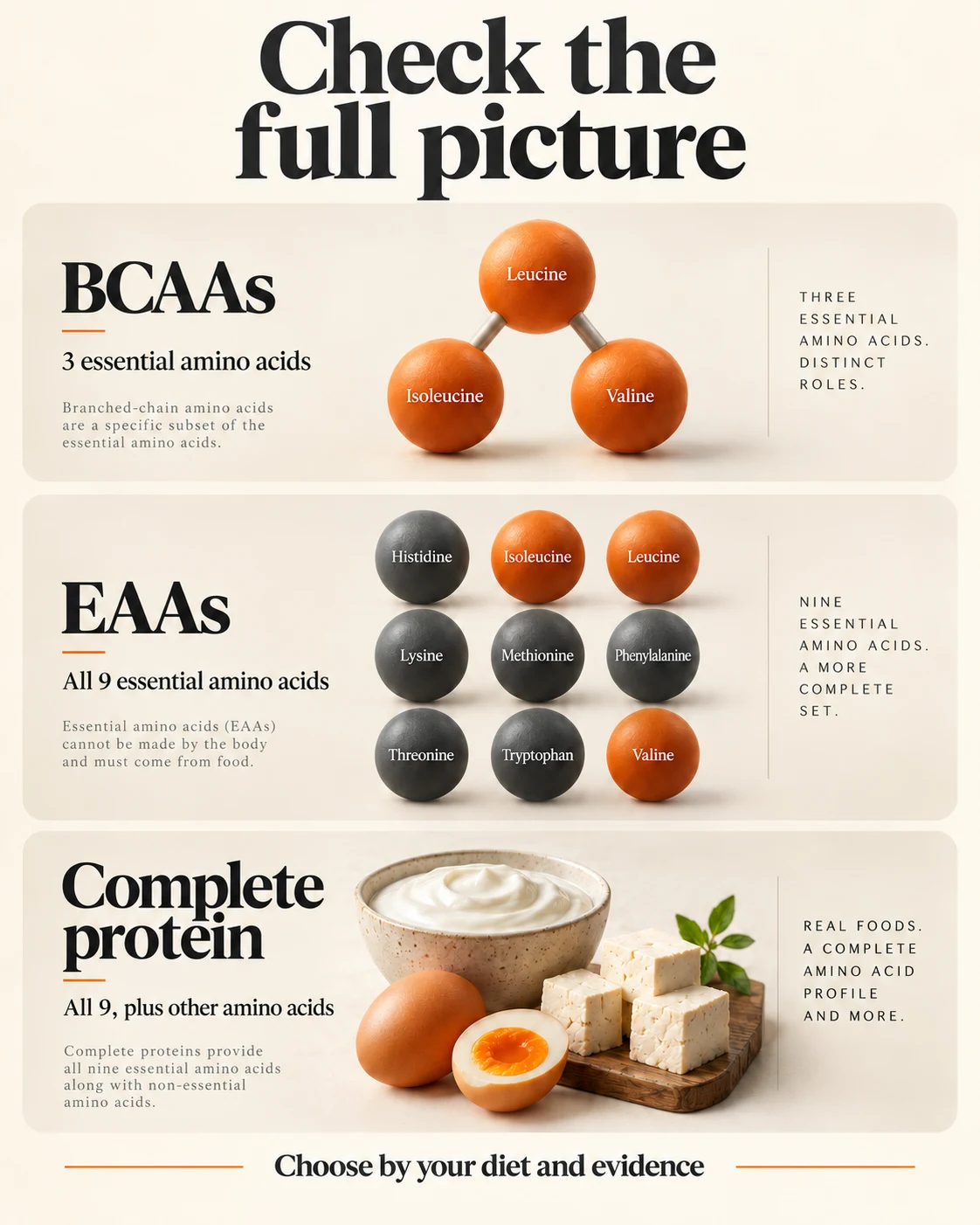
Amino acids are the building blocks used to make proteins. The nine essential amino acids are histidine, isoleucine, leucine, lysine, methionine, phenylalanine, threonine, tryptophan, and valine. A BCAA product supplies only leucine, isoleucine, and valine. An EAA product supplies all nine.
Leucine helps activate signaling involved in muscle protein synthesis. But activating that machinery and supplying everything needed to keep it working are separate jobs. Muscle protein contains more than three amino acids. Your body can draw on amino acids already available, but a BCAA drink does not supply the other six essential ones.
This explains why a plausible mechanism should not become a promise of larger muscles. The Australian Institute of Sport’s evidence summary discusses the limits of isolated BCAA and leucine supplementation. Getting BCAAs through protein foods also provides the remaining amino acids.
Watch: three BCAAs within the nine essential amino acids
This short animation explains the ingredient coverage. It does not show a measured change in muscle growth or rank products by effectiveness.
Silent animation, 8.5 seconds. Open the animation directly. Playback pauses when it leaves view; reduced-motion preferences keep playback manual.
BCAA vs. EAA vs. complete protein
On a small screen, swipe the table sideways to see every column.
| Option | What it supplies | Most useful question |
|---|---|---|
| BCAA supplement | Three essential amino acids; other ingredients vary | Is a possible soreness benefit worth the cost when my protein needs are already covered? |
| EAA supplement | All nine essential amino acids in a free-amino-acid mixture | Do I need a small, light drink when a meal or shake is difficult? |
| Complete protein food or powder | All nine essential amino acids, plus other amino acids; food may add other nutrients | Am I trying to meet my daily protein needs or replace a missing protein serving? |
Examples of complete protein include dairy, eggs, fish, meat, and soy. Plant-based eaters can also meet their needs with enough protein from a varied diet. Check the amount of protein per serving and the composition of a powder rather than assuming every plant blend or product labeled “amino” is interchangeable.
EAAs offer a more complete amino-acid supply than BCAAs, but that does not make them necessary for everyone. They do not replace the full nutrition of a meal. If a shake fits your routine, our protein powder guide can help you compare practical options.
How many essential amino-acid types are included?
Count of essential amino-acid types, on a shared 0–9 scale. This is composition, not dose, absorption or muscle-growth performance.
Exact counts and what they mean
On a small screen, swipe the table sideways to see every column.
| Category | Count out of 9 | Meaning |
|---|---|---|
| BCAA formula | 3 | Leucine, isoleucine and valine |
| Complete EAA formula | 9 | All nine essential amino acids, if the label lists them |
| Complete protein | 9 | All nine essential amino acids in adequate proportions, plus nonessential amino acids |
Sources: NIH ODS BCAA definitions and the ISSN essential-amino-acid position stand. Amounts and formulas vary. Nine types does not establish that two servings have equivalent nutrition or effects.
What the muscle-growth studies found
In Jackman and colleagues’ 2017 trial, 10 young resistance-trained men took 5.6 grams of BCAAs or placebo after resistance exercise in a crossover design. Muscle myofibrillar protein synthesis over four hours was 22% higher with BCAAs.
That is a measured biological effect. It is not a finding of 22% more muscle, 22% greater strength, or a benefit demonstrated in men over 50. The trial followed an acute response, rather than months of training. It also did not directly compare BCAAs with whey protein, so it cannot supply a head-to-head percentage advantage or disadvantage against whey.
Long-term decisions need evidence about long-term outcomes. A 2021 review of isolated leucine and BCAA supplementation found the strength and hypertrophy claims poorly supported by the available literature. A 2025 systematic review of pure oral BCAA supplements also described inconsistent performance and body-composition findings, with study-quality problems limiting confidence.
BCAAs can affect muscle metabolism, but a dependable added muscle-building benefit remains unproven. If your aim is to add strength, make your progression measurable: log repetitions, weights, and how often you train. Our strength-training basics explain how to build that foundation.
Do BCAAs help soreness and recovery?
A 2024 systematic review and meta-analysis of 18 studies found lower delayed-onset muscle soreness at several follow-up times from 24 to 96 hours after muscle-damaging exercise. Findings for blood markers were mixed. Many studies did not report enough dietary information to establish whether participants already met their amino-acid needs, and exercise protocols, doses, and participant groups differed.
A separate 2021 systematic review included 10 randomized trials and found a possible soreness benefit, without a settled best protocol. The reviews suggest a possible soreness benefit; they do not establish faster recovery across all measures.
One placebo-controlled eccentric-exercise study illustrates the distinction: BCAAs reduced soreness, but did not improve the loss of muscle function. How a muscle feels and how well it performs can move differently.
If you are sore after every session, review the size of the training jump, the amount of unfamiliar exercise, sleep, and the spacing of hard sessions. A drink should not be the reason you keep repeating a workout you cannot recover from. Our guide to rest and recovery helps put those decisions in context.
Watch: protein and keeping muscle as you age
Cleveland Clinic geriatrician Ronan Factora, MD, and registered dietitian Julia Zumpano discuss dietary protein, food choices and staying active. The player starts at the protein discussion, about 4:45 into their longer conversation.
This is broader nutrition guidance for aging, not a review of BCAA trials or the products above. Individual protein targets still depend on your health and circumstances. Watch the protein discussion on YouTube · Read Cleveland Clinic’s transcript.
What changes for men over 50?
If daily tasks are getting harder, preserving strength matters. A study in young trained men cannot establish an age-specific BCAA benefit. Older adults may have a less responsive muscle-building response to a small protein serving, which makes meal quality and sufficient protein worth checking.
The ISSN position stand on protein and exercise gives a general range of 1.4–2.0 grams of protein per kilogram of body weight per day for most exercising individuals, with typical individual servings of 20–40 grams of high-quality protein. It notes that age and exercise affect serving needs. These are sports-nutrition reference ranges, not a prescription for every man.
For illustration, an 80-kilogram exerciser would calculate 112–160 grams a day using that range. You do not need to chase the upper end simply because it appears in a table. Training load, appetite, food preferences, health, and professional advice all matter. Use our protein calculator for men over 50 as a planning estimate.
Look at the meals that are easiest to overlook. Coffee and toast may leave breakfast short. A salad can be a substantial meal when it includes beans, tofu, fish, or another protein source. Choose a meal adjustment you can repeat on ordinary days.
Check your protein before choosing BCAAs
Use a complete day of food to compare your logged protein with a sports-nutrition reference range. This is a planning estimate for healthy exercising adults, not a deficiency test or an individualized prescription.
Example: 80 kg and 100 g logged protein
Reference range: 112–160 g/day, using 1.4–2.0 g/kg/day.
This example is about 12 g below the lower reference value. Start by reviewing complete-protein foods and the accuracy of the food log.
BCAA grams cannot replace missing complete protein gram for gram. This result does not tell you to buy a supplement.
Method: body weight in kg × 1.4 and × 2.0; 1 lb = 0.45359237 kg. Values are rounded to whole grams. The ISSN protein and exercise position stand gives this range for most exercising individuals. It does not apply automatically to every age, activity level or medical condition. Labels and food logs are estimates.
Without JavaScript, multiply your kg weight by 1.4 and 2.0, then compare with a full day of protein. For a prescribed dietary restriction, use your clinician’s plan instead.
Does the 2:1:1 ratio or timing make BCAAs better?
A 2:1:1 ratio means two parts leucine to one part isoleucine and one part valine, usually by weight. In a 5-gram BCAA serving, that would be 2.5 grams leucine and 1.25 grams each of the other two. This is label arithmetic, not evidence that the mixture is best.
Higher-leucine ratios do not automatically produce greater strength or growth. Nor does the 2017 trial validate the usual 2:1:1 claim: its 5.6-gram drink contained 2.6 grams leucine, 1.4 grams isoleucine, and 1.6 grams valine. Study doses and mixtures should be described accurately.
The soreness reviews used different schedules and did not establish one optimal daily dose. Associations between dose, duration, and outcomes across separate studies do not prove that increasing your own dose will help. A serving used in a trial is also not a universal recommendation.
For complete protein, your daily intake and a routine you can maintain deserve priority over a precisely timed amino-acid drink. If you train early, plan a breakfast afterward that you can actually eat. If dinner follows your workout, it can supply protein. Our protein-timing guide covers the practical choices.
Safety and label checks before buying
The NIH Office of Dietary Supplements reports no safety concerns in studies using up to 20 grams daily for up to six weeks. That short-term observation is not a recommended dose or a guarantee of long-term safety. Its broader assessment finds inconsistent evidence for performance, muscle mass, and recovery benefits.
Review supplements with your clinician or pharmacist if you have kidney or liver disease, a condition affecting amino-acid metabolism, or take medication. Inherited disorders such as maple syrup urine disease require specialist management of BCAAs. Treatment studies in liver disease do not justify treating yourself with a gym supplement.
- Read the amounts: find total BCAAs per serving, the individual amino acids, and how many scoops make a serving.
- Check the rest of the formula: caffeine, other stimulants, sweeteners, and extra supplements change what you are taking.
- Check quality: independently certified products can reduce uncertainty about contents and contamination. Certification does not prove that the product works.
- Avoid unnecessary stacking: check whether your pre-workout and other drinks already contain the same ingredients.
Stop using a product if it causes symptoms and seek medical advice when needed. Persistent weakness, unexplained weight loss, or severe muscle pain deserves assessment rather than another recovery powder.
Choose around the protein gap
Affiliate disclosure: As an Amazon Associate, PrimeForMen earns from qualifying purchases. The links below are affiliate links.
Food can cover your protein needs. If a powder would make your routine easier, compare what it actually supplies before buying. We compared the catalog details and ingredient fit. We have not tested these products ourselves.

Optimum Nutrition Gold Standard Whey · Double Rich Chocolate · 2 LB
Best for: Filling a genuine protein gap when a powder is more practical than another protein food.
Who should skip: Skip it if meals already meet your needs, if you avoid dairy, or if milk protein is unsafe for you. Whey is a milk protein.
- Whey supplies all nine essential amino acids, including the three BCAAs.
- This catalog option is the chocolate-flavored 2 lb tub; check the selected flavor and full ingredient list.
- Count the labeled protein toward your daily total rather than adding a separate BCAA powder automatically.
* Affiliate link. Check the current seller, label and selected size on Amazon.

Nutricost BCAA Powder · No Flavor Added · 90 Servings
Best for: Comparing a straightforward isolated-BCAA label with the complete-protein option above.
Who should skip: Skip it if you already get enough complete protein. This is not our default muscle-building purchase, and it cannot replace a protein food or complete protein powder.
- The catalog identifies a 2:1:1 BCAA powder with no added flavor and 90 labeled servings.
- Only three of the nine essential amino acids are BCAAs; this is not a complete protein source.
- Check the Supplement Facts and directions on the actual tub; the ratio and serving count do not prove better results.
* Affiliate link. Check the current seller, label and selected size on Amazon.

BlenderBottle Classic V2 · Black · 28 oz
Best for: Mixing a powder with liquid when you do not need a countertop blender.
Who should skip: Skip it if you already own a suitable shaker. It will not blend frozen fruit, and buying a bottle does not create a need for a supplement.
- This catalog option is one black 28 oz plastic shaker bottle.
- The Classic range uses a removable BlenderBall whisk for mixing powders.
- Leave room to shake, follow the fill markings and wash the bottle after use.
* Affiliate link. Check the current seller, label and selected size on Amazon.
Product details: Nutricost BCAA range · BlenderBottle Classic range. Product formulas and package options can change.
A meal-first plan for your next training week
- Record three ordinary days. Include a training day and a rest day. Use food labels and realistic portions to estimate protein; include snacks and drinks.
- Find the missing serving. Add Greek yogurt or a soy alternative with meaningful protein at breakfast, tofu or chicken at lunch, or fish, lentils, and other protein foods at dinner. Check the actual label rather than assuming an alternative has the same protein.
- Make busy days easier. Keep a repeatable meal or complete protein shake available. Choose something you tolerate and can afford.
- Track the outcome you care about. For strength, record training progression. For soreness, record how you feel at similar times after comparable workouts. Changes in training or sleep can also explain changes.
- Review the budget. If protein is already adequate, a separate BCAA purchase needs a clear purpose. You can reasonably choose to skip it.
A lower-calorie diet makes planning more important. BCAAs do not turn an aggressive calorie cut into a muscle-preserving plan. Keep resistance training and adequate protein in the picture, and get help if appetite or health problems make sufficient food difficult.
Creatine has a different role from amino acids; it is not a replacement for protein either. Our guide to creatine and protein after 50 explains how to consider those choices separately.
Your BCAA buying checklist
Keep your meal and label checks together. The one-page PDF includes a fillable space for questions and notes.
Conclusion
BCAA supplements have a plausible mechanism, a measured acute effect in a small trial, and evidence of reduced soreness in some settings. Their added value for long-term muscle growth and performance is much less certain. Start with your meals and training plan. Choose complete protein when you need protein, and treat a separate BCAA product as an optional purchase whose benefit must justify its cost.
Frequently Asked Questions
Do I need BCAAs if I already take whey protein?
Whey already supplies BCAAs and the other essential amino acids. If your overall protein intake meets your needs, a separate BCAA supplement has uncertain additional value. Check what problem the extra product would solve before adding it.
Are BCAAs better than EAAs?
BCAAs supply three essential amino acids; EAAs supply all nine. EAAs therefore provide a more complete supply for muscle protein synthesis. The better practical choice still depends on your goal, tolerance, and diet. Neither product is automatically necessary.
Can BCAAs prevent muscle loss during a diet?
They should not replace adequate protein or resistance training during weight loss. Evidence does not establish that adding isolated BCAAs reliably prevents muscle loss when your diet already provides enough protein. Plan the whole diet instead of relying on an amino-acid drink.
Should I take BCAAs before or after a workout?
Research has not established one best timing schedule for all users. Studies use different protocols and measure different outcomes. Arrange meals or complete protein around your routine first; a precise BCAA schedule is a lower-priority decision.
Will BCAAs increase testosterone?
BCAAs are nutrients, and muscle-protein-synthesis signaling is not the same as raising testosterone. The evidence discussed here does not establish BCAAs as a testosterone treatment. Persistent symptoms that concern you should be assessed by a clinician.
Medical note: This guide provides general education, not individualized medical advice. Discuss supplement use and protein targets with your healthcare professional when health conditions or medications may affect your needs. See our editorial policy for how we assess evidence.