

Nicotine can affect muscle growth through appetite, sleep, cardiovascular strain, recovery, and training consistency.
- Nicotine is not a muscle-building supplement; any short-term alertness benefit comes with recovery and dependence tradeoffs.
- The biggest muscle-growth risk is indirect: lower appetite, poorer sleep, higher cardiovascular load, and inconsistent training.
- Vaping, pouches, gum, and cigarettes differ in toxic exposure, but nicotine itself still has stimulant and addictive effects.
Bottom line For men training seriously, the useful question is not whether nicotine has one isolated effect on hypertrophy.

Does nicotine affect muscle growth? Yes, it can, but usually through indirect tradeoffs rather than one simple “nicotine kills gains” mechanism. Nicotine may suppress appetite, disrupt sleep, raise heart rate and blood pressure, reinforce dependence, and make recovery habits less consistent. If your calories, protein, sleep, hydration, and training output stay strong, the effect may be smaller. If nicotine makes you eat less, sleep worse, or train on a stressed system, muscle growth can suffer.
- Nicotine is not a muscle-building supplement; any short-term alertness benefit comes with recovery and dependence tradeoffs.
- The biggest muscle-growth risk is indirect: lower appetite, poorer sleep, higher cardiovascular load, and inconsistent training.
- Vaping, pouches, gum, and cigarettes differ in toxic exposure, but nicotine itself still has stimulant and addictive effects.
- Protein, electrolytes, and bands can support training basics, but they do not treat nicotine dependence or offset nicotine risks.
- If nicotine use feels hard to control, treat that as a health issue, not a willpower problem.
The Prime Perspective
For men training seriously, the useful question is not whether nicotine has one isolated effect on hypertrophy. The better question is whether it protects or damages the system that lets muscle grow: enough food, progressive training, quality sleep, blood pressure control, and repeatable recovery.
That is why this article is a companion to our guide on whether vaping affects muscle growth. Vaping adds device aerosol and lung concerns. This page isolates nicotine itself and the tradeoffs that matter even when the delivery method changes.
How Nicotine Can Interfere With Muscle Growth
Muscle growth depends on a boring stack of inputs: mechanical tension, enough calories, enough protein, sleep, recovery time, and a cardiovascular system that can tolerate hard training. Nicotine can pull against that stack in several ways.
The CDC notes that most e-cigarettes contain nicotine and that nicotine is highly addictive. Addiction matters for lifters because it can shape timing, cravings, sleep, stress, and consistency. The National Institute on Drug Abuse summarizes nicotine as the addictive drug in tobacco products, which is the real starting point for a practical risk assessment.
Nicotine Interference Chain
This is the practical chain most lifters should watch. The problem is rarely one dramatic event. It is several small drags on the recovery system adding up over weeks.
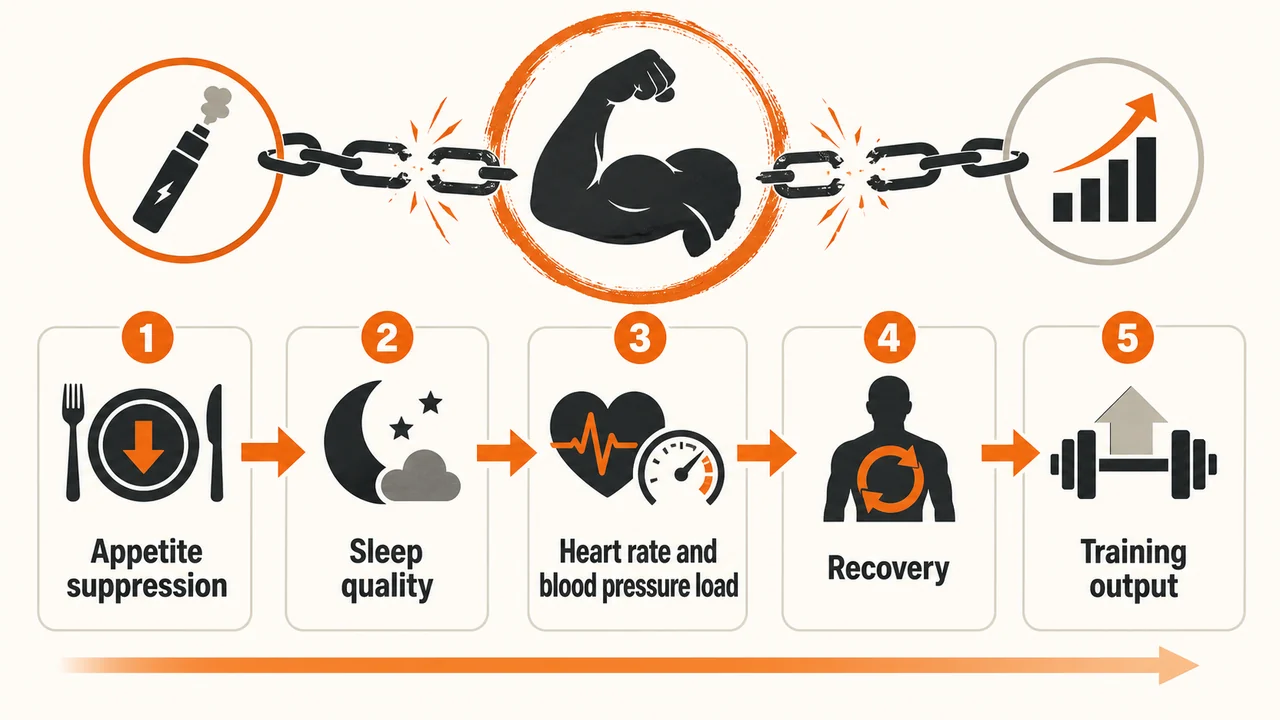
Nicotine and the Big Five Muscle-Growth Tradeoffs
1. Appetite: the easiest way nicotine hurts a bulk
If nicotine blunts hunger, the muscle-growth problem is straightforward: you may miss the calorie surplus you think you are hitting. This matters most for lean men, hardgainers, and anyone already struggling to eat enough protein and carbs around training.
Use your food log as the truth source. If nicotine makes you skip breakfast, under-eat after training, or replace meals with stimulants, your plan needs a correction. Our guide to protein timing for men over 40 is a useful next step if your intake is inconsistent.
2. Sleep: the hidden recovery cost
Sleep is where training stress gets converted into adaptation. Nicotine is a stimulant, and late-day use can be a problem even when you fall asleep quickly. The useful test is not only bedtime. It is morning readiness, resting heart rate, mood, soreness, and whether you can repeat quality sessions.
3. Cardiovascular strain: heart rate and blood pressure load
Hard lifting already raises cardiovascular demand. Nicotine can add a stimulant layer on top of that, especially if you use it near training. For men who also do conditioning, high-stress work, poor sleep, or high caffeine, the total load matters. The broader training-stress picture overlaps with our breakdown of cardio and cortisol.
4. Recovery behavior: cravings can steer the day
Nicotine dependence can shape small decisions: delaying meals, reaching for a pouch instead of a recovery snack, dosing late, or cutting warmups short. None of these looks dramatic in isolation. Together, they can reduce the consistency that hypertrophy needs.
5. Training output: stimulation is not progression
Some people feel more alert with nicotine. Alertness is not the same as better programming, more recoverable volume, cleaner technique, or stronger weekly progression. If a stimulant makes a session feel better but worsens sleep or appetite afterward, the net effect can still be negative.
| Tradeoff | What nicotine can do | Muscle-growth risk | PrimeForMen score |
|---|---|---|---|
| Appetite | Can make food feel less urgent. | Missed calories, weaker bulks, lower protein consistency. | High |
| Sleep | Can keep the nervous system more stimulated. | Lower readiness, slower recovery, more soreness. | High |
| Heart rate and blood pressure | Can add cardiovascular load. | Harder conditioning, poorer recovery signal, higher strain. | Medium-high |
| Training consistency | Can create cravings and timing rituals. | Less predictable meals, sleep, and session quality. | Medium |
| Direct hypertrophy mechanism | Evidence is less clean than the lifestyle tradeoffs. | Possible concern, but not the first variable to fix. | Unclear |
Support the Basics Nicotine Often Disrupts
These products can help with training fundamentals, not nicotine dependence. They do not treat nicotine dependence or offset nicotine risks. Use them only as basic support for protein intake, hydration, and consistent resistance training.
- Cover protein before you worry about advanced supplements.
- Keep hydration and electrolytes steady when appetite or routine slips.
- Use simple resistance tools to keep training consistent at home or while traveling.
Amazon Product Shortlist
These products do not treat nicotine dependence or offset nicotine risks. They are practical training-support tools only.

Protein powder
Useful when the real gap is daily protein consistency, not another complicated supplement.
- Makes higher-protein days easier when meals are rushed.
- Fits post-workout or low-prep meal routines.
- Pairs well with strength, recovery, and weight-management goals.

Electrolyte powder
Best when sweat, heat, session length, or low-carb phases make plain water feel insufficient.
- Supports sodium/fluid replacement during sweaty sessions.
- More useful for long or hot training than casual sipping.
- Powder or tablets make dosing easier to adjust.

Resistance bands
The easiest low-friction tool for warm-ups, anti-rotation work, and travel training.
- Scales from rehab-style activation to hard accessory sets.
- Supports push, pull, and core patterns without much space.
- Useful when cables or machines are not available.
*Affiliate disclosure: PrimeForMen may earn from qualifying purchases. Product images are loaded from Amazon media URLs and product availability can change.
*PrimeForMen may earn a commission from qualifying purchases. Product categories are for training support only and are not nicotine-cessation products.
Does the Delivery Method Change the Muscle-Growth Risk?
Yes and no. Cigarettes, vapes, nicotine pouches, gum, and lozenges are not identical. Smoke exposure is different from a pouch. Vaping aerosol is different from gum. But if the product delivers nicotine, the stimulant, appetite, sleep, heart-rate, blood-pressure, craving, and dependence questions still matter.
That is why men often get confused. They switch from smoking to vaping or pouches and assume the muscle-growth question is solved. It may reduce some exposures, but it does not automatically make nicotine compatible with optimal recovery.
Most articles argue about nicotine as if it is either a performance enhancer or a muscle killer. The more useful middle ground is this: nicotine can make the basics harder to execute. If your training plan already has weak links, nicotine tends to exploit them.
What to Do This Week If You Use Nicotine
Track the real inputs
For seven days, track protein, total calories, sleep time, resting heart rate, and training performance. Do not guess.
Move nicotine away from training
Avoid using nicotine as a pre-workout crutch. If performance drops without it, your recovery or nutrition probably needs attention.
Protect the last 3 hours before bed
If sleep quality is poor, late nicotine is one of the first variables to tighten.
Build a replacement routine
Swap the trigger moment with a walk, water, protein snack, breathing drill, or mobility block. Keep it simple enough to repeat.
If soreness, fatigue, or stalled sessions are already a problem, start with the recovery foundation in our guide to muscle recovery techniques. If protein intake is the weak link, compare practical options in our guide to the best protein powders.
Conclusion
Nicotine can affect muscle growth mainly by making the growth environment worse: less food, lower sleep quality, higher cardiovascular strain, more cravings, and less consistent recovery. It is not a smart hypertrophy tool, and it is not something protein powder or electrolytes can cancel out.
The practical move is to measure what nicotine changes in your routine. If your calories, protein, sleep, and training output improve when nicotine use drops, you have your answer. If quitting feels difficult, use professional cessation support instead of trying to solve dependence with gym discipline alone.
Medical Disclaimer: This article is for general education and does not replace medical advice, diagnosis, or treatment. Nicotine dependence, high blood pressure, chest pain, severe sleep disruption, or withdrawal symptoms should be discussed with a qualified healthcare professional.
Affiliate Disclosure: Some links in this article are affiliate links. PrimeForMen may earn a commission if you buy through them, at no extra cost to you. Recommendations are editorial and should not be read as treatment for nicotine dependence.
Frequently Asked Questions About Nicotine and Muscle Growth
Does nicotine directly stop muscle growth?
Not in a clean, guaranteed way that applies equally to everyone. The stronger practical concern is indirect: nicotine can reduce appetite, disrupt sleep, increase cardiovascular load, and make recovery behaviors less consistent.
Do nicotine pouches affect muscle growth?
They may, especially if they suppress appetite, worsen sleep, raise heart rate, or reinforce frequent dosing. Pouches avoid smoke, but they still deliver nicotine.
Is vaping worse for muscle growth than nicotine alone?
Vaping adds aerosol exposure and lung-performance questions on top of nicotine. For the nicotine-specific side, the main issues remain appetite, sleep, cardiovascular strain, dependence, and training consistency.
Can protein powder offset nicotine’s effect on gains?
No. Protein powder can help you hit daily protein targets, but it does not treat nicotine dependence, improve blood pressure, or erase sleep disruption. It only supports one part of the recovery equation.
Should I quit nicotine if I want more muscle?
If nicotine makes you eat less, sleep worse, train inconsistently, or feel dependent, reducing or quitting is likely to help your overall fitness system. If quitting feels difficult, use evidence-based cessation support and speak with a healthcare professional.