
Core workout for beginners should build control before intensity. Your core is not just abs. It is your trunk system: abdominals, obliques, lower back, diaphragm, pelvic floor, and deep stabilizers that transfer force between your upper and lower body.
For men starting out, the goal is simple: build a stronger, more stable trunk that improves lifting, posture, athletic movement, and low-back resilience. You do not need fancy exercises. You need the right sequence and smart progression.
TL;DR
- A core workout for beginners should prioritize bracing, breathing, anti-rotation, and anti-extension first.
- Train core 2-4 times per week in short, high-quality blocks of 10-20 minutes.
- Planks alone are not enough; include carries, dead bugs, side-plank variants, and controlled rotation work.
- Progress by improving time-under-tension and movement quality before adding complexity.
- Consistent core training improves lifting mechanics, athletic output, and back comfort.
Build a Core That Actually Supports Performance
The beginner goal is trunk control under load and movement, not chasing random ab burn.
Control spinal position during movement.
Transfer force across full-body exercises.
Reduce unnecessary strain in training and daily life.
Use this with lower body home workouts, home cardio exercises, and functional fitness training for a complete beginner system.
The Prime Perspective
Most beginners train abs like a beach-muscle accessory. Better approach: train your core like a performance engine that protects your spine and improves every major lift.
What Beginners Need to Understand About Core Training
Your core has four primary jobs:
- Resist extension: stop your low back from over-arching under load.
- Resist rotation: keep your trunk stable when force tries to twist you.
- Resist lateral flexion: control side-bending under asymmetrical load.
- Transmit force: connect hips and shoulders for efficient movement.
When beginners train these functions, posture and lifting quality improve fast. When they skip them, they often plateau, leak force, and feel low-back discomfort during squats, presses, carries, or sports work.
Core Workout for Beginners: Best Exercise Categories
| Category | Beginner Example | Main Benefit | Common Error | Coaching Fix |
|---|---|---|---|---|
| Anti-extension | Dead bug, body saw | Spinal control under tension | Rib flare and low-back arch | Exhale fully and brace before each rep |
| Anti-rotation | Pallof press hold | Rotational stability | Torso turning during press | Square hips and press slower |
| Anti-lateral flexion | Suitcase carry | Side-to-side trunk control | Leaning toward/away from load | Tall posture and shorter steps |
| Flexion control | Curl-up variation | Trunk stiffness and awareness | Neck pulling and momentum | Slow tempo and neutral neck |
| Integrated core | Front-loaded squat | Real-world force transfer | Losing brace at depth | Reset breath before each rep |
Evidence Reality Check for Beginner Core Training
US guidance supports strength training and regular movement as key pillars for long-term function and health (CDC Physical Activity Basics). National medical guidance also emphasizes exercise for improved musculoskeletal function and reduced health risk over time (MedlinePlus exercise and physical fitness guidance).
For beginners, core work should be integrated into full-body training instead of treated as endless high-rep ab circuits.
Amazon.com Picks
Beginner Core Training Kit
Why these categories: they improve resistance options, exercise execution, and consistency for core-focused sessions.
Resistance Band Sets
Perfect for beginner anti-rotation drills like Pallof presses and core activation sequences.
- Low-impact progression
- Travel-friendly setup
- Great for home training
Ab Wheel Rollers
Strong anti-extension tool when used with strict progression and controlled range.
- High core tension potential
- Clear progression pathway
- Compact and affordable
Exercise Mats
Improves comfort and setup quality for floor-based core work and mobility prep.
- Better consistency at home
- Supports floor drills
- Reduces setup friction
* As an Amazon Associate, we earn from qualifying purchases.
Core Workout for Beginners: 3-Day Starter Plan
This plan works well for men with limited training history and busy schedules.
Day 1: Bracing and Anti-Extension
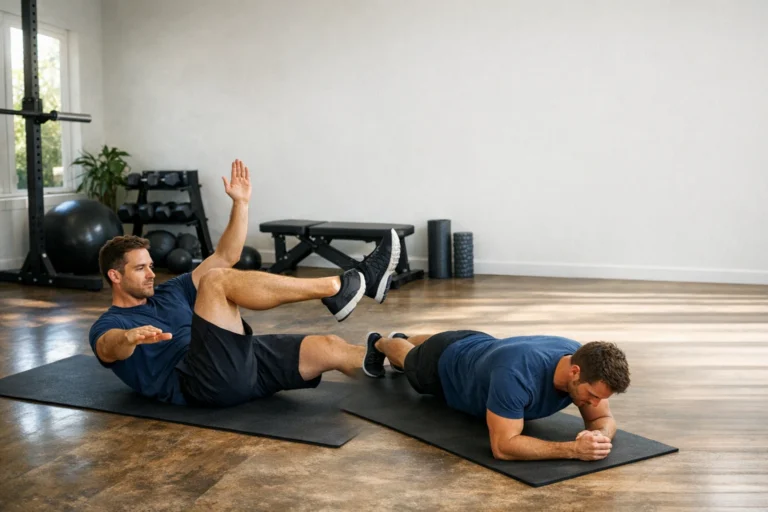
- Dead bug: 3 x 6-8 reps each side
- Forearm plank: 3 x 20-40 seconds
- Glute bridge hold: 3 x 20-30 seconds
- Bird dog: 3 x 6 each side
Day 2: Anti-Rotation and Carry Strength
- Pallof press hold: 3 x 20-30 seconds each side
- Suitcase carry: 4 x 20-30 meters each side
- Side plank (knees or full): 3 x 20-30 seconds each side
- Marching bridge: 2-3 x 8 each side
Day 3: Integrated Core Control
- Goblet squat with pause: 4 x 6-8
- Half-kneeling press: 3 x 8 each side
- Bear crawl: 4 x 15-25 meters
- Curl-up variation: 3 x 8-10 controlled reps
Rest 45-90 seconds between exercises. Start conservative and prioritize perfect reps over fatigue chasing.
8-Week Progression Roadmap for Beginners
| Weeks | Primary Target | Progression Strategy | Success Marker |
|---|---|---|---|
| 1-2 | Technique and breathing | Lower reps, slow tempo, strict form | No low-back irritation and better control |
| 3-4 | Time-under-tension | Increase holds 5-10 seconds | Stable posture under longer sets |
| 5-6 | Load introduction | Add light resistance to carries/presses | Improved trunk stiffness during lifts |
| 7-8 | Integrated performance | Blend core drills into full-body sessions | Better squat/press mechanics and endurance |
The key rule: do not jump to advanced exercises until the basics are controlled. Better execution beats more complex exercise selection.
How to Breathe and Brace in a Core Workout for Beginners
Breathing mechanics decide whether beginner core work actually trains your trunk or just fatigues your shoulders and neck. Use this repeatable sequence on each rep:
- Set posture: ribcage stacked over pelvis, neutral spine.
- Inhale through nose: fill lower ribs and abdomen (360-degree expansion).
- Exhale with control: feel ribs move down without collapsing posture.
- Brace lightly: create trunk tension as if preparing for a light punch.
- Move with control: keep the brace while limbs move.
If your low back arches or your shoulders take over, reset the breath and reduce range. Breathing and bracing quality are the core of core training for beginners.
Sample Weekly Layout for Beginners
| Day | Primary Training | Core Focus | Duration | Intensity Goal |
|---|---|---|---|---|
| Monday | Full-body strength | Day 1 anti-extension block | 15 min | Technical quality |
| Tuesday | Low-intensity cardio | Optional light core activation | 8-10 min | Recovery support |
| Wednesday | Strength or bodyweight session | Day 2 anti-rotation block | 15-20 min | Controlled tension |
| Friday | Full-body session | Day 3 integrated core block | 15 min | Carryover to lifts |
| Weekend | Walk/mobility | Emergency 10-minute core option | 10 min | Habit consistency |
This schedule gives you enough frequency to improve while keeping fatigue manageable for a true beginner phase.
Beginner Mistakes That Slow Core Progress
- Too much spinal flexion work: endless crunches without stability training.
- No progression plan: repeating same holds with no added demand.
- Breathing ignored: poor bracing mechanics reduce exercise value.
- Going to failure: quality drops and compensation patterns rise.
- Separating core from full-body training: no carryover to real movement.
Core Training by Goal: What to Emphasize
| Goal | Exercise Emphasis | Weekly Frequency | Expected Early Benefit |
|---|---|---|---|
| Low-back resilience | Anti-extension + carries | 3x/week | Better tolerance for daily activity |
| Lifting performance | Bracing drills + integrated compounds | 2-3x/week | More stable squat/press mechanics |
| Athletic movement | Anti-rotation + crawling patterns | 3-4x/week short blocks | Better force transfer and control |
| Body composition support | Core circuits + full-body training | 3x/week + cardio | Higher total work capacity |
Pair this guide with hydration supplements, post-workout supplements, and online personal training if you want faster and safer progression.
What Most Guys Miss
Beginner core work is about control, not collapse. If you can keep posture and breathing clean under moderate tension, you are building a core that actually transfers to real performance.
10-Minute Emergency Core Session (Busy Day Option)
When time is tight, run this quick circuit for quality reps:
- Dead bug: 40 seconds
- Side plank: 30 seconds each side
- Pallof press hold: 30 seconds each side
- Suitcase carry march in place: 45 seconds each side
- Rest 60 seconds and repeat for 2-3 rounds
This keeps habit momentum even on high-stress days and helps you avoid all-or-nothing training patterns.
Your 24-Hour Action Plan
- Step 1: Film one set of plank and dead bug to check posture and breathing quality.
- Step 2: Run Day 1 from the starter plan and record hold times and exercise quality.
- Step 3: Schedule your next two core sessions now, so consistency is locked for the week.
Conclusion
A core workout for beginners works best when it is simple, structured, and repeatable. Build bracing skill first, progress tension gradually, and integrate core work with full-body training.
Do that for 8 weeks and you will likely notice better posture, more stable lifts, and stronger overall performance without unnecessary complexity.
Frequently Asked Questions About Core Workout for Beginners
How often should beginners do a core workout?
Most beginners do well with 2-4 weekly sessions of 10-20 minutes, depending on total training load.
Are planks enough for beginner core training?
No. Planks are useful, but beginners should also train anti-rotation, carries, and integrated movement patterns.
Can core workouts reduce lower-back pain risk?
Good core training can improve trunk control and movement mechanics, which may reduce common stress patterns linked to discomfort.
Should beginners train abs every day?
Daily high-fatigue ab work is rarely needed. Most men progress faster with 2-4 high-quality sessions and recovery between harder days.
What is the best first core exercise for beginners?
Dead bug is one of the best starting options because it teaches bracing, breathing, and controlled limb movement.
The information provided in this article is for educational purposes only and is not intended as a substitute for advice from your physician or other health care professional.
PrimeForMen may earn commissions from qualifying purchases when readers use product links. This does not change our editorial standards for evidence, fit, and safety.