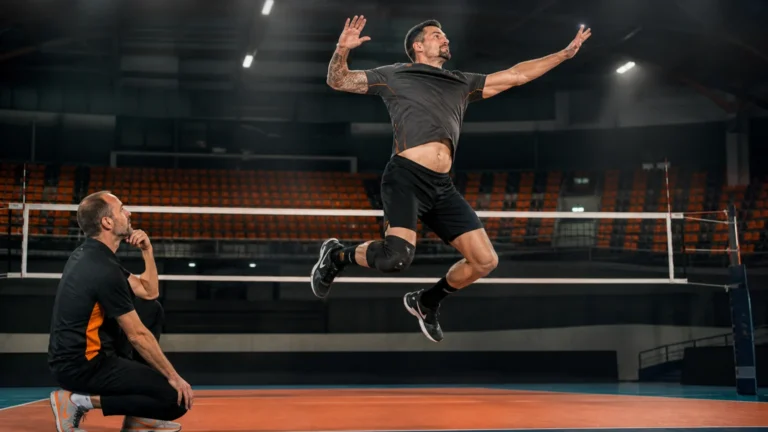
Volleyball-specific training guide: improve approach jumps, acceleration, lateral movement, landing control, strength, shoulder capacity, and weekly planning.
- Approach technique and arm swing matter as much as raw leg strength.
- Plyometrics improve jump performance when progressed rather than piled on.
- Strength and conditioning must account for jumps already performed in practice.
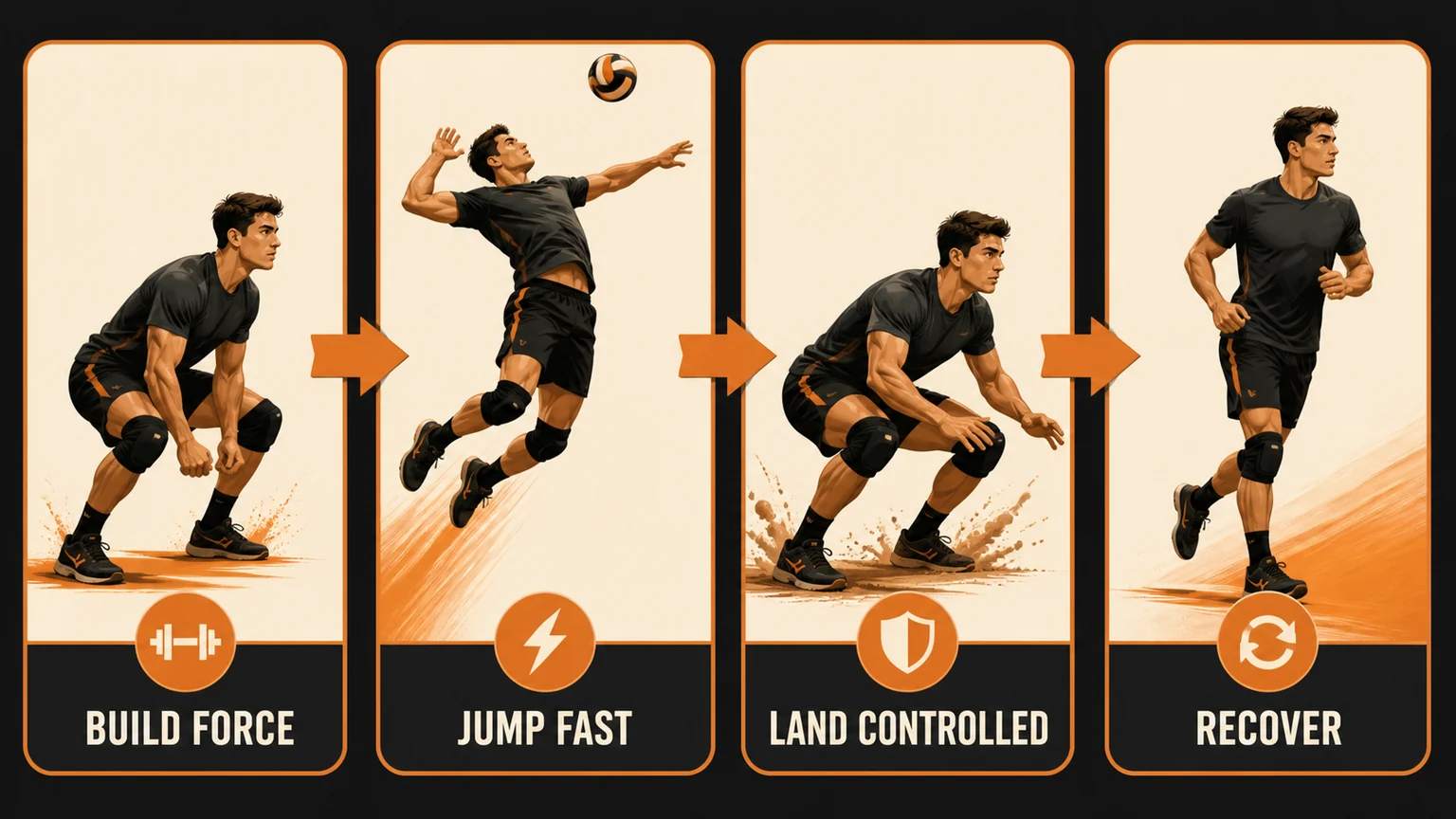
Bottom line Build strength, convert it into clean jumps and fast court movement, then control total contacts so quality survives the season.
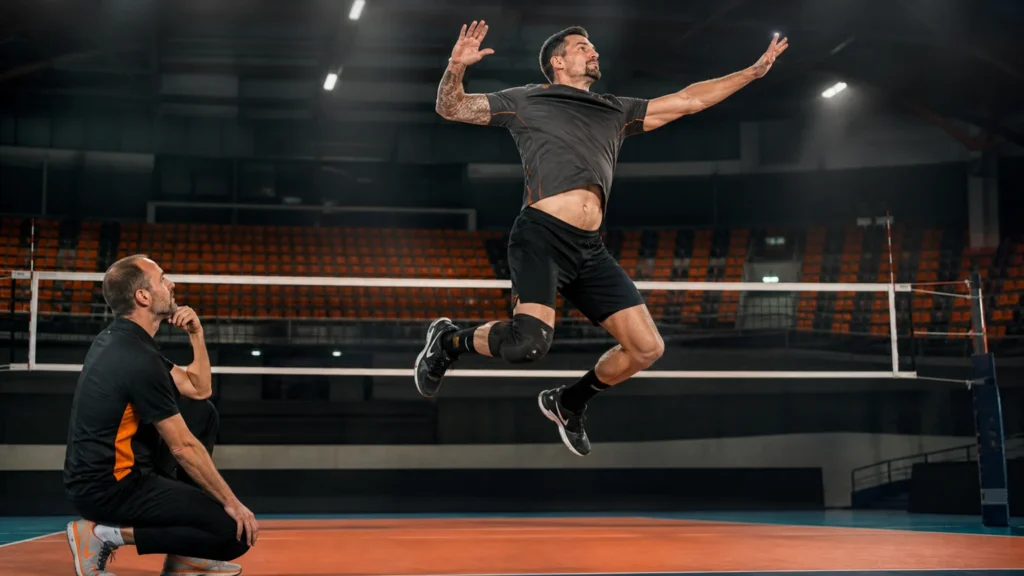
Volleyball-Specific Training works best when the plan matches the real question, the current training load, and the reader's recovery capacity. The goal is a clear decision and a repeatable next step—not another list of disconnected tips.
Quick Summary: Volleyball-Specific Training
- Volleyball requires repeated high-force jumps, short accelerations, lateral reactions, overhead skill, and rapid recovery between rallies.
- Use strength training to raise force capacity and plyometrics to express it quickly.
- Track jumps from practice, matches, and conditioning as one weekly load.
- Neuromuscular warm-ups should combine strength, balance, plyometrics, and agility rather than rely on stretching alone.
- Painful landings, recurrent ankle giving-way, or persistent shoulder symptoms require qualified assessment.
The Prime Perspective
The best jump program is not the one with the most contacts. It is the one that improves takeoff and landing while leaving enough spring for actual volleyball.
Volleyball-specific training develops the ability to approach, jump, land, accelerate, shuffle, brake, swing, and recover repeatedly. It combines technical practice with strength, plyometrics, shoulder capacity, ankle and knee control, and enough aerobic fitness to maintain quality across sets.
Train the Physical Qualities Behind Each Rally
| Quality | Volleyball demand | Useful training | Key control |
|---|---|---|---|
| Maximal strength | Higher force potential | Squat, split squat, hinge, pull | Leave reps in reserve |
| Explosive power | Approach and block jump | Jumps, throws, Olympic-lift derivatives | Stop when height falls |
| Acceleration | Cover short court distances | 5–10 m starts | Full recovery |
| Deceleration | Defensive control and landing | Stick landings, shuffle-to-brake | Quiet aligned finish |
| Shoulder capacity | Serving and attacking volume | Rows, presses, cuff and scapular work | Track hitting load |
| Aerobic recovery | Recover between rallies and sets | Easy cardio and court intervals | Do not replace speed |
Amazon Product Shortlist
These tools support skill contacts and court organization. PrimeForMen has not independently tested them, and a coach should still guide technique and jump load.

Tachikara Sensi-Tec Indoor Volleyball
For position-specific serving, setting, passing, and attacking work with an indoor-size ball.
- NFHS-approved indoor model.
- Composite cover for regular practice.
- Confirm inflation and league specifications.

OVANTO Volleyball Training Kit
For solo contact repetition when a coach has already established the intended movement and target.
- Adjustable elastic return system.
- Supports repeated setting or hitting contacts.
- A rebound tool cannot correct technique by itself.

Flat Marker Cones
For marking approach steps, shuffle distances, defensive zones, and safe deceleration targets.
- Low-profile flat-disc design.
- Multiple colors simplify movement cues.
- Keep all markers outside landing hazards.
*As an Amazon Associate, PrimeForMen earns from qualifying purchases. Availability and prices can change.
A Two-Day Strength and Power Plan
Day A — Force and approach jump
- Approach jump: 4 x 3 high-quality contacts
- Trap-bar deadlift or squat: 4 x 4–6
- Rear-foot-elevated split squat: 3 x 6–8 per side
- Chest-supported row: 3 x 8–12
- Landmine or dumbbell press: 3 x 6–10
- Calf raise plus trunk carry: 3 sets
Day B — Speed and landing
- Lateral bound to stick: 3 x 3 per side
- Countermovement jump: 4 x 3
- Romanian deadlift: 3 x 6–8
- Step-up: 3 x 6–10 per side
- Pull-up or pulldown: 3 x 6–10
- External rotation and serratus work: 2–3 sets
Yes. A 2021 meta-analysis of 18 studies and 746 volleyball players found small-to-moderate improvements in sprint and several jump measures after plyometric jump training. The result supports structured progression, not unlimited jump contacts.
The volleyball plyometric meta-analysis included amateur and professional players. No intervention injuries were reported in the included studies, but study supervision and selected participants do not guarantee safety for every recreational program.
Track Jump Load Across the Entire Week
Count high-intensity jumps from skill practice, scrimmages, matches, and gym plyometrics. A hitter already completing a high-volume practice does not need another large jump circuit that evening. Begin with 20 to 40 purposeful contacts in an added session and reduce the dose when height, timing, or landing quality drops.
Progress one variable: contact count, approach speed, jump type, external load, or shorter recovery. Do not increase all of them in the same week.
Use a Complete Neuromuscular Warm-Up
A systematic review of ankle-sprain prevention in female athletes found support for comprehensive neuromuscular programs combining strength, balance, plyometrics, and agility. The evidence spans several sports and does not define one perfect volleyball warm-up.
- Raise temperature with two to four minutes of court movement.
- Use ankle, hip, trunk, and shoulder mobility in comfortable ranges.
- Perform low-amplitude hops and landing holds.
- Add short shuffles, brakes, and progressive approach jumps.
- Finish with position-specific ball contacts before full speed.
Condition for Repeat Quality
Use short court intervals such as 8 to 12 rounds of 10 to 20 seconds of movement with 40 to 60 seconds easy. Keep the pattern technically clean. Add easy cycling, rowing, or jogging for general aerobic work when it does not reduce jump quality.
Connect this with lower-body training, unilateral strength, core workouts, band training, recovery, and the sports-specific training pillar.
Skill practice is already physical training. Count jumps, swings, landings, and court movements before adding gym volume. The best accessory plan fills the gap instead of duplicating fatigue.
What to Do This Week
- Count jumps in one normal practice before adding plyometrics.
- Perform two strength sessions built around squat, hinge, pull, press, and calf work.
- Add two low-volume jump exposures while fresh.
- Practice landings and short defensive brakes on both sides.
- Reduce added contacts when approach height or landing control declines.
Conclusion
Build strength, convert it into clean jumps and fast court movement, then control total contacts so quality survives the season.
Next Step: Build the Full Sports-Specific System
Connect this plan to the PrimeForMen sports-specific training guide so strength, conditioning, skill, and recovery support the same goal.
Frequently Asked Questions About Volleyball-Specific Training
What is volleyball-specific training?
It develops the exact strength, jump, speed, braking, shoulder, energy-system, and skill qualities used in volleyball while accounting for position and practice load.
How often should volleyball players lift?
Two full-body sessions work well for many players in the off-season. In season, one or two lower-volume sessions may maintain strength around practice and matches.
Do plyometrics improve volleyball jumping?
Yes. Meta-analytic evidence supports improvements in several jump and sprint measures, but programming quality, total contacts, age, and existing practice load matter.
Should volleyball players run long distances?
Easy aerobic work can support recovery, but conditioning should also reflect short rallies, brief rests, repeated jumps, and rapid court movements.
How can volleyball players protect their ankles?
Use progressive landing, balance, strength, agility, and sport-practice exposure. Previous sprains or repeated giving-way may require rehabilitation and individualized support.
This article is educational and does not replace individualized medical advice, diagnosis, or treatment. Discuss persistent symptoms, hormone concerns, cardiovascular risk, digestive problems, medications, or exercise restrictions with a qualified clinician.
Some links are affiliate links. PrimeForMen may earn a commission at no extra cost to you. Product inclusion does not override evidence, fit, or safety.