

Can you do 1000 pushups a day? Learn the risks, benefits, recovery rules, and a safer progression plan.
- Possible: Yes, if you break the reps into many small sets and already have strong pushup endurance.
- A short challenge, charity event, or mental endurance test, not a long-term muscle-building plan.
- Main risk: Overuse pain in the shoulders, elbows, wrists, and lower back from repeating one movement pattern daily.
Bottom line If you still want to try it, earn the volume gradually, keep every set submaximal, add pulling work, and stop when pain or form breakdown shows up.

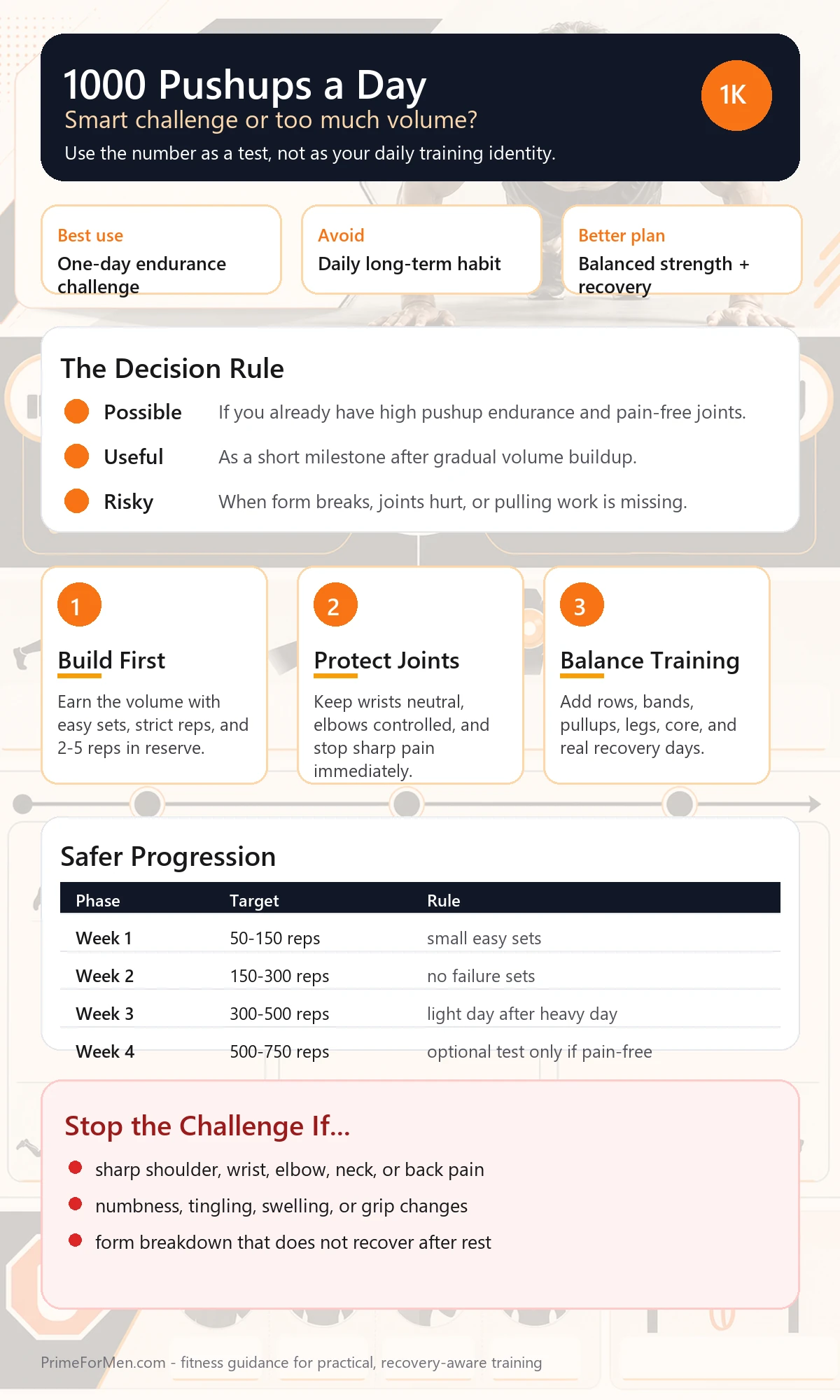
1000 pushups a day is possible for a small group of highly adapted athletes, but it is not a smart daily training plan for most men. A single 1,000-rep day can be treated as an endurance challenge. Doing it every day turns into repeated high-volume stress on the same shoulders, elbows, wrists, chest, and triceps with little room for recovery.
Quick Summary: 1000 pushups a day
- Possible: Yes, if you break the reps into many small sets and already have strong pushup endurance.
- Best for: A short challenge, charity event, or mental endurance test, not a long-term muscle-building plan.
- Main risk: Overuse pain in the shoulders, elbows, wrists, and lower back from repeating one movement pattern daily.
- Better plan: Build volume gradually, leave reps in reserve, train pulling movements, and rotate recovery days.
- Stop rule: Sharp joint pain, numbness, swelling, or form breakdown means the session is over.
The Prime Perspective
The question is not whether a man can force 1,000 pushups into a day. Many can. The better question is whether the volume moves him toward stronger, more resilient training. For most readers, the answer is no if it becomes a daily habit.
Use 1,000 pushups as a test only after you have earned the volume. If your goal is muscle, posture, joint durability, or long-term fitness, a balanced plan beats a bigger number. Our fitness guidance follows the standards described in the PrimeForMen editorial policy.
Can You Really Do 1000 Pushups a Day?
Yes, but the context matters. You are not doing 1,000 perfect pushups in one unbroken set. You are accumulating reps across the day: 20 reps every 20 to 30 minutes, 50 reps across 20 sets, or 100 reps across 10 spread-out blocks.
That makes the challenge mechanically possible. It does not make it automatically useful. A man who can already do 50 to 80 strict pushups in one set, has no wrist or shoulder pain, and has trained high-volume bodyweight work may tolerate a controlled one-day attempt. A beginner who jumps from 50 total reps a day to 1,000 is mostly testing tissue tolerance, not discipline.
What Happens to Your Body
Pushups train the chest, triceps, front shoulders, serratus anterior, and core. Done with clean form, they can be a strong bodyweight exercise. Done in extreme daily volume, they become a recovery problem.
The first few hundred reps may feel productive: pump, heat, and momentum. Later reps often shift into compensation. The hips sag, elbows flare, shoulders roll forward, wrists take more load, and the lower back starts helping a movement that should be controlled by the trunk.
That is why a 1,000-rep day should be judged by rep quality, pain signals, and recovery the next day. The number alone is not a useful scoreboard.
| Goal | What 1000 Pushups Does | Better Training Choice |
|---|---|---|
| Build muscle | Creates huge fatigue, but not necessarily better growth. | Progressive sets near technical failure, plus recovery and load progression. |
| Improve endurance | Can improve pushup-specific work capacity if volume is built gradually. | Density blocks, EMOM sets, and weekly volume increases. |
| Improve general fitness | Hits one movement pattern hard while neglecting pulling, legs, and conditioning. | A balanced full body home workout. |
| Lose fat | Burns some calories, but the fatigue cost is high. | Nutrition control, steps, resistance training, and sustainable conditioning. |
| Mental challenge | Useful as a short test if joints are healthy and form is protected. | One planned challenge day with recovery before and after. |
Benefits: What You Can Realistically Expect
The benefits are real, but they are narrower than social media makes them sound. Pushups are useful because they are simple, scalable, and equipment-free. For men training at home, they belong in a larger upper body home workout, not as the only upper-body plan.
Muscular Endurance
High-volume pushups improve your ability to repeat submaximal pushing reps. That is endurance in a specific movement pattern.
Technique Practice
Moderate daily practice can make the pushup feel smoother, but only if every rep stays clean.
Consistency
A challenge can create structure. The problem starts when consistency turns into ignoring pain and recovery.
Daily pushups can help build upper-body strength, but reputable health sources also warn that repeating the same exercise every day can lead to plateaus and injury risk if form, variation, and recovery are ignored. Medical News Today notes that daily pushups can carry risks such as back pain, wrist pain, elbow strain, and training plateaus when people repeat the same movement without enough balance. Medical News Today’s review of daily pushups is a useful baseline for that tradeoff.
Risks: Shoulders, Wrists, Elbows, and Recovery
The risk is not that pushups are dangerous. The risk is that 1,000 daily reps compress too much repeated stress into the same joints and tissues.
Mayo Clinic’s strength-training guidance is simple: train major muscle groups at least twice weekly, but do not train the same muscle group two days in a row. That does not mean every light pushup is forbidden. It does mean a hard, high-volume pushup challenge conflicts with normal recovery logic. Mayo Clinic’s strength training basics are a stronger standard than viral challenge rules.
Stop the Challenge If This Happens
- Sharp shoulder, elbow, wrist, neck, or low-back pain.
- Numbness, tingling, swelling, or pain that changes your hand position.
- Form breakdown that does not recover after rest.
- Pain that is worse the next morning rather than normal muscle soreness.
- Fatigue that affects sleep, mood, appetite, or normal training for several days.
Who Should Not Try 1000 Pushups a Day?
Skip the challenge if you are new to training, currently dealing with shoulder or wrist pain, recovering from an injury, or unable to perform at least 25 strict pushups without form breakdown. Also skip it if you are using the challenge to replace a complete program.
If you need a base first, start with strength training basics or a simple no equipment workout. The fastest way to make a big challenge productive is to stop making it your first serious plan.
1000 Pushups in One Day vs. Every Day
These are different goals. One planned 1,000-rep day is a high-volume event. Doing 1,000 pushups every day is a training system, and a poor one for most people.
| Version | Best Use | Main Rule |
|---|---|---|
| One-day challenge | Testing endurance, charity, or personal milestone. | Plan recovery before and after. |
| Short phase, 3-7 days | Only for adapted athletes experimenting with volume. | Keep sets easy and monitor joint pain daily. |
| Daily long-term habit | Rarely the best choice. | Replace with balanced programming. |
A Safer 4-Week Pushup Progression
If your goal is to work toward a high-rep day, build the capacity instead of ambushing your joints. Use strict reps. Stop each set with 2 to 5 reps still in reserve. Add pulling work so the shoulders do not live in a constant pushing pattern.
| Week | Daily Pushup Target | How to Split It | Recovery Rule |
|---|---|---|---|
| 1 | 50-150 total reps | 5-10 easy sets across the day. | Take a day off if wrists or shoulders feel irritated. |
| 2 | 150-300 total reps | Use small sets, never grind to failure. | Add rows, band pull-aparts, or pullups. |
| 3 | 300-500 total reps | Break into 20-40 rep blocks depending on your max. | Rotate one lighter day after every heavy day. |
| 4 | 500-750 total reps, optional test day | Only test higher if form and joints are still clean. | Schedule recovery after the highest-volume day. |
If this progression already feels aggressive, that is useful feedback. Drop the targets and build a durable base with bodyweight core workouts and balanced upper-body sessions.
Useful Gear for a Safer Pushup Block
You do not need equipment to do pushups, but the right support can reduce friction if you are training high volume. Keep the gear simple and only buy what solves a real training problem.
Push-Up Handles or Parallettes
Best fit if flat-hand pushups irritate your wrists or you want a neutral grip.
- Lets the wrist stay straighter during high-rep sets.
- Can increase range of motion if your shoulders tolerate it.
- Easy to use with incline, decline, and slow-tempo pushups.
Wrist Wraps or Wrist Support
Best fit if your wrists are the limiting factor, not your chest or triceps.
- Adds support during longer density blocks.
- Useful when transitioning from low to moderate volume.
- Does not replace pain-free mechanics or rest days.
Resistance Bands for Pulling Balance
Best fit if you are adding rows, face pulls, and band pull-aparts to balance all the pushing.
- Helps train the upper back without a full gym setup.
- Easy to pair with pushup sessions at home.
- Supports shoulder balance when pushup volume climbs.
*Affiliate disclosure: PrimeForMen may earn a commission if you buy through these links, at no extra cost to you. Recommendations are based on use-case fit for this article.
Form Checklist for High-Rep Pushups
High volume magnifies small form errors. Your first rep and your last rep do not need to look identical, but they should follow the same rules.
Hands and Wrists
Hands slightly wider than shoulder width. Spread the fingers. Keep pressure through the whole hand, not only the heel of the palm.
Shoulders and Elbows
Elbows track roughly 30 to 45 degrees from the torso. Do not let the shoulders roll forward at the bottom.
Core and Hips
Ribs down, glutes lightly tight, body moving as one line. If the hips sag, end the set.
What to Do Instead for Muscle Growth
If you want more chest, shoulders, and arms, you do not need 7,000 pushups per week. You need progressive overload, enough hard sets, and recovery. That can mean weighted pushups, dumbbell pressing, dips, rows, pullups, and direct triceps work.
For a more balanced path, use strength training at home as the backbone and put pushups inside the plan. If recovery is already lagging, read the guide to active recovery workouts before adding more volume.
24-Hour Protocol for a One-Day Attempt
- Before: Do not test 1,000 reps after a hard chest, shoulder, or triceps day.
- Warm up: 5-8 minutes of easy movement, shoulder circles, scapular pushups, and low-rep practice sets.
- During: Use small sets early. If your max is 50, sets of 15-25 are smarter than sets of 40.
- After: Stop chasing more volume. Hydrate, eat normally, and let the next day be recovery or light pulling/mobility.
- Review: If joints hurt more than muscles, the attempt exposed a weak link. Fix that before repeating it.
Conclusion
1000 pushups a day sounds disciplined, but the better standard is whether the plan makes you stronger without beating up your joints. A one-day challenge can be a memorable endurance test. A daily 1,000-rep habit is usually a poor substitute for balanced training.
If you still want to try it, earn the volume gradually, keep every set submaximal, add pulling work, and stop when pain or form breakdown shows up. If your real goal is muscle, strength, or long-term fitness, build a complete program and let pushups be one tool inside it.
Medical Disclaimer
This article is for general fitness education only. It is not medical advice, diagnosis, or treatment. If you have shoulder, wrist, elbow, back, cardiovascular, or other health concerns, talk with a qualified medical professional before attempting high-volume exercise.
Frequently Asked Questions About 1000 Pushups a Day
Is doing 1000 pushups a day good for you?
Usually not as a daily long-term plan. It can build pushup endurance, but the recovery cost and overuse risk are high. Most men will get better results from balanced strength training.
Can 1000 pushups a day build muscle?
It may build some endurance and muscle in beginners, but it is not an efficient hypertrophy plan. Muscle growth depends on progressive overload, hard sets, nutrition, and recovery.
How long does it take to do 1000 pushups?
It depends on your set size and rest periods. Many people who complete it spread the work over several hours. Trying to rush the reps usually increases form breakdown.
What is a safer daily pushup number?
A safer number is the amount you can perform with clean form while recovering well. For many men, that may be 50-200 total reps on selected days, not 1,000 every day.
Should beginners try the 1000 pushup challenge?
No. Beginners should first build strict form, shoulder control, and basic weekly training consistency. A high-rep challenge should come after months of gradual preparation.