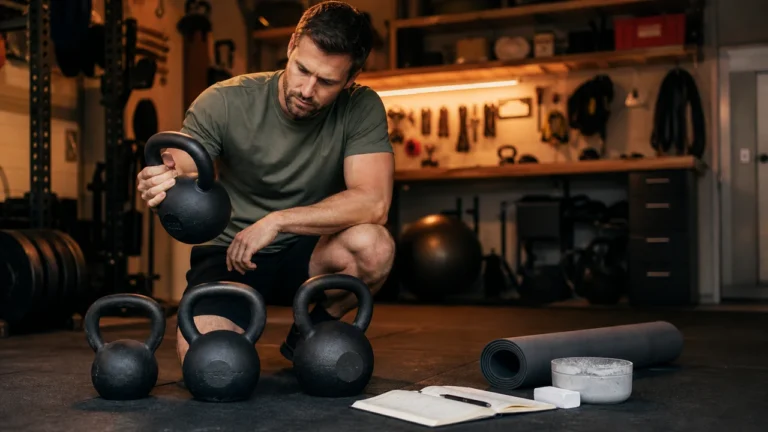
Compare cast iron, competition and adjustable kettlebells. Choose a starting weight, check handle fit and see when an adjustable model makes sense.
- Choose the bell type around your space, hand fit and progression plan.
- An adjustable kettlebell saves space only when its change mechanism fits your workout style.
- Learn the hip hinge before adding speed or load to swings.
Bottom line Buy the fewest bells that support safe technique and clear progression; an adjustable model is a tool, not an automatic upgrade.
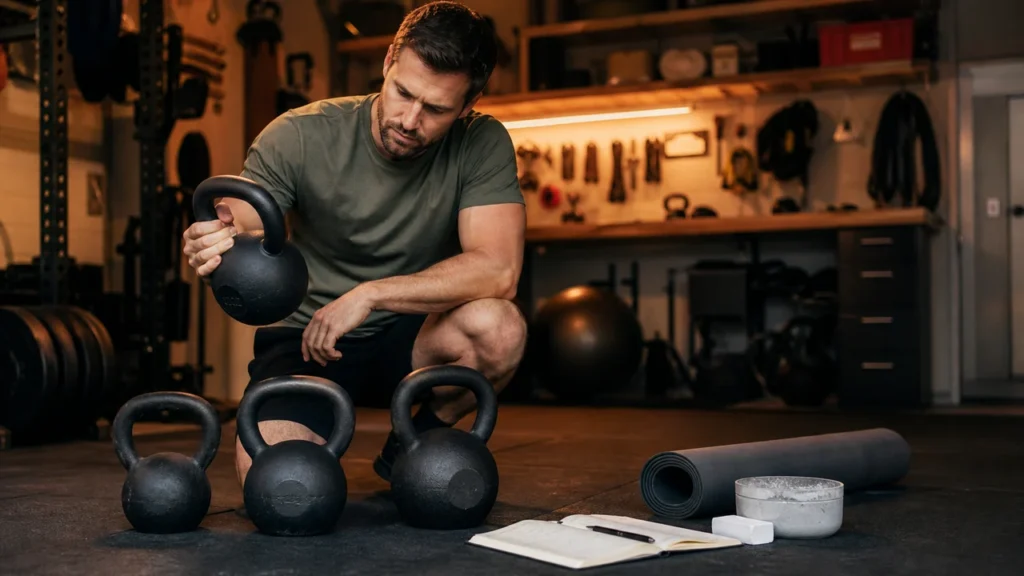
Kettlebells for men work best when the purchase and the program match: a bell you can deadlift, goblet squat, carry, press when appropriate, and eventually swing with clean reps.
- Buy by movement, not ego: swings, squats, presses, carries, and get-ups often need different starting weights.
- A fixed cast iron bell is usually the simplest first buy; adjustable kettlebells make sense when space is the bottleneck.
- Learn the hinge before swings. Deadlifts, carries, rows, and goblet squats are safer first steps for most beginners.
- Progress one variable at a time: reps, sets, time, density, range, load, or exercise complexity.
This guide is general fitness education, not medical advice or individualized coaching. Stop any exercise that causes sharp pain, dizziness, numbness, chest pain, worsening symptoms, or unusual discomfort, and speak with a qualified professional when needed.
The best kettlebell purchase is not the heaviest bell you can move once. It is the bell you can move with crisp reps, repeatable breathing, and enough room to progress without turning every session into compensation.
Kettlebell Buyer Scorecard: What Actually Matters
Do not buy a kettlebell by weight alone. Score it by the job: can you hinge it, squat it, carry it, grip it, store it, and progress it? A good bell fits your hand, floor, space, and training week. A bad bell looks strong online and makes every session harder to repeat.
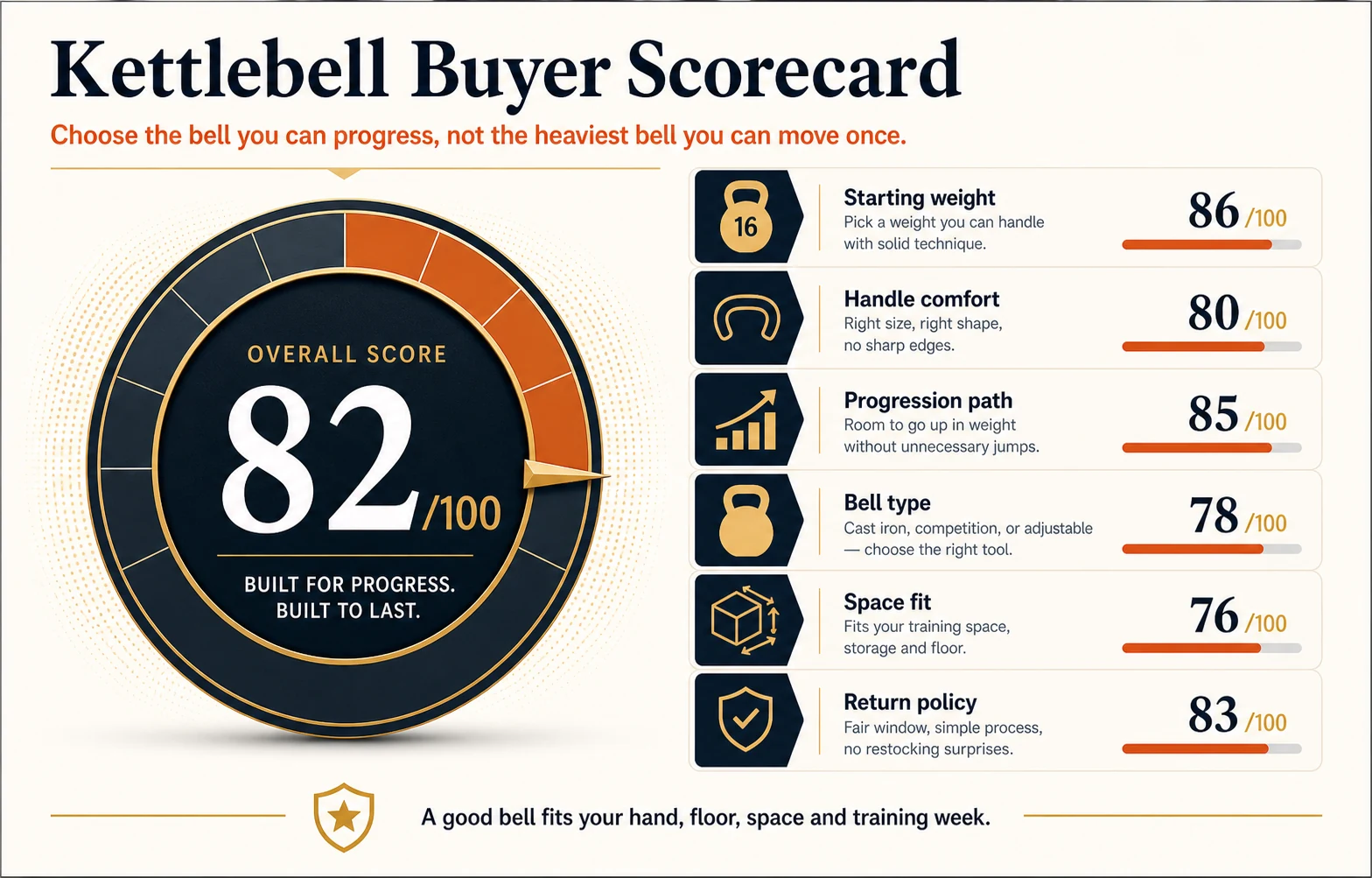
| Criterion | Why It Matters | What To Check |
|---|---|---|
| Starting weight | Swings, presses, carries, and get-ups do not all use the same load. | Pick by the exercise you will train most often, not the heaviest bell you can lift. |
| Handle comfort | A bad handle ruins swings, cleans, rows, and carries. | Width, diameter, coating, texture, seams, and whether two hands fit. |
| Progression path | One good bell should still be useful after four to eight weeks. | Can you add reps, sets, time, density, range, or load without losing form? |
| Bell type | Cast iron, competition, and adjustable kettlebells solve different problems. | Fixed feel, consistent size, space savings, adjustment speed, and skill goals. |
| Space and floor fit | A good home-gym tool still fails if storage is annoying. | Flat base, footprint, mat, floor protection, and where the bell lives. |
| Returns and warranty | Heavy gear is expensive and irritating to send back. | Return window, shipping terms, brand support, and seller reliability. |
What Kettlebell Weight Should Men Start With?
The right starting weight depends on the exercise. A bell that is good for swings may be too heavy for presses or Turkish get-ups. If technique breaks, the bell is too heavy for that movement.
| Exercise or Goal | Beginner | Trained Beginner | Advanced |
|---|---|---|---|
| Kettlebell deadlift | 12-16 kg | 16-24 kg | 24-32 kg+ |
| Two-hand swing | 12-16 kg | 16-24 kg | 24-32 kg+ |
| Goblet squat | 12-16 kg | 16-24 kg | 24-32 kg+ |
| Farmer carry | 16-24 kg | 24-32 kg | 32 kg+ |
| Single-arm row | 12-16 kg | 16-24 kg | 24 kg+ |
| Press, clean, or snatch | 8-12 kg | 12-16 kg | 16-24 kg+ |
| Turkish get-up | 6-12 kg | 12-16 kg | 16 kg+ |
Body size, training age, injury history, grip, mobility, and technique all matter. Start lighter than your ego wants, then progress only when control stays high.
Cast Iron vs. Competition vs. Adjustable Kettlebells
Cast iron is usually the best first kettlebell because it is simple, durable, and easy to understand. Competition bells are better when you care about clean, snatch, or sport-style technique. Adjustable bells are useful when space matters more than perfect fixed-bell feel.
| Type | Best For | Pros | Watch Out For |
|---|---|---|---|
| Cast iron kettlebell | Home gyms, swings, goblet squats, carries | Simple, durable, usually the best first buy. | Size changes as weight changes; handle finish varies by brand. |
| Competition kettlebell | Cleans, snatches, sport-style skill work | Same bell size across weights; technique feels more consistent. | Often more expensive and less necessary for basic squats/carries. |
| Adjustable kettlebell | Small spaces and multiple loads | One footprint can cover several weights. | Shape, handle, and adjustment speed may not feel like a fixed bell. |
| Vinyl or coated kettlebell | Floor protection and low-cost starts | Can be friendlier to floors. | Bulky shapes and weak handles can make training worse. |
| Kettlebell pair | Double-kettlebell squats, carries, complexes | Powerful later progression option. | Usually a second purchase after single-bell control is solid. |
Premium Kettlebell Shortlist by Buyer Situation
These are direct product starting points with Amazon media images. Re-check current price, sizing, seller, shipping, return terms, and available weights before buying.

REP Fitness Cast Iron Kettlebell
Best first-buy style when you want one reliable fixed bell for swings, squats, deadlifts, rows, and carries.
- Fixed weight keeps training simple and easy to track.
- Good fit for home-gym basics before advanced skills.
- Choose the load by your main movement, not the heaviest option.

Kettlebell Kings Competition Kettlebell
Best when clean, snatch, or sport-style skill work matters more than a basic first bell.
- Consistent size across weights supports repeatable technique.
- Better fit for skill-focused users than casual buyers.
- Skip it if your plan is only basic carries and goblet squats.
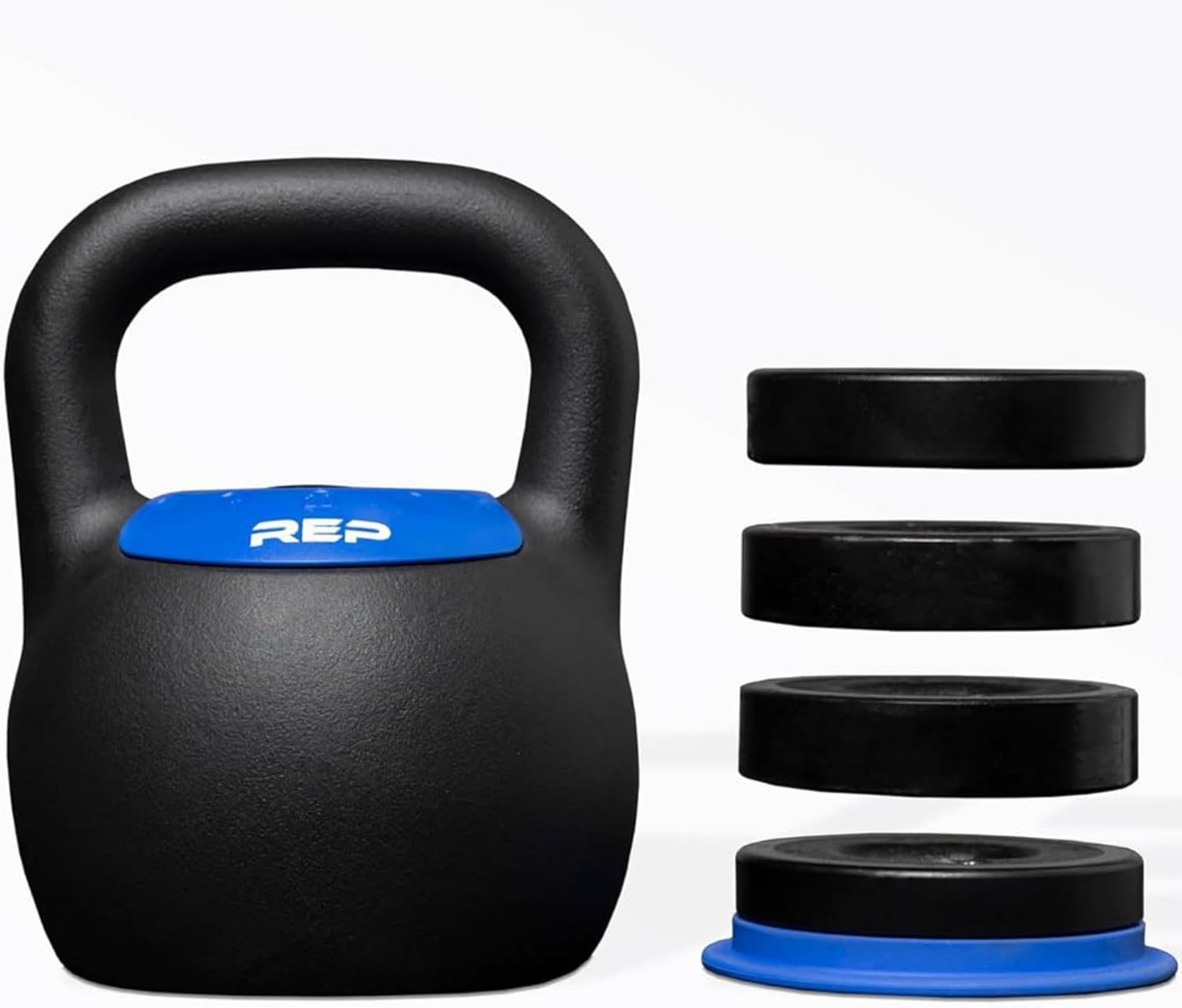
REP Fitness Adjustable Kettlebell
Best when you want multiple loads but do not want a full row of fixed bells.
- Useful for rows, presses, squats, carries, and load progression.
- Saves space in apartments, garages, and compact home gyms.
- Check handle feel and adjustment process before committing.

BowFlex SelectTech 840 Kettlebell
Best for a compact adjustable option when space and easy load changes are the main buying problem.
- Works when one unit must cover several training loads.
- Good fit for general strength work, rows, squats, and carries.
- Less ideal if you want the exact feel of a fixed competition bell.

ProsourceFit Home Gym Floor Tiles
Best setup support when floor protection, storage, and safe starts matter in a home gym.
- Helps protect floors during deadlifts, starts, and storage.
- Useful for compact spaces with kettlebells and other equipment.
- Measure the area before choosing tile quantity and thickness.
*Affiliate disclosure: PrimeForMen may earn from qualifying purchases. Product images are loaded from Amazon media URLs. Product names, prices, availability, warranties, and seller details can change.
Best Adjustable Kettlebell: Dial, Plate or Competition Shell?
The best adjustable kettlebell keeps a predictable handle and body shape across the loads you use most. A quick-change dial model is convenient for circuits. A plate-loaded competition shell is better when clean, snatch, and rack mechanics matter. A simple screw-lock design is cheaper but slower to change.
Quick-change dial
Fast for goblet squats, rows, presses, and mixed circuits. Inspect the lock before every set and avoid impact unless the manual permits it.
Competition shell
Consistent external size supports technique across loads. Internal plate changes take longer but create a more traditional feel.
Screw-lock plates
Low-cost and compact. Best for slower strength sessions, not rapid weight changes or ballistic complexes.
Fixed bells
Still best for partner workouts, fast circuits, drops, and the least mechanical uncertainty.
| Check | Pass condition | Red flag |
|---|---|---|
| Handle | Enough clearance for two hands; smooth transitions without sharp seams | Grip changes dramatically between settings |
| Lock | Clear visual or tactile confirmation | Plates rattle or the mechanism can be moved unintentionally |
| Load range | Covers the light press and heavier hinge work you plan | Big jumps force poor progression |
| Floor use | Manual allows controlled placement and your flooring protects both surfaces | Product is treated like a drop-safe gym bell without evidence |
For most men building a small home gym, one adjustable bell plus one fixed moderate bell is a practical combination: the adjustable model handles progression, while the fixed bell keeps circuits moving. Men over 50 should prioritize a secure lock, manageable jumps, and a handle that does not force the wrist. Pair the purchase with our kettlebell workout for men over 50.
Learn the Hinge Before You Swing
The kettlebell swing is earned by the hinge. If you cannot deadlift the bell with a neutral spine and quiet control, do not turn it into a ballistic swing yet. Start with deadlifts, then hike passes, then short swing sets.
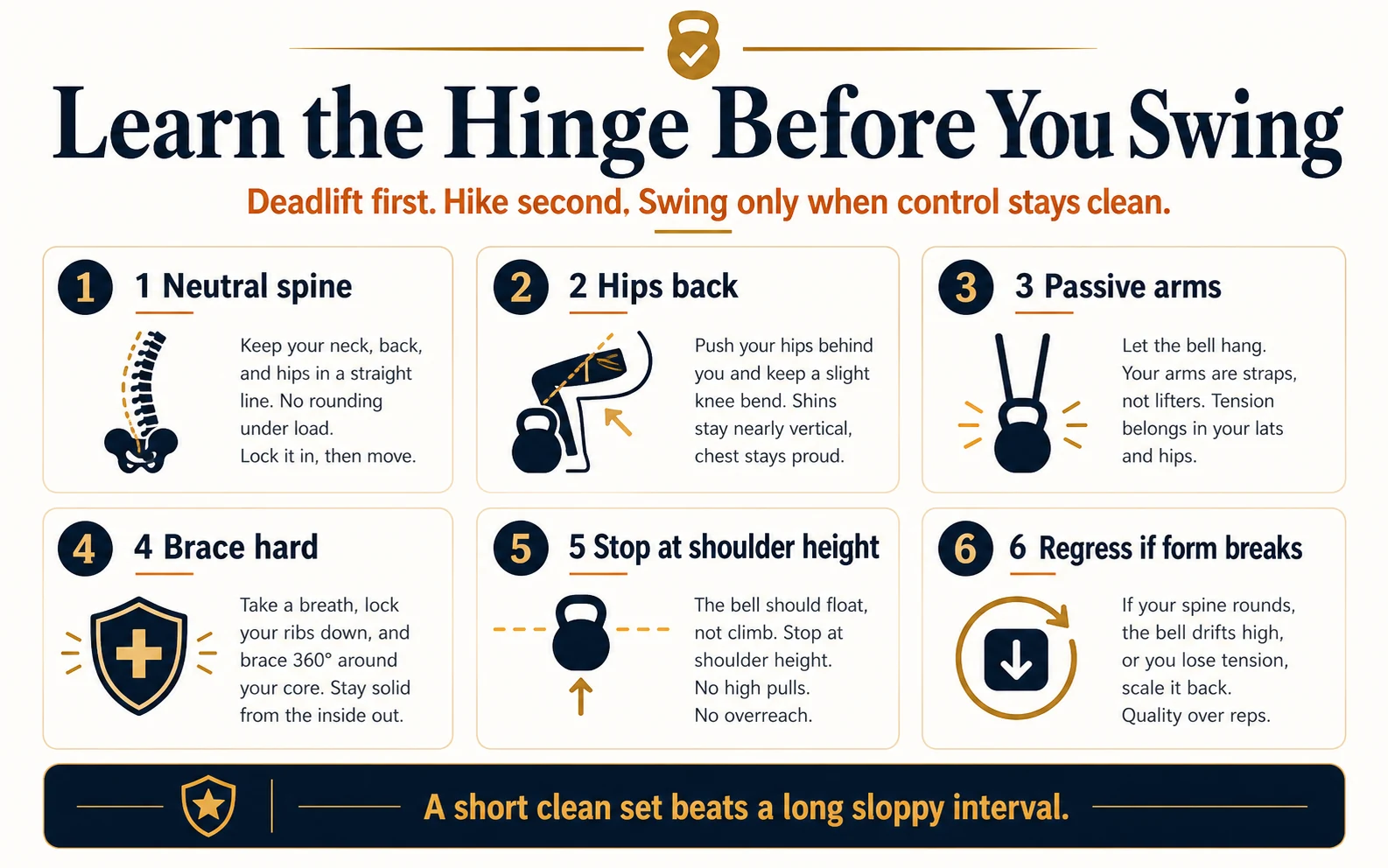
The NSCA describes the two-arm kettlebell swing around a hip-hinge setup with the hips moving back, a neutral spine, straight arms, and hip/knee extension driving the bell. That is the practical reason beginners should learn the deadlift pattern before chasing high-rep swings. See the NSCA two-arm kettlebell swing guide for the movement breakdown.
| Error | Why It Matters | Correction |
|---|---|---|
| Squat-to-front-raise | Shoulders do the work while hips barely contribute. | Hinge back, keep arms passive, and let hips drive the bell. |
| Rounded back | Spine position changes under load. | Regress to kettlebell deadlifts and lighter hinge drills. |
| Overextended top | Low back replaces glute lockout. | Stand tall without leaning back. |
| Too many reps too soon | Technique degrades under fatigue. | Use short sets and stop while reps are still clean. |
Kettlebell Exercise Library: What Each Bell Should Help You Train
A kettlebell purchase should map to exercises. If you are new, start with deadlifts, goblet squats, carries, rows, and controlled hinges. Swings come after the hinge. Cleans, snatches, and Turkish get-ups come after control.
| Exercise | Main Use | Technique Focus | Start Rule |
|---|---|---|---|
| Kettlebell deadlift | Hinge pattern | Neutral spine, hips back, quiet setup. | Learn before swings. |
| Two-hand swing | Power and conditioning | Hip drive, passive arms, bracing. | Only after clean hinges. |
| Goblet squat | Squat pattern and trunk | Upright torso, knees track, controlled depth. | Good beginner staple. |
| Farmer carry | Grip, posture, trunk | Tall posture, quiet steps, even breathing. | Excellent first load test. |
| Suitcase carry | Anti-lateral flexion | Do not lean toward or away from the bell. | Use moderate load. |
| Kettlebell row | Back and pulling strength | Stable torso, shoulder blade control. | Safer early pull than cleans. |
| Press, clean, snatch, get-up | Skill, control, power | Wrist, shoulder, ribs, timing. | Use lighter bells and build slowly. |
4-Week Kettlebell Starter Plan
Do not start with a complex. Start with a base. For four weeks, build hinge, squat, row, carry, and core control. Add swings only when the hinge stays clean.
Session A
Deadlift 3×8, goblet squat 3×6-10, row 3×8/side, farmer carry 3×30-45 sec, plank or dead bug 2-3 sets.
Session B
Hinge drill 3×5, swing 5×5-10 if ready, goblet squat 3×8, suitcase carry 3×20-40 steps/side, easy mobility.
Use kettlebell complexes only after these basics are reliable. For broader strength context, connect this plan with strength training basics, strength training at home, and home gym equipment.
Kettlebells for Men Over 40
After choosing the bell, use the complete kettlebell workout for men over 50 to progress from deadlifts and carries toward squats, presses, and earned swings.
For men over 40, kettlebells work best as repeatable strength and conditioning tools, not as daily punishment. Goblet squats, rows, deadlifts, carries, and controlled swings can fit a home routine well. The mistake is turning every kettlebell session into a max-fatigue test.
| Goal | Good Kettlebell Use |
|---|---|
| Strength maintenance | Goblet squats, rows, carries, and deadlifts. |
| Low-impact conditioning | Short swing or carry intervals with controlled rest. |
| Grip and trunk | Farmer carries, suitcase carries, and front-rack carries. |
| Posterior chain | Deadlift to swing progression. |
| Recovery management | Two to three short sessions instead of daily burnout circuits. |
The CDC adult activity guidance is a useful baseline: adults need regular moderate activity and muscle-strengthening work. Kettlebells can support the strength side and some conditioning, but they should still be dosed like training, not punishment.
How to Program Kettlebells by Goal
Kettlebells are not one training method. They can support strength, conditioning, power, hypertrophy support, grip, trunk control, and small-space home training. The program should decide the bell, not the other way around.
| Goal | Exercises | Format | Progression |
|---|---|---|---|
| Strength base | Goblet squat, row, deadlift, carry | 3-4 sets, moderate reps | Load or reps |
| Conditioning | Swings, carries, simple complexes | Intervals, EMOM, density blocks | Time or density before load |
| Power | Swings, cleans after skill is ready | Low reps, full rest | Speed and quality first |
| Core and carryover | Suitcase carry, front-rack carry, get-up | Distance, time, quality | Longer carry or heavier bell |
| Small-space home gym | Deadlift, squat, carry, row | Simple full-body sessions | Consistency first |
Kettlebell Progression Ladder
Add difficulty only when the original reason for the exercise stays intact. If the swing loses its hinge, the row twists, the carry leans, or the goblet squat collapses, you did not progress. You changed the exercise into compensation.
1. Technique
Cleaner hinge, better brace, quieter setup.
2. Reps or sets
Add work without changing the movement.
3. Time
Longer carries or controlled intervals.
4. Density
Same work in less time, only if form holds.
5. Load
Heavier bell after control is consistent.
6. Complexity
Swing to clean to snatch, not on day one.
When to Stop or Regress a Kettlebell Exercise
Kettlebell training becomes risky when the clock matters more than the rep. Stop the set when hinge, breathing, grip, shoulder position, or spinal control changes sharply.
| Signal | Decision |
|---|---|
| Back rounds in the hinge | Return to deadlifts or reduce weight. |
| Low back overextends at the top | Stop swings and rebuild the lockout. |
| Bell crashes into the wrist on cleans | Regress technique and use a lighter bell. |
| Grip panics before hips or breathing do | Shorten the set, check handle feel, or use chalk later. |
| Sharp pain, numbness, dizziness, or chest pain | Stop training and get appropriate professional guidance. |
Common Buying Mistakes
- Buying the heaviest kettlebell that sounds impressive.
- Buying a pair before you can use one bell well.
- Choosing a cheap coated bell with a bad handle.
- Buying adjustable only for space, then ignoring handle feel.
- Using chalk to hide poor mechanics or a bad grip fit.
- Starting with swings before deadlifts and carries are stable.
Bottom Line
Buy the kettlebell that fits your first useful training block, not the version of yourself you hope shows up later. For most men, that means one reliable fixed bell or one good adjustable bell, a simple hinge-squat-row-carry plan, and slow progression.
Next step: use core workout for trunk context, then move to kettlebell complexes only after your basic reps are clean.
Frequently Asked Questions About Kettlebells
What is the best kettlebell weight for men to start with?
Many men start around 12-16 kg for swings, squats, and deadlifts, but presses and get-ups often need less. Pick the weight by exercise quality, not ego.
Is 16 kg a good starting kettlebell for men?
It can be a good starting point for many men on swings, deadlifts, and goblet squats. It may be too heavy for presses, get-ups, or anyone still learning the hinge.
Should I buy one kettlebell or a pair?
Most beginners should buy one good bell first. Buy a pair later when single-bell technique, squats, carries, and programming are already consistent.
Are adjustable kettlebells worth it for home gyms?
They can be worth it when space is limited and you need several loads. They are less ideal if the handle, shape, or adjustment process makes training awkward.
What is the difference between cast iron and competition kettlebells?
Cast iron bells usually change size as weight changes. Competition bells keep the same external size across weights, which can help clean, snatch, and sport-style technique.
Should beginners start with kettlebell swings?
Not immediately. Beginners should learn deadlifts, hinges, goblet squats, carries, and rows first. Swings come after the hinge stays clean.
Can kettlebells build muscle?
They can support muscle growth when load, volume, exercise selection, and progression are strong enough. For pure hypertrophy, combine them with dumbbells, barbells, or machines when needed.
Affiliate and editorial note: PrimeForMen may earn from qualifying purchases. Product choices are included because they match buyer use cases in this guide; they are not medical claims or guarantees. Always verify current Amazon listing details before purchasing.