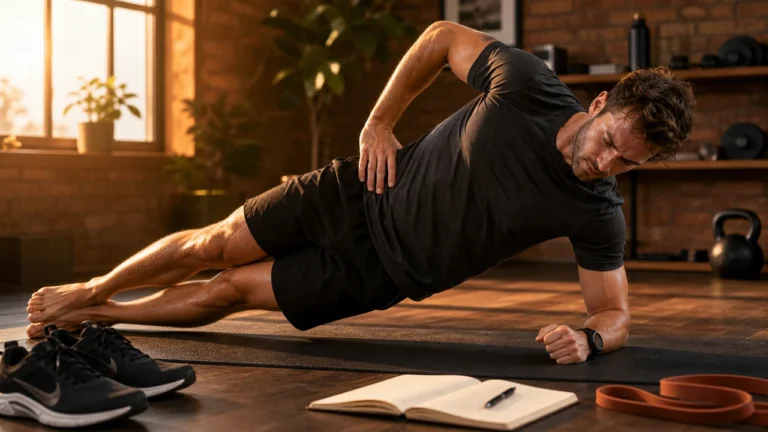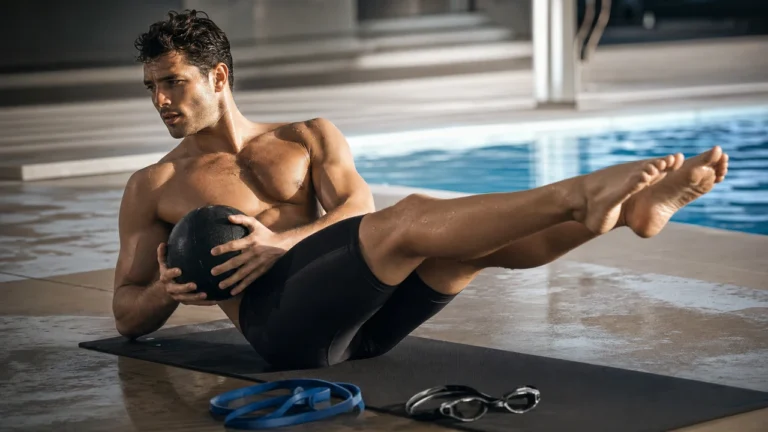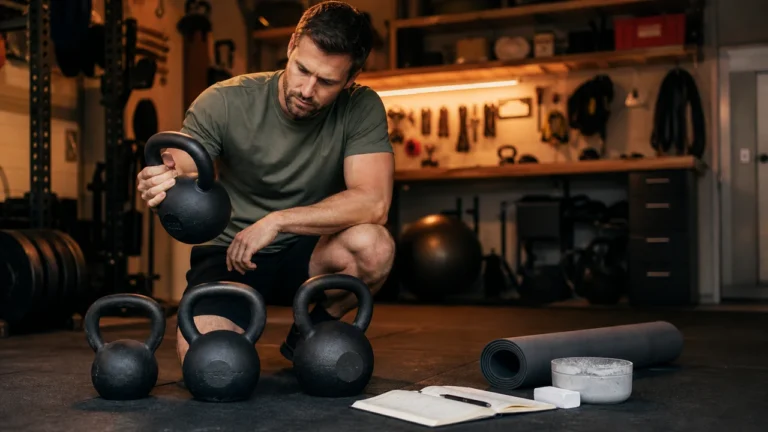
Core workouts with equipment should do more than make your abs burn; the right tools teach your trunk to resist motion, transfer force, and handle progressive load without turning every session into random crunch volume.
TL;DR:
- Use equipment to train anti-extension, anti-rotation, lateral stability, and loaded carry strength.
- Progress by changing leverage, load, tempo, range of motion, and total weekly sets.
- Cables and bands are best for rotational control; ab wheels are best for anti-extension.
- Dumbbells and kettlebells turn core training into whole-body bracing practice.
- Stop any drill that creates sharp pain, radiating symptoms, or uncontrolled low-back extension.
Medical note: This guide is educational and not medical advice. If you have back pain, hernia concerns, recent surgery, dizziness, neurological symptoms, or a condition that affects exercise tolerance, get personal guidance from a qualified clinician before adding loaded core work.
PrimeForMen perspective: Equipment is not automatically better than bodyweight training. It is better when it gives you a cleaner way to measure progress, challenge the exact core function you need, and keep technique honest as you get stronger.
What Equipment Adds to Core Training
Bodyweight core work is useful, especially if you are rebuilding consistency through a simple core workout. Equipment becomes valuable when you need clearer resistance, smoother progression, or a way to make the core work under real load.
The goal is not to collect more exercises. The goal is to train the trunk functions that carry over to lifting, carrying, sport, and everyday movement.
Anti-extension
Resist the ribs flaring and the low back arching. Ab wheels, stability balls, sliders, and long-lever planks fit here.
Anti-rotation
Resist being pulled or twisted. Bands, cables, Pallof presses, chops, and offset loads are the main tools.
Loaded bracing
Hold posture under external load. Dumbbells, kettlebells, sandbags, and trap bars make the core work globally.
Carry capacity
Walk while staying stacked. Farmer carries, suitcase carries, rack carries, and overhead carries build usable trunk strength.
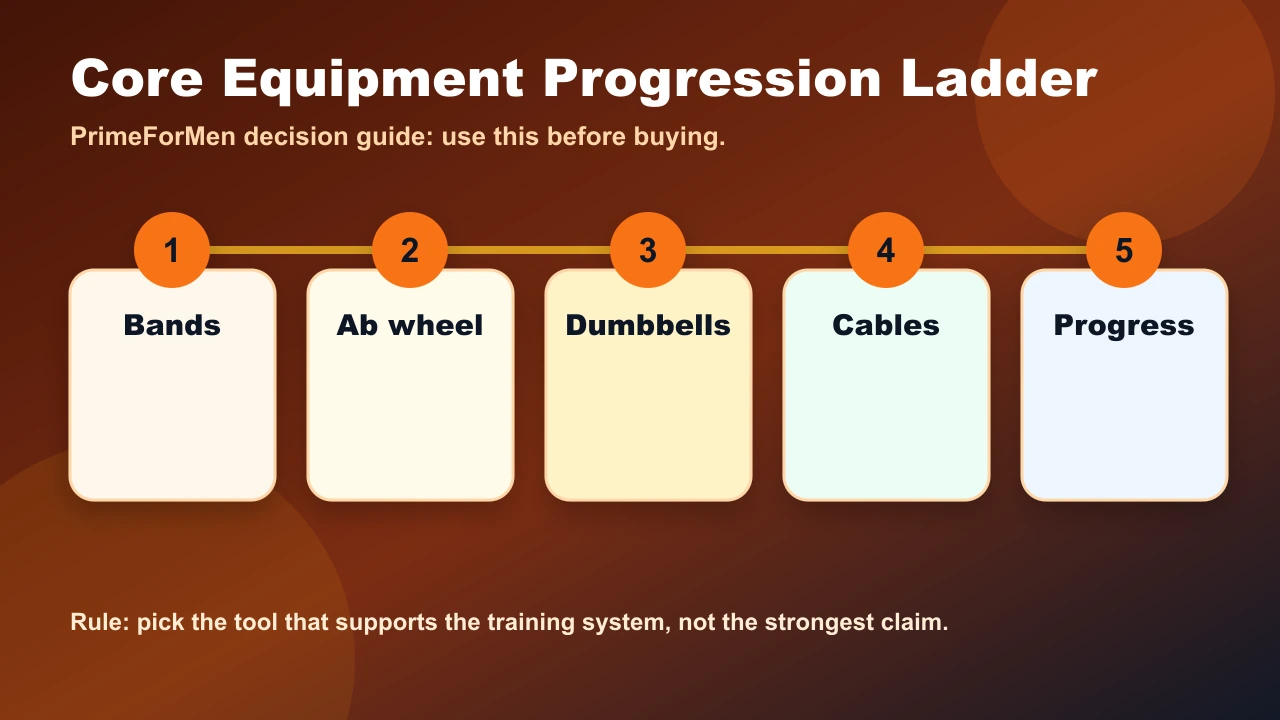
The Smart Progression Ladder
Start with the least equipment needed to create a clean challenge. If your pelvis tips forward, your ribs flare, or your shoulders take over, the tool is too advanced for the job today.
- Band dead bug: Learn to keep ribs down while the limbs move.
- Pallof press hold: Build anti-rotation without spinal twisting.
- Dumbbell front rack march: Add breathing and bracing under load.
- Ab wheel partial rollout: Increase anti-extension demand through longer leverage.
- Suitcase carry: Make the core stabilize while you move through space.
If you already train at home, this ladder pairs well with a broader strength training at home setup because the same tools support presses, rows, squats, and carries.
The gap most equipment guides miss: A harder tool is not a better tool if it removes the core action you are trying to train. Heavy cable chops can become arm swings. Ab wheel rollouts can become low-back extension. Carries can become a grip test. Choose the load that lets the trunk do the work.
Core-Tool Usefulness Meter
Best low-cost option for Pallof presses, dead bugs, chops, and warm-up activation.
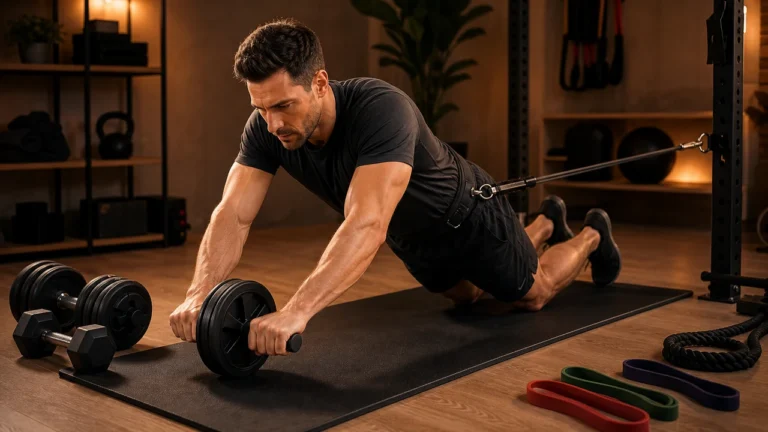
Excellent for anti-extension if you can keep the ribs down and progress range gradually.
Strongest crossover tool because it supports carries, marches, rows, presses, and offset loading.
Precise and smooth for anti-rotation, wood chops, lifts, and controlled rotational patterns.
Equipment Worth Considering
These tools earn their place because they support measurable progression without needing a full gym.
- Pick the tool that matches your weakest core function first.
- Favor adjustable resistance so you can progress slowly.
- Keep technique quality higher than the urge to add load.
Amazon Product Shortlist
These are practical product starting points, not medical or performance guarantees. Use the images, sizing, labels, reviews, and return policy to compare the real item before buying.

Ab wheel
A compact core tool for men who can brace and want a harder anti-extension challenge.
- Progresses beyond basic planks without needing a machine.
- Makes range easy to scale by shortening the rollout.
- Rewards control instead of high-rep crunch fatigue.

Resistance bands
The easiest low-friction tool for warm-ups, anti-rotation work, and travel training.
- Scales from rehab-style activation to hard accessory sets.
- Supports push, pull, and core patterns without much space.
- Useful when cables or machines are not available.

Adjustable dumbbells
The strongest space-saving upgrade when progression matters more than collecting equipment.
- Lets you increase load without filling a room with pairs.
- Works for strength, carries, presses, rows, and core loading.
- Keeps home training measurable week to week.
*Affiliate disclosure: PrimeForMen may earn from qualifying purchases. Product images are loaded from Amazon media URLs and product availability can change.
*Affiliate disclosure: PrimeForMen may earn a commission if you buy through these links, at no extra cost to you.
How to Build a Core Session With Equipment
A useful session has one bracing drill, one anti-rotation drill, and one loaded movement. You do not need ten exercises. You need enough quality work to create adaptation and enough restraint to recover.
20-minute equipment-based core template
- Band dead bug: 2 sets of 6-8 slow reps per side.
- Pallof press: 3 sets of 8-12 reps per side, with a 2-second hold.
- Ab wheel rollout: 3 sets of 4-8 controlled reps, stopping before the back arches.
- Suitcase carry: 4 walks of 20-40 meters per side.
Progress this the same way you would progress other strength work: add a rep, add a little load, slow the lowering phase, increase carry distance, or move from partial to longer range. For a deeper framework, use the PrimeForMen guide to progressive overload.
Best Equipment Choices by Training Goal
Your best tool depends on the adaptation you want. For a small home setup, bands and adjustable dumbbells cover more ground than most single-purpose devices. If you want a broader buying checklist, compare this against fitness gear and equipment and the shorter essential fitness gear guide.
- For stronger rollouts: ab wheel, sliders, or a stability ball.
- For rotational control: cable column, resistance bands, or a landmine attachment.
- For bracing under load: dumbbells, kettlebells, sandbags, or a trap bar.
- For athletic transfer: cables, medicine balls, and carries after you own the basics.
Common Mistakes That Make Core Equipment Less Effective
- Chasing range before control: A short rollout with a stable pelvis beats a long rollout with an arched back.
- Turning anti-rotation into rotation: In Pallof presses, your torso should stay quiet while the arms move.
- Using carries as a speed drill: Walk deliberately and keep the shoulders level.
- Training abs after total fatigue: If your trunk control is gone, the drill becomes compensation practice.
- Ignoring the rest of the body: Core strength supports pressing, rowing, squatting, hinging, and athletic movement. It does not replace them.
That is why equipment-based core work belongs beside your bigger lifts and not in a separate fitness universe. If your upper-body program also needs structure, connect this work with upper body home workouts.
Safety and Recovery Guidelines
The CDC recommends adults combine regular aerobic activity with muscle-strengthening work on at least two days per week; their adult physical activity guidance is a useful baseline for overall weekly planning. The full Physical Activity Guidelines for Americans also emphasizes gradual progression and activity matched to current capacity.
For core equipment specifically, keep the first two weeks conservative. Your deep trunk muscles, grip, shoulders, hip flexors, and low back all share the load. Soreness is not the goal; repeatable control is.
Bottom Line
Core workouts with equipment work best when each tool has a job. Use bands and cables for anti-rotation, an ab wheel for anti-extension, dumbbells for loaded bracing, and carries for practical trunk endurance. Progress one variable at a time and keep your form strict enough that the core, not momentum, does the work.
Frequently Asked Questions About Core Workouts With Equipment
What equipment is best for core workouts?
Resistance bands, an ab wheel, and adjustable dumbbells are the best starting set for most men because they cover anti-rotation, anti-extension, loaded carries, and full-body bracing without taking up much space.
Are ab wheels safe for beginners?
They can be safe if you start with partial range, keep the ribs down, and stop before the low back arches. If you cannot control that position, begin with dead bugs, stability ball rollouts, or plank variations first.
How often should I train core with equipment?
Two to four short sessions per week is enough for most lifters. Keep the volume modest if your main workouts already include squats, deadlifts, rows, presses, or loaded carries.
Can resistance bands build a stronger core?
Yes. Bands are especially useful for Pallof presses, chops, lifts, and dead bug variations because they create directional tension that your trunk must resist.
Should core exercises be loaded heavy?
Some core exercises can be loaded, but only after you can maintain posture and breathing. Heavy carries and offset dumbbell work are usually better loading choices than forcing heavy spinal flexion.