
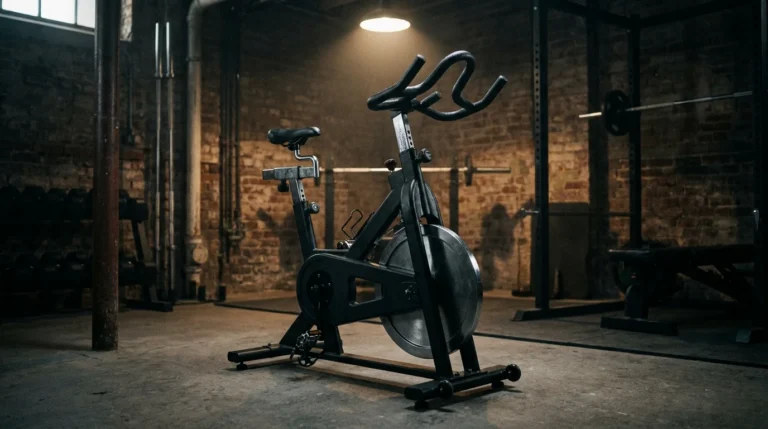
When it comes to exercise bikes for home workouts, I learned the hard way that cheaping out is the fastest route to an expensive laundry rack. Back in 2012, I bought a $150 chain-driven friction bike off Craigslist. The guy who sold it to me smiled a little too widely as I loaded it into my truck. I found out why the next morning.
TL;DR: The Bottom Line on Indoor Bikes
- Skip the Friction: Magnetic resistance is non-negotiable for a smooth, silent ride that actually mimics a road bike.
- Beware the “Smart” Trap: A high-quality “dumb” bike paired with your own tablet is cheaper, more durable, and immune to software obsolescence.
- Setup is Everything: If you don’t adjust the saddle height to match your iliac crest, you will destroy your knees.
- Know Your Geometry: Upright spin bikes are for building athletic power; recumbent bikes are for rehab and mobility. Pick the right tool for the job.
Pedaling that rusty contraption felt like dragging a cinderblock through wet cement. The chain clanked loud enough to wake the neighbors, the friction pad smelled like burning rubber after ten minutes, and the seat felt like it was designed by a medieval inquisitor. It lasted exactly three weeks before I draped a wet towel over the handlebars and never rode it again.
Look, you don’t need to spend three grand on a bike with a giant touchscreen that yells at you. But you do need a piece of biomechanical hardware that functions correctly.
If you want to build an unstoppable aerobic engine, scorch body fat, and protect your joints without pissing off your downstairs neighbors, an indoor bike is one of the most efficient tools on the planet (making it a staple for apartment-friendly workouts). But you have to buy the right one, and you have to set it up perfectly.
In this guide, we are cutting through the marketing fluff. We’re going to talk about flywheel weight, resistance mechanics, and how to avoid the “smart bike” trap that ends up bricking your equipment in three years.
Let’s get into it.
🏃♂️ The Prime Perspective
Stop thinking of an exercise bike as a piece of consumer electronics. It’s not an iPad. It is a mechanical tool designed to deliver progressive overload to your cardiovascular system. Buy it for the steel, the drive belt, and the bearings—not the screen.
Why Exercise Bikes for Home Workouts Actually Make Sense
Let’s get one thing straight: I love lifting heavy iron. But if you are neglecting your aerobic engine, you are leaving massive performance and longevity gains on the table.
We’ve talked extensively about home cardio exercises on PrimeForMen, but the indoor bike holds a special place in the hierarchy of conditioning tools. Why? Because it removes the eccentric load.
When you run, every footstrike sends shockwaves up your tibia and into your knees. That eccentric braking force causes muscle damage—which is fine, unless you are also trying to recover from heavy deadlifts. Cycling is purely concentric.
You can push your heart rate to the absolute limit, flush blood into your legs, and wake up the next day without feeling like you were hit by a bus.
The Engine Builder: VO2 Max and Zone 2
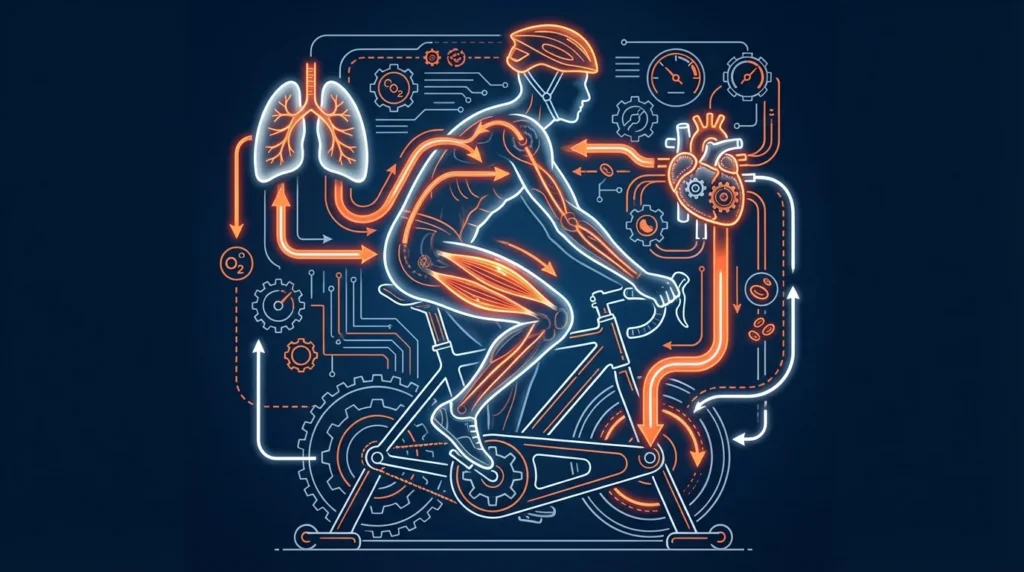
The real magic of an indoor bike lies in its versatility. It is the perfect vehicle for Zone 2 cardio—that steady-state, conversational-pace aerobic work that builds mitochondrial density and creates an unbreakable aerobic base.
You can sit on a bike for 45 minutes, watch a podcast, and actively improve your cellular health without frying your central nervous system.
On the flip side, it is a brutal tool for raising your VO2 Max. When you crank the resistance and push your wattage / power output to the redline, the bike becomes a torture chamber that forces your heart and lungs to adapt.
Research published in the National Library of Medicine highlights that indoor cycling significantly improves aerobic capacity and blood pressure, making it a cornerstone for cardiovascular health.
Hardware Over Hype: Stop Buying Plastic Junk
If you walk into a big-box sporting goods store trying to build your fitness on a budget, you will be surrounded by cheap plastic bikes that look like alien spaceships.
Ignore them. When evaluating a bike, you need to look at three critical mechanical components.
1. Flywheel Weight (Inertia)
The flywheel is the heavy metal wheel that spins when you pedal. Its job is to create momentum (inertia) so the pedal stroke feels smooth, not choppy.
- Light Flywheels (Under 20 lbs): Found on cheap bikes. They feel jerky. When you push down on the pedal, it accelerates, but it immediately decelerates at the bottom of the stroke. It feels awful.
- Heavy Flywheels (30–45 lbs): This is what you want for a spin-style bike. The heavy mass requires effort to get moving, but once it’s spinning, the inertia carries the pedals smoothly through the “dead spots” at the top and bottom of the stroke.
2. Magnetic Resistance vs. Friction Pad
This is the biggest differentiator in ride quality and longevity.
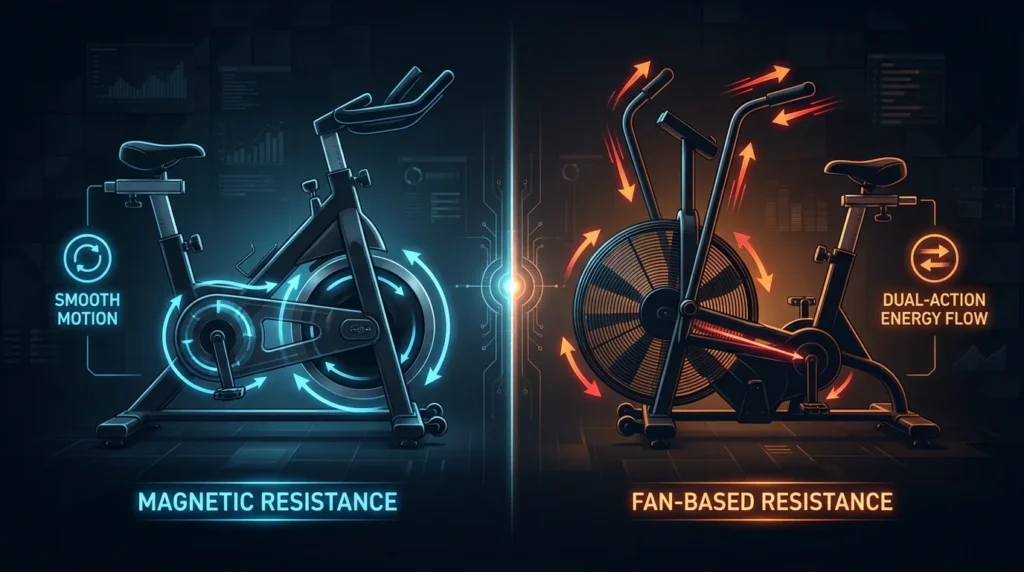
A friction pad is literally a piece of felt or leather that clamps down on the spinning metal flywheel. It creates resistance, but it also creates noise, dust, and inconsistent tension. Over time, the pad wears out and needs to be replaced.
Magnetic resistance uses powerful magnets that move closer to or further away from the metal flywheel without ever actually touching it. The closer the magnets, the harder it is to pedal. Because there is no physical contact, magnetic resistance is dead silent, perfectly consistent, and requires zero maintenance. Always choose magnetic.
3. Belt Drive System vs. Chain Drive
Old-school bikes used a metal chain, exactly like an outdoor bicycle. They are loud, they require lubrication, and they can snap.
Modern, high-quality indoor bikes use a belt drive system (Kevlar/Poly-V). A tough, grooved rubber belt connects the pedals to the flywheel. It is practically silent, requires no maintenance, and delivers a relentlessly smooth transfer of power.
4. The Q-Factor
The Q-factor is the distance between the inside of the pedal attachments (essentially, how wide your feet are spaced apart). A wide Q-factor forces you to pedal like you are riding a horse, which places terrible lateral shear stress on your knees and hips.
You want a narrow Q-factor (ideally around 150mm to 170mm) that mimics the natural biomechanics and kinematics of a real road bike, keeping your hips, knees, and ankles stacked in a straight line. If a brand doesn’t list the Q-factor in their specs, consider it a massive red flag—they are likely hiding a wide, uncomfortable stance.
The Resistance & Drive Matrix
| Component | Mechanism of Action | Ideal Application | PrimeForMen Verdict | Common Pitfall |
| Friction Pad | Felt pad physically squeezes the flywheel. | Extreme budget setups. | Avoid. | Wears out quickly, inconsistent tension, loud. |
| Magnetic Resistance | Eddy currents create drag via magnets near the flywheel. | Serious home gyms, apartments. | Gold Standard. | Silent, zero maintenance, smooth power curve. |
| Chain Drive | Metal chain links connect crank to flywheel. | Replicating outdoor road bike “feel.” | Passable, but outdated. | Requires lubrication, loud clanking, prone to rust. |
| Belt Drive (Poly-V) | Kevlar-reinforced rubber belt transfers power. | High-performance home training. | Gold Standard. | Whisper-quiet, maintenance-free. |
💡 What Most Guys Miss
The fitness tech industry is hiding a dirty secret: “Smart” bikes are built to become obsolete. A proprietary 22-inch touchscreen attached to a bike guarantees that when the tablet’s operating system stops updating in 4 years, your $2,500 bike becomes a brick. Buy dumb iron and use a smart iPad.
The “Smart” Connected Fitness Ecosystem Trap
If you are looking at exercise bikes for home workouts, you have inevitably seen the ads for Peloton, NordicTrack, and Echelon. They sell you on the connected fitness ecosystem—the high-def screens, the live leaderboards, and the instructors yelling motivational quotes at you.
Here is the problem: You are paying a massive premium for a tablet bolted to a piece of metal, plus a mandatory $40/month subscription just to turn the resistance knob.
When the company decides to update its software, and your bike’s built-in tablet doesn’t have the RAM to support it, your bike is obsolete.
The “Dumb Bike + Smart Tablet” Solution
The intelligent move for your home gym is to buy a commercial-grade “dumb” bike—one with magnetic resistance, a heavy flywheel, and basic Bluetooth telemetry to broadcast your cadence and power.
You then buy a $300 iPad, mount it to the handlebars, and run whatever app you want (Peloton, Zwift, or just YouTube). If the iPad breaks in five years, you buy a new iPad. The heavy steel bike underneath it will still be working perfectly.
Smart vs. Dumb + Tablet (5-Year Cost Breakdown)
| Approach | Upfront Hardware Cost | 5-Year Subscription Cost | Hardware Obsolescence Risk | Flexibility |
| Premium Smart Bike (e.g., Peloton) | $1,500 – $2,500 | ~$2,400 ($40/mo) | High (Locked to built-in screen) | Locked into one proprietary app forever. |
| High-End Dumb Bike + iPad | $800 – $1,000 | $0 – $780 ($13/mo app only) | Zero (Just replace the iPad) | Watch Netflix, use Zwift, use Peloton app, or do nothing. |
Choose Your Weapon: Upright, Recumbent, or Airbike
Before you buy, you need to understand the fundamental difference in recumbent vs. upright geometry, as well as the unique beast that is the airbike.
The Upright Spin Bike
This is the standard indoor cycle. You lean forward, engage your core, and drive power downward. It mimics a road bike and is the best choice for traditional cardio, interval training, and maximizing leg power. If you want to check out our guide on essential fitness gear, a solid upright bike is always at the top of the list.
The Recumbent Bike
You sit back in a bucket seat with your legs out in front of you. Because your back is fully supported, it requires almost zero core engagement.
Let me be blunt: Unless you are over 65, recovering from lower back surgery, or undergoing physical therapy, skip the recumbent bike. It does not provide the athletic carryover a healthy guy needs.
The Airbike (The Devil’s Tricycle)
Bikes like the Rogue Echo or the AssaultBike use a giant fan for resistance. They also feature moving handlebars, creating dual-action resistance. The harder you push and pull with your arms and legs, the exponentially harder the wind resistance pushes back.
You do not use an Airbike for a 45-minute casual ride watching Netflix. You use it to experience total metabolic failure in 10 minutes. It is the ultimate tool for HIIT at home.
The Biomechanical Setup: Save Your Knees
The greatest bike in the world will shred your patellar tendons if you set it up wrong. Biomechanics & Kinematics matter. Most guys jump on, adjust the seat so their feet touch the pedals, and start grinding. This is how you end up in physical therapy.
Here is the exact protocol to dial in your fit before you ever turn the pedals.
1. Find Your Iliac Crest (Saddle Height)
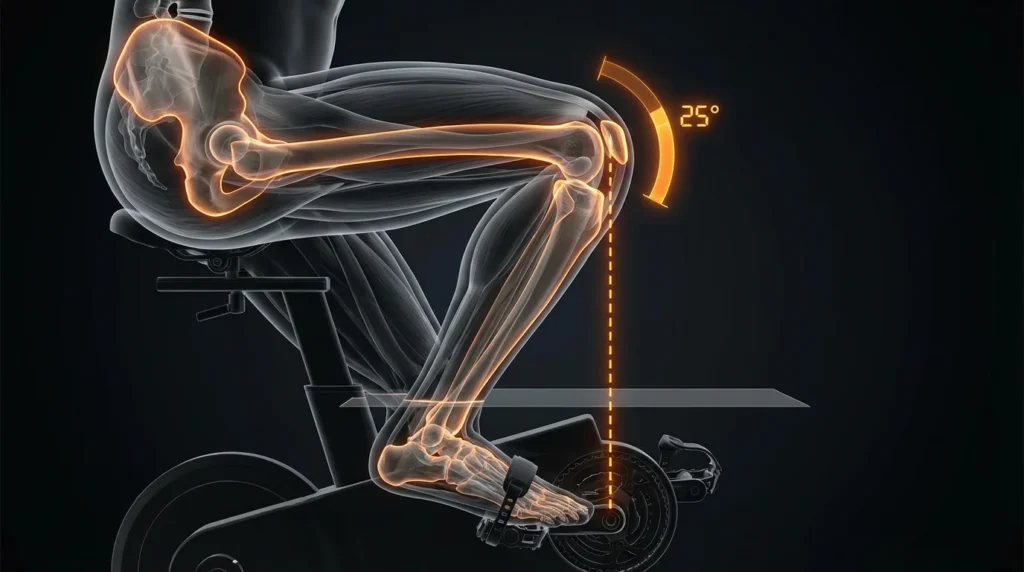
- Stand directly next to the saddle. Lift your leg until your thigh is parallel to the floor. Find the bony protrusion at the top of your hip bone—this is your iliac crest.
- Adjust the saddle so it is perfectly level with this bone.
- When you sit on the bike and place the ball of your foot on the pedal at the 6 o’clock (bottom) position, there should be a slight 25 to 30-degree bend in your knee.
- Your leg should never lock out completely straight, and your hips should not rock side-to-side as you pedal.
2. The Plumb Line (Saddle Fore/Aft)
- Sit on the bike with your feet on the pedals. Bring the pedals to the 3 o’clock and 9 o’clock horizontal positions.
- Drop a plumb line (or just visualize a straight line) down from the front of your kneecap on the forward leg. That line should intersect directly through the ball of your foot and the center of the pedal axle.
- Slide the seat forward or backward until this lines up.
3. Handlebar Height and Reach
- Unless you are training for the Tour de France, you do not need the handlebars slammed down to the frame.
- For general fitness, keep the handlebars roughly level with the saddle, or an inch or two higher to relieve pressure on your lower back.
- You should have a slight bend in your elbows, relaxed shoulders, and a neutral spine.
The 3-Point Biomechanical Setup Protocol
| Anatomical Target | Adjustment Point | The Benchmark | Biomechanical Goal | Injury Risk if Ignored |
| Knee Extension | Saddle Height | Level with the Iliac crest. 25-30° knee bend at bottom stroke. | Maximize power output without joint lockout. | Patellar tendonitis, IT band syndrome, hip rocking. |
| Knee Alignment | Saddle Fore/Aft | Kneecap perfectly stacked vertically over the pedal axle at 3 o’clock. | Keep shear force off the patella during downward drive. | Anterior knee pain, meniscus strain. |
| Spine/Shoulders | Handlebar Height | Level with saddle, slight bend in the elbows. | Prevent lumbar flexion and upper back tension. | Lower back pain, neck strain, numb hands. |
Programming: Exercise Bikes for Home Workouts
Having the bike is step one. Knowing how to use it is step two. If you jump on and pedal aimlessly for twenty minutes while looking at your phone, you are wasting your time. You need intent.
Protocol 1: The Aerobic Base Builder (Zone 2)
To build cellular efficiency, you need to ride at a conversational pace. Use telemetry heart rate tracking (like a chest strap). Calculate your max heart rate (roughly 220 minus your age) and stay between 60% and 70% of that number.
Maintain a steady cadence (RPM) of about 80-90. Do this for 45 to 60 minutes, two to three times a week. This is how you build stamina without burning out your nervous system, prioritizing the importance of rest and recovery.
Protocol 2: The VO2 Max Scorcher (HIIT)
Once a week, you need to suffer. We are talking true High-Intensity Interval Training (HIIT).
Warm up for 10 minutes. Then, crank the resistance up and sprint with maximum wattage for 30 seconds. Your legs should be burning, and you should be gasping for air. Back the resistance off and pedal slowly for 90 seconds to recover. Repeat this 6 to 8 times. Cool down for 5 minutes.
This entire quick workout takes 25 minutes and triggers a massive metabolic response that elevates fat burning for hours after you step off the bike.
✅ Your 24-Hour Action Plan
- Step 1: Assess your current space and budget. Commit to a magnetic resistance bike (or Airbike) and reject the friction-pad junk.
- Step 2: Once your bike arrives, spend exactly 15 minutes executing the 3-Point Biomechanical Setup to align your saddle with your iliac crest.
- Step 3: Schedule your first ride: A 30-minute Zone 2 baseline test to establish your comfortable cadence and working heart rate.
Breaking Through the Noise
Buying an indoor bike shouldn’t require an engineering degree, but it does require you to look past the shiny screens. Focus on the steel, the flywheel, the drive belt, and the magnetic resistance.
If you dial in your biomechanics and approach your programming with intent, this piece of equipment will become the cornerstone of your cardiovascular health.
If you feel like your progress has stalled with lifting, jumping on a bike for dedicated Zone 2 work might just be the ticket to overcoming fitness plateaus by improving your work capacity and recovery speed between heavy sets.
Now stop reading, get your gear sorted, and get to work.
Frequently Asked Questions About Exercise Bikes for Home Workouts
Are exercise bikes good for losing belly fat?
Yes, but with a caveat. You cannot spot-reduce belly fat. However, indoor cycling burns a massive amount of calories and improves insulin sensitivity. Combined with a caloric deficit, high-intensity intervals on an exercise bike will strip visceral and subcutaneous fat off your entire body, including your belly.
How long should I ride an exercise bike daily?
You shouldn’t ride it daily with high intensity. Aim for 3 to 4 days a week. Two of those days should be longer, steady-state Zone 2 rides (45-60 minutes), and one or two days should be short, brutal HIIT sessions (20-30 minutes). Rest and recovery are mandatory, unless you want to crash headfirst into overtraining syndrome.
Do exercise bikes build muscle in your legs?
They will build endurance and increase the size of your slow-twitch muscle fibers, particularly in the quads and calves. However, an exercise bike will not give you the massive hypertrophy that heavy barbell squats or leg presses will. Use the bike for engine building; use the barbell for mass.
What is a good cadence (RPM) for beginners?
A healthy cadence is faster than most beginners think. You should aim to keep your RPM between 80 and 90 during steady-state riding. If you are mashing the pedals at 50 RPM, your resistance is too high, and you are putting unnecessary strain on your knee joints. Shift to a lighter gear and spin faster.
Is an Airbike better than a spin bike?
It depends on your goal. If you want to build a long, steady aerobic base (Zone 2) while watching a movie, a magnetic spin bike is vastly superior. If you want to do 15 minutes of soul-crushing intervals that test your muscular endurance and mental toughness, the Airbike is the undisputed king.
Disclaimer: The information provided in this article is for educational purposes only and is not intended as a substitute for advice from your physician or other health care professional.