
Do testosterone boosters help with weight loss? Compare the evidence, check supplement claims and use a practical two-week plan with a free worksheet.
- A hormone change does not prove fat loss.
- Booster supplements and prescription therapy have different evidence.
- Check the exact product, study population and outcome.
Bottom line Use the worksheet to evaluate a claim and choose one manageable habit; arrange assessment for persistent symptoms.

Testosterone boosters and weight loss are often marketed together, but over-the-counter boosters are not an established weight-loss treatment. A change in a testosterone blood test does not prove that a supplement reduces body fat. Prescription testosterone, treatment of a nutrient deficiency and an herbal booster are different interventions with different evidence and risks.
Quick Summary: Testosterone Boosters and Weight Loss
- Do not use a testosterone-boosting claim as evidence of fat loss.
- Low testosterone requires clinical assessment; belly fat or tiredness alone cannot diagnose it.
- Research on prescription testosterone cannot be transferred to a supplement bottle.
- Build a manageable eating and activity plan while arranging assessment for persistent symptoms.
- Check the exact formula, study population and measured outcome before believing a product claim.
The Prime Perspective
For a man over 50 deciding where to spend time and money, the useful question is: what problem needs solving? An unclear eating pattern calls for a workable nutrition plan. Persistent sexual symptoms or unexplained fatigue call for assessment. A confirmed deficiency calls for targeted care. None of those automatically creates a reason to buy a multi-ingredient testosterone booster.
This guide separates those decisions and gives you a practical starting plan. It does not rank boosters as fat burners. Our broader testosterone booster guide covers the category; here the focus is whether its claims justify using it for weight loss.
Three Treatments That Marketing Often Blurs Together
| Option | What it is | What you cannot assume |
|---|---|---|
| Over-the-counter booster | A supplement containing herbs, minerals or other ingredients marketed for testosterone support. | That it meaningfully raises testosterone, treats hypogonadism or causes fat loss. |
| Targeted deficiency treatment | Correction of a specific nutritional problem, based on appropriate assessment. | That more of the nutrient is better, or that a mixed booster is needed. |
| Prescription testosterone therapy | Hormone treatment considered for appropriately diagnosed patients, with monitoring. | That findings apply to men with normal levels or to retail supplements. |
On a small screen, swipe the table horizontally to compare all columns.
The Endocrine Society guideline bases diagnosis on compatible symptoms and consistently low testosterone, confirmed with repeat morning fasting measurement. It also calls for evaluation of the cause. A single home result or a supplement seller’s symptom quiz cannot complete that assessment.
What the Research Actually Measures
A systematic review published online in 2023 examined 52 studies of 27 proposed testosterone boosters. Most did not increase total testosterone. Some ingredients showed possible effects in particular populations, but the review’s central outcome was serum testosterone—not proof of sustained weight loss from a finished commercial blend.
That distinction matters even when a study is positive. A result in infertile men, younger athletes or men with a particular deficiency may not apply to a generally healthy 55-year-old trying to lose abdominal fat. An ingredient extract at a specific dose is also not interchangeable with a proprietary mixture that contains an undisclosed amount.
Prescription therapy has a separate literature. A systematic review of testosterone replacement in men with obesity and low testosterone evaluated body composition and other outcomes in that defined population. Across 16 randomized trials, the review found about a 2-kg gain in lean body mass with moderate-certainty evidence. Results for waist circumference and BMI varied substantially between studies, with prediction intervals including no effect. Those findings are not evidence that an herbal capsule works. Changes in lean mass, fat mass and total body weight are different outcomes and should not be presented as though they were the same result.
Read a Booster Claim in Five Steps
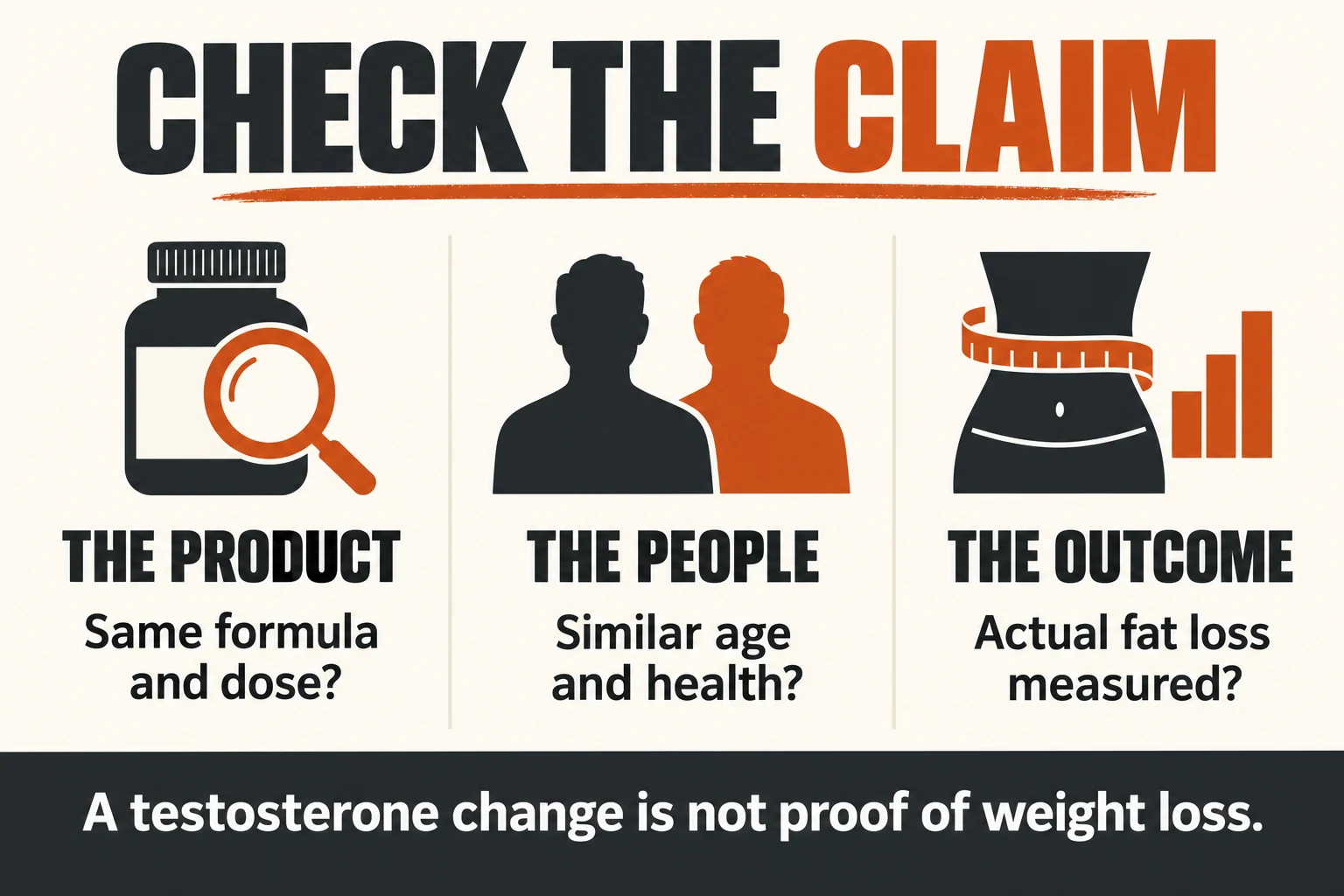
- Find the actual endpoint. Was the study measuring testosterone, libido, strength, body fat or body weight? “Hormone support” does not answer a weight-loss question.
- Match the product. Compare the ingredient, extract, dose and duration. A study of one ingredient cannot validate every blend that includes its name.
- Match the people. Look for age, baseline testosterone, health conditions and training status. Do not assume a special population represents all men over 50.
- Check the comparison. Did a control group receive the same diet and exercise support? If both groups changed their habits, the total change in the supplement group is not automatically the supplement’s effect.
- Look beyond the headline. Consider participant numbers, dropouts, side effects, funding and follow-up. A short trial cannot demonstrate years of safe use or durable weight loss.
A worked example: “Boosts testosterone by 20%”
This is an invented advertising example, not a result for a specific product. Before treating the number as useful, ask: 20% compared with what, in whom, over how long, and did body fat change more than in the comparison group? Even a correctly reported hormone change leaves the fat-loss question unanswered if fat loss was not measured.
A before-and-after photograph cannot answer those questions. Lighting, posture, time, diet and training may differ. Look for the published methods and outcomes rather than treating a photograph as a controlled experiment.
Common Ingredients: What Their Presence Does Not Prove
| Label ingredient | Relevant distinction | Practical implication |
|---|---|---|
| Vitamin D or zinc | A nutrient need is different from a weight-loss indication. | Address an identified need; do not stack high-dose products hoping to accelerate fat loss. |
| Ashwagandha | Limited testosterone evidence and some stress or sleep research do not establish it as a weight-loss treatment. | Check suitability and interactions; “natural” does not mean risk-free. |
| Tribulus, D-aspartic acid and other booster ingredients | Hormone findings vary; ingredient marketing is not proof of a finished product’s weight-loss benefit. | Apply the study checklist instead of assuming a longer ingredient list is stronger evidence. |
| Caffeine or a “thermogenic” blend | A stimulant effect is not confirmation that low testosterone was the problem. | Check total stimulant exposure and sleep effects rather than interpreting an energy surge as fat loss. |
NCCIH’s ashwagandha summary notes limited testosterone evidence, medication interactions and reported liver injury. Thyroid disorders and certain other conditions warrant particular caution. Our ashwagandha evidence guide explores the hormone question separately.
The NIH Office of Dietary Supplements describes limited evidence for weight-loss supplements generally and warns about interactions and harm. Adding a “testosterone” label does not remove those concerns. If a formula also acts as a stimulant product, read the fat-burner guide for that separate category.
Could Low Testosterone Be Part of the Picture?
It can be, but body shape cannot tell you. Obesity and low testosterone can coexist, and the Endocrine Society’s patient guidance notes that some causes, including obesity-related factors, may be reversible. This does not mean every man needs hormone tests or that weight loss will correct every case.
Persistent reduced libido, fewer spontaneous erections, erectile changes or unexplained fatigue deserve a conversation with a clinician, particularly when several symptoms occur together. Sleep problems, medication effects and other conditions can overlap. Do not postpone evaluation until you have completed a diet or tried a supplement.
Bring a timeline of symptoms, your medications and supplements, relevant previous results and any fertility plans. Ask whether testing is appropriate, how results will be confirmed, and what other causes need consideration. Let the clinician interpret results in context rather than applying a single internet cutoff to every laboratory report.
If testosterone is prescribed, ask about expected benefits, risks and monitoring. Fertility is an important part of that discussion because therapy can suppress sperm production. Do not start, stop or adjust prescribed treatment based on changes in the bathroom scale. This article is not a testosterone dosing guide.
A Two-Week Starting Plan That Does Not Depend on a Booster
The following is an editorial planning example for adults for whom intentional weight loss is appropriate. It is not a promise of a particular result or a hormone-treatment protocol. Adapt it with your care team if you have relevant health conditions, are frail, have unintended weight loss or need a medically tailored eating or activity plan.
Days 1–3: Establish a usable baseline
Write down your usual meals, drinks, sleep times and activity without trying to make the record look impressive. Identify one recurring difficulty: unplanned evening snacks, caloric drinks, missed meals followed by overeating, or long inactive periods. A brief record is enough to choose a first action; it need not become permanent calorie tracking.
If weighing is useful and comfortable for you, use the same scale under similar morning conditions on several days. Record the readings without reacting to each one. Skip weighing if it worsens anxiety or disordered eating; a clinician or dietitian can help select more appropriate ways to monitor progress.
Days 4–7: Make one food change and schedule movement
Choose a repeatable change, such as replacing one routine sugary drink with an unsweetened option or planning a filling lunch instead of relying on snacks. Build meals around a suitable protein food, produce and portions that fit your plan. A powder is optional convenience, not a requirement. Our protein timing guide provides more meal-planning context.
Schedule two manageable strength sessions on nonconsecutive days and short walks at a level you can tolerate. The CDC adult activity guideline recommends at least 150 minutes of moderate activity weekly and muscle strengthening on two days. That is a broader target to work toward, not a requirement to jump from inactivity to the full amount this week.
Days 8–14: Repeat, then review the process
Keep the first change stable. Use the beginner options in our full-body home workout if you need a structured routine. Choose a consistent sleep opportunity and note barriers such as late caffeine or an unpredictable schedule. Exercise supports health and weight management without needing a claim that every workout produces a lasting hormone boost; see exercise and testosterone evidence.
At the end of two weeks, review what you actually repeated. If the plan was difficult, simplify it. If it was manageable, continue long enough to assess a trend. Two weeks is a setup period, not proof of success, failure or a testosterone problem. Persistent symptoms warrant assessment regardless of what the weight record shows.
NIDDK’s weight-management guidance emphasizes a sustainable eating pattern, activity, support and a plan for maintaining progress. If you need more help, discuss structured treatment with a qualified professional rather than assuming another supplement is the missing step.
Track Progress Without Confusing Water, Fat and Hormones
Use consistent conditions and look at trends. Food, fluids and bowel contents affect scale weight, so a single reading cannot isolate fat change. A home scale’s body-fat estimate is also not a hormone test. Avoid changing your entire plan in response to one unexpected number.
For example, suppose several comparable readings average 210 pounds one week and 209.6 the next. The difference is 0.4 pounds, but those two averages alone cannot identify precisely how much fat changed or why. Continue observing the pattern alongside the behaviors you can repeat. This is a mathematical example, not an expected weekly outcome.
A waist measurement can provide another observation if you use the same location and technique. Do not tighten the tape to obtain a smaller number. Record training consistency and everyday function too. A smaller waist, a stronger lift and lower body weight describe different things; none proves a booster caused the change.
Free claim-check and two-week worksheet
Record the product’s exact promise, the evidence it cites, questions for a clinician and one repeatable habit. The second page provides a simple weekly review. It does not calculate a testosterone score or recommend a supplement.
Download the fillable two-page worksheet
Save a copy and use a PDF reader that supports forms. Your entries remain in your own file.
Optional Tracking Tools, Only If You Need Them
A notebook and suitable equipment you already own may be enough. These are Amazon search categories, not independently tested product recommendations. Compare the actual specifications before buying; no particular device is required for this plan.
As an Amazon Associate, we earn from qualifying purchases.
Safety Checks Before Taking Any Booster
Take the full label to a pharmacist or clinician, including serving size and every other supplement you use. Check overlapping ingredients rather than reviewing bottles in isolation. A proprietary blend that hides individual amounts makes this harder. Independent quality verification can help assess aspects of manufacturing; it does not establish that the product causes weight loss.
The FDA warns that some bodybuilding products marketed as supplements contain steroids or steroid-like substances. This is not a claim that every booster is adulterated, but it makes drug-like promises and unclear labels serious warning signs. Products promoted as SARMs or steroid alternatives are not ordinary nutritional gap-fillers.
If a product causes concerning symptoms, seek medical advice rather than adding another supplement to counteract them. Chest pain, severe shortness of breath, jaundice or dark urine need prompt medical attention. Bring the packaging. Read our testosterone booster safety guide for additional context.
Conclusion
Testosterone boosters are not an established shortcut to weight loss. Keep the decisions separate: evaluate persistent symptoms, treat confirmed problems appropriately, and build a sustainable weight-management plan. Start with one manageable habit and use the worksheet to challenge any supplement promise before spending money.
Frequently Asked Questions
Do testosterone boosters burn belly fat?
They are not established treatments for abdominal fat loss. A testosterone claim does not demonstrate a reduction in belly fat, and a supplement cannot be assumed to target one body area.
Will raising testosterone make the scale go down?
Not necessarily. Hormone levels, fat mass, lean mass and total weight are separate measurements. Any treatment decision should use the relevant clinical diagnosis and expected benefits, not a guaranteed scale change.
Should I get tested before trying to lose weight?
Routine testosterone screening is not recommended for everyone. Discuss persistent compatible symptoms with a clinician. You can arrange that assessment while making appropriate eating and activity changes.
Can I combine a booster with a fat burner?
Do not assume the combination is safe or more effective. Blends can overlap in stimulants and other ingredients, and interactions depend on your medications and health. Have both complete labels reviewed before use.
How long should I try a booster for weight loss?
There is no evidence-based trial duration that makes an unproven booster a weight-loss treatment. Use a structured weight-management plan and seek assessment for symptoms rather than repeatedly extending a supplement trial.
Medical Disclaimer
This article is educational and does not diagnose low testosterone or prescribe treatment. The worksheet and two-week plan are editorial examples, not individualized care. The featured image and claim-check graphic are AI-generated illustrations. See our editorial policy for how we approach evidence and corrections.
Affiliate Disclosure
PrimeForMen may earn a commission from qualifying purchases through the Amazon links above. The links identify optional tracking categories; they are not evidence of weight-loss effectiveness or a claim of product testing.