

Vitamin D corrects deficiency but does not reliably boost testosterone. Learn what trials show, when testing helps, and safe dose limits.
- Vitamin D deficiency and lower testosterone can occur together without proving causation.
- Randomized trials do not show a reliable testosterone boost from vitamin D supplements.
- Correct deficiency for health, then evaluate persistent hormone symptoms separately.
Bottom line Treat vitamin D as a nutrient to get right—not as a guaranteed testosterone shortcut.

Does vitamin D increase testosterone? For most men, the honest answer is: not reliably. Correcting a genuine vitamin D deficiency supports bone, muscle, and general health, but taking extra vitamin D has not consistently raised total or free testosterone in randomized trials.
PrimeForMen Evidence Check
Quick Answer
Treat vitamin D as a nutrient to get right, not as a hormone hack. If your status is low, correcting it makes sense for established health reasons. If your vitamin D is already adequate, more is unlikely to create a meaningful testosterone boost.
- Vitamin D deficiency and lower testosterone can occur together, but that does not prove one causes the other.
- Randomized trials do not show a clear, repeatable testosterone increase from vitamin D supplements.
- Correct a documented deficiency for overall health—not with a guaranteed hormone target.
- Low-testosterone symptoms require clinical evaluation and properly timed hormone testing.
- For healthy adults, routinely taking more than the recommended intake is not an evidence-based shortcut.
What the research actually shows
The vitamin D and testosterone story became popular because observational studies often find that men with lower 25-hydroxyvitamin D—usually written as 25(OH)D—also have lower testosterone. That relationship is biologically plausible. Vitamin D receptors exist in reproductive tissues, and both vitamin D status and testosterone can move with season, body composition, activity, and general health.
But an association cannot tell us whether vitamin D is the cause. Men who spend less time outdoors may also exercise less. Men with obesity may have lower vitamin D status and lower testosterone for separate metabolic reasons. Illness, poor sleep, medications, age, and calorie balance can affect both measurements. Once researchers assign men to vitamin D or placebo, the expected hormone boost becomes much less convincing.
| Evidence type | What it can show | What it means for you |
|---|---|---|
| Observational studies | Vitamin D status and testosterone sometimes track together. | Useful for forming a hypothesis, but vulnerable to shared lifestyle and health factors. |
| Small early trials | A few studies reported increases in selected groups. | Interesting, but small samples and secondary analyses can overstate certainty. |
| Randomized controlled trials | Most have not found a meaningful rise in total or free testosterone. | The best current reason not to market vitamin D as a dependable testosterone booster. |
| Systematic reviews | Pooling trials has not produced a clear, reproducible androgen effect. | Correct deficiency for health; do not promise a hormone outcome. |
A recent systematic review and meta-analysis of randomized trials found no statistically clear or reproducible effect on total testosterone or androgen bioavailability markers. That does not make vitamin D unimportant; it means the testosterone claim is stronger than the clinical evidence.
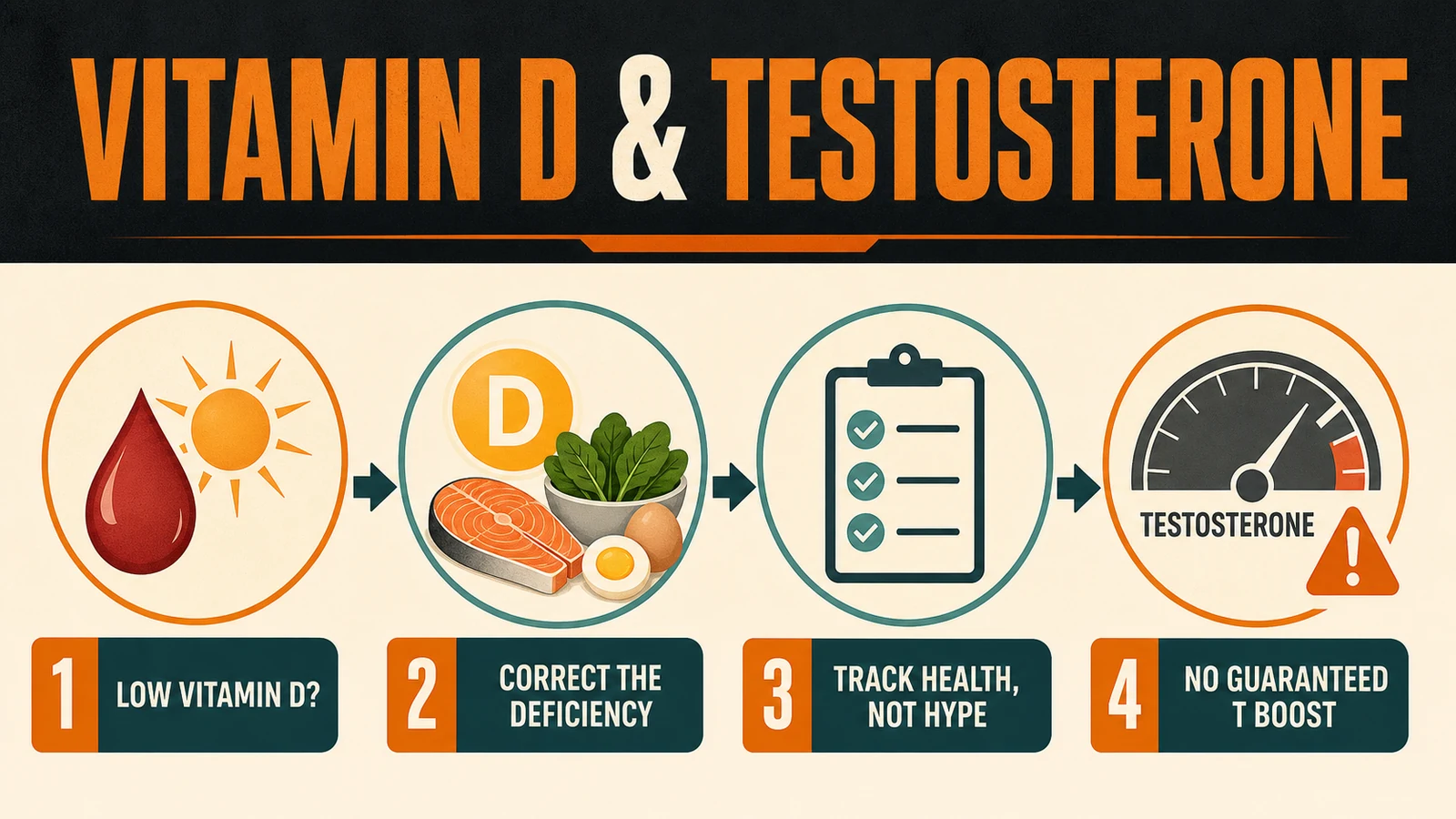
Why low vitamin D and low testosterone can appear together
Two low lab values can share upstream causes without one directly controlling the other. This is the central reasoning error behind many “boost testosterone naturally” articles.
Who should think about vitamin D status?
Vitamin D deserves attention when your diet, health history, or environment makes low intake or low status more plausible. Examples include very limited sun exposure, older age, darker skin, obesity, fat-malabsorption conditions, or prior bariatric surgery. Certain medications can also affect vitamin D metabolism.
That does not mean every healthy man needs routine vitamin D screening. Current clinical guidance generally advises against population-wide testing in healthy adults without an established indication. A clinician may still order 25(OH)D when symptoms, bone health, calcium problems, malabsorption, medication use, or another risk factor makes the result actionable.
How to evaluate low-testosterone symptoms properly
Low energy, reduced libido, weaker erections, low mood, poor training progress, or loss of muscle are not specific to testosterone deficiency. They can overlap with sleep apnea, calorie restriction, medication effects, depression, thyroid problems, high training stress, and other conditions.
A sensible evaluation starts with symptoms and context. Testosterone is usually measured in the morning, and a low result is normally confirmed on a separate day before a diagnosis is considered. Depending on the result, clinicians may look at free testosterone, sex hormone-binding globulin, luteinizing hormone, prolactin, thyroid markers, or other tests. Vitamin D is one possible piece of the picture—not the diagnostic shortcut.
If recovery and sleep are obvious weak links, our guides to fixing sleep before buying sleep aids and building a sustainable strength routine address higher-impact fundamentals first.
A practical decision path for vitamin D
Are you addressing bone health, a known deficiency, a clinician-identified risk, or simply hoping for a testosterone boost? Only the first three give you a clear health target.
Count vitamin D from food, fortified products, multivitamins, and stand-alone supplements. More than one bottle can quietly push the total higher than intended.
If treatment is indicated, the useful outcome is correction of vitamin D status or the condition being treated—not a promised testosterone number.
If fatigue, libido changes, infertility concerns, or erectile problems persist, seek a proper evaluation rather than increasing the dose.
Vitamin D doses, food, sunlight, and safety
For U.S. adults, the recommended dietary allowance is 600 IU (15 micrograms) per day through age 70 and 800 IU (20 micrograms) after age 70. Fatty fish, egg yolks, fortified milk or plant beverages, and fortified cereals can contribute. Sunlight can help the skin make vitamin D, but production varies by season, latitude, skin pigmentation, age, clothing, sunscreen, and time outdoors.
The adult tolerable upper intake level is 4,000 IU (100 micrograms) per day from all sources unless a clinician is supervising treatment. The NIH Office of Dietary Supplements explains that excessive vitamin D can cause hypercalcemia, nausea, weakness, kidney problems, and—in severe cases—soft-tissue calcification.
Deficiency treatment may use a different dose for a defined period, but that is not the same as taking high doses indefinitely. Extra caution is appropriate with kidney disease, granulomatous disorders, hyperparathyroidism, high calcium, and medications such as thiazide diuretics. Discuss dosing with a qualified clinician when any of those apply.
What matters more for testosterone than a vitamin D shortcut?
If testosterone support is the real goal, prioritize factors with a broader physiological impact: adequate sleep, resistance training, enough calories and dietary fat, reducing substantial excess body fat, moderating heavy alcohol use, and treating sleep apnea or other medical problems. None is a guaranteed “boost,” but each addresses a real constraint instead of assuming one nutrient controls the entire system.
Our evidence-led review of ingredients marketed for testosterone separates deficiency correction from supplement hype. You can also compare the claims around ashwagandha and testosterone or use the broader testosterone booster decision guide before buying anything.
Conclusion: correct deficiency, do not promise a testosterone boost
Vitamin D is essential. A deficiency deserves attention. But the current randomized evidence does not support selling vitamin D as a reliable testosterone booster for men.
The useful move is simple: meet normal intake needs, treat a documented problem appropriately, and evaluate persistent low-testosterone symptoms on their own terms. That approach protects your health and your wallet.
Frequently Asked Questions About Vitamin D and Testosterone
Does vitamin D increase testosterone if I am deficient?
Correcting a deficiency may improve general health, but studies have not shown a dependable testosterone increase even in all deficient groups. Treat the deficiency for established health reasons and measure hormone symptoms separately.
How much vitamin D should a man take for testosterone?
There is no validated “testosterone dose.” Most healthy adults should meet the recommended intake rather than chase high doses. Individual treatment doses should be based on a clinical indication and professional guidance.
Should I test vitamin D if my testosterone is low?
Not automatically. A clinician may include vitamin D when your history suggests a risk or when the result would change care. Low testosterone itself requires symptoms plus properly timed, confirmatory hormone testing.
Can vitamin D improve libido or erectile function?
There is no reliable evidence that vitamin D works as a direct libido or erectile treatment. Deficiency, sleep, cardiovascular health, medication effects, stress, and hormone disorders can overlap, so persistent symptoms deserve a broader evaluation.
Is vitamin D3 better than D2?
Both forms can raise vitamin D status. Vitamin D3 may produce a somewhat larger or more sustained increase in some comparisons, but product choice still does not turn vitamin D into a proven testosterone booster.