
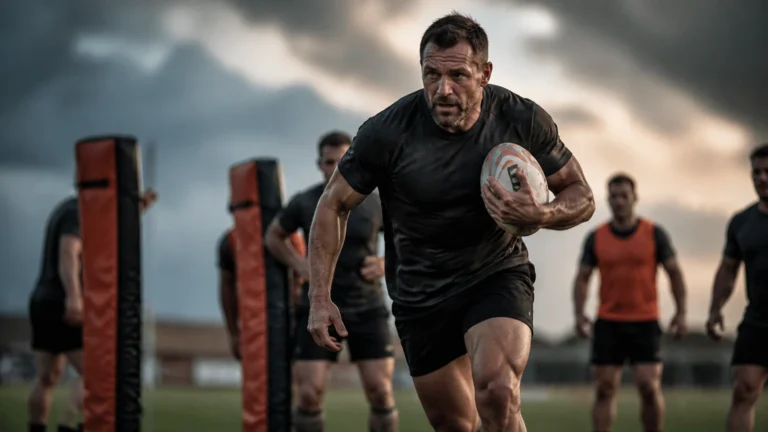
Rugby-specific training guide: build strength, speed, repeat-sprint conditioning, hamstring capacity, tackle skill, recovery, and a weekly plan.
- Forwards and backs share core qualities but need different volume and emphasis.
- Tackle skill requires coached feedback; gym strength alone does not make contact safe.
- Hamstring prevention works best as progressive training, not a token warm-up set.
Bottom line Train the position, rehearse contact with qualified coaching, and build enough aerobic recovery and hamstring strength to repeat speed safely.
Rugby-Specific Training works best when the plan matches the real question, the current training load, and the reader's recovery capacity. The goal is a clear decision and a repeatable next step—not another list of disconnected tips.
Quick Summary: Rugby-Specific Training
- Rugby demands strength, power, acceleration, braking, repeat sprints, aerobic recovery, and decision-making under fatigue.
- Position and level change running volume, collision exposure, body-mass demands, and skill priorities.
- Progressive Nordic hamstring work can improve strength and may reduce hamstring injury burden when integrated consistently.
- Tackle interventions generally use instruction, video, or expert feedback; contact should never be self-taught from a written list.
- Concussion symptoms, neck pain, neurological changes, or a suspected serious injury require immediate removal and medical protocols.
The Prime Perspective
The rugby player who wins one collision but cannot recover for the next phase is not fully prepared. Match fitness is the ability to express skill and force repeatedly without losing control.
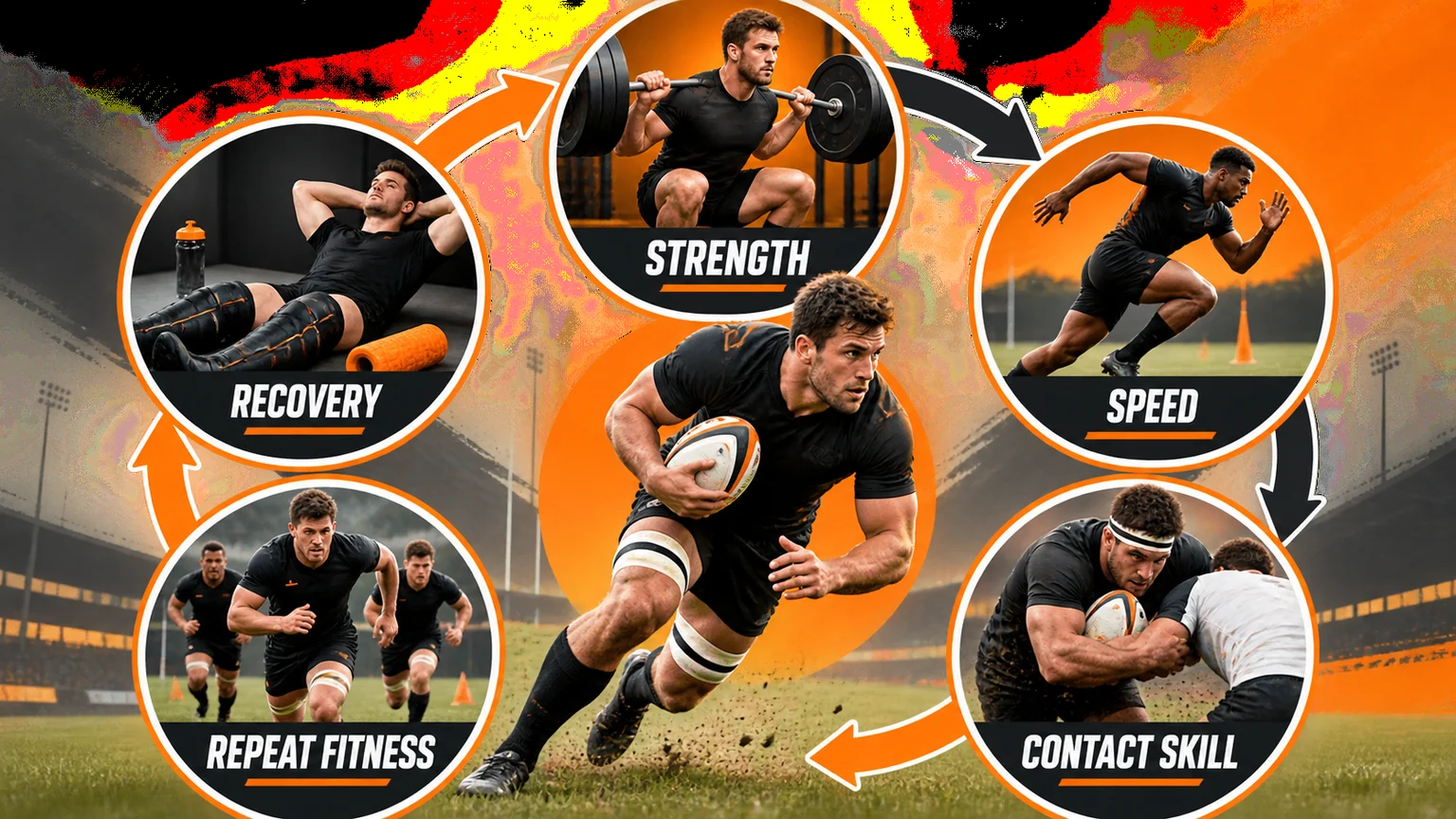
Rugby-specific training builds the force, power, speed, repeat-effort fitness, contact skill, braking control, and tissue capacity required for the player’s position. It combines gym strength, field speed, aerobic conditioning, progressive hamstring and neck work, and coached rugby practice.
Start With Position and Match Demand
| Quality | Forwards emphasis | Backs emphasis | Shared need |
|---|---|---|---|
| Maximal strength | Scrum, ruck, collision | Contact and robustness | Progressive compound lifts |
| Acceleration | Short forceful efforts | More frequent open-field speed | 5–20 m quality sprints |
| Max velocity | Lower exposure but still relevant | Higher priority | Progressive sprint exposure |
| Aerobic capacity | Recover between collisions | Recover between high-speed runs | Repeat quality |
| Contact skill | Ruck, maul, tackle | Open-field tackle and carry | Qualified coaching |
| Body mass | May support role | Must not compromise speed | Nutrition and health first |
Amazon Product Shortlist
These tools support ball skill, coached contact, and organized footwork. PrimeForMen has not independently tested them. Contact equipment must be used within qualified coaching and current rugby safety protocols.

World Rugby Shop x Gilbert G-TR4000 Ball
For passing, catching, kicking, and handling practice with the correct size for the player group.
- Hand-stitched three-ply construction.
- Available in several rugby sizes.
- Confirm size and inflation before practice.

FORZA Rugby Ruck and Roll Pad
For coached ruck and contact drills with a competent holder, clear progressions, and adequate space.
- C-shaped pad for breakdown drills.
- Foam core and multiple handles.
- Protective equipment does not make unsupervised contact safe.

20-Foot Adjustable Agility Ladder
For organizing warm-up footwork and low-amplitude coordination before reactive field drills.
- Adjustable rung spacing.
- Twenty-foot length supports several patterns.
- Ladder speed does not equal tackle or game agility.
*As an Amazon Associate, PrimeForMen earns from qualifying purchases. Availability and prices can change.
A Two-Day Rugby Strength Plan
Day A — Lower-body force and contact support
- Trap-bar deadlift or squat: 4 x 3–6
- Bench press or landmine press: 4 x 4–8
- Nordic hamstring progression: 2–4 sets
- Chest-supported row: 3 x 6–10
- Split squat: 3 x 6–8 per side
- Neck isometrics with qualified instruction: 2–3 sets
Day B — Power and unilateral capacity
- Jump or medicine-ball throw: 4 x 3
- Clean-pull derivative or kettlebell swing: 4 x 3–6
- Pull-up or pulldown: 3 x 6–10
- Step-up or reverse lunge: 3 x 6–10 per side
- Single-leg hinge: 3 x 6–10 per side
- Farmer carry: 3 controlled trips
Use a mixed approach: low-intensity aerobic work for recovery and base fitness, short acceleration and maximal-speed exposures for running quality, and repeat-effort intervals that resemble rugby work-to-rest demands. Skill and decision-making should remain technically recognizable under fatigue.
Three Field Sessions With Different Jobs
- Acceleration: 6–10 x 10–20 meters with full recovery.
- Max-speed exposure: 4–6 progressive 30–50-meter runs for prepared players.
- Repeat effort: 2–3 sets of 5 x 20 seconds hard / 40 seconds easy, with three minutes between sets.
Do not turn the acceleration day into conditioning by cutting rest. Speed requires freshness. Repeat-effort work comes later and should not be stacked blindly on the highest-collision practice.
Progressive Nordic hamstring training can increase eccentric strength and forms part of rugby injury-prevention programs. A systematic review found hamstring strains represented up to 15% of rugby union injuries and supported combined assessment, sprint exposure, and progressive strengthening.
The rugby hamstring systematic review identified position, fatigue, previous injury, asymmetry, return-to-play readiness, and running actions as contributing factors. Nordic work is useful, but not a complete prevention strategy.
Tackle Skill Requires Coaching and Feedback
A 2025 systematic scoping review found only 13 player-level tackle intervention studies across collision sports. Most focused on the tackler and used instruction, video, or expert coaching. Outcomes improved, but the evidence does not justify learning contact alone from an article.
- Use progressive intensity and appropriate equipment.
- Profile technique before adding speed or fatigue.
- Remove players immediately for possible concussion or neurological symptoms.
- Follow the governing body's return-to-play process rather than self-testing.
Place the Work Inside a Match Week
| Day | Example focus | Load rule |
|---|---|---|
| Monday | Recovery and mobility | Low collision and low speed |
| Tuesday | Strength plus acceleration | Highest neural quality |
| Wednesday | Team skill and conditioning | Track running and contact |
| Thursday | Power maintenance and tactical work | Lower volume |
| Friday | Primer and walk-through | Finish fresh |
| Saturday | Match | Competition load |
| Sunday | Rest or easy recovery | Review symptoms |
Contact, sprinting, and gym work all draw from the same recovery budget. A player cannot treat team practice as “skills only” when it includes repeated accelerations and collisions.
Build the Supporting System
Use powerlifting basics, unilateral training, lower-body work, band training, cardio programming, recovery guidance, and the sports-specific training pillar.
What to Do This Week
- Identify whether strength, acceleration, repeat fitness, or skill is the current limiter.
- Complete two full-body strength sessions with progressive hamstring work.
- Add one acceleration and one repeat-sprint exposure while fresh.
- Rehearse contact only in a coached, progressive environment.
- Reduce extra conditioning as match and collision load rises.
Conclusion
Train the position, rehearse contact with qualified coaching, and build enough aerobic recovery and hamstring strength to repeat speed safely.
Next Step: Build the Full Sports-Specific System
Connect this plan to the PrimeForMen sports-specific training guide so strength, conditioning, skill, and recovery support the same goal.
Frequently Asked Questions About Rugby-Specific Training
What is rugby-specific training?
It develops the strength, power, speed, conditioning, contact skill, neck and hamstring capacity, and decision-making required by rugby while reflecting position and match schedule.
How many days a week should rugby players lift?
Two or three sessions can fit the off-season. In season, one or two lower-volume exposures may maintain strength around team training and matches.
Do rugby players need long-distance running?
Easy aerobic work can support recovery, but conditioning must also include accelerations, repeat sprints, changes of direction, and rugby skill under controlled fatigue.
Are Nordic hamstring curls good for rugby?
They can improve eccentric hamstring capacity and are supported within progressive prevention programs, but volume must be built gradually and combined with sprint exposure.
Can I practice tackling alone?
No. Tackle technique and contact progressions require qualified coaching, a partner or pad holder, suitable equipment, and the sport’s current safety protocols.
This article is educational and does not replace individualized medical advice, diagnosis, or treatment. Discuss persistent symptoms, hormone concerns, cardiovascular risk, digestive problems, medications, or exercise restrictions with a qualified clinician.
Some links are affiliate links. PrimeForMen may earn a commission at no extra cost to you. Product inclusion does not override evidence, fit, or safety.