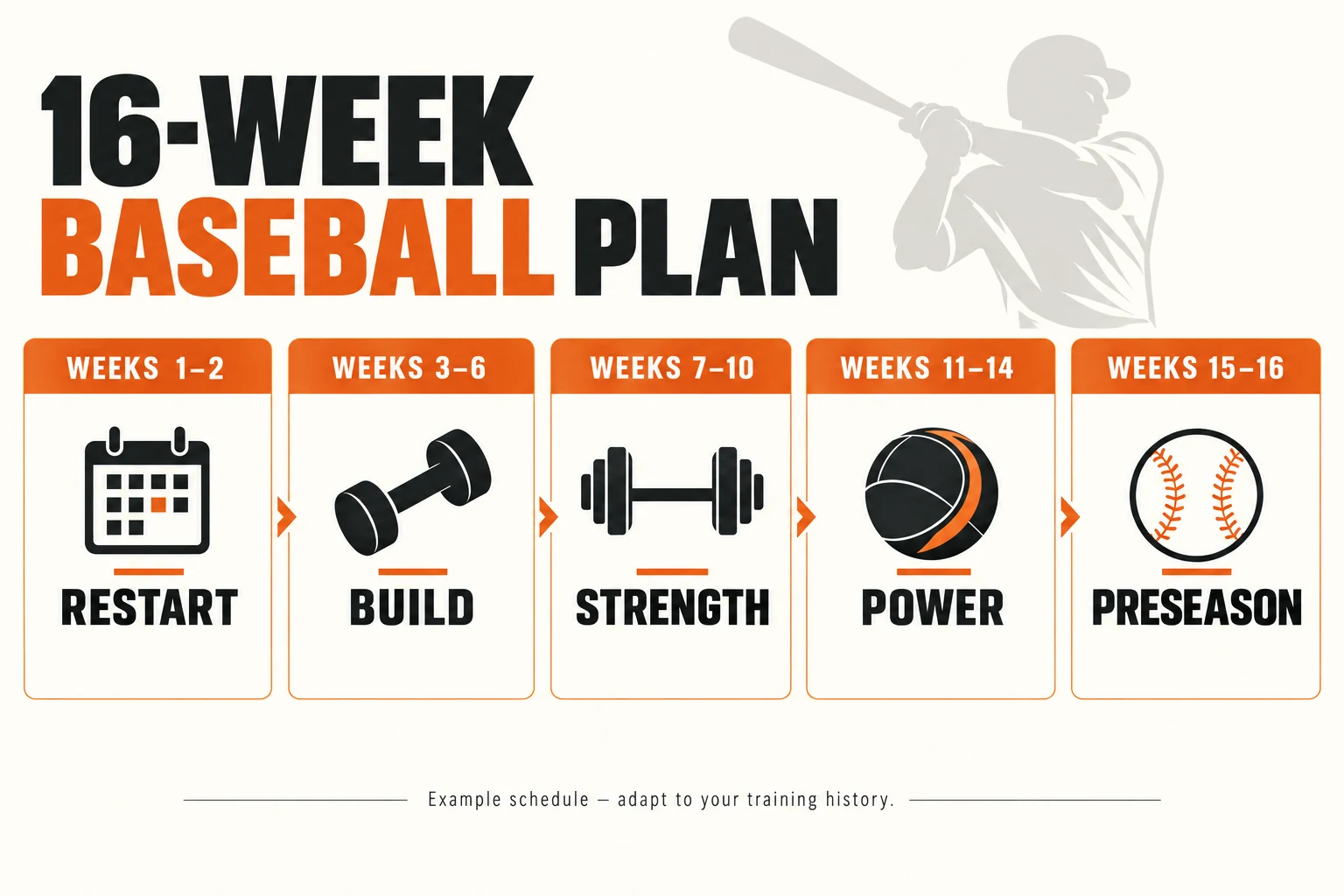
A 16-week baseball strength example with two main workouts, phase-by-phase progression and ways to coordinate lifting with practice.
- Five phases total exactly 16 weeks.
- Two main workouts keep the schedule manageable.
- Coordinate strength work with throwing and practice.
Bottom line Put skill sessions on the calendar first, then choose two lifting days you can recover from.
An off-season baseball strength program should fit the time until your season, your lifting experience and your throwing workload. Below is an exact 16-week example for healthy adult recreational players who already know the basic lifts. It develops general strength and then introduces modest power work; it does not promise added pitching velocity or replace a throwing program.
The Prime Perspective
The program that you can recover from is more useful than a professional athlete’s schedule copied into a busy working week. Training history matters more than matching a younger player’s workload. Men over 50 may use this as a planning framework, with an appropriately qualified coach adapting it to their capacity and injury history.
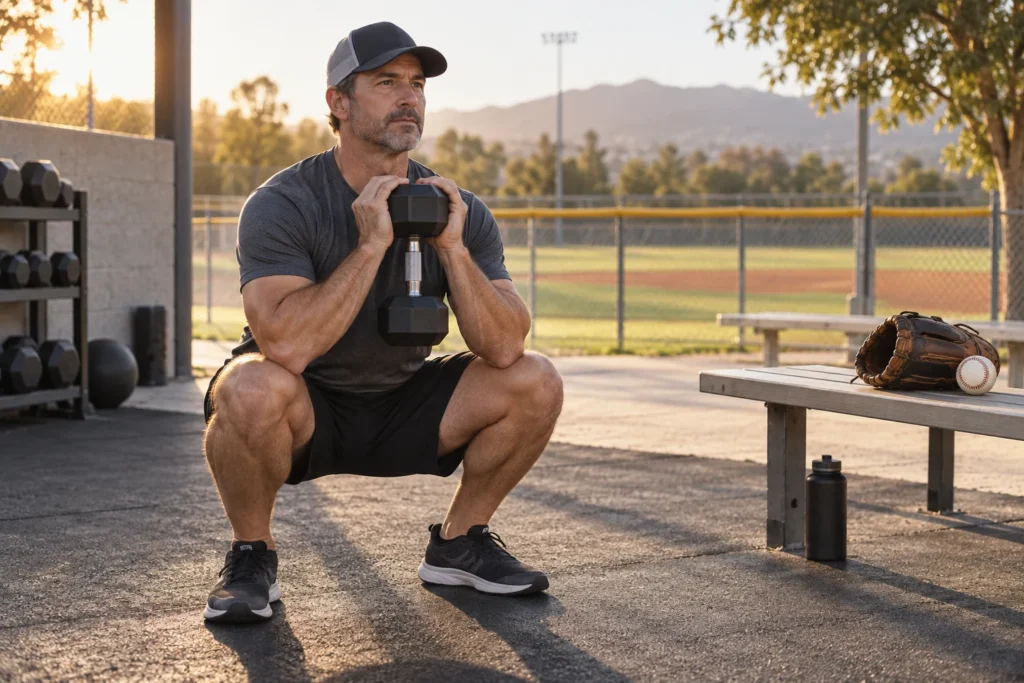
This is an editorial sample, not a tested PrimeForMen intervention or an individualized coaching prescription. The images are AI-generated illustrations. If basic movement patterns are unfamiliar, start with strength training at home before the loading phases. Youth athletes need an age-appropriate supervised plan; MLB Pitch Smart provides age-specific pitching guidance.
Before Week One: Define Your Starting Point
Record your first practice or game date, the days you can train and any current pain. Put bullpen sessions and harder throwing days on the calendar before adding gym sessions. A pitcher, a catcher and an occasional outfielder do not start with the same workload.
Use an easy rehearsal of the squat, hip hinge, row, push and split stance. Choose loads you can control without straining. You do not need a one-repetition maximum test or a maximal throw to begin. A review of offseason baseball training describes the importance of individual assessment and organized preparation; the specific 16-week example below is our editorial application, not a reproduction of a validated trial.
On a small screen, swipe the table sideways to read every column.
| Weeks | Purpose | Gym approach | Move forward when |
|---|---|---|---|
| 1–2 | Restart | Two easy sessions; 1–2 sets per exercise, 8–10 controlled reps. | Movement is comfortable and normal activity is unaffected the next day. |
| 3–6 | Build consistency | Two sessions; 2–3 sets, 8–10 reps. Optional light third day. | Technique remains stable across sessions. |
| 7–10 | Build strength | Two sessions; main lifts 3 × 5–6, accessories 2 × 8. | Loads leave about two good reps available; skill work is not deteriorating. |
| 11–14 | Introduce power | Small throws or jumps first; main lifts 2–3 × 5. | Power repetitions stay crisp and recovery remains manageable. |
| 15–16 | Prepare for practice | Two shorter sessions; main lifts 2 × 5, fewer accessories. | You arrive at skill sessions feeling ready rather than depleted. |
If a phase needs extra time, extend the calendar and stop calling it a 16-week completion. If you only have eight weeks, do not compress sixteen weeks of work into them. Build a shorter plan with your coach around your current ability.
Your Two Main Workouts
Warm up for about 8–10 minutes with easy movement, then unloaded versions of the exercises and lighter practice sets. Use the set and rep instructions for your current phase above. Rest about two minutes between demanding strength sets and longer if needed to regain control; these are not race-against-the-clock circuits.
On a small screen, swipe the table sideways to read every column.
| Movement | Workout A | Workout B |
|---|---|---|
| Main lower-body lift | Goblet squat or coached front squat | Dumbbell Romanian deadlift or a familiar trap-bar deadlift |
| Upper-body pull | Supported dumbbell row | Cable row or assisted pull-up |
| Upper-body push | Incline push-up or dumbbell bench press | Comfortable-grip dumbbell press or incline push-up |
| Single-leg work | Supported split squat | Low step-up |
| Trunk / carry | Suitcase carry: 2 × 20–30 seconds per side | Pallof press: 2 × 8 controlled reps per side |
For unilateral movements, the prescribed reps are per side. Start with the easier side-supported option when balance limits the exercise. A shoulder that hurts during pressing needs assessment or modification, not a command to “push through.” See unilateral training for exercise-selection context.
Progression example: in weeks 3–6, start a lift at two sets of eight with several comfortable repetitions left. Add repetitions within the range before increasing weight. Once both sets reach ten with consistent technique on two sessions, try the smallest practical weight increase and return to eight. A third set is an optional next step, not a requirement to add load and volume together.
How to Place Lifting Beside Baseball
For a recreational position player with weekend skill practice, a starting example is Monday Workout A, Thursday Workout B and Saturday skill practice. Tuesday can be easy walking or cycling; Wednesday and Friday are rest or light activity. This is a calendar example, not a throwing prescription.
Pitchers should have their coach place strength work around their actual throwing plan. Do not assume a generic rest interval resolves arm fatigue. If a harder throwing session is added, reconsider the optional gym work first. Catchers can reduce additional lower-body volume when catching practice already imposes substantial leg work.
An optional third session in weeks 3–10 might include light rows, carries and comfortable mobility for 20–25 minutes. It should not become another heavy leg day. Keep it out when your two main sessions or sport practice already feel difficult to recover from.
Power Work in Weeks 11–14
Power work belongs near the beginning of a session after the warm-up, while movement is still controlled. For a player already comfortable with these activities, one example is three sets of three light medicine-ball rotational throws per side before Workout A, and three sets of three low jumps with controlled landings before Workout B. Rest fully between sets. Use a throwing area and wall approved for the equipment, with nobody in the rebound path.
These replace some work; they are not a demand to add a second full workout. Skip jumps and throws if you lack experience, have pain, or cannot control the landing or release. Continue the strength phase and get coaching instead. There is no requirement to perform Olympic lifts, loaded jumps or weighted-ball pitching.
Our medicine ball guide helps distinguish equipment types, while plyometric training covers the progression questions to resolve before adding more impact.
What an Actual Week Looks Like in Each Phase
Use the examples below with Workouts A and B above. They describe a healthy adult recreational position player whose skill practice is on Saturday. Pitchers should substitute their coach-set throwing calendar. An “easy activity” day means comfortable movement, not extra intervals or a secret third heavy workout.
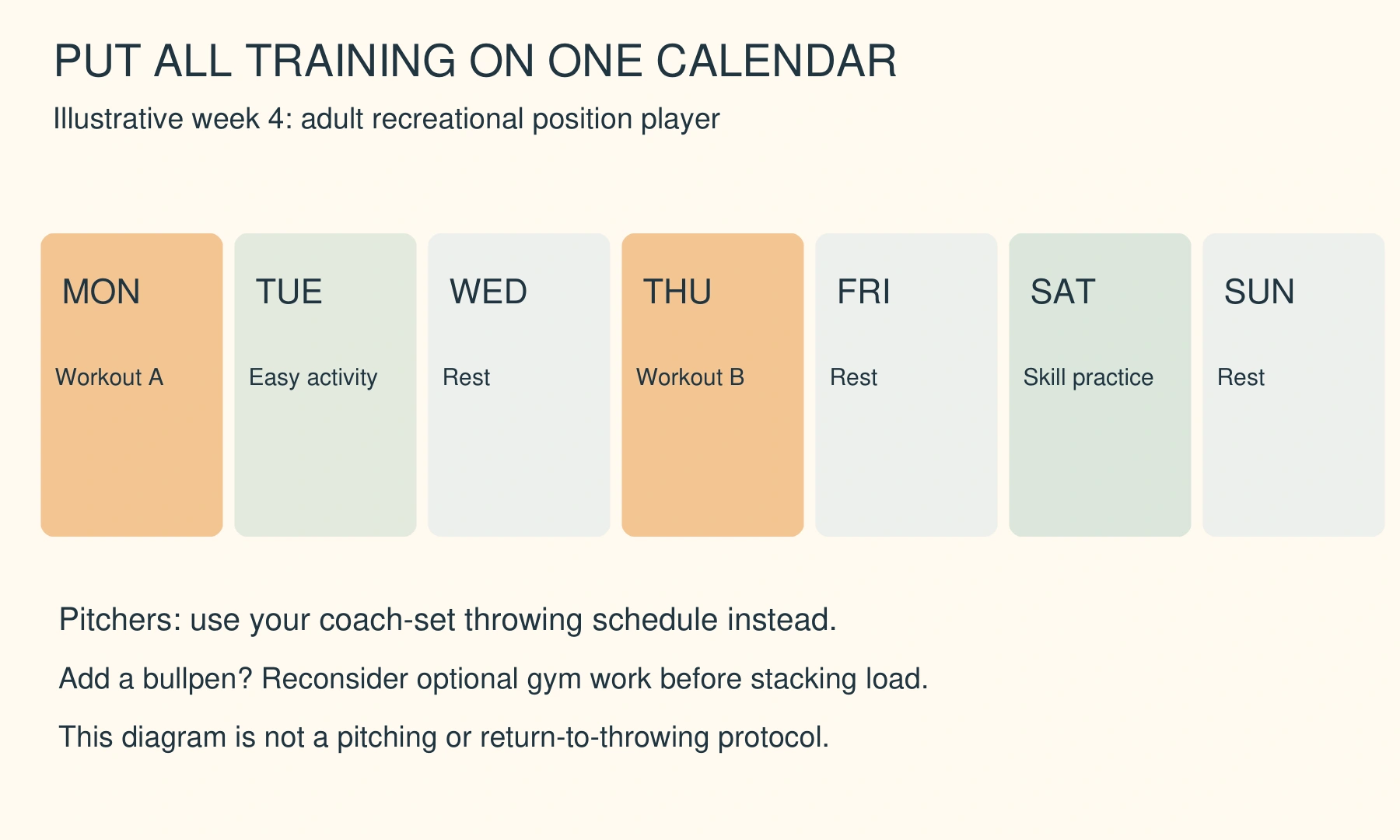
On a small screen, swipe the table sideways to read every column.
| Example week | Monday / Workout A | Thursday / Workout B | Rest of the week |
|---|---|---|---|
| Week 1: restart | One easy set of 8 per main movement. Use a short carry. | Repeat the same modest approach with Workout B. | Easy activity Tuesday; rest Wednesday/Friday/Sunday; only familiar comfortable skill activity. |
| Week 4: build | Two sets of 8–10 per main movement. Carry 2 × 20 seconds per side. | Two sets of 8–10; Pallof press 2 × 8 per side. | Saturday skill practice; no compulsory third lift. |
| Week 8: strength | Main lower lift 3 × 5–6; row, push and split squat 2 × 8. | Main hinge 3 × 5–6; other lifts 2 × 8. | Protect skill quality; omit optional training if recovery is slipping. |
| Week 12: power | After warming up, 3 × 3 light rotational throws per side; lower lift 2 × 5 and accessories 2 × 6–8. | Experienced jumpers: 3 × 3 low controlled jumps first; hinge 2 × 5 and accessories 2 × 6–8. | These low-volume power drills replace work, not add a second session. Skip them if not ready. |
| Week 16: preseason | Familiar main lifts 2 × 5; choose only one or two light accessories. | A second short session only if it fits practice and recovery. | Baseball practice now drives the calendar; do not add new exercises or test maximums. |
The table specifies sample weeks, not automatic permission to advance. If week 4 still causes limiting soreness, repeat its manageable version instead of switching to week 8 loading. If your first game arrives before you are ready for power work, skip that phase rather than rushing it.
How to Choose and Adjust the Starting Load
Begin with the easiest familiar version and a load you can move consistently while leaving several good repetitions available. For a first set of eight, ask whether another two or three controlled repetitions would be realistic. If not, reduce the load. This estimate is a practical guide, not a laboratory measurement.
A foundation example: Monday, row 2 × 8 at a comfortable load; next comparable session, 2 × 9; later, 2 × 10. Only after two comfortable sessions at the top of the range should you consider the smallest practical increase. Record the actual repetitions so a heavier weight with fewer controlled reps is not mistaken for an unqualified improvement. See progressive overload for more context.
Pitcher, Catcher and Field-Player Adjustments
On a small screen, swipe the table sideways to read every column.
| Role | What to record | What to reconsider first |
|---|---|---|
| Pitcher | Coach-planned throwing sessions, intensity changes and any symptoms. | Extra upper-body work and medicine-ball volume; do not improvise weighted-ball or return-to-throwing programs. |
| Catcher | Catching practice and accumulated time in demanding positions. | Additional split-squat, step-up or jump volume when legs are already fatigued. |
| Infielder | Fielding repetitions and lateral movement practice. | New cutting drills added beside an already demanding practice. |
| Outfielder | Longer running and repeated acceleration exposure. | Extra sprint work before adding another lower-body session. |
| Returning player / over 50 | Recent training history, next-day limitations and consistency. | Later-phase volume; extend the foundation rather than matching younger teammates. |
Watch the Rotational Throw Before Adding It
The demonstration by VSP South Bay coaches Sean Herrin and Yohei Arakaki shows how they coach a rotational medicine-ball throw. Focus on coordinated lower-body and trunk movement. It does not establish that a specific throw increases your pitching velocity, and it does not replace assessment of your movement or shoulder history.
Use a light ball intended for the chosen throw, a suitable approved wall or open throwing area, and a clear rebound path. Learn the basic version first. The sample power phase uses only three sets of three repetitions per side; do not copy every variation in the video into one workout. If you cannot release and receive or retrieve the ball predictably, stop and get instruction.
A Worked Training-Log Example
Week 4: Monday A completed with goblet squat 2 × 8, with two or three good repetitions left. Thursday B completed with familiar loads. Saturday batting practice felt normal. Next week: add one repetition to the squat sets, keep other work unchanged. In contrast, if Thursday’s split squats made Saturday movement noticeably difficult, repeat or reduce that exercise instead of progressing it.
The point of the log is to connect a gym decision to the next baseball session. Record “shoulder discomfort during throwing” accurately instead of diagnosing it as weakness. Persistent or increasing symptoms require appropriate assessment. Your log helps the conversation; it does not determine the diagnosis.
Download the weekly baseball training log (fillable PDF)
Save a local copy and use a PDF reader that supports form fields. Your entries are not sent to PrimeForMen.
Track Results Without Chasing Every Number
Log the exercise, sets, reps, load and how the session felt. Note throwing or batting work and any next-day limitation. Recheck a familiar lift at the same repetitions and effort every four weeks. More controlled work at similar effort is useful progress.
If you time a 10-yard sprint, use the same surface, footwear, start and timing method. A shorter time is faster; a longer time is slower. Small differences can be measurement noise. Do not diagnose fatigue from one attempt. Throwing velocity and batting results depend on technique and other factors, so strength improvement cannot guarantee a particular MPH gain.
Recovery, Food and Equipment
Plan regular meals, adequate fluids and enough sleep to support the work you are asking yourself to do. Supplements are optional, not a condition for starting. Use the protein planning tool as a general food-planning aid, not a clinical prescription.
A pair of suitable dumbbells, a stable support for rows and a clear training area cover much of the example. Use the home gym equipment guide if you need to compare options. Borrow or use existing equipment before buying a specialist tool for a phase you have not reached.
Conclusion
Start by placing two manageable strength sessions around your baseball schedule. Follow the 16-week sequence only while technique and recovery justify it. Arriving prepared for practice matters more than completing every planned set on the calendar.
Frequently Asked Questions
Is this a complete pitching program?
No. It is a strength-planning example. Throwing progression, pitch counts and return from arm problems require separate age- and player-specific guidance.
Can men over 50 use it?
Training history, current capacity and health matter. An experienced healthy adult may use it as a framework; a returning player should start lower and seek appropriate coaching rather than copy the later phases.
How many days should I lift?
This example uses two main sessions. A third lighter session is optional, and should be omitted when it compromises recovery or skill practice.
Will it add pitching velocity?
No specific velocity gain is promised. Throwing performance depends on technical skill, workload and individual factors as well as physical preparation.
What if I miss a week?
Resume with manageable work instead of doubling sessions. If the interruption is substantial, repeat or step back a phase and adjust the season calendar.
Training and medical boundary: This editorial example is not individualized coaching or rehabilitation. Stop activity that causes sharp or increasing pain and seek appropriate assessment. Chest pain, fainting or severe unexplained breathlessness during exercise warrant urgent medical attention. Images are conceptual, not evidence of a tested program.