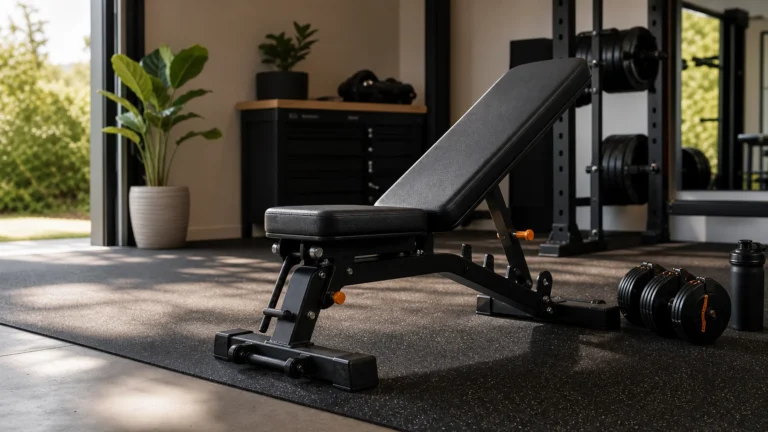
Compare flat, adjustable and foldable weight benches by stability, total system load, pad fit and storage—especially for heavier lifters.
- Calculate total system load: lifter, weights and a sensible safety margin.
- Judge stability at the angles you will use, not only on a flat bench.
- Check pad height, width and rack fit before prioritizing foldability.
Bottom line For heavier users, published capacity is only the start; frame stability and total system load determine the safer buy.
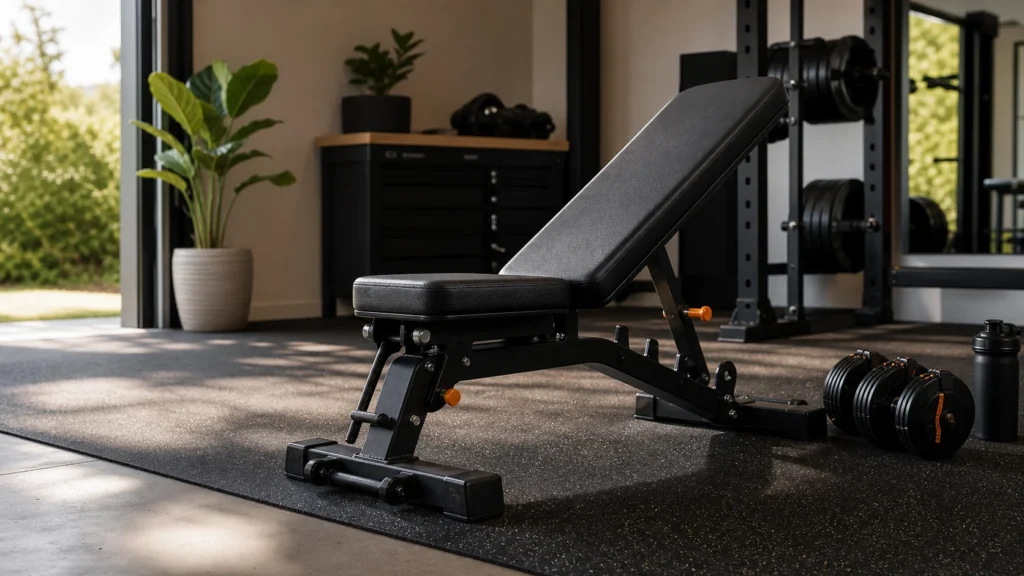
Best weight benches for home gyms are not the benches with the most angles or the loudest load-rating claim. The right bench is stable under the work you actually do, fits your floor space, stores without friction, and gives you more repeatable training options with dumbbells, barbells, or bodyweight work.
Quick Summary: best weight benches for home gyms
- Choose an adjustable bench if incline pressing, seated pressing, rows, and exercise variety matter most.
- Choose a flat utility bench if stability, simplicity, and value matter more than angles.
- Choose a foldable bench only when storage is the limiting factor and the frame does not wobble.
- Load rating means user weight plus training weight, not a vague number on a sales page.
- The best bench is the one you can set up, trust, and use every week.
The Prime Perspective
A weight bench is not just an accessory. It changes the exercises you can repeat safely: dumbbell press, incline press, chest-supported rows, step-ups, split squats, pullovers, rear-delt work, and more controlled pressing angles.
The mistake is buying the bench that looks strongest online while ignoring the room. A bench that blocks your garage, wobbles on carpet, sits too high, or takes five minutes to unfold becomes friction. Friction kills home training.
Amazon.com picks
High-Quality Weight Bench Shortlist
These are direct product examples, not generic categories. Check current price, dimensions, listed capacity, return policy, recent review photos, and room fit before buying.
Disclosure: this guide includes Amazon affiliate links. PrimeForMen may earn a commission if you buy through these links at no extra cost to you. Product picks are editor-researched for home-gym fit, stability signals, storage reality, and use case.

Best adjustable bench pick
REP AB-3100 Adjustable Weight Bench
Best if dumbbell pressing, incline work, split-squat support, and exercise variety matter more than the smallest folded footprint.
- Good fit for lifters who want one bench to cover flat and incline dumbbell work.
- Check the listed load rating, angle range, and footprint against your room before ordering.
- Choose this style only if you have enough space to adjust the back pad without hitting walls.

Heavy-duty stability pick
Body-Solid GFID71B Heavy-Duty FID Bench
Best if stability and long-term durability matter more than compact storage or easy room-to-room movement.
- Better category fit for heavier dumbbell pressing and rack-adjacent home gym setups.
- Confirm total user-plus-weight load rating, bench height, and available floor clearance.
- Skip this type if you need a bench that folds flat into a closet after every session.

Stowable room-saver pick
Bowflex 3.1S Adjustable and Stowable Bench
Best if you need a real adjustable bench but cannot let it live open in a spare room or apartment.
- Useful for lifters who train in shared rooms and need vertical storage after workouts.
- Measure both open and stored dimensions; the stored shape still needs a dedicated spot.
- Best for controlled dumbbell work, not for treating a compact bench like a commercial rack station.

Modular premium pick
Ironmaster Super Bench
Best if you want a compact, serious bench platform and may add attachments later.
- Strong fit for buyers who value modularity and a simpler pad profile over a budget price.
- Review attachment compatibility, bench height, and storage needs before committing.
- Skip if you want the cheapest foldable bench or do not want to manage optional add-ons.

Value adjustable pick
FLYBIRD WB7 Adjustable Weight Bench
Best if you want an adjustable home-gym bench with strong claimed capacity and easier movement than heavy commercial models.
- Good comparison point when budget matters but you still want more than a very basic foldable bench.
- Check recent review photos for wobble, pad comfort, wheel usability, and real-room size.
- Use controlled reps and inspect hardware periodically, especially if the bench is moved often.
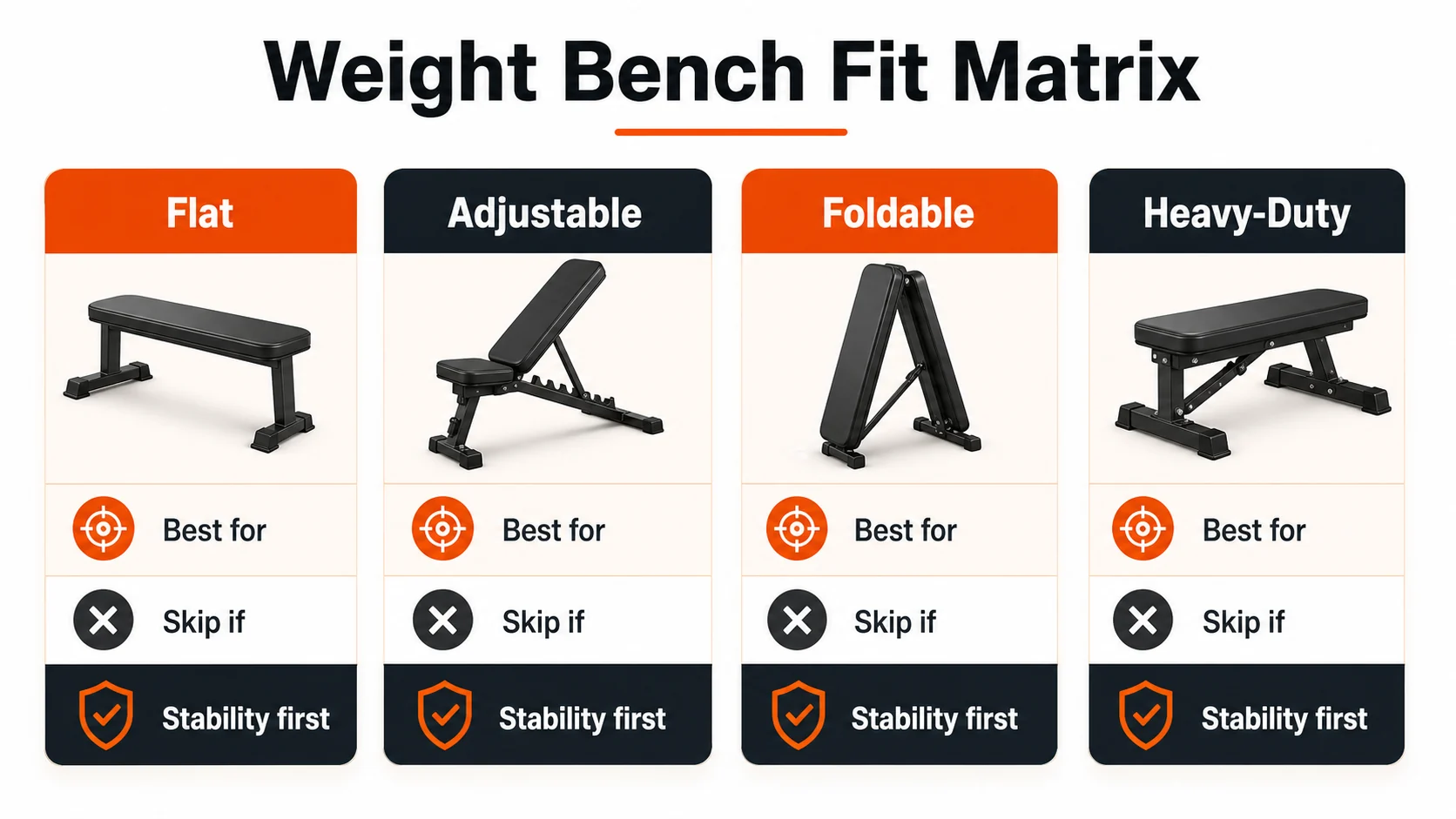
Flat vs Adjustable vs Foldable vs Heavy-Duty Benches
Bench type matters more than brand preference. You are choosing a tradeoff between stability, angles, footprint, storage, and long-term loading.
| Bench type | Best for | Watch out for | PrimeForMen verdict |
|---|---|---|---|
| Flat utility bench | Flat dumbbell press, rows, step-ups, simple strength work. | No incline work and less exercise variety. | Best value if you want stable basics. |
| Adjustable bench | Incline press, seated press, rows, shoulder work, variety. | More moving parts and more room needed around the bench. | Best all-around choice for most home gyms. |
| Foldable bench | Apartments, shared rooms, closets, low-friction storage. | Wobble, hinge quality, shorter pads, lower confidence under load. | Buy only after measuring and checking stability. |
| Heavy-duty FID bench | Garage gyms, heavier dumbbell work, rack-adjacent lifting. | Higher price, heavier frame, poor portability. | Best for serious lifters with dedicated space. |
The Load Rating Rule Most Buyers Miss
Load rating is not your body weight. It is your body weight plus the weight in your hands plus a margin for movement. If you weigh 200 pounds and press two 70-pound dumbbells, the bench needs to tolerate more than 340 pounds in real use.
Decision rule: if the listed capacity is vague, hidden, or unsupported by the frame design, do not treat it as a serious bench for loaded pressing.
Best Adjustable Weight Bench for Heavy Users: Use the System Load
A heavy user should choose a bench by total system load, frame stability, pad support, and adjustment hardware—not body weight alone. Add your body weight, both dumbbells or the loaded bar, and a margin for movement and long-term wear. A 275-pound man pressing two 80-pound dumbbells already places 435 pounds in the system before dynamic forces.
System capacity
Use body weight plus external load. Treat the published rating as a ceiling, not a target.
Contact and wobble
Wide rear support, level feet, tight pivots, and a rigid ladder or pin system matter more than extra angles.
Body fit
Pad width, height, gap, and shoulder freedom determine whether the bench feels stable without blocking the press.
| Buyer profile | Prioritize | Usually skip |
|---|---|---|
| Heavy user, dumbbell training | Wide stable base, high system rating, wheels, small pad gap | Ultralight folding frames with vague ratings |
| Barbell benching in a rack | Rack fit, safeties, pad height, minimal lateral movement | Foot geometry that collides with stance or rack uprights |
| Shared home gym | Fast ladder adjustments, readable angles, transport handle | Slow loose pins that invite incorrect setup |
| Small room | Upright storage explicitly supported by the manufacturer | Assuming every adjustable bench is safe to stand vertically |
Recheck fasteners after the first several sessions and inspect welds, pivots, upholstery, and adjustment points routinely. If a bench rocks on a level floor, do not solve the problem by loading it harder. Return, repair, or replace it within the proper warranty path.
Bench Specs That Actually Matter
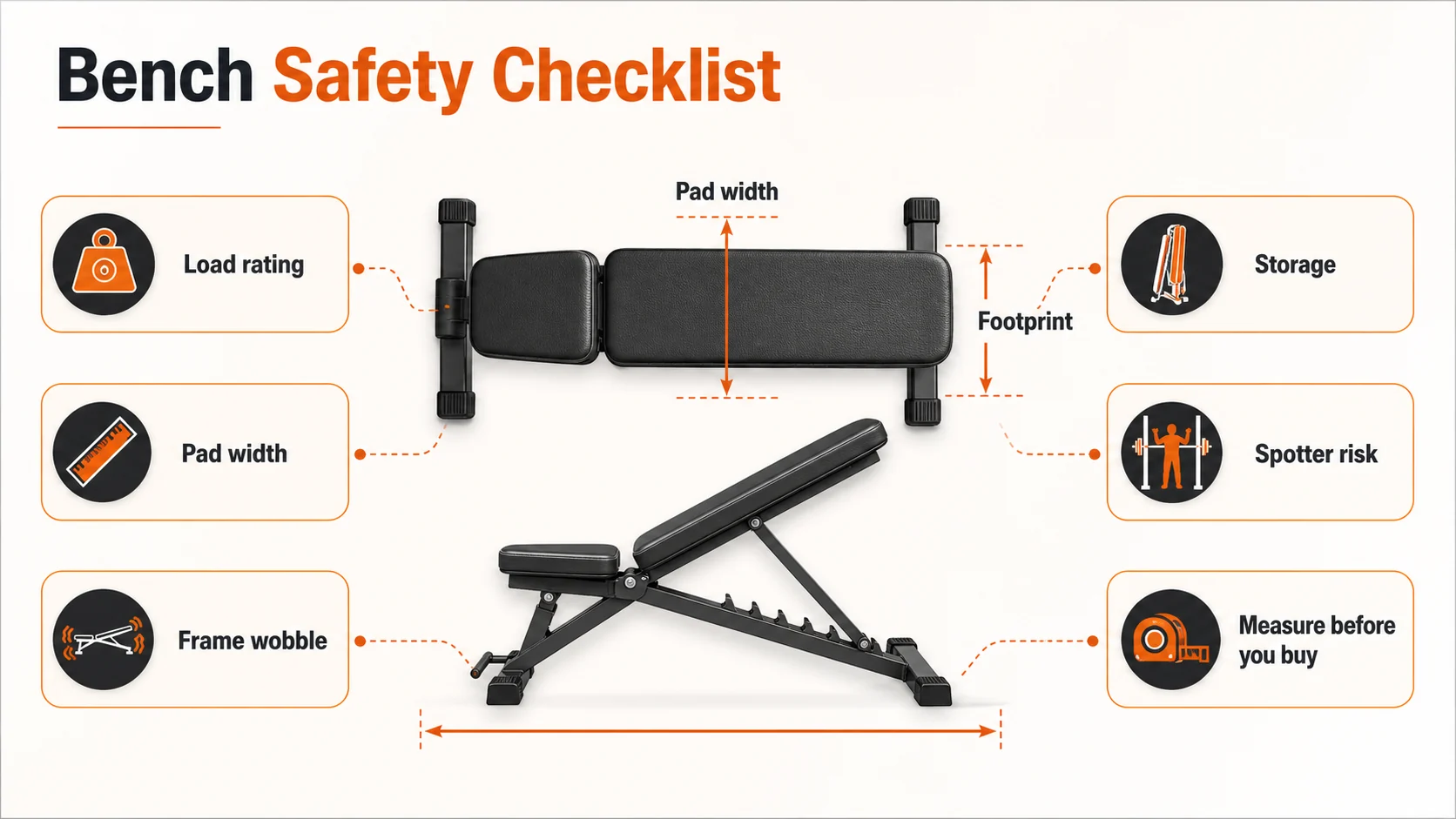
| Spec | Why it matters | What to check |
|---|---|---|
| Load rating | Protects the bench from being used beyond its intended capacity. | User weight plus dumbbells/barbell plus margin. |
| Pad width | Affects upper-back support and shoulder movement. | Too narrow can feel unstable; too wide can restrict some lifters. |
| Bench height | Changes leg drive, setup, and getting on/off the bench. | Shorter lifters and men with mobility limits should check this carefully. |
| Foot design | Controls wobble on rubber flooring, concrete, carpet, or wood. | Wide feet and rubber contact points usually feel more secure. |
| Adjustment ladder | Determines angle options and locking confidence. | Back pad should lock cleanly without shifting under normal setup. |
| Stored size | Decides whether the bench remains usable or becomes clutter. | Measure folded or vertical footprint, not only open footprint. |
Best Bench by Training Goal
Adjustable Bench Buying Guide
An adjustable bench is the best first bench for many men because it unlocks the most exercises. Pair it with adjustable dumbbells, and a small home gym suddenly covers far more than flat pressing.
Foldable Bench Buying Guide
Foldable benches solve storage. They do not automatically solve training. The hinge, frame, feet, pad length, and lock system matter more than the fact that it folds.
Storage test: if folding the bench takes enough effort that you avoid training, the bench failed its main job. If it folds easily but wobbles under load, it also failed.
Heavy-Duty Bench Buying Guide
A heavy-duty bench makes sense when the bench will stay in a dedicated training area and support heavier loading. It pairs well with strength training basics, racks, heavier dumbbells, and long-term progressive overload.
It makes less sense in a bedroom, hallway, or shared room where movement and storage matter as much as strength.
Bench Safety for Home Training
Most bench risk at home comes from overconfidence: too much load, no safeties, no spotter, unstable feet, or a bench placed on a poor surface. The bench is only one piece of the setup.
| Risk | Better choice | What to avoid |
|---|---|---|
| Heavy barbell benching alone | Rack safeties, spotter, or dumbbell variations. | Max attempts with no escape plan. |
| Bench wobble | Flat floor, wide feet, stable frame, lower load. | Pressing harder to “test” a shaky bench. |
| Shoulder irritation | Controlled range, better pad position, lighter warm-up sets. | Forcing angles that do not fit your shoulders. |
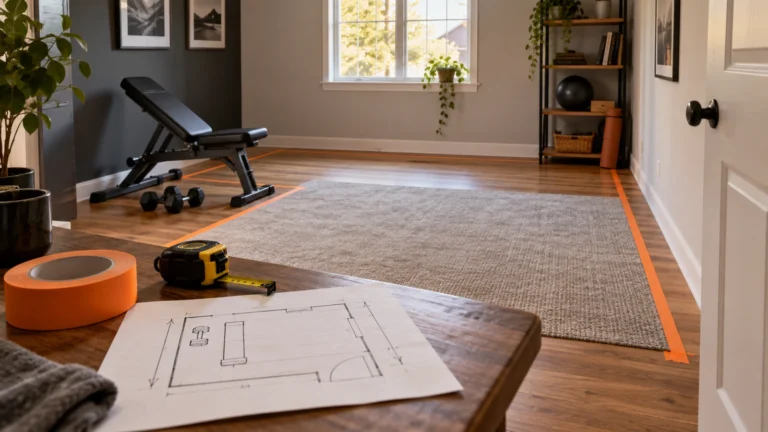
| Small-room collisions | Measure dumbbell path and walking space. | Buying based only on product footprint. |
For baseline training context, the CDC adult physical activity guidelines still support a practical point: adults need regular muscle-strengthening work. A bench should make that easier to repeat, not harder to start.
Budget Tiers: What to Buy First
| Budget tier | Bench move | Why |
|---|---|---|
| Under $150 | Delay the bench unless you find a stable flat utility option. | Dumbbells, bands, and flooring may create more training value first. |
| $150-$300 | Compare foldable and entry adjustable benches carefully. | This is where storage wins can come with stability tradeoffs. |
| $300-$600 | Look for stronger adjustable or stowable options. | Better fit for repeated dumbbell training and longer use. |
| $600+ | Consider heavy-duty or modular benches. | Only worth it when the space and training habit are already proven. |
If the whole setup is still forming, use the broader home gym equipment guide or the fitness on a budget guide before buying the bench.
Four-Week Bench Integration Plan
| Week | Focus | Bench work |
|---|---|---|
| 1 | Stability and setup | Flat dumbbell press, one-arm rows, light split-squat support. |
| 2 | Angle control | Add low-incline press and chest-supported rows if the bench feels stable. |
| 3 | Progression | Add small weight jumps or one extra set while keeping reps controlled. |
| 4 | Decision audit | Keep the bench if it removed friction; change setup if it created clutter. |
What Most Buyers Miss
The missing question is not “How many angles does it have?” It is “Will I trust this bench enough to use it hard, and will I still be willing to set it up three months from now?” Specs matter because they protect consistency.
How We Chose These Weight Bench Picks
We evaluated weight benches by training value per square foot, stability signals, listed capacity, adjustment range, storage friction, pad support, room fit, product-page clarity, recent review-photo usefulness, and use-case match. These picks are editor-researched, not lab-tested or long-term hands-on tested by PrimeForMen unless explicitly stated.
Commercial links are marked with sponsored/nofollow attributes in line with Google guidance on qualifying outbound links.
Before paying for a leg attachment, compare exact bench compatibility and seated versus lying curl setup in our leg extension and curl machine guide. If your goal is Nordic curls or back extensions, use the separate Nordic bench and Roman-chair comparison; a general-purpose weight bench does not automatically provide the required support.
Conclusion
The best weight bench for a home gym is not automatically the biggest, cheapest, or most adjustable option. It is the bench that supports your actual training, fits your room, stays stable, and removes setup friction.
If you want one default answer, choose a stable adjustable bench. If you want maximum simplicity, choose a flat utility bench. If storage decides everything, choose a foldable or stowable bench only after checking wobble, load rating, pad support, and folded footprint.
Next step: pair the bench with adjustable dumbbells, a clear strength training at home plan, and enough floor space to train without moving half the room first.
Training disclaimer: this article is editorial fitness guidance, not medical advice. If you have shoulder pain, chest symptoms, dizziness, recent surgery, or a medical condition that affects exercise, speak with a qualified professional before changing training.
Affiliate disclosure: some product links are sponsored affiliate links. PrimeForMen may earn from qualifying purchases. This does not change the price you pay or the criteria used in this guide.
FAQs
What are the best weight benches for home gyms?
The best weight bench for a home gym is the one that fits your training and room. Most men should compare an adjustable bench for variety, a flat utility bench for stability, a foldable bench for storage, and a heavy-duty bench for higher loading.
Is an adjustable bench better than a flat bench?
An adjustable bench is better for exercise variety: incline press, seated shoulder press, supported rows, and different dumbbell angles. A flat bench is better when maximum simplicity, stability, and value matter more than angle options.
What load rating should a home weight bench have?
Use total load, not just body weight. Add your body weight, both dumbbells or barbell load, and a margin for movement. If the listed capacity is vague, the bench is not a good fit for serious loaded training.
Are foldable weight benches safe?
Foldable benches can be safe for controlled home workouts when the frame locks securely, the feet sit flat, and the load rating fits the work. They are a poor choice if the hinge, pad, or feet wobble under light testing.
How wide should a weight bench pad be?
Most lifters do well with a pad that supports the upper back without forcing the shoulders into an awkward position. Very narrow pads can feel unstable, while very wide pads can restrict shoulder movement for some pressing styles.
Should I buy a FID bench for a home gym?
Buy a flat-incline-decline bench only if you will use those angles. A FID bench adds versatility, but it also adds moving parts, storage friction, and more stability checks than a simple flat bench.
Can I bench press at home without a spotter?
Avoid heavy barbell benching alone without safeties. Dumbbell pressing, push-ups, machine work, or rack safeties are safer options when no spotter is present. Do not let a home bench create a false sense of security.
What bench works best for adjustable dumbbells?
A stable adjustable bench usually pairs best with adjustable dumbbells because it unlocks flat press, incline press, seated press, one-arm rows, pullovers, and rear-delt work without needing multiple machines.
Is a cheap weight bench worth it?
A cheap bench can be worth it for light, controlled work if it is stable and properly rated. It is not worth it if the pad shifts, the feet rock, the listed capacity is unclear, or you plan to press heavier loads.
What should men over 40 look for in a weight bench?
Men over 40 should prioritize stable feet, a supportive pad, controlled adjustment, easy setup, and enough height for safe getting on and off. The bench should make repeatable strength work easier, not add joint or setup friction.
Do I need a bench for a home gym?
You do not need one on day one. A bench becomes useful when dumbbell training is already consistent and you want more pressing, rowing, incline, and supported variations than floor exercises allow.
How much space do I need for a weight bench?
Measure the bench open, the space needed to walk around it, the dumbbell path, and the storage position. A bench that technically fits but blocks the room will not get used consistently.