

Probiotics for fitness: strain-specific gut-muscle guidance, product fit, safety checks, and a 30-day trial for men who train.
- Choose probiotics by job: daily support, protein tolerance, travel disruption, or high-load training context.
- Strain ID and viability matter more than the biggest CFU number on the front label.
- Run one product for 30 days and keep it only if digestion, tolerance, or consistency clearly improves.
Bottom line A probiotic belongs in your fitness stack only when it solves a trackable problem without adding new GI noise.

Probiotics for fitness can be useful for men who train, but not because a capsule magically builds muscle, burns fat, or replaces better nutrition. The real question is narrower: can a specific probiotic strain help your digestion, gut barrier, immune resilience, or tolerance for a higher-protein diet enough to improve consistency?
That is where most probiotic content goes wrong. It talks about “gut health” as if every strain does the same job. It does not. A probiotic is closer to a tool than a multivitamin. The strain, dose, delivery format, safety context, and the problem you are trying to solve all matter.
Quick Summary: Probiotics for Fitness
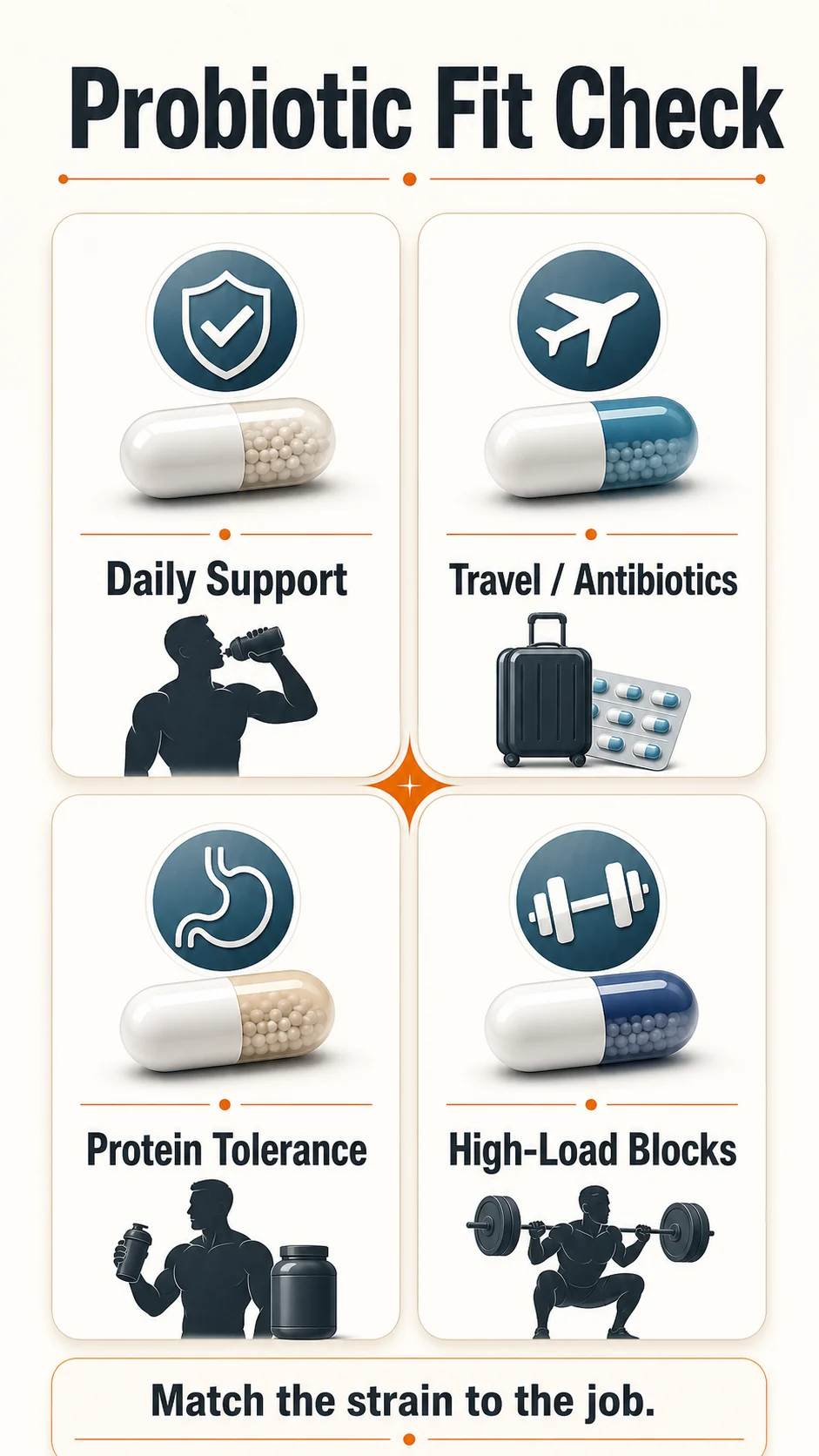
- Use probiotics for fitness only when you have a clear job: digestive regularity, travel disruption, antibiotic context, protein tolerance, or high-load training support.
- CFU count is not the deciding factor. Strain ID, survivability, expiration viability, and third-party testing matter more.
- Some sport-focused research is promising, especially around immune function, GI symptoms, and select performance markers, but results are strain-specific.
- Men who are immunocompromised, seriously ill, or dealing with persistent GI symptoms should get medical input before using probiotics.
- Run a 30-day trial with a baseline log. Keep the product only if digestion, training tolerance, or recovery markers clearly improve.
The Prime Perspective
Most guys buy probiotics the same way they buy pre-workout: bigger number, louder label, faster checkout. That is the wrong filter. A 100-billion CFU product with vague “proprietary blend” language may be less useful than a lower-count product with a named strain and a job that matches your problem.
Bottom line: a probiotic earns a spot in your stack only if it solves a trackable issue without creating new GI noise. If your digestion is already steady, your diet is consistent, and you are recovering well, you may not need one.
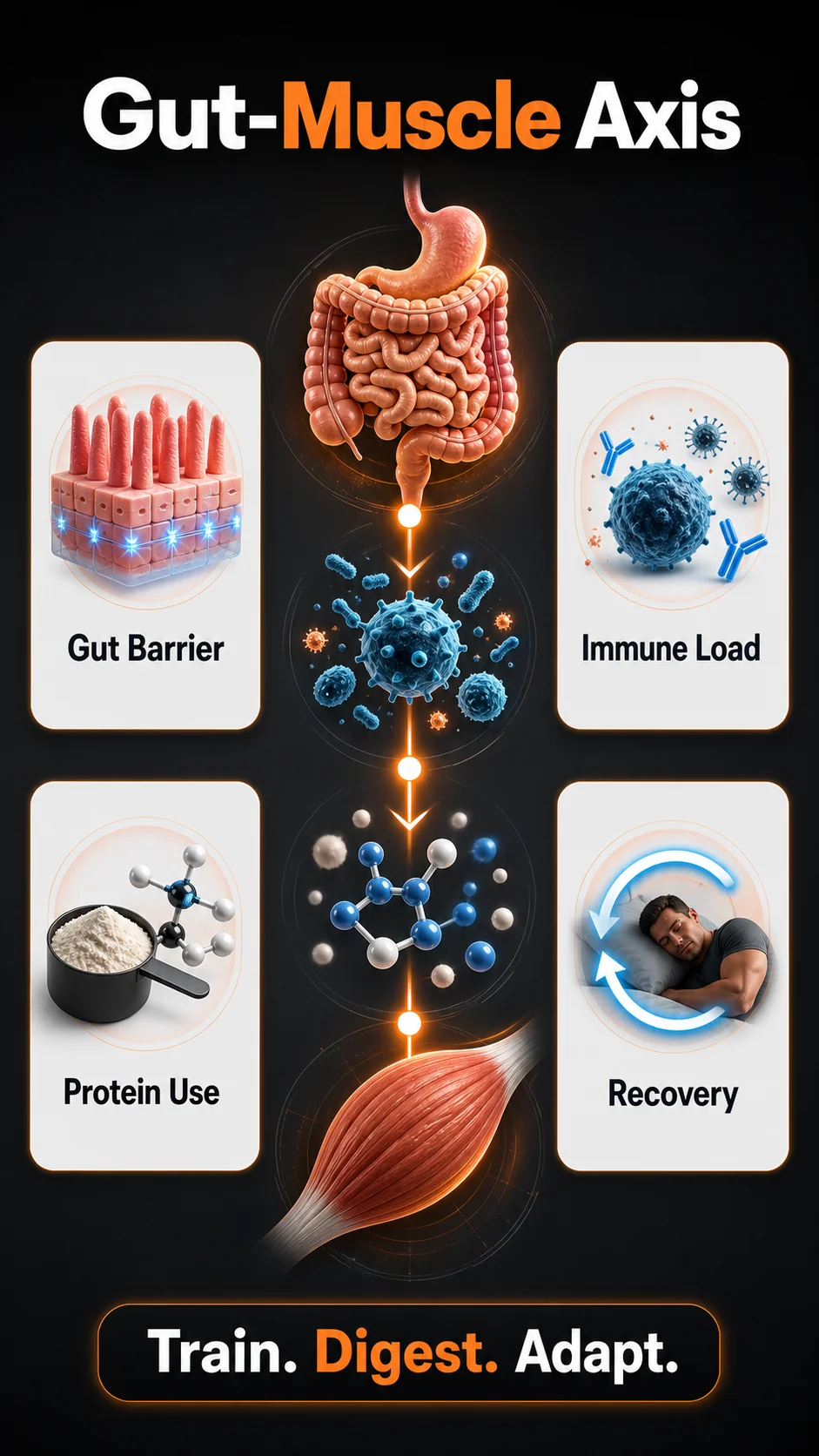
How the Gut-Muscle Axis Connects to Training
The gut-muscle axis is the two-way relationship between the intestinal microbiome, immune signaling, nutrient handling, inflammation, and skeletal muscle function. That does not mean probiotics are anabolic. It means the gut can influence the conditions under which training adaptation happens.
Hard training can shift blood flow away from the gut toward working muscle. In some athletes, especially during heat, long sessions, heavy blocks, or poor fueling, that stress can increase GI symptoms and affect barrier function. The practical goal is not to “seal a leaky gut” with a miracle capsule. The goal is to reduce avoidable friction: bloating, irregularity, post-shake discomfort, travel disruption, and immune setbacks that interrupt training.
| Training issue | Gut link | What a probiotic may help | What it cannot replace |
|---|---|---|---|
| High-protein diet feels heavy | Meal size, fiber balance, lactose tolerance, gut motility | Some men may tolerate shakes or higher protein better with the right strain and slower ramp-up. | Correct protein dose, food quality, lactose control, hydration |
| Heavy training blocks increase GI noise | Stress load, sleep debt, heat, blood-flow shifts, meal timing | May support regularity and reduce symptom swings in some users. | Deloads, sleep, lower session stress, smarter fueling |
| Travel breaks consistency | New foods, disrupted schedule, altered stool pattern | Specific options such as Saccharomyces boulardii are commonly used around travel and antibiotic context. | Food hygiene, fluid intake, medical care for severe symptoms |
| Frequent training interruptions | Immune stress and recovery debt can overlap | Sport probiotic research often focuses on immune and upper-respiratory outcomes in athletes. | Calories, sleep, reduced volume, vaccination and medical advice when relevant |
Best Probiotic Fit by Fitness Goal
The genus on a label, such as Lactobacillus or Bifidobacterium, is not enough. Species and strain codes matter because effects do not automatically transfer from one strain to another. This is why “contains probiotics” is weak language and “contains Lactobacillus plantarum TWK10” is a more meaningful starting point.
| Fitness goal | Entities to know | What to look for | Buying caution |
|---|---|---|---|
| Performance research interest | Lactobacillus plantarum TWK10, Lactobacillus plantarum PS128 | Strain-specific human data, not generic “plantarum” claims. | Do not assume every product in the species has the same effect. |
| Immune support during high-volume blocks | Bifidobacterium animalis subsp. lactis, Bifidobacterium lactis Bl-04 | Named strain, viable count through expiration, transparent label. | Immune support is not infection prevention or treatment. |
| Digestive regularity and protein tolerance | Lactobacillus rhamnosus GG, Bacillus coagulans, mixed daily blends | Start low, track stool, bloating, and post-meal comfort. | If symptoms are persistent, do not self-diagnose with supplements. |
| Travel or antibiotic context | Saccharomyces boulardii | Clear yeast probiotic labeling and timing guidance. | Ask a clinician if you are on antibiotics or have medical risk factors. |
Three Probiotic Categories Worth Comparing
These are product categories for men who already know why they want a probiotic. They are not required supplements, and they are not medical treatment.

Thorne FloraSport 20B
Best fit when you want a sport-focused daily probiotic and care about label quality, testing context, and simple use during harder training blocks.
- Check the current label for third-party sport testing and exact strain information.
- Use it as a consistency tool, not as a muscle-building shortcut.
- Track digestion, missed sessions, and recovery feel for 30 days.

Garden of Life Dr. Formulated Probiotics Men
Best fit for a daily men-focused digestive support product when your main issue is regularity, diet transition, or higher-protein meal tolerance.
- Compare strains, CFU through expiration, and storage instructions before buying.
- Start with the label serving and avoid stacking multiple probiotic products.
- Pair it with enough fiber, fluids, and consistent meal timing.

Florastor Daily Probiotic
Best fit when the reason is travel disruption or antibiotic-context discussion, because Saccharomyces boulardii is a yeast probiotic with a different use case.
- Use this category for travel or clinician-guided antibiotic context, not general hype.
- Review medication and immune status before use if you have health risks.
- Stop and get medical help for fever, blood, dehydration, or severe diarrhea.
* As an Amazon Associate, PrimeForMen earns from qualifying purchases.
The CFU Count Trap
CFU means colony-forming units. It tells you how many live microorganisms are intended to be present. The problem is that a bigger CFU count does not automatically mean a better product for training.
More is not always better
A high-count product can cause bloating, gas, or loose stool if you ramp too aggressively. Start with the label dose and judge tolerance.
Expiration matters
Look for CFU guaranteed through expiration, not only “at time of manufacture.” Heat, storage, and age can matter.
Strain beats slogan
“50 billion probiotics” is less useful than a transparent label with genus, species, strain, storage instructions, and testing context.
Protein, Amino Acids, and Bloating
If you are increasing protein, first fix the basics: total dose, meal spacing, lactose tolerance, fiber, fluids, and the type of protein powder. Our guide to best protein powders is the better first stop if your shake itself is the problem.
Probiotics may help some men tolerate a higher-protein diet more comfortably, but they do not override poor intake strategy. If every shake causes bloating, test whey isolate, lactose-free options, smaller servings, slower drinking, and meal timing before assuming the microbiome is the only issue. For timing questions, pair this with protein timing for muscle gain after 40.
What Most Guys Miss
The supplement is the last mile. Your microbiome responds to food pattern, fiber diversity, sleep, alcohol intake, stress, antibiotics, and training load. A probiotic can be useful, but it works inside that system. If the system is chaotic, the capsule gets blamed for a problem it did not create.
Before buying: confirm the problem you want to solve in one sentence. Example: “I want fewer GI problems when increasing protein.”
Before judging: use the same product, same dose, and same tracking method for 30 days unless side effects make stopping obvious.
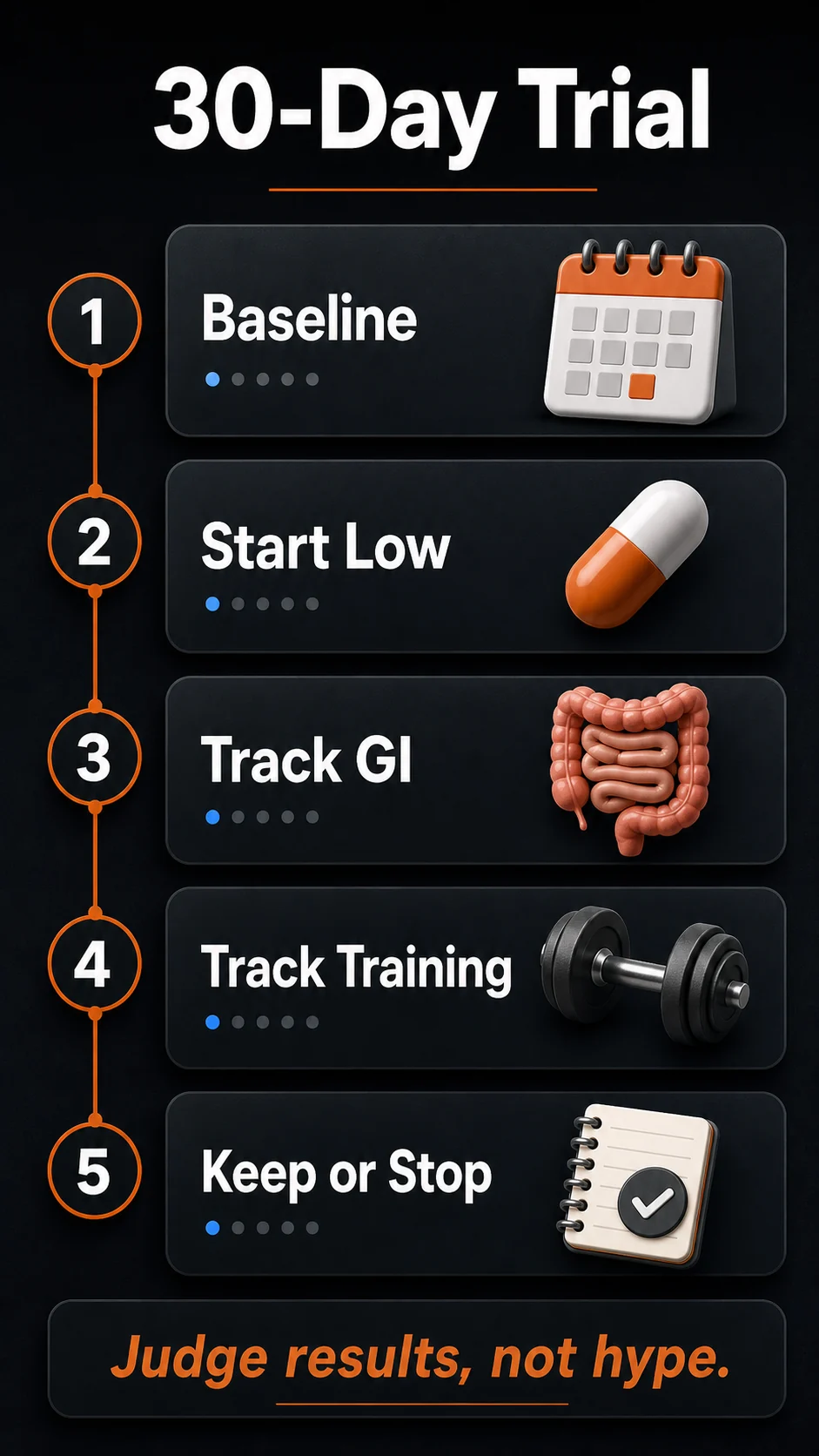
The 30-Day Probiotic Trial Protocol
Do not evaluate a probiotic by mood or marketing. Evaluate it like training data. Keep the rest of your stack stable, add one product, and track outcomes that matter.
| Phase | What to do | What to track | Decision rule |
|---|---|---|---|
| Days 1-3 | Record baseline without changing supplements. | Stool pattern, bloating, appetite, training comfort, missed sessions. | If symptoms are severe, do not start. Get medical advice. |
| Days 4-14 | Start one probiotic at the label dose, preferably with food unless the label says otherwise. | Gas, stool changes, sleep, session readiness, post-shake tolerance. | Mild adjustment may happen. Strong worsening means stop. |
| Days 15-30 | Keep training, diet, and other supplements steady. | Compare against baseline and note any clear improvement. | Keep only if the benefit is obvious enough to justify cost. |
When Not to Use a Probiotic Without Medical Input
Probiotics are widely used, but they are not risk-free for every person. Be more careful if you are immunocompromised, seriously ill, have a central venous catheter, have complex GI disease, recently had major surgery, or are dealing with unexplained weight loss, blood in stool, persistent diarrhea, fever, or severe abdominal pain.
If your issue is recovery, start with rest and recovery, total calories, sleep, and training load. If your issue is supplement stacking, use our broader supplement recommendations and post-workout supplements guides to keep the stack small.
Sources and Further Reading
For this refresh, the key evidence frame comes from the International Society of Sports Nutrition position stand on probiotics, NCCIH’s safety overview, and PubMed-indexed research on probiotic use in athletic and gut-health contexts.
- International Society of Sports Nutrition position stand: probiotics
- PubMed entry for the ISSN probiotics position stand
- NCCIH: Probiotics, usefulness and safety
- PubMed-indexed review on probiotics and exercise-related health contexts
- PrimeForMen nutrition and supplements hub
Conclusion
Probiotics for fitness make sense when the problem is specific and trackable. Use them for digestive regularity, higher-protein tolerance, travel disruption, antibiotic-context discussion, or high-load training support. Do not use them as a shortcut for recovery, muscle gain, or fat loss.
The best move is simple: choose one product category, verify the strain and label quality, run a 30-day trial, and keep it only if your data improves. That is how you separate useful supplementation from another expensive bottle in the cabinet.
FAQ: Probiotics for Fitness
Can probiotics help build muscle?
Not directly. Probiotics are not anabolic supplements. They may support conditions that help training consistency, such as digestion, immune resilience, or tolerance for higher-protein meals, but they do not replace protein, progressive training, sleep, or calories.
What is the best probiotic strain for athletes?
There is no single best strain for every athlete. Research is strain-specific. Entities often discussed in sport contexts include Lactobacillus plantarum TWK10, Bifidobacterium lactis Bl-04, Lactobacillus rhamnosus GG, and Saccharomyces boulardii for certain travel or antibiotic contexts.
How many CFU should a fitness probiotic have?
Do not buy by CFU count alone. Look for CFU guaranteed through expiration, clear strain names, storage instructions, and a dose you can tolerate. Higher counts can be unnecessary or uncomfortable for some men.
Should I take probiotics with protein powder?
You can, but first make sure the protein powder itself fits you. Lactose, serving size, sweeteners, speed of drinking, and total daily protein can all cause discomfort. A probiotic may help some men, but it is not the first fix for a poor protein setup.
Are fermented foods enough?
Foods like yogurt, kefir, sauerkraut, and kimchi can support diet quality, but they do not always provide the same strain, dose, or survivability as a targeted supplement. Use foods for baseline nutrition and supplements only when a defined use case remains.
Can probiotics help with recovery?
Possibly indirectly, mostly by reducing GI friction or supporting immune and gut-barrier context in some people. They do not replace sleep, deloading, hydration, carbohydrates, calories, or sensible training volume.
When should I stop taking a probiotic?
Stop if symptoms clearly worsen, if you develop severe GI symptoms, or if there is no measurable benefit after a fair 30-day trial. Get medical advice for fever, blood in stool, dehydration, severe pain, persistent diarrhea, or unexplained weight loss.
Are probiotics safe for every man?
No. Most healthy adults tolerate probiotics, but risk is higher for immunocompromised people, seriously ill patients, and certain medical situations. If you have a complex health history, ask a clinician before using probiotics.
Do I need a prebiotic with my probiotic?
Not always. Prebiotics feed beneficial bacteria, but they can also increase gas or bloating if added too fast. If your fiber intake is low, increase it gradually through food before adding a strong prebiotic supplement.
What is a synbiotic?
A synbiotic combines probiotics with prebiotics. It can be useful, but the same rule applies: judge the exact strains, dose, tolerance, and use case rather than assuming the combo is automatically better.
Medical Disclaimer: This article is for general educational purposes only and does not replace medical advice, diagnosis, or treatment. Talk with a qualified clinician before using probiotics if you have immune system concerns, chronic GI disease, severe symptoms, recent surgery, or medication questions.
Affiliate Disclosure: Some product links may be affiliate links. If you buy through them, PrimeForMen may earn a commission at no extra cost to you. Recommendations are based on fit, label quality, and reader use case, not guaranteed outcomes.