Does rhodiola increase testosterone? Review the human trial, stress and exercise evidence, safety concerns and supplement quality checks.
- A small male trial found no significant increase.
- Fatigue relief does not establish a hormone effect.
- Medicines and product quality need a safety check.
Bottom line If testosterone is your concern, seek appropriate evaluation before buying a rhodiola supplement.
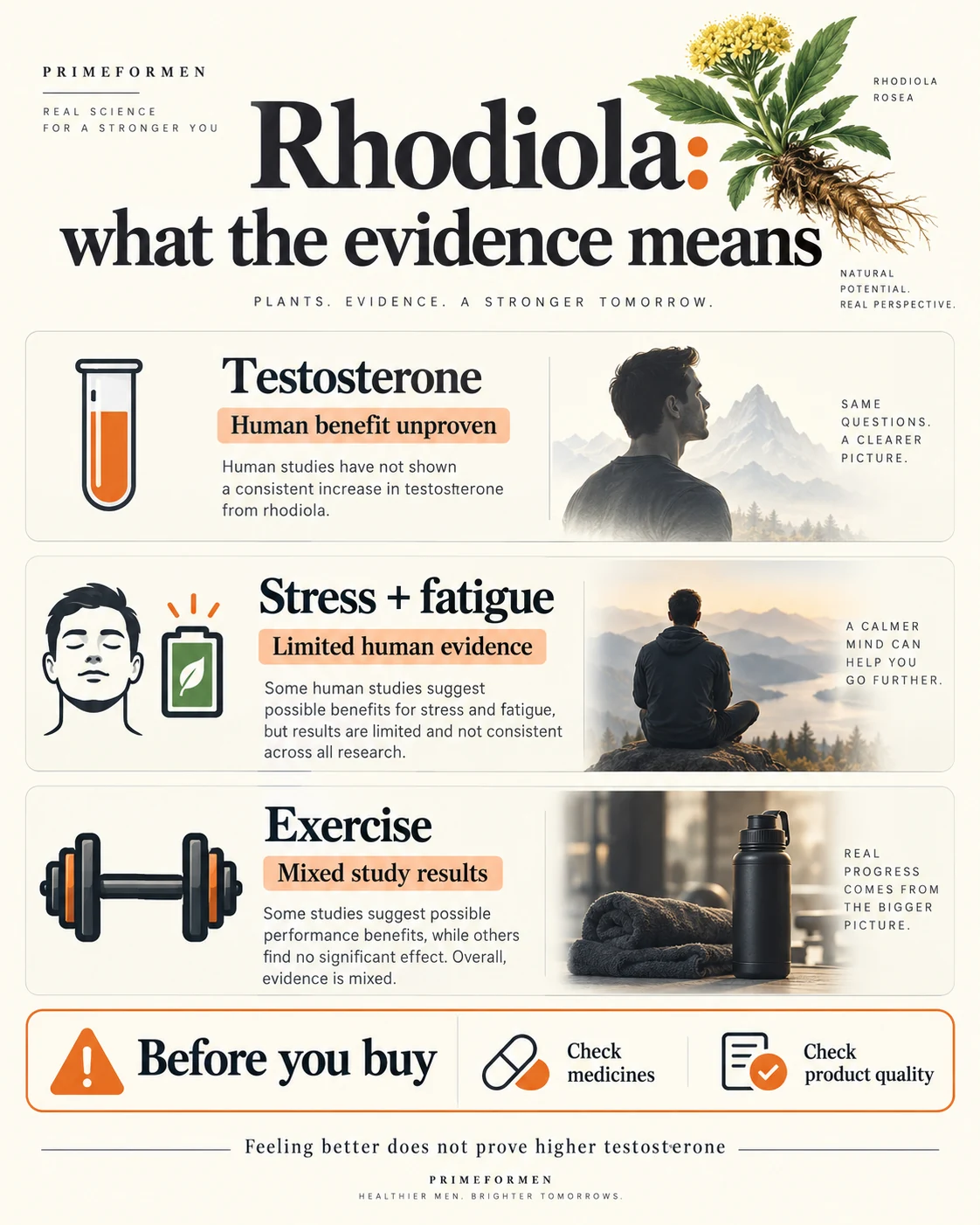
Does rhodiola increase testosterone? Human research has not established that it does. Rhodiola rosea has also been studied for fatigue, stress and exercise, but those outcomes answer different questions. Feeling more alert does not tell you whether your testosterone changed.
The Prime Perspective
If you are considering rhodiola because your energy, libido or training performance has slipped, start by naming the problem. “I want to feel less exhausted after work” and “I have repeatedly low testosterone results” require different decisions. A capsule marketed for both can blur that distinction.
We do not recommend buying rhodiola to raise testosterone. For other goals, weigh the uncertain benefit against your medical history, medicines and cost. Our editorial policy requires supplement recommendations to follow the evidence.
What rhodiola is, and what “adaptogen” means
Rhodiola rosea is a plant whose root and rhizome are used in herbal preparations. You may see it sold as golden root or arctic root. Labels often use the word “adaptogen” to suggest help with stress. That word does not establish a measured hormone effect or identify a treatment for testosterone deficiency.
The European Medicines Agency recognizes certain arctic-root medicines for temporary stress symptoms, including fatigue and weakness, on the basis of traditional use. It explicitly distinguishes that history from sufficient clinical-trial evidence. Its public guidance concerns adults and advises medical consultation if use extends beyond two weeks. That recognition is not an endorsement for testosterone treatment. Read the EMA assessment and monograph documents.
Does rhodiola increase testosterone in human trials?
A randomized placebo-controlled trial gave 26 healthy male students 600 mg rhodiola extract daily for four weeks. The extract was standardized to 3% rosavins. Testosterone, cortisol and growth hormone did not significantly change. Some reaction-time measures improved; exercise capacity did not. Jówko and colleagues’ trial.
The study tested the hormone claim directly, but its small sample and short follow-up limit what it can establish. It does not answer whether a different preparation or an older population would respond differently.
This trial established no testosterone-boosting dose or treatment duration. Taking more rhodiola or using it for longer does not resolve the study’s limitations.
On a small screen, swipe the table sideways to see every column.
| Evidence | What was studied | What it means for testosterone |
|---|---|---|
| Human hormones | 26 healthy men; four weeks of rhodiola versus placebo; testosterone measured. | No significant testosterone benefit in this trial. |
| Stress-related fatigue | 60 adults; 28 days of SHR-5 extract; fatigue, attention and awakening cortisol assessed. | Some positive results, but this trial did not establish increased testosterone. |
| Fatigue during shift work | 48 nursing students; 42 days; fatigue outcomes favored placebo. | Fatigue benefits cannot be assumed across settings. |
| Exercise outcomes | Human studies test performance, effort or reaction time rather than treating low testosterone. | A performance outcome does not prove a lasting hormone change. |
| Animal-derived cells | Salidroside tested in oxidatively stressed mouse Leydig cells. | A laboratory mechanism, not evidence that oral rhodiola raises testosterone in men. |
Resting testosterone in a four-week trial
Plasma testosterone before exercise, in nmol/L. Bars show means; black whiskers show mean ± standard deviation (SD), participant spread rather than confidence intervals. Scale: 0–35 nmol/L.
| Group | Men | Before, mean ± SD | Week 4, mean ± SD |
|---|---|---|---|
| Rhodiola | 13 | 21.7 ± 2.2 | 21.6 ± 1.2 |
| Placebo | 13 | 24.7 ± 2.1 | 26.5 ± 2.5 |
Source: Jówko et al., Table 2. One small trial in healthy young men; no significant hormonal benefit was reported. Baseline differences and changes in the bars do not establish a treatment effect or a benefit for men over 50. No clinical reference range is shown.
Stress relief, cortisol and testosterone are separate outcomes
A 2009 trial randomized 60 adults with stress-related fatigue to SHR-5 rhodiola extract or placebo. Over 28 days, the researchers found improvements in selected fatigue and attention outcomes and a difference in the cortisol response to awakening. The study used 576 mg extract daily. That is a description of the experiment, not a dosing recommendation. Olsson and colleagues’ fatigue trial.
In a different randomized trial involving 48 nursing students on shift work, fatigue scores favored placebo after 42 days. The authors urged caution when interpreting the result. Together with the favorable studies, it shows that fatigue findings are mixed. The nursing-student trial.
Avoid treating cortisol as a number that must always be pushed down. Its timing and the reason for a test matter. Our guide to cardio and cortisol explains why a training response needs context. A feeling of stress, a wearable score and a clinical hormone measurement are not interchangeable.
Why laboratory findings do not settle the question
A 2025 study examined salidroside, a compound found in Rhodiola, in mouse Leydig cells exposed to hydrogen peroxide to create oxidative damage. The investigators reported changes in oxidative-stress markers and testosterone secretion in that cell model. Read the salidroside cell study.
The researchers tested an isolated compound in deliberately damaged cells, rather than giving men an oral rhodiola supplement. The result can guide further research, but leaves oral dosing, human blood levels, symptom improvement, fertility outcomes and long-term safety unanswered. A testosterone promise on a product label would go beyond what the experiment tested.
Watch for three substitutions in marketing: a compound becomes a whole herb, an animal or cell result becomes a human result, and a mechanistic possibility becomes a guaranteed benefit. Each substitution adds a claim the original experiment did not test.
Who should skip rhodiola or get advice first?
The National Center for Complementary and Integrative Health describes rhodiola as possibly safe for up to 12 weeks, while noting limited evidence overall. Reported adverse effects include dizziness, headache, insomnia, dry mouth and excess saliva. It also reports an interaction with losartan, a medicine used for high blood pressure. Evidence on pregnancy and breastfeeding safety is insufficient. NCCIH’s rhodiola safety guidance.
Get a medication review first
If you use prescription medicines, bring the exact product label to a pharmacist or clinician. Losartan deserves specific attention. A case report also described restlessness, trembling and other symptoms after rhodiola was added to paroxetine. This is a safety signal, not proof that every antidepressant combination causes the same reaction. The paroxetine interaction case report.
Avoid self-experimenting with mood symptoms
A published case report describes mania associated with rhodiola use. It cannot establish how common this is, but a history of bipolar disorder or mania warrants specialist advice before use. A marked change in mood or behavior needs prompt medical attention. The mania case report.
Stop if you develop adverse effects
Do not treat new insomnia, dizziness or agitation as evidence that a supplement is “working.” Stop taking it and contact a health professional. Severe symptoms, such as collapse, chest pain, breathing difficulty or acute confusion, require urgent care.
Do not add rhodiola to prescribed testosterone treatment without telling the prescriber. The absence of a well-studied interaction is not a guarantee that a particular product is appropriate. Keep taking prescribed medicines as directed while seeking advice.
How to read a rhodiola supplement label
If you still consider rhodiola for a separate goal after professional advice, read the label before comparing prices. Look for the full botanical name, plant part, extract amount per serving, standardization information, other active ingredients and a batch or lot number. “Rhodiola blend” tells you less than a clearly specified preparation.
Do not assume that root powder, concentrated extract and isolated salidroside are equivalent. The preparations used in studies define those studies; they do not turn every retail product into the tested intervention.
- Choose a clearly stated goal, such as tracking fatigue, rather than a vague promise of hormone balance.
- Avoid proprietary blends that obscure the amount of each ingredient.
- Check any claimed independent certification in the certifier’s directory.
- Reject claims of guaranteed testosterone increases or treatment of hypogonadism.
The NIH Office of Dietary Supplements explains that quality seals can assess manufacturing, ingredients and contaminants, but do not guarantee safety or effectiveness. FDA also does not approve dietary supplements for safety and effectiveness before marketing. A certification cannot supply the missing testosterone evidence. NIH supplement guidance; FDA dietary-supplement questions and answers.
Our guide to testosterone-booster safety covers broader label and risk questions. The comparison with ashwagandha and testosterone also needs ingredient-specific evidence; one herb’s trial does not validate another herb or a multi-ingredient blend.
If you suspect low testosterone, change the next step
Do not use your response to rhodiola as a home hormone test. The Endocrine Society recommends diagnosing hypogonadism only when compatible symptoms and signs occur alongside unequivocally and consistently low testosterone concentrations. It recommends confirming results with a repeat morning fasting total testosterone measurement. Further evaluation looks for the cause. Endocrine Society testosterone guideline.
For men over 50, fatigue can be an easy route into supplement shopping. Age alone does not establish testosterone deficiency, and feeling better after taking a capsule does not confirm it. Bring persistent changes in libido, sexual function or energy to a clinician, together with your medicines, supplements and any previous test results.
Prepare a supplement discussion
Choose the points you want to discuss with a pharmacist or clinician. This checklist organizes the conversation; it cannot diagnose low testosterone, prescribe a dose or clear rhodiola as safe for you.
Your choices stay in this page. They are not submitted by this tool or saved to a profile. Avoid entering personal medical details on a shared device.
Your next discussion
Rhodiola has no established testosterone-boosting benefit. Bring the exact label, your medicine list and a symptom timeline to a professional discussion. Selecting no risk flags does not establish safety.
- For persistent symptoms or an abnormal result, ask about assessment before trying another supplement.
- Ask a pharmacist to review the exact product and all medicines.
For severe symptoms such as chest pain, collapse, breathing difficulty or acute confusion, seek urgent care. Do not stop prescribed medicines because of this checklist.
Use the questions above as a paper checklist. JavaScript enables personalized notes and a dedicated print view; the article’s safety guidance still applies.
Watch: how to evaluate a supplement claim
This educational video from the U.S. Food and Drug Administration explains supplement labels, benefit claims and risks. Use it to prepare questions about a product. It does not demonstrate that rhodiola raises testosterone.
Watch the FDA video on YouTube · FDA source and companion materials
Optional tools for an organized review
Affiliate Disclosure: As an Amazon Associate, PrimeForMen earns from qualifying purchases. These tools organize an existing routine or observations; neither raises testosterone. A notebook or organizer you already own may be sufficient.
Record observations and organize an existing routine
Buying rhodiola is not a required next step. Start with your current supplies and professional advice.

Amazon Basics Classic Lined Notebook
Best for: For recording sleep times, fatigue and questions for an appointment. Skip if your phone notes or existing notebook already work.
Current Amazon listing: Amazon Basics Classic Lined Writing Notebook for Note Taking and Journaling, Hardcover with Elastic Closure, 240 Pages, 5" x 8.25", Black
- Ruled pages for a simple daily record
- Hardcover with elastic closure
- Keep dates and observations together

Ezy Dose Weekly Pill Organizer, X-Large, Blue/Clear
Best for: For an established routine only after a pharmacist confirms medicines can leave their original packaging. Skip if original packaging is required or you already have a suitable organizer.
Current Amazon listing: Ezy Dose Weekly (7-Day) Pill Organizer, X-Large Medicine Case, Blue/Clear
- Seven daily compartments
- Blue and clear case for visual organization
- Keep a separate current medicine list
* As an Amazon Associate, PrimeForMen earns from qualifying purchases.
An organizer does not prevent drug interactions or replace child-safe storage. Keep medicines out of children’s reach. Follow each medicine’s storage instructions and ask a pharmacist before repacking it.
What to do this week
- Write down the actual concern: tiredness, sleep, libido, recovery or an abnormal blood test. Note when it started and whether it is persistent.
- Record sleep timing, training load and current supplements for several days. Use the rest and recovery guide to review your training schedule.
- If symptoms persist, arrange medical assessment instead of starting a hormone stack. Ask whether testing is appropriate for your history.
- Bring the exact rhodiola label and your medication list to a pharmacist before use. Include products marketed as pre-workouts or stress blends.
- If you already take rhodiola, separate your observations from your assumptions. “I feel less tired” is an observation; “my testosterone increased” requires measurements and interpretation.
Rhodiola: before-you-buy checklist
Keep the practical checks with you. This one-page PDF includes fillable notes you can save or print.
Conclusion
Human research has not established that rhodiola raises testosterone; stress, exercise and cell findings cannot supply that evidence. This week, note your symptoms and review your recovery habits. If symptoms persist or you already have a low result, arrange medical assessment before buying another supplement.
Frequently asked questions
Does rhodiola increase testosterone in men over 50?
No reliable evidence establishes that benefit or supports treating diagnosed testosterone deficiency with rhodiola.
What rhodiola dose should I take for testosterone?
There is no validated dose for increasing testosterone. Research doses should not be turned into personal treatment instructions.
Can rhodiola lower cortisol and indirectly raise testosterone?
A fatigue trial found a change in awakening cortisol response, but did not establish increased testosterone. The proposed indirect pathway remains unproven as a treatment strategy.
How long does rhodiola take to raise testosterone?
No demonstrated timeline exists. A timeline for fatigue or alertness does not establish when testosterone will change.
Can I take rhodiola with testosterone replacement therapy?
Discuss the exact product with your prescriber or pharmacist first. Rhodiola has not been established as a way to improve TRT outcomes, and medicines, mood history and product ingredients affect the decision.