

Does Vitamin B12 affect testosterone levels? If you feel like your engine is stalling, your brain is foggy, and your libido has taken a permanent vacation, you’re probably hunting for a single culprit to blame. You want a smoking gun.
The short answer is: Vitamin B12 does not directly “boost” testosterone in healthy men, but a B12 deficiency can create a systemic environment that suppresses your body’s ability to produce and use testosterone effectively.
Key Takeaways: The TL;DR for Men
- Not a Booster: B12 isn’t a “testosterone booster” like Vitamin D or Zinc might be; taking more than you need won’t give you “super-human” T-levels.
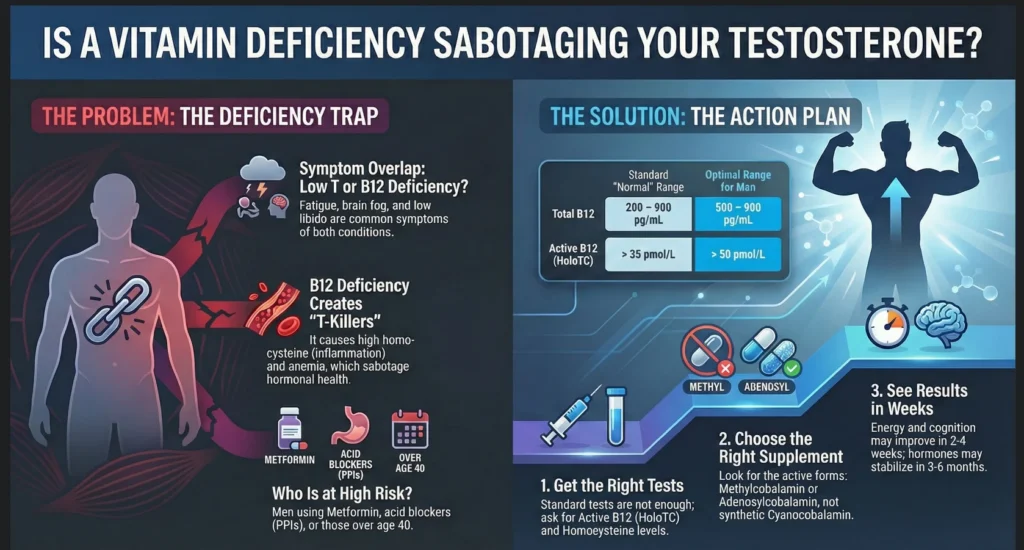
- The Deficiency Trap: A B12 deficiency can lead to high homocysteine and anemia, both of which are “T-killers” that sabotage your hormonal health.
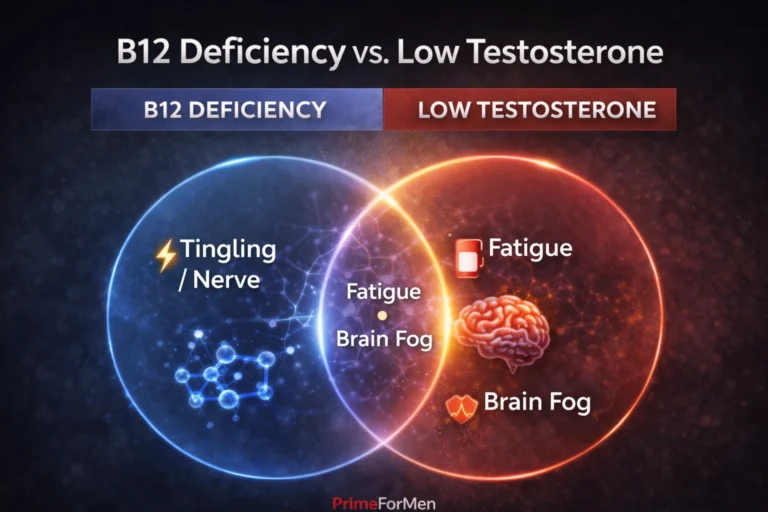
- The Symptom Overlap: Fatigue, brain fog, and low libido are common to both Low T and B12 deficiency, making it easy to misdiagnose yourself.
- Medication Warning: If you take Metformin or acid blockers, your risk for a B12-induced hormonal dip is significantly higher.
- The Fix: Testing for both Total/Free Testosterone and Active B12 (HoloTC) is the only way to know the truth.
🏃♂️ The Prime Perspective
Years ago, I hit a wall. I was training hard, eating what I thought was a “clean” diet, but I felt like a ghost of myself. My brain was in a constant fog, and my recovery in the gym was non-existent. My first thought? “My T-levels must be tanking.” I went to my doc, practically begging for TRT. But when the labs came back, my testosterone was actually decent—it was my B12 that was in the gutter. I’d been so focused on “high-protein” that I’d ignored the fact that my gut wasn’t actually absorbing the nutrients I was shoving into it. I learned the hard way that you can have all the “raw materials” for testosterone in the world, but if your foundational chemistry—like your B12 levels—is broken, the whole machine grinds to a halt. It’s not always about the “sexier” hormones; sometimes, it’s about the basic B vitamin you’ve been taking for granted.
The Great Overlap: Is it Low T or B12 Deficiency?
The biggest challenge with the question “Does Vitamin B12 affect testosterone?” is that the symptoms of a deficiency look almost identical to low testosterone for men.
When your B12 is low, your body struggles to create healthy red blood cells. This leads to megaloblastic anemia, which means your tissues aren’t getting enough oxygen. When your testes aren’t getting oxygen, they aren’t producing testosterone. It’s a physiological domino effect.
Side-by-Side: The Symptom Comparison
| Symptom | Low Testosterone | B12 Deficiency |
| Fatigue | Very Common | Universal (96% of cases) |
| Brain Fog | Common | Very Common |
| Muscle Loss | Gradual/Significant | Rare (more like weakness) |
| Nerve Pain | Rare | Hallmark (Tingling/Numbness) |
| Libido | Significant Drop | Moderate Drop |
How Does Vitamin B12 Affect Testosterone? 3 Scientific Mechanisms
If you search the web, you’ll find plenty of articles saying there’s “no link.” But that’s a surface-level take. Recent research, including a landmark 2024 study published in The Journal of Nutrition, found that men with higher serum B12 concentrations had significantly improved androgenic profiles.
Here is how B12 actually works behind the scenes to protect your T-levels:
1. The Homocysteine “Inflammation” Link
This is what most guys miss. Think of B12 as the waste-management crew of your bloodstream. It helps clear out a ‘trash’ amino acid called homocysteine by turning it back into something useful (methionine).
If you don’t have enough B12, homocysteine builds up in your blood. High homocysteine is toxic to your blood vessels and triggers systemic inflammation. Chronic inflammation is the enemy of the HPG axis, the signaling system that tells your brain to produce testosterone.
💡 What Most Guys Miss
Research suggests that B12 doesn’t just “support” the system; it’s present directly in the testes. It helps protect the mitochondria—the power plants—of your Leydig cells. These are the specific cells responsible for synthesizing testosterone. Without B12, these power plants “burn out” due to oxidative stress, leading to a drop in intratesticular testosterone production.
2. Nerve Health and the “T-Signal”
Your brain and your balls are in constant communication via nerves. B12 is the primary nutrient responsible for the myelin sheath—the protective coating on your nerves. If that coating wears thin (demyelination), the electrical signals from your pituitary gland to your testes can become “noisy” or weak. Think of it like trying to stream a 4K movie on a bad Wi-Fi connection.
3. The Oxygenation Factor
We’ve mentioned anemia, but it deserves a deeper look. Testosterone production is an energy-intensive process. If your blood flow is carrying “giant, immature” red blood cells that can’t carry oxygen (a hallmark of B12 deficiency), your body goes into survival mode. In survival mode, the body deprioritizes “luxury” functions like reproduction and muscle building to keep the heart and lungs alive.
Who is Really at Risk for a B12 Dip?
Most doctors will tell you that B12 deficiency is rare unless you’re a strict vegan. They’re wrong. Here are the three most common reasons modern men are running low:
- Metformin Use: This common drug for Type 2 diabetes and insulin resistance is notorious for blocking B12 absorption. If you’ve been on Metformin for more than a year, your risk of deficiency increases by up to 30%.
- Acid Blockers (PPIs): You need stomach acid to “unlock” B12 from the protein in your food (like steak). If you take Nexium, Prilosec, or other PPIs for heartburn, you’re essentially starving your body of B12.
- The Aging Gut: As we cross the age of 40, our stomachs produce less “Intrinsic Factor”—the protein required to absorb B12. This is why many older men feel a sudden drop in vitality that they assume is just “getting old.”
Testing: Don’t Just Get a “Normal” Result
If you ask your doctor, “Does Vitamin B12 affect testosterone?” and they run a standard B12 test, you might get a “Normal” result of 250 pg/mL.
The Problem: Most functional medicine experts consider anything below 500 pg/mL to be a “functional deficiency” for active men. Furthermore, standard tests measure total B12, but only about 20% of that is actually “Active” and available for your cells to use.
Optimal vs. Standard Ranges
| Marker | Standard “Normal” | PrimeForMen “Optimal” |
| Total B12 | 200 – 900 pg/mL | 500 – 900 pg/mL |
| Active B12 (HoloTC) | > 35 pmol/L | > 50 pmol/L |
| Total Testosterone | 300 – 1000 ng/dL | 600 – 900 ng/dL |
How to Fix Your B12 (and Save Your T-Levels)
If you’ve confirmed a deficiency, don’t just grab the cheapest pill at the drugstore. Most cheap supplements use Cyanocobalamin, a synthetic form that contains a tiny amount of cyanide and requires several conversion steps in the liver.
Instead, look for Methylcobalamin or Adenosylcobalamin. These are the active forms your body can use immediately. This is especially important for men with the MTHFR genetic mutation, who struggle to convert synthetic vitamins.
✅ Your 24-Hour Action Plan
- Step 1: Ask your doctor for a ‘Functional B12 Panel.’ Tell them: ‘I want to check my Total B12, Active B12 (HoloTC), and Homocysteine.’ Most labs only check the total, which hides the real story.
- Step 2: Audit your medicine cabinet. If you are on Metformin or PPIs, discuss a B12 supplementation strategy with your doctor immediately.
- Step 3: Switch to a high-quality “Methylated” B-Complex. Look for brands like Thorne or Life Extension that prioritize bioavailability.
Frequently Asked Questions About How Vitamin B12 Affects Testosterone
Does Vitamin B12 affect testosterone directly?
No, it is not a direct precursor or booster. However, a deficiency in B12 leads to high homocysteine and anemia, both of which are clinically proven to suppress natural testosterone production and testicular health.
Can a B12 deficiency cause symptoms of Low T?
Yes. Fatigue, brain fog, and low libido are common symptoms of both low B12 and low testosterone. This overlap often leads men to believe they have a hormonal issue when the root cause is actually a vitamin deficiency.
How does Metformin affect B12 and testosterone?
Metformin is known to interfere with B12 absorption in the gut. Over time, this deficiency can lead to elevated homocysteine and reduced oxygenation of tissues, both of which can negatively impact natural testosterone production.
What is the best form of B12 for men’s hormonal health?
The methylated forms—Methylcobalamin and Adenosylcobalamin—are superior because they are biologically active and more easily absorbed, especially for men with the MTHFR genetic mutation.
How long after starting B12 will I see a change in my vitality?
Energy levels and cognitive function often improve within 2 to 4 weeks of correcting a deficiency. However, it may take 3 to 6 months of optimal B12 levels for the body’s hormonal environment to fully stabilize and for testosterone production to recover.
Final Thoughts: The Foundational Health Approach
Does Vitamin B12 affect testosterone? Absolutely—but not in the way most supplement companies want you to think. It’s not a magic pill that will double your T-levels overnight.
Instead, think of B12 as the “maintenance crew” for your body’s hormonal factory. If the crew doesn’t show up, the factory gets dirty, the machines (Leydig cells) overheat, and production slows down. Stop looking for the “booster” and start fixing the foundation. Get tested, clear the homocysteine, and give your body the oxygen it needs to perform.