

Compare omega-3 supplements by EPA+DHA, full serving, fish or algae source, trial evidence and safety questions before buying.
- Read EPA and DHA per stated serving, not the front-label oil weight.
- Prescription trial results do not apply to every retail fish-oil product.
- Review medication, bleeding and heart-rhythm questions before choosing a bottle.
Bottom line Photograph the full label, add EPA and DHA on the same basis, and settle the reason for use before comparing products.

Omega-3 supplements can provide EPA and DHA when those fatty acids are hard to obtain from your usual diet. Whether a particular bottle is worth buying depends on its actual contents, your reason for considering it and your medical context. A large fish-oil number on the front, or a study of a prescription drug, cannot answer all three questions.
Start with the Supplement Facts panel and the food you actually eat. If you are trying to manage high triglycerides, a heart condition or symptoms, involve your clinician before treating a retail supplement as the solution.
Quick Summary: Omega-3 supplements
- Compare EPA plus DHA per stated serving. Fish oil, total omega-3 and EPA+DHA are different quantities.
- Fish oil and algae oil can supply EPA or DHA; flaxseed oil mainly supplies ALA.
- Trials differ by formulation, participants and purpose. Prescription icosapent ethyl is not interchangeable with an ordinary fish-oil capsule.
- Medication, bleeding and heart-rhythm questions need individual review. Higher concentration does not automatically mean a better choice.
- Check source, serving count, additional ingredients, seller and storage instructions before buying.
The Prime Perspective
We start by comparing readable labels and the reason for considering a supplement. Write down the task first: a food-intake question, an already discussed supplement plan, or a medical treatment decision. Then compare products that fit that task.
The examples below show arithmetic and selection checks. We have not taken or independently tested these products. Our editorial policy explains how we separate research, manufacturer specifications and affiliate recommendations.
What EPA, DHA and ALA tell you
EPA is eicosapentaenoic acid; DHA is docosahexaenoic acid. ALA, alpha-linolenic acid, is a different omega-3 found in plant foods such as flaxseed. Conversion from ALA to EPA and DHA is limited. Fish and algae products therefore deserve their own label comparison; an ALA quantity cannot simply be entered as the same quantity of EPA+DHA. See the NIH Office of Dietary Supplements overview.
If a front label says “1,000 mg fish oil,” turn the bottle around. You may find a smaller combined EPA and DHA amount. If it says “total omega-3,” that can include other omega-3 fatty acids. Record EPA and DHA separately when they are disclosed; leave a missing value unknown rather than estimating it from the oil weight.
Food, supplements and prescription treatment serve different purposes
| Option | What to examine | Useful distinction |
|---|---|---|
| Seafood in meals | The type of seafood, meals you enjoy and practical access | A meal provides more than isolated EPA and DHA. A fish-intake association does not prove a capsule has the same effect. |
| Fish-oil supplement | EPA+DHA, full serving, fish source and capsule ingredients | Ordinary retail supplements have different concentrations. Fish gelatin also matters if you avoid animal ingredients. |
| Algae-oil supplement | Whether it contains DHA alone or both EPA and DHA, and the capsule shell | An algae product can fit a vegan preference, but the word algae does not establish an identical formula to fish oil. |
| Flaxseed-oil supplement | ALA content and the actual reason for choosing it | Its ALA is not a direct substitute in an EPA+DHA comparison. |
| Prescription omega-3 medicine | Exact drug, indication, prescribed amount, other treatment and monitoring | This is a clinician-managed treatment decision. Do not substitute a shop product because both mention omega-3. |
For a broader look at ordinary meals and supplements, use our nutrition and supplements guide. Identify what remains difficult to obtain from food before choosing a product.
Read omega-3 supplement labels in the right order
1. Find the serving, then the nutrient amounts
Circle the serving size before reading the milligram lines. Two softgels in a serving means the amounts beneath that heading describe both together. A bottle containing 120 softgels therefore has 60 such servings. A single-softgel calculation is possible, but it is a different basis and should be labeled clearly.
Add the EPA and DHA values on the same basis. For example, the current NOW Omega-3 manufacturer panel lists 360 mg EPA and 240 mg DHA per two-softgel serving: 600 mg combined per serving, or 300 mg per softgel. The 2,000 mg fish-oil line is not the combined EPA+DHA amount. This is label arithmetic, not a recommendation to take a particular number.
Read the omega-3 label
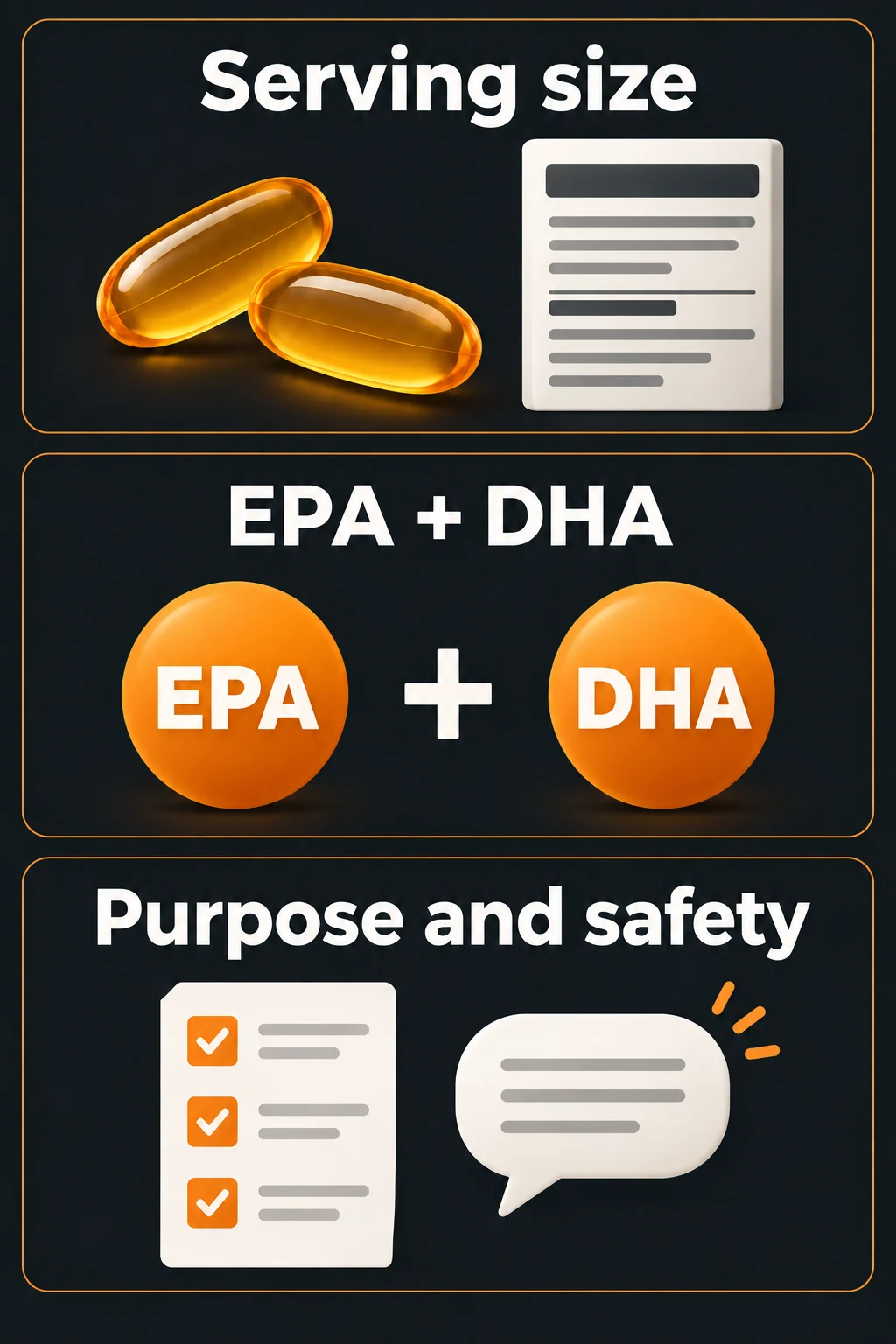
Read the stated serving first, add EPA and DHA on that basis, and review the purpose and safety questions before choosing a product. The sequence does not recommend a dose or predict a health benefit.
Silent, 8.5 seconds. Open the animation directly. Playback pauses offscreen; reduced-motion preferences keep playback manual. Essential explanations remain in readable text.
2. Keep a comparison amount separate from a recommended dose
Suppose two fictional labels each state a two-capsule serving. Label A lists 360 mg EPA and 240 mg DHA. Label B lists 650 mg EPA and 450 mg DHA. Their sums are 600 and 1,100 mg per serving, or 300 and 550 mg per capsule, so Label B is more concentrated. That calculation does not show that it prevents more disease, has fewer side effects or suits your medication.
Use one consistent basis when comparing costs. Dividing the current bottle price by its stated servings compares the cost of those servings; dividing by its capsule count compares capsules. If the price changes or the listing changes pack size, redo that calculation. We do not publish a fixed cost ranking that could silently compare different quantities.
3. Check the source and everything else in the bottle
Read the ingredient list as well as the nutrient panel. Fish source, gelatin, flavoring and added vitamins can change the fit. A product combining omega-3 with vitamin D creates an extra nutrient to count if you already use a multi or a separate vitamin D supplement. Our multivitamin guide explains how to check overlapping nutrients.
A quality-testing logo is worth checking in the certifier’s own directory for the exact product. Manufacturer purity claims or a certificate do not establish that the product treats your condition. Ask what was tested, which batch it covers and whether the document belongs to the actual item being sold.
What the large trials actually tested
The VITAL, REDUCE-IT and STRENGTH trials tested different formulations and populations. Their results cannot support a single claim that every fish-oil product protects the heart. Trial doses describe the research; they are not shopping instructions.
| Trial | Participants and treatment | Finding and limit |
|---|---|---|
| VITAL | 25,871 US adults: men aged at least 50 and women at least 55. A daily 1 g fish-oil capsule supplied 460 mg EPA and 380 mg DHA; median follow-up was 5.3 years. | No significant reduction in the primary major-cardiovascular-event or invasive-cancer outcomes. Some secondary outcomes, including myocardial infarction, differed. Those do not justify describing the trial as a universal prevention success. |
| REDUCE-IT | 8,179 statin-treated patients with elevated triglycerides and cardiovascular disease or diabetes plus risk factors. Prescription icosapent ethyl, 4 g/day, was compared with mineral-oil placebo. | The primary composite cardiovascular outcome occurred in 17.2% versus 22.0% over median 4.9 years. This selected population and purified prescription EPA result cannot be assigned to every retail EPA+DHA product. |
| STRENGTH | 13,078 patients at high cardiovascular risk received 4 g/day of an EPA+DHA carboxylic-acid formulation or corn oil. | No significant benefit on the primary cardiovascular outcome; the trial stopped early for futility. New atrial fibrillation was more frequent in the omega-3 group. |
Do not read these studies as a direct contest between the three bottles in our shopping section. None was a head-to-head test of those products. Differences between trials also do not prove that an ingredient ratio alone explains their results. Your clinician can interpret which findings matter to your condition and existing treatment.
For training goals, keep the task specific. These cardiovascular trials do not establish a testosterone boost or a guaranteed improvement in strength or recovery. Review post-workout supplements separately when your question concerns training nutrition.
Safety questions to settle before choosing a bottle
Fish oil can cause unpleasant taste, heartburn, nausea or other digestive discomfort. Discuss regular medication use, particularly anticoagulants, with your clinician or pharmacist. The NIH overview also notes increased atrial-fibrillation risk in two long-duration trials of 4 g/day in people with cardiovascular disease or high risk. These findings do not establish the same risk for every retail amount or every healthy user.
Medication or bleeding context
Bring the actual label, medicine list and planned procedures to the review. Do not change a prescribed blood thinner on your own or use this article to decide whether monitoring is unnecessary.
Heart-rhythm history or symptoms
A history of atrial fibrillation belongs in the discussion before supplement use. New palpitations, fainting, chest discomfort or breathlessness require appropriate medical assessment; severe or urgent symptoms need emergency care.
Source or tolerance concerns
Check fish and capsule ingredients if you have an allergy or dietary restriction. If a product causes troublesome symptoms, stop self-directed use and seek advice instead of masking the reaction by trying more capsules.
The FDA explains that dietary supplements generally do not receive premarket approval for safety and effectiveness. A lawful supplement listing, a popular brand or a “natural” description is not evidence that it is a suitable treatment for you.
Compare the label and record your question
Keep a photograph of the front, Supplement Facts and ingredients. Enter only quantities explicitly supplied by that panel, in milligrams. If you cannot establish the serving or a separate EPA/DHA value, record what is missing and ask the manufacturer. A combined total alone cannot reveal an undisclosed EPA:DHA split.
Compare the label and choose a review question
Use the quantities from your current Supplement Facts panel for arithmetic. Select the context to identify a question to review. This helper does not verify a label, recommend a dose, diagnose a condition or clear a product for use.
Add EPA and DHA per stated serving, then divide by the number of softgels in that serving if a per-softgel comparison is needed. A missing value remains unknown. Prescription treatment and safety questions need individual review. Use the worked examples and printable sheet.
Keep your review with you
Use the eight-field label sheet while comparing a bottle or preparing for a healthcare discussion. Keep a photo of the current panel. Fill and save the PDF, or print a blank copy.
Download my omega-3 label comparison (fillable PDF). The helper print button creates a separate record with your current choices, notes and checkmarks.
For a clinician-managed plan, record the exact product and instructions your healthcare team agreed on. An arithmetic result never replaces that plan. Keep the record when you switch products so a different concentration does not pass unnoticed.
Watch: fish-oil decisions need dietary and medical context
Mayo Clinic: fish oil and the wider health routine
Mayo Clinic cardiologist Stephen Kopecky discusses fish oil alongside diet and lifestyle. This clip was recorded in 2020. Its broad supplement statements do not establish a benefit for the products below; use the formulation-specific trial evidence and safety context above when making a decision.
Watch the original video on YouTube if the embed does not play.
Optional fish-oil and algae formats to compare
Compare an ordinary fish-oil formula, a more concentrated fish-oil formula and a vegan algae source. These are alternatives to consider for an identified need, not products to take together. We have not independently tested them or verified a specific batch; none is recommended here to treat high triglycerides or prevent a heart attack.
* As an Amazon Associate, PrimeForMen earns from qualifying purchases. Check the exact selected product, current label and suitability before ordering.
Best for: Readers comparing a straightforward fish-oil formula after identifying a relevant need. Skip if fish ingredients do not fit your diet, the serving format is inconvenient or suitability questions remain unresolved. Current Amazon listing: NOW Supplements, Omega-3 180 EPA / 120 DHA, 200 Softgels Best for: Readers comparing a more concentrated EPA+DHA formulation with the amount already agreed for their routine. Skip if the concentration does not fit the intended plan, fish ingredients are unsuitable or a prescription replacement is the goal. Current Amazon listing: Nordic Naturals Ultimate Omega, 1280 mg Omega-3 Fish Oil, Lemon - 120 Count Best for: Readers who avoid fish or animal ingredients and want to compare an algae source. Skip if the nutrient panel does not fit the intended comparison or medication and condition questions remain unresolved. Current Amazon listing: Nordic Naturals Algae Omega, 715mg Vegan EPA+DHA, Plant-Based - 60 Count * As an Amazon Associate, PrimeForMen earns from qualifying purchases.Recommended Products

NOW Omega-3: ordinary fish-oil label example
View on Amazon

Nordic Naturals Ultimate Omega: concentrated fish-oil comparison
View on Amazon

Nordic Naturals Algae Omega: vegan-source comparison
View on Amazon
What to check this week
- Write down how often you actually eat oily fish, or why fish does not fit your diet. Use a normal week rather than an unusually good one.
- State the reason you are considering a supplement. A general dietary question and treatment of a diagnosed condition need different decisions.
- Photograph the full label and calculate EPA+DHA per stated serving. Check how many servings the bottle contains.
- List added nutrients, other supplements and medicines. Put unresolved interaction or rhythm questions on the appointment sheet.
- Check the storage instructions and expiration date. Do not keep a bottle in a hot car or assume every liquid and softgel requires the same refrigeration.
If a seal is damaged, a product looks spoiled or you notice a persistent rancid odor, contact the seller or manufacturer and avoid using that bottle while the concern is unresolved. Flavor alone is not a reliable quality test. Keep the original packaging and lot number so the item can be identified.
Conclusion
Choose omega-3 supplements by the stated serving, actual EPA+DHA, source and reason for use. Complete the label comparison before comparing prices, and take medical-treatment or safety questions to a qualified professional. A more concentrated capsule changes the arithmetic; it does not provide its own clinical justification.
Continue with our supplements guide for men over 50 or the nutrition and supplements category when a different nutrient or food question remains.
Frequently asked questions
Does 1,000 mg fish oil mean 1,000 mg EPA and DHA?
No. Fish-oil weight includes other fats. Add the separately stated EPA and DHA amounts per serving, and keep that figure distinct from total oil or total omega-3.
How much omega-3 should men over 50 take?
Age alone does not select a supplement amount. Diet, the exact formulation, purpose and medical context matter. Ask your clinician about treatment needs; the comparator shows label quantities, not a personal dose.
Is algae oil equivalent to fish oil?
Compare their actual nutrient panels. Some algae products contain both EPA and DHA, while others mainly provide DHA. Source preference and capsule ingredients also matter. Identical EPA+DHA totals do not prove identical clinical outcomes.
Can I replace prescription omega-3 medicine with a supplement?
Do not substitute it without the prescriber’s guidance. Prescription formulations, indications and monitoring differ from ordinary retail products. A shared omega-3 name does not establish equivalence.
Should omega-3 products be refrigerated?
Follow the instructions for the exact product, including any separate rule after opening. Keep it in its original packaging away from heat and light. Ask the manufacturer if instructions are missing or spoilage is suspected.
Medical disclaimer: This article is educational and does not diagnose deficiency, select a treatment or determine a safe supplement amount. Discuss symptoms, medications, allergies, cardiovascular conditions and planned procedures with an appropriate healthcare professional. Do not alter prescribed treatment based on a label calculation.
Affiliate disclosure: Product links can earn PrimeForMen a commission at no extra cost to you. Product inclusion reflects a stated comparison use, not a guarantee of quality, safety or health benefit.