

Does almond milk affect testosterone? Compare the human evidence, protein and fortification, and choose a milk that fits your diet.
- No proven testosterone-boosting effect.
- Protein and fortification vary by product.
- Whole almonds and almond milk are different foods.
Bottom line Check your usual carton and the protein in the whole meal before changing your breakfast.

Is almond milk good for testosterone? It can fit a healthy diet, but there is no convincing direct human evidence that drinking it raises testosterone. There is also no good evidence that an ordinary serving lowers testosterone in men. Those are evidence limits, not proof that every product and intake level has been tested.
For most readers, the useful decision is nutritional: do you want a light dairy-free drink, a meaningful source of protein, or a replacement for the nutrients you previously got from milk? Almond milk can suit the first goal. It needs a closer label check for the other two.
The Prime Perspective
To judge a testosterone claim, check whether a study measured the hormone in men who drank almond milk. Its nutritional value is a separate question: does it help you meet your dietary needs?
We would choose almond milk for taste, lactose avoidance, or its fit in a meal, without expecting it to correct low testosterone. Our editorial policy requires human evidence for a hormone claim; a plausible mechanism alone is insufficient.
What the evidence actually tells us
On a small screen, swipe the table sideways to see every column.
| Claim | What we can establish | Practical meaning |
|---|---|---|
| Almond milk boosts testosterone | No convincing direct human intervention evidence identified | Do not expect a measurable hormone increase |
| Almond milk lowers testosterone | No convincing evidence of a reduction from ordinary consumption in men | Avoiding it solely for testosterone is not evidence based |
| Fortification improves nutrient intake | Supported by the specific product’s nutrition label | Useful if those nutrients are otherwise missing from your diet |
| More vitamin D means more testosterone | Human supplementation trials have not consistently supported this inference | Fortified milk is not a hormone treatment |
There are human studies of almond milk, but the outcome matters. A 2025 crossover trial in 22 adults with type 2 diabetes compared oatmeal meals made with almond milk and cow’s milk. It investigated glucose, lipids, and gastrointestinal hormones. It does not demonstrate an increase in male testosterone.
Whole almonds, concentrated extracts, animal experiments, and studies in women cannot answer the same question as a trial of a commercial beverage in adult men. The food, dose, population, and measured outcome all have to match. A result involving hormone-binding proteins in women with polycystic ovary syndrome should not become a warning that a man’s morning coffee lowers his testosterone.
Does almond milk contain estrogen?
Almond milk is not the same as an estrogen medication. The broader concern usually comes from phytoestrogens, plant compounds that can interact with estrogen receptors. A chemical resemblance or receptor interaction does not, by itself, tell us the direction or size of a hormone change after eating a food.
Soy provides a better-studied example. A 2021 meta-analysis of 41 clinical studies found no significant effects of soy protein or isoflavones on men’s total testosterone, free testosterone, estradiol, estrone, or sex hormone-binding globulin. It does not directly test almond milk, but it shows why “plant estrogen lowers male testosterone” is an unreliable rule.
There is also direct beverage research: a randomized trial of soymilk in 35 men found no statistically significant between-group differences in total or free testosterone over the study period. Soy is not disqualified as a milk alternative because of a testosterone myth.
Results for one food do not establish the effects of every plant milk at every dose. Ordinary food portions also differ from concentrated supplements. The almond-milk evidence supports neither a testosterone boost claim nor a warning of hormone disruption.
Almond milk vs. soy milk vs. dairy milk
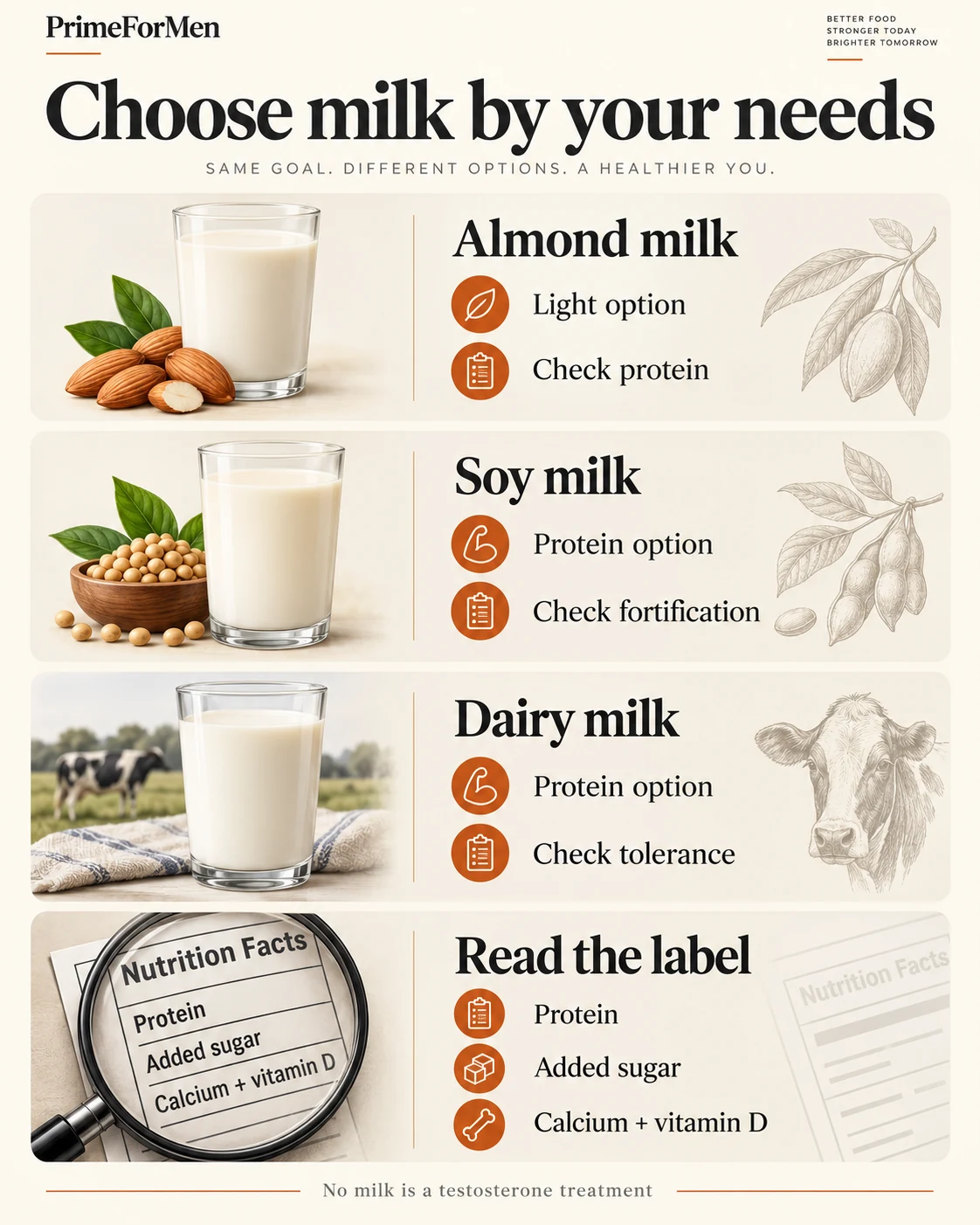
If you replace dairy milk every day, the biggest practical difference may be protein. Fortification can make the calcium numbers look similar while leaving a large protein gap.
On a small screen, swipe the table sideways to see every column.
| Product | Protein | Calcium | Added sugar | Best reason to choose it |
|---|---|---|---|---|
| Silk Unsweet Almondmilk | 1 g | 470 mg | 0 g | A light, fortified dairy-free drink when protein comes from elsewhere |
| Silk Unsweet Soymilk | 8 g | 470 mg | 0 g | A plant-based option that also contributes substantial protein |
| Horizon Organic 2% Reduced Fat Milk | 8 g | 300 mg | 0 g | A protein-containing dairy option if you tolerate and enjoy it |
Protein in three milk examples
Grams of protein per 1 cup (240 mL). All bars use the same scale, starting at zero.
| Specific product | Serving | Protein |
|---|---|---|
| Silk Unsweet Almondmilk | 240 mL | 1 g |
| Silk Unsweet Soymilk | 240 mL | 8 g |
| Horizon Organic 2% Reduced Fat Milk | 240 mL | 8 g |
Manufacturer examples checked October 4, 2026, not category averages or hormone outcomes. Formulations vary; the carton you buy takes priority. A protein comparison does not establish a testosterone benefit.
Sources: manufacturer nutrition panels for Silk almond milk, Silk soy milk, and Horizon 2% milk. These are examples, not averages or product endorsements. Formulas vary; the carton you buy takes priority.
Repeating that 7-gram protein reduction across several meals makes a bigger difference to your daily intake. You can replace the lost protein with other foods.
Zero added sugar does not mean zero total sugar. The dairy example contains naturally occurring lactose. Check both lines, especially when comparing plain milk with sweetened vanilla or chocolate alternatives. For broader meal planning, use our nutrition and supplements guide.
Read the label in this order
- Start with the serving size. Compare equal volumes. A small splash in coffee and a full glass are different contributions to your day.
- Check protein. If the drink replaces a protein source, plan the replacement. Standard almond milk and protein-enriched almond blends are not interchangeable.
- Look for calcium and vitamin D. Fortified products can help replace these nutrients. Homemade or unfortified drinks may not.
- Check added sugar. Unsweetened is a straightforward starting point if you want a neutral drink. Flavored versions need their own label check.
- Read the allergen statement. Almond is a tree nut. Soy and dairy have different allergy considerations; lactose-free dairy still contains milk proteins.
The FDA’s guidance on milk alternatives emphasizes differences in protein, calcium, vitamin D, potassium, saturated fat, and added sugars. “Plant-based” does not establish nutritional equivalence.
Do not assume the front of the carton answers everything. “Original,” “organic,” and “natural” do not tell you how much protein it contains. Nor should you assume every almond drink supplies zinc or magnesium in meaningful amounts. Count what the label states, and follow storage instructions.
What about vitamin D and testosterone?
Vitamin D is worth getting for its established nutritional functions, including calcium absorption. But the claim that fortified almond milk raises testosterone skips several steps. A drink’s vitamin content does not establish a clinical hormone effect.
The supplementation evidence is mixed. A 2024 meta-analysis of 17 trials found an increase in total testosterone but no significant change in free testosterone. A 2026 systematic review, using different rules for combining measurements, found no clear, reproducible increase in total testosterone and rated the evidence as low certainty. Neither review tested whether drinking fortified almond milk improves testosterone or related symptoms.
If your clinician identifies a deficiency, address that deficiency using their advice. If your concern is low testosterone, ask about an appropriate assessment. Buying a fortified drink, adding a high-dose supplement, and starting hormone therapy are three very different actions.
Make almond milk work in an actual meal
Breakfast oats
Cook oats with unsweetened fortified almond milk if you like the taste. Add a separate protein source, such as Greek yogurt on the side or eggs. For a fully plant-based meal, consider soy yogurt with a useful protein content or tofu alongside the oats. Check quantities rather than assuming that any “yogurt alternative” supplies protein.
A post-workout smoothie
Use almond milk as the liquid, then add a protein source and fruit. Whey can suit someone who tolerates dairy; a soy or other appropriate plant protein can suit a dairy-free meal. Adding protein changes the smoothie’s nutrition. It does not turn the drink into a testosterone booster.
Coffee or an evening drink
A splash of almond milk can be a simple taste preference. You do not need to redesign your entire diet around it. If several full glasses replace meals, however, check that those meals still supply enough energy and protein.
Our protein calculator for men over 50 can help with a starting estimate if that age group applies to you. A calculator cannot account for every medical condition; individual advice matters if you have a prescribed dietary restriction.
For training, the drink is only one part of recovery. A workable routine, adequate meals, and rest deserve more attention than chasing an ingredient’s theoretical hormone effect. Our strength training basics and rest and recovery guide cover those practical habits.
When to skip it or seek medical advice
Avoid almond milk if you have an almond allergy, and follow your allergy specialist’s advice about other tree nuts and cross-contact. Do not use a drink marketed as dairy-free as proof that it is safe for every allergy.
If you have kidney disease or a prescribed fluid, potassium, or phosphorus restriction, ask your clinical team which drink and portion fit your plan. Brands differ, and a general nutrition comparison is not a kidney diet prescription.
Persistent low libido, fewer spontaneous erections, erectile difficulties, or unexplained fatigue warrant a conversation with a clinician. These symptoms can have causes other than testosterone deficiency. Changing milk brands cannot identify the cause.
The Endocrine Society’s clinical guidance explains that diagnosis requires compatible signs or symptoms and consistently low testosterone, confirmed with a repeat morning fasting blood test. A single result, a symptom quiz, or a perceived response to a food is insufficient.
Compare two drink labels for your actual pour
Choose examples or enter your carton values. All three nutrient fields use a 240 mL basis. If your label uses another serving size, first multiply its nutrient value by 240 and divide by the label’s serving size in mL.
Label-based estimate for 240 mL of each drink
| Nutrient | Drink A | Drink B |
|---|---|---|
| Protein | 1.0 g | 8.0 g |
| Calcium | 470 mg | 470 mg |
| Added sugar | 0.0 g | 0.0 g |
Drink B provides 7.0 g more protein for this pour. This does not predict a hormone effect.
Arithmetic estimate: label value × pour volume ÷ 240. Label rounding and changed formulas limit precision. Calcium is the listed amount, not an estimate of absorption. Added sugar excludes naturally occurring sugars. This tool does not assess your total diet, deficiencies, medical restrictions, or testosterone.
Example sources: Silk almond, Silk soy, Horizon 2%. Use your purchase carton when it differs.
The table shows the two default 240 mL examples. For another pour, multiply each value by your mL amount and divide by 240; use your own label if it differs.
Watch: compare labels before choosing your drink
Mayo Clinic dietitian Angie Murad explains serving sizes, added sugars, and other Nutrition Facts entries. Use the same checks when comparing milk alternatives. The clip teaches label reading; it does not demonstrate a testosterone benefit from almond milk.
Watch on YouTube or read the Mayo Clinic transcript (PDF).
Optional supplies for a repeatable breakfast
You can use the milk, oats, and measuring cup already in your kitchen. These options help with shopping and portions; none is recommended as a testosterone treatment. Grocery delivery, seller, and selected pack can vary by location.
Affiliate disclosure: As an Amazon Associate, PrimeForMen earns from qualifying purchases. You pay no extra through these links.
Best for: Oats, coffee, or smoothies when another food supplies the protein. Choose it for taste and dietary fit. Skip it if you have an almond allergy, already have a suitable drink, or need the beverage itself to provide substantial protein. Current Amazon listing: Silk Plant Based Almond Milk, Unsweet, 64 fl oz Carton Best for: Making porridge with your chosen milk and adding a separate protein source. A plain oat base lets you choose toppings and portions. Skip it if you already have oats or need certified gluten-free oats for your care plan. Current Amazon listing: Quaker, Quaker 100% Natural Whole Grain Old Fashioned Oats, 42 Ounce Best for: Checking your drink volume instead of assuming every glass holds 240 mL. Useful when you want repeatable portions for the comparison tool. Skip it if your existing jug has clear volume markings. Current Amazon listing: Pyrex Prepware 1-Quart Measuring Cup, Clear with Red Measurements * As an Amazon Associate, PrimeForMen earns from qualifying purchases.Compare practical breakfast supplies

Silk Unsweet Almond Milk · 64 fl oz
Check Silk Unsweet on Amazon

Quaker Old Fashioned Oats · 42 oz
Check Quaker Oats on Amazon

Pyrex Prepware 1-Quart Measuring Cup
Check Pyrex Measuring Cup on Amazon
What to do this week
- Photograph the label on your usual drink and check serving size, protein, calcium, vitamin D, and added sugar.
- If almond milk replaced dairy or soy milk, identify where that meal’s missing protein will come from.
- Choose one breakfast or smoothie you enjoy and make it nutritionally complete. You do not need a special hormone recipe.
- Keep your drink choice separate from symptom assessment. Arrange care if sexual symptoms or unexplained fatigue persist.
Your milk label checklist
Keep the practical checks with you. This one-page PDF includes fillable notes you can save or print.
Conclusion
Almond milk can be a useful dairy-free ingredient, especially when you prefer an unsweetened fortified version and get enough protein elsewhere. It has not been established as a way to increase testosterone, and ordinary consumption is not supported as a cause of low testosterone in men.
Choose the drink that fits your meals, preferences, and allergies. If low testosterone is your actual concern, the next step is a proper assessment, not a different carton.
Frequently asked questions
Does almond milk boost testosterone?
No convincing direct human trial evidence establishes that it does. Fortification can contribute nutrients, but that is not proof of higher testosterone.
Can almond milk lower testosterone or raise estrogen?
There is no convincing evidence that an ordinary serving causes these changes in men. Direct almond-milk hormone research is limited, so avoid claiming that every dose has been proven neutral.
Is soy milk worse than almond milk for male hormones?
Human clinical research does not support avoiding soy because it lowers testosterone. Soy milk often supplies more protein; compare specific labels and choose according to nutritional needs and allergies.
Is almond milk a good post-workout drink?
It can be the liquid in a recovery meal or smoothie. Standard almond milk supplies little protein, so add a suitable protein source or choose a higher-protein drink.
Is homemade almond milk better for testosterone?
There is no established testosterone advantage. Homemade drinks are usually not fortified, and their nutrient content depends on the recipe and straining. Plan calcium, vitamin D, and protein from other sources if needed.