Use isometric exercises safely with goal-based hold times, progressions, breathing cues, and a practical 12-minute workout.
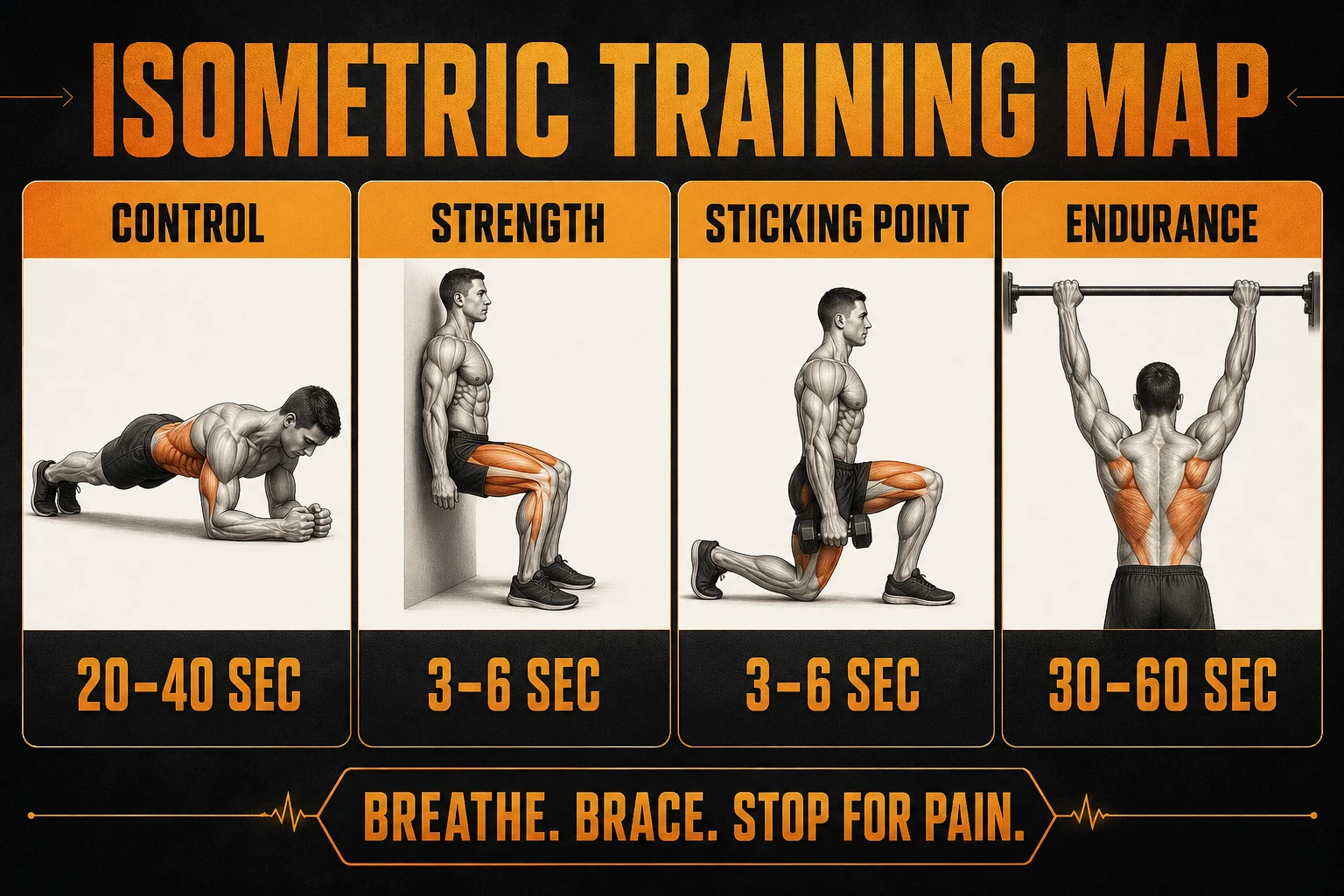
- Use 20–40 second controlled holds for stability and endurance.
- Use brief 3–6 second high-effort holds for strength and sticking points.
- Train multiple joint angles and keep full-range strength work in the program.
Bottom line Match the hold to the goal: position, effort, and breathing matter more than chasing the longest time.
Quick Answer: Isometric exercises build force by creating muscular tension without visible joint movement. They work best as a targeted supplement—for bracing, positional strength, sticking points, or time-efficient training—not as a complete replacement for full-range strength work.
Isometric exercises look simple because nothing moves. The training effect, however, depends on what you are holding, how hard you contract, how long you stay there, and whether that position transfers to your actual goal. A wall sit, a plank, and a maximal pull against an immovable bar are all isometrics, but they are not the same workout.
Quick Summary: Isometric Exercises
- An isometric contraction creates force while the working joint angle stays nearly unchanged.
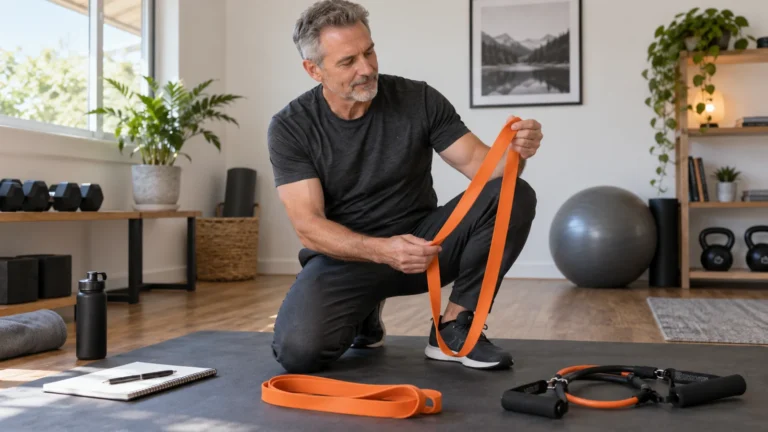
- Yielding holds maintain a position; overcoming isometrics push or pull against an immovable object.
- Longer submaximal holds suit control and endurance; brief high-effort holds suit maximal force and sticking points.
- Isometrics can complement dynamic lifting, but full-range training remains important for broad strength and movement capacity.
- Stop for sharp pain, dizziness, chest discomfort, or unusual shortness of breath.
The Prime Perspective
The useful question is not “Are isometrics effective?” It is “Effective for what?” A hold earns its place when it solves a defined problem: maintaining posture, building tolerance in a position, strengthening a weak joint angle, or adding productive tension when equipment and time are limited.
What Is an Isometric Exercise?
During an isometric exercise, the muscle produces tension while the joint remains essentially still. That differs from the lifting phase of a curl, where the muscle shortens, and the lowering phase, where it lengthens under load. “Still” does not mean “easy”: the internal force can range from a gentle brace to a near-maximal effort.
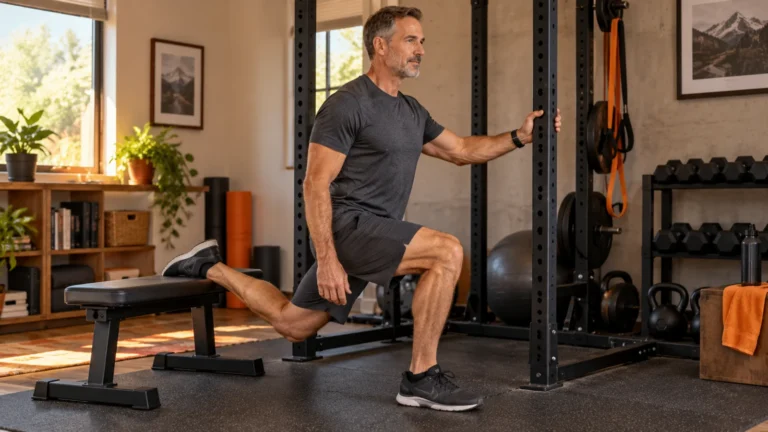
The familiar examples are planks, side planks, wall sits, calf-raise holds, split-squat holds, and static carries. But a lifter pulling as hard as possible against safety pins is also performing an isometric contraction, even though the effort is brief and maximal.
Yielding vs. Overcoming Isometrics
| Type | What you do | Best use | Example |
|---|---|---|---|
| Yielding | Resist gravity or an external load and prevent the position from changing. | Control, bracing, local endurance, technique awareness | Wall sit, plank, paused split squat |
| Overcoming | Push or pull maximally against an object that cannot move. | High force, neural intent, a specific sticking point | Barbell pull against fixed rack pins |
Most beginners should start with yielding holds because the effort is easier to scale and exit. Overcoming isometrics require a stable setup, careful positioning, and a gradual force ramp; they are an advanced strength tool rather than a default home exercise.
What Isometric Training Can—and Cannot—Do
Isometrics are especially specific to the trained joint angle. Research on joint-angle specificity shows that the largest strength improvements occur around the position used in training. Some improvement can carry to nearby angles, but one static position does not automatically create equal strength through the entire range.
That is why isometrics should usually sit beside dynamic exercises. Squats, presses, rows, and hinges train force through changing positions; isometric holds reinforce selected positions inside those patterns. For a broader foundation, see our guide to strength training basics.
The Knowledge Gap: Duration Without Effort Means Little
A 30-second hold at 40% effort and a 30-second hold close to failure are different training doses. Record the exercise, position, hold time, effort, and whether your alignment changed. Progress only one variable at a time.
How Long Should You Hold an Isometric Exercise?
| Goal | Starting dose | Effort | Progression |
|---|---|---|---|
| Technique and control | 2–4 sets of 15–30 sec | Moderate; clean breathing | Improve position before adding time |
| Local muscular endurance | 2–4 sets of 30–60 sec | Moderate to hard | Add 5–10 sec, then choose a harder variation |
| Strength at a position | 3–5 sets of 5–15 sec | Hard, controlled | Add resistance or leverage, not endless duration |
| Maximal overcoming effort | 3–5 sets of 3–6 sec | Very high after a gradual ramp | Use only with a secure setup and adequate rest |
These are practical starting ranges, not medical prescriptions. Beginners should leave a clear margin before form failure. If you can hold a position for a minute without meaningful effort, the next step is usually a harder leverage, more external resistance, or a more demanding position—not a five-minute hold.
Six Isometric Exercises With a Clear Purpose
1. Wall Sit: Lower-Body Endurance
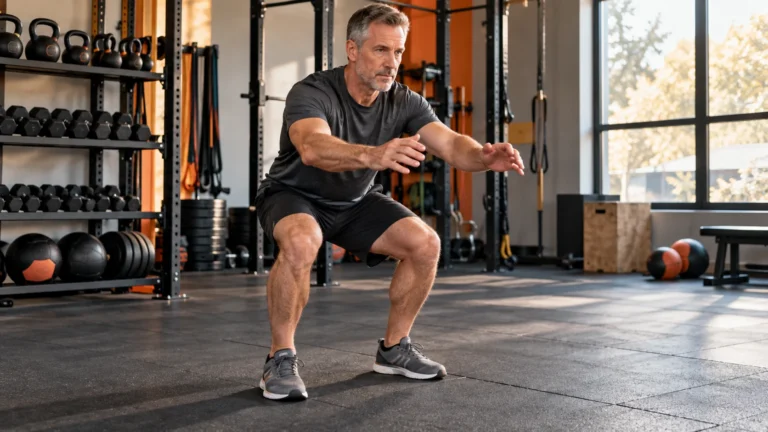
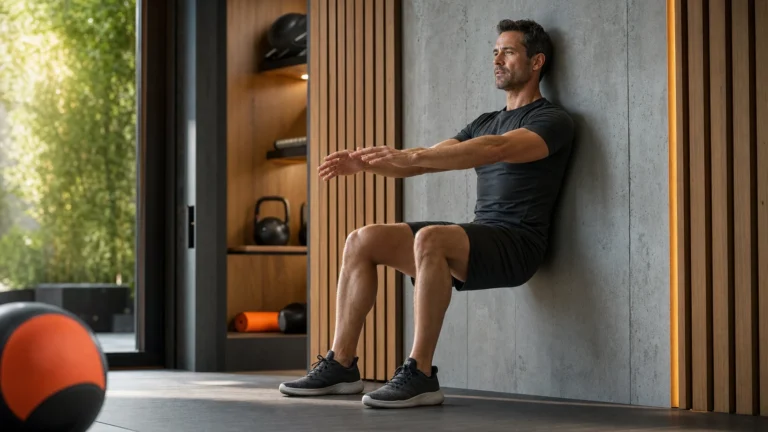
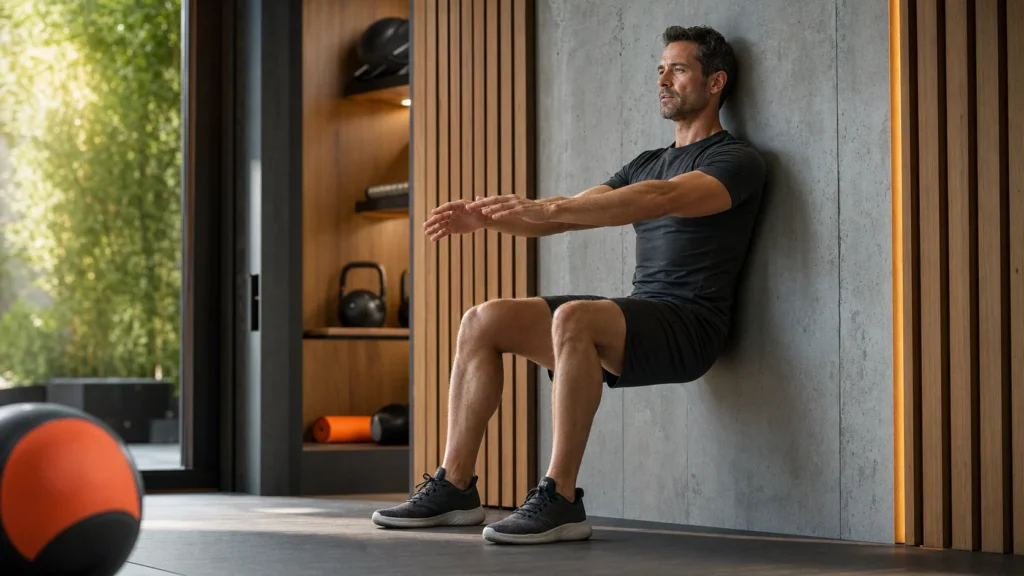
Place your back against a wall, feet far enough forward that the knees track comfortably over the feet, and lower only as far as you can control. Start with 20–30 seconds. Move higher if the knees feel irritated; do not force a textbook 90-degree angle.
2. Split-Squat Hold: Single-Leg Position
Lower into a split stance and stop above the floor. Keep the front foot planted and the pelvis level. This is useful for exposing left-right differences without turning the session into a balance circus.
3. Front Plank: Anti-Extension Control
Brace as if preparing for a controlled impact, keep the ribs stacked over the pelvis, and stop before the lower back sags. If a short, strict plank is easy, use a harder variation rather than simply chasing longer time. Our core stability exercises guide explains the bracing progression in more depth.
4. Side Plank: Lateral Trunk Control
Stack the shoulders and hips, press the floor away, and keep the body in one line. Bend the lower knee for a regression. Progress by lengthening the lever or adding a slow top-leg lift.
5. Push-Up Hold: Pressing Position
Pause at a controllable depth with elbows angled naturally from the torso. Use an incline if the bottom position collapses. This trains a specific part of the press, so combine it with full-range push-ups when tolerated.
6. Calf-Raise Hold: Ankle Stiffness and Balance
Rise onto the ball of the foot, keep pressure through the big-toe side, and hold without rolling the ankle outward. Use support so balance does not become the limiting factor.
A Practical 12-Minute Isometric Workout
Rest 35 seconds. Choose a knee angle you can own without pain.
Rest 45 seconds. Hold just above your deepest controlled position.
Rest 30 seconds between sides. Keep breathing behind the brace.
Rest 40 seconds between sides. Use a wall lightly for balance if needed.
Complete two rounds. Repeat twice weekly with at least one day between sessions. When every hold is stable and the final seconds remain controlled, add five seconds or move to a slightly harder variation. For a full no-gym session that includes movement, pair this with our no-equipment workout plan.
Breathing, Blood Pressure, and Safety
High-effort static contractions can produce a substantial short-term blood-pressure response, especially when combined with breath holding and straining. Exhale gently, keep the face and neck relaxed, and avoid turning beginner holds into maximal efforts.
At the same time, structured isometric training has been studied as one possible component of blood-pressure management. That does not mean a hard wall sit is a self-prescribed treatment. The 2023 systematic review on isometric resistance training concerns planned training protocols and population-level outcomes—not permission to ignore individual medical risk.
The Mayo Clinic overview of isometric exercise also emphasizes breathing rather than straining. Speak with a qualified clinician before high-effort isometrics if you have uncontrolled high blood pressure, cardiovascular disease, a recent injury, or exercise restrictions.
How to Combine Isometrics With Dynamic Training
Use one or two holds, not a second full workout hidden inside the first. Before lifting, a low-fatigue hold can reinforce position. After the main lift, a harder hold can add focused work. On a home-training day, isometrics can make light resistance more challenging.
| Placement | Use | Example |
|---|---|---|
| Warm-up | Low fatigue, positional awareness | Two 15-second split-squat holds |
| After main lift | Target a weak angle | Three 8-second push-up holds |
| Home workout | Create difficulty without more load | Wall sit paired with controlled squats |
| Recovery day | Only when easy and symptom-free | Gentle calf or glute holds |
Progressive overload still matters. Increase resistance, leverage, effort, set count, or hold time gradually. Our guide to progressive overload shows how to make that progression measurable.
Bottom Line
Isometric exercises are not magic and they are not merely “easy exercises for rehab.” They are a precise way to create force in a chosen position. Start with controlled yielding holds, match duration to the goal, breathe throughout the effort, and keep dynamic full-range training in the program. The best isometric is the one with a clear purpose and a progression you can actually track.
Frequently Asked Questions About Isometric Exercises
Can isometric exercises build muscle?
They can contribute to muscle growth when the contraction is sufficiently challenging and progressed, but dynamic training usually provides a simpler way to load a muscle through more of its range.
Are isometrics good for strength?
Yes, particularly at or near the trained joint angle. Combine them with full-range strength work when you want broader carryover.
How often should I train isometrics?
Two or three weekly exposures per movement pattern are enough for most beginners. Hard maximal efforts require more recovery than easy control holds.
Should I hold my breath during an isometric exercise?
No. Use controlled breathing unless a qualified coach or clinician has given you a specific protocol and you understand the risks.
Are isometric exercises safe for knee or back pain?
They can sometimes be useful because the position and effort are adjustable, but pain has many causes. Use a comfortable range and seek individualized guidance for persistent, severe, or worsening symptoms.