Plan slower kettlebell practice after 50 with bell handling, both-side session timing, swing coaching limits and a printable training record.
- Use suitable slower movements before adding unfamiliar ballistics.
- Park the bell before repositioning for the other side.
- No age-based weight or online self-test establishes readiness.
Bottom line Write down the pickup and put-down, then count both sides and bring unresolved handling questions to a qualified instructor.
A kettlebell workout for men over 50 does not have to begin with swings, timed complexes or an age-based starting weight. Begin with suitable movements you understand, a bell you can handle deliberately and enough time to put it down between tasks. The pickup, side change and finish are part of the exercise.
This guide gives a slower session example using deadlifts, supported rows, stationary suitcase holds and a bodyweight wall press. It explains what that session leaves out, how to count both sides and when ballistic exercises need coaching. For a complete weekly schedule across equipment types, use our workout plan for men over 50; do not add this full session without counting its overlapping work.
Quick Summary: Kettlebell Workout for Men Over 50
- Choose a load for the specific movement and its pickup, not from a universal starting-weight table.
- Slower lifts and holds can provide useful practice without requiring swings or overhead work.
- Park the bell before side changes. A moving hand-to-hand exchange is a separate skill.
- The one-set example budgets 19:16; two sets budget 28:02. Both include rest, side changes and setup.
- A comfortable deadlift, online checklist or symptom selection does not clear you for swings or diagnose exercise suitability.
The Prime Perspective
Kettlebell practice needs space, grip and practiced handling, even with one compact bell. One bell can load both sides separately. It cannot remove the time spent lifting it, parking it and preparing the opposite side.
Leave enough time in slower practice to learn the pickup, movement and put-down. Swings, cleans and snatches involve acceleration and catching or redirecting a moving load. Their skill demands do not disappear because the session is labeled beginner or over 50.
What a kettlebell can contribute
The handle and offset mass let you perform hinges, rows, holds, carries and other resistance exercises. These can contribute to strength training when the movement, effort and total program fit your goals. A workout’s equipment name does not establish muscle gain, fat loss, joint protection or a guaranteed cardiovascular effect.
The CDC’s adult activity recommendations include strengthening the major muscle groups at least twice weekly. Adults 65 and older also have guidance covering balance and abilities. A slow bell practice session is not automatically your aerobic activity, and one exercise list is not the full recommendation.
Age does not select the bell. Training experience, conditions, medications, balance, grip, current recovery and instruction matter. A bell manageable for a two-hand deadlift can be too demanding for a one-hand row or an overhead position. You may need different loads, another implement or an unloaded version.
Completing a hinge or hold does not prove readiness for a swing. A checklist cannot assess your movement, cardiovascular suitability or an underlying symptom. Use it to prepare questions and record work.
Bell handling before working sets
Clear the floor and the intended put-down area. Keep other people and pets outside the working space. Inspect the handle, surface and any adjustable mechanism. A flat bell base helps it rest on the floor, but the floor and bell must still be stable. Do not balance the bell on soft cushions, unstable books or furniture.
Practice a deliberate two-hand pickup only when that hinge and starting height are suitable. Keep the load close to your body as appropriate to the movement, stand without leaning backward and reverse the movement to park it. Do not drop it, and keep fingers clear of the bell and floor contact. For a row or suitcase hold, arrange your stance before lifting the working load.
When changing sides, lower the bell completely to its suitable resting position, release it and reposition yourself. Re-grip for the other side. Passing a moving bell between hands is not a shortcut in this example. If picking it up from the floor is unsuitable, resolve an appropriate supported starting height and handling method with instruction before working sets.
| Choice | What happens | What to resolve |
|---|---|---|
| Deadlift | A controlled lift from a suitable starting position, then a controlled return | Hinge, grip, starting height and putting the bell down |
| Supported row | One-side pull with a stable support and controlled return | Support stability, trunk position and both sides |
| Suitcase hold or carry | A stationary hold or walking with the load beside you | Grip, balance, space and the pickup; walking adds a demand |
| Swing | A ballistic hip-driven movement that redirects a moving bell | Coached setup, hinge timing, grip, breathing, stopping and parking |
| Clean, snatch or loaded get-up | Additional catching, overhead or transfer demands | Specific instruction and an individually suitable progression |
Choose the bell format around your practice
Affiliate Disclosure: As an Amazon Associate, we earn from qualifying purchases. Links marked * are affiliate links. We have not hands-on tested these products. Existing equipment and the free record may be enough.
Best for: A fixed bell when the selected mass, handle and pickup fit your individually suitable practice. Skip if the current selected variant is unsuitable or your existing bell already works. Current Amazon listing: REP FITNESS Kettlebells for Strength and Conditioning, Fitness, and Cross-Training - LB and KG Markings Best for: Reducing storage when one of the manufacturer-listed formats fits your intended work. Skip if the minimum setting, step size, mechanism or exact Amazon variant is unresolved. Current Amazon listing: Rep Fitness Adjustable Kettlebell | Weight Set for Home Gym | Strength Training Equipment for Men & Women | Compact Steel Bell with Ergonomic Handle | Choose 16 kg, 24 kg or 40 lb Models Best for: Keeping bell settings, both sides and handling questions together. Skip if the free worksheet or your existing notebook already serves that purpose. Current Amazon listing: Ultimate Workout Journal - Fitness Training Planner for Men and Women * As an Amazon Associate, PrimeForMen earns from qualifying purchases.Recommended Products

REP fixed kettlebell format
View on Amazon

REP adjustable kettlebell formats
View on Amazon

Ultimate Workout Journal
View on Amazon
Four movements for the slower example
Two-hand deadlift
The American Council on Exercise deadlift technique article describes the kettlebell as one way to teach the hinge. It also discusses adapting starting height. That requires an appropriate stable arrangement, not a homemade stack that might tip.
Stand with a suitable stance around the bell, bend at the hips with some knee bend and take the handle with both hands. Keep a controlled trunk position and press through the feet as you stand. Finish tall without pushing the hips far forward or leaning back. Return deliberately to the starting position. The bell does not need to swing away from your legs.
A deadlift remains a slower strength movement in this example. Making it fast does not reproduce swing technique and is not our substitute for an unfamiliar swing. If the hinge or pickup cannot be performed as intended, practice without load or get instruction rather than chasing the repetition target.
Supported one-hand row
Arrange a stable support that can resist your hand pressure. Set the feet and hinge before taking the bell. Pull with a controlled shoulder and elbow path, without twisting the torso or bouncing to finish. Lower and park the bell before repositioning to the other side.
The handle opening, bell size and chosen load all affect the setup. A grip that forces an awkward wrist position or makes the bell strike the legs needs review. Record both sides, even when the planned repetitions match. Our unilateral training guide explains why separate sides need separate workload records.
Stationary suitcase hold
With an individually suitable load beside one leg, stand in a comfortable stance and hold for the chosen short interval without deliberately leaning toward or away from the bell. Continue breathing. Stop when grip or position is no longer controlled, even if the interval has not finished.
Park the bell before changing sides. The sample uses a stationary hold so that walking space does not dictate the session. That is still a balance and grip task, not a universally safe replacement for walking. Carries add steps, turns and obstacles; use them only when appropriate and account for the route.
Wall press
Use a solid wall and a hand and foot position that allows a comfortable controlled press. Lower toward the wall and press away without leading with the head or shrugging. Step closer when an individually suitable shorter lever is needed.
This pushing movement uses bodyweight. It avoids introducing an unfamiliar kettlebell rack or overhead press simply to make every exercise use the bell. If no pushing variation fits, omit it and seek help with the choice; the remaining work is a partial practice session.
A worked session with rest and side changes
The dose below is an adaptable editorial example for familiar, individually suitable movements. It is not a kettlebell clinical trial protocol or a prescription for everyone over 50. No starting mass is assigned. Use a load you can handle for the specific task, stop before losing control and allow longer rest when needed.
| Order | Work | Rest and handling | What to write |
|---|---|---|---|
| Warm-up and rehearsal | 5 minutes of easy movement, unloaded hinges and setup rehearsal | Longer if the setup needs it | Movement options and pickup plan |
| Two-hand deadlift | 2 sets of 6 | 60 seconds between bouts, including before the next exercise | Bell load and starting height |
| Supported row | 2 sets of 6 each side: left, right, left, right | 60 seconds between bouts; add 20 seconds on each left-to-right change | Both sides and support |
| Suitcase hold | 2 holds of 15 seconds each side: left, right, left, right | 60 seconds between bouts; add 20 seconds on each left-to-right change | Actual hold time per side and grip |
| Wall press | 2 sets of 6 | 60 seconds before the first set and between sets | Hand and foot placement |
| Finish | 3 minutes for easy movement, putting equipment away and notes | Keep enough time for deliberate handling | Actual duration and questions |
Add 30 seconds of setup for each of the three changes between exercises, separate from the 60-second rests. Twelve work bouts create eleven between-bout rests, including the right-to-left return between a movement’s first and second pair of sides. The four extra 20-second handling allowances cover the left-to-right changes in rows and holds. Right-to-left repositioning is included within its 60-second pause; take extra time if necessary.
Include all the work and rest in the time budget
For arithmetic only, assume four seconds for each of the 48 repetitions: 2 deadlift sets, 4 row bouts and 2 wall-press sets, each of 6. That gives 3:12 of repetition work. Four holds add 1:00. Together the active work is 4:12. The four-second assumption includes the controlled return and is not an instruction to follow a fixed tempo.
Add 5:00 warm-up + 4:12 work + 11:00 rest + 1:30 exercise changes + 1:20 side changes + 2:00 dedicated initial handling rehearsal + 3:00 finish = 28:02. The two minutes of handling rehearsal are separate from general warm-up; actual practice may take longer.
One set per movement gives six bouts: deadlift, left row, right row, left hold, right hold and wall press. Repetitions take 1:36 and holds take 0:30, so work totals 2:06. With five 60-second rests, three 30-second exercise changes and two 20-second side changes, the full arithmetic is 5:00 + 2:06 + 5:00 + 1:30 + 0:40 + 2:00 + 3:00 = 19:16. Extend the whole-session estimate if needed.
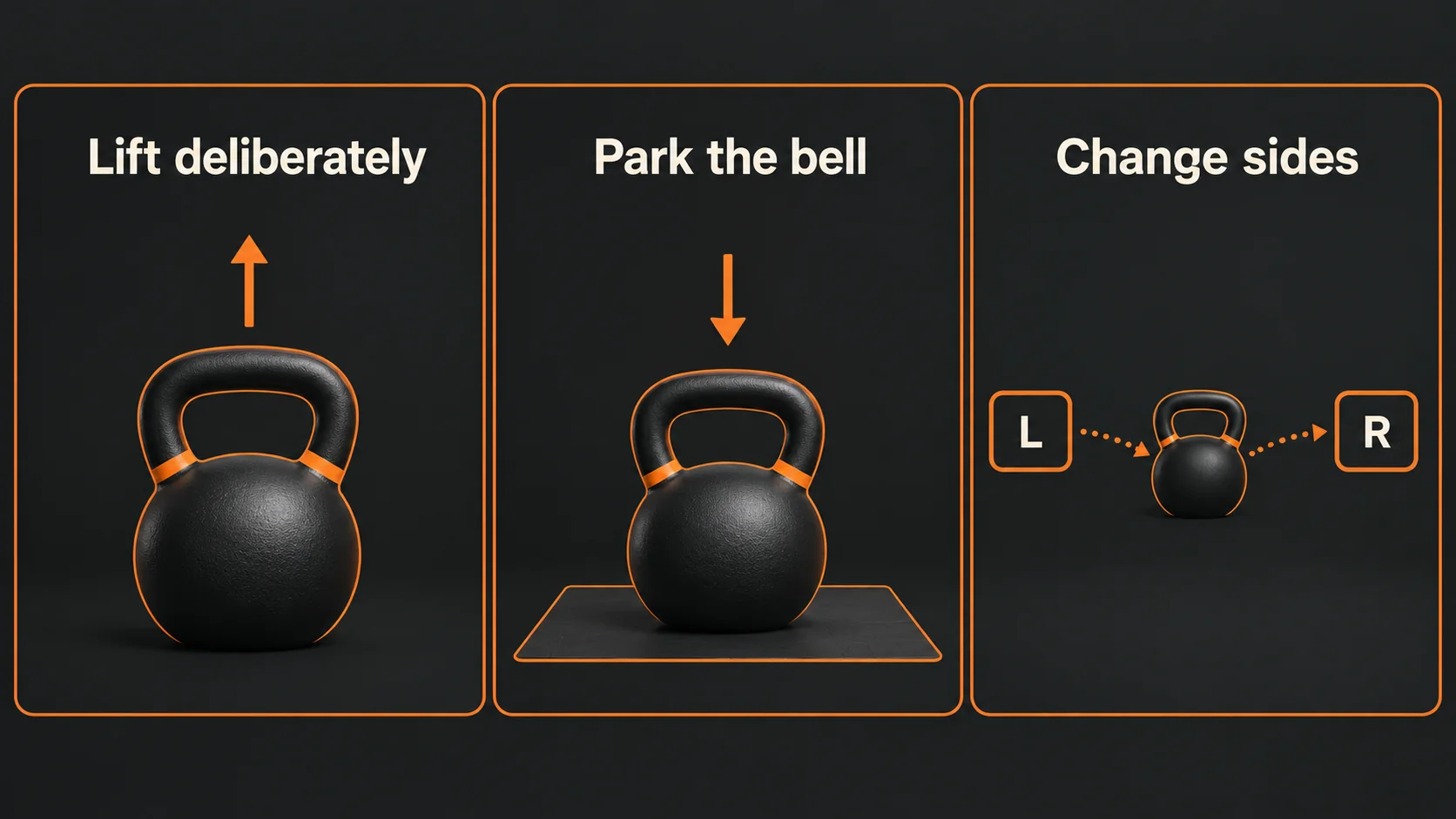
Park the bell before changing sides
Finish the left-side task, park the bell, reposition and begin the right-side task. The silent illustration explains handling order; it does not show swing technique or require a particular exercise dose. Open the silent MP4.
Swings need their own instruction
The ACE two-hand swing technique guide begins its teaching discussion with the hip hinge. A swing uses a timed hip drive and a moving bell; it is not a squat with an arm raise. Its setup and finish need practice as well as the middle repetitions.
Learn with a qualified kettlebell instructor who can observe your movement, choose an appropriate load and teach how to stop and park the bell. A video gives useful context, but it cannot inspect your technique or identify why an exercise hurts. Do not add swing intervals because you completed a deadlift set, or use a timed self-test as permission.
Watch the swing setup and finish
Brett Jones, a certified athletic trainer, CSCS and StrongFirst Certified Master Emeritus, demonstrates creating the hinge before reaching and returning the bell to its starting position. This is ballistic-technique context for a coaching discussion. It is separate from our slower worked session.
Watch the StrongFirst demonstration on YouTube and read the official setup explanation. Watching does not establish readiness, and the video is not a follow-along prescription.
Fixed versus adjustable bells
A fixed bell has no load-selector procedure, but you still need a suitable mass, intact handle, usable grip and stable put-down. An adjustable bell saves storage space and adds a mechanism to inspect. Handle diameter, bell size, units and minimum setting can matter more than the largest advertised load.
REP lists three adjustable formats: 8 to 16 kg in 2 kg steps, 16 to 24 kg in 2 kg steps and 20 to 40 lb in 5 lb steps. Those are different models, not one bell covering every value. Its instructions say not to slam or drop the bell because damage can compromise plate retention. Follow the current model’s adjustment and locking checks before lifting.
A 2 kg step is about 4.4 lb. A 5 lb step may be too large for your next row or hold even if another movement can use it. Repeating the current suitable work, changing one programming variable with instruction or using another implement are possible choices. An adjustable selector is not an automatic progression schedule.
Keep kettlebell practice within the week’s workload
Do not increase the number of sets automatically in week two. Write the completed repetitions, both sides, actual hold time, load, setup and response. Review whether the practice remained controlled and whether it overlaps with the rest of your week. Persistent, worsening or unexplained symptoms need appropriate advice before experimenting with more work.
A fictional entry might say: “Row: left 6 + 6, right 6 + 5; final right repetition stopped when I started twisting. Same bell and support. Ask about setup before changing load.” The entry records where control changed so you can review the setup before adding load.
Use our strength progression guide for the broader decision. If the grip or weight changes make dumbbells more practical, compare the dumbbell setup options after 50. Choose another implement or a bodyweight movement when it fits the task better.
Prepare my kettlebell practice
Choose the setup and intended work, then keep an actual record. This helper organizes an example; it cannot assess your technique, symptoms or exercise suitability.
Stop painful movement or exercise that makes you unwell. Persistent, worsening or unexplained symptoms need appropriate advice. Chest pain, fainting or severe unusual breathlessness require urgent care. A selected answer does not establish exercise suitability. Slower example: one set budgets 19:16; two sets 28:02 including both row and hold sides, rest and handling. Ballistic work needs separate instruction; this record does not clear it.
Use the fillable PDF or write your chosen setup and completed work in a notebook. The interactive result needs JavaScript.
Record handling as well as repetitions
The one-page record has eight editable fields for the bell, pickup plan, both sides, rests, actual duration and coaching questions. Fill it digitally or print it blank; an ordinary notebook is also enough.
Conclusion
Prepare one suitable slower session, including where the bell starts and finishes. Count both sides and the time between them. Keep ballistic work for a separately instructed progression, and bring your actual record to the next training decision.
Our home gym equipment guide helps with the wider setup. Our editorial policy explains evidence and product boundaries.
Kettlebell practice questions after 50
What kettlebell weight should I buy after 50?
Choose for the actual movements, grip and handling with suitable instruction. There is no universal age-based starting mass. A bell suitable for a two-hand deadlift may be too demanding for a row, hold or overhead exercise.
Can I skip swings?
Yes. The worked session uses slower movements and holds, plus a wall press. It is not a swing-conditioning session and does not cover every possible training goal.
Is a fast deadlift a substitute for a swing?
No. Accelerating a deadlift does not teach the swing’s moving-bell path, timing or finish. Keep the deadlift controlled and learn ballistic technique separately with appropriate instruction.
Should I pass the kettlebell between hands?
In this slower example, park it completely before changing sides. A moving exchange is a separate skill, and dropping or slamming an adjustable bell can damage its mechanism.
Should I add sets next week?
Not automatically. Review completed work, control, response and the whole week’s demands. Repeat suitable practice or address technique and symptoms before adding work.
Medical Disclaimer: This is general editorial exercise information, not diagnosis, rehabilitation, a personalized prescription or exercise clearance. Stop painful movement or exercise that makes you unwell. Seek urgent care for chest pain, fainting or severe unusual breathlessness. Individual conditions may need healthcare advice; technique and bell handling may need a qualified trainer.