

What exercise can and cannot do for testosterone, with human evidence, a practical strength week and a free recovery log.
- Separate temporary responses from resting levels.
- Use training outcomes to guide your exercise choices.
- Follow a manageable two-day strength example.
Bottom line Plan your first two sessions, record the work, and take persistent symptoms to a clinician.

Exercises to boost testosterone are often sold as a way to raise a hormone number. Strength training can improve strength and physical function, and exercise can temporarily change testosterone after a session. That does not mean a particular lift reliably raises your resting testosterone or treats a diagnosed deficiency. Choose training you can progress and recover from, rather than a workout designed around a promised hormone spike.
The Prime Perspective
If you become stronger, walk farther and recover well, training is delivering something useful even if a hormone measurement does not rise. Conversely, feeling exhausted after a hard workout does not show that it was hormonally effective. This guide is an editorial explanation and sample plan, not a medically reviewed treatment protocol or an independently tested PrimeForMen intervention.
For men over 50, training experience, current activity, health conditions and recovery capacity matter more than copying an influencer’s heaviest exercise. Our fitness guide for men over 50 provides the broader starting framework.
What the Research Measures—and What It Does Not
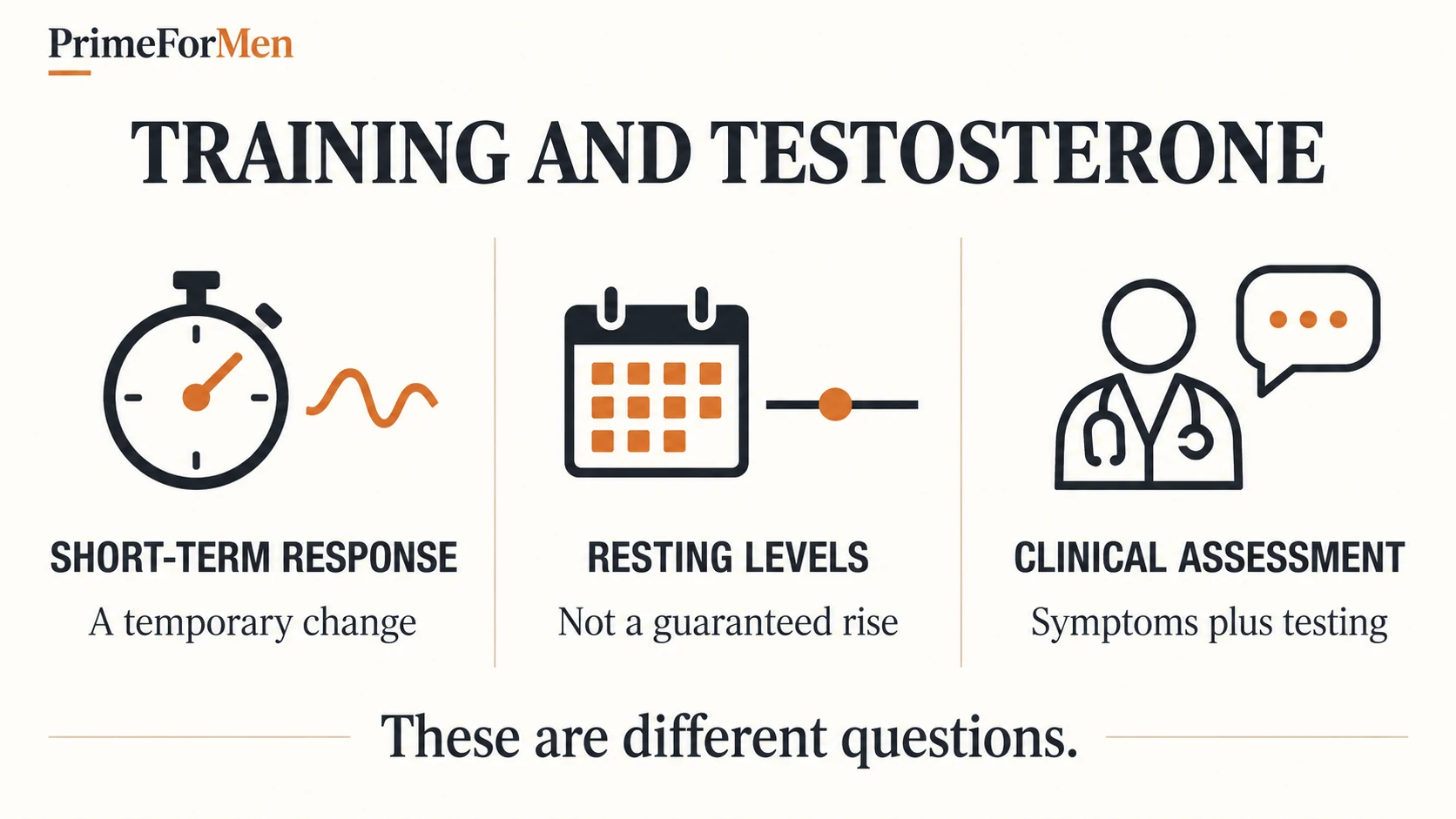
A blood or saliva sample collected immediately after exercise answers a narrow question about that moment. A resting measurement after weeks of training addresses a different question. Improvement in symptoms or health requires further evidence. These outcomes should not be treated as interchangeable.
Swipe sideways on a small screen to read every column.
| Evidence | People and duration | Finding | Useful limit |
|---|---|---|---|
| Acute-exercise meta-analysis (2020) | 48 studies; 569 participants; mean age about 30; samples around individual exercise sessions. | An increase was evident immediately and within 30 minutes in the pooled analysis; not after 30 minutes. | A short-lived pooled response is not a guaranteed response for every man or a treatment outcome. |
| Resting-testosterone meta-analysis (2021) | 11 randomized trials; 421 insufficiently active, apparently healthy men aged 19–75; median training duration 12 weeks. | The average effect on resting total testosterone was negligible: standardized mean difference 0.00, 95% CI −0.20 to 0.20. | This concerns men with normal gonadal function; it does not settle treatment for diagnosed hypogonadism. |
| Lifestyle study in overweight and obese men (2016) | 41 men completed 12 weeks of aerobic exercise plus calorie restriction. | Testosterone increased; greater step-count changes were associated with greater increases. | Combined lifestyle changes and subgroup associations do not isolate the effect of one exercise or prove causation. |
The standardized effect in the second row is a statistical comparison, not a testosterone reading in ng/dL. The range around it expresses uncertainty. A near-zero average does not mean exercise has no health benefits, and it does not prove that no individual can experience a change. It does argue against advertising a predictable resting-testosterone increase from a generic lifting plan.
The practical distinction is population and outcome: healthy inactive men, men living with obesity and men with an established hormone disorder cannot automatically be treated as the same group. An older study can remain useful for a clearly defined question; newer publication dates alone do not remove design limitations.
Choose Movements for Their Training Value
No special barbell lift is mandatory. A squat trains knee and hip extension, a hinge loads the back of the legs, pushing and pulling cover the upper body, and a carry or trunk exercise adds control. Pick a version that fits your equipment and current skill. The following are exercise options, not a hormone ranking.
Swipe sideways on a small screen to read every column.
| Pattern | Starting option | Main cue | If it is too difficult |
|---|---|---|---|
| Squat | Bodyweight squat or goblet squat | Keep the whole foot grounded; let knees track with toes. | Use a shallower comfortable range or controlled sit-to-stand from a firm chair. |
| Hinge | Light dumbbell Romanian deadlift | Soften the knees and move hips back; keep weights near the legs. | Rehearse an unloaded hip hinge; do not chase floor depth. |
| Push | Wall or incline push-up | Move torso and hips together; use a stable fixed surface. | Raise the hand position or shorten the comfortable range. |
| Pull | Supported one-arm dumbbell row | Brace on a stable support; bring elbow toward hip without twisting. | Reduce weight and range while keeping the torso quiet. |
| Trunk / carry | Dead bug or suitcase hold | Keep breathing and resist unwanted trunk movement. | Use shorter holds or move one limb at a time. |
Those patterns also appear in our four-week full-body home workout, which provides a more detailed home-training progression. You do not need to perform squats and heavy deadlifts in the same session to make training worthwhile.
Watch a controlled squat before adding weight
This NASM demonstration shows a goblet squat. Watch the setup, foot contact and controlled movement. A kettlebell or suitable dumbbell can provide the front-held load. The video teaches the exercise; it does not provide evidence that squats treat low testosterone.
A Two-Day Strength Plan You Can Actually Follow
This is a conservative starting example for generally healthy adults who can perform the selected movements comfortably. New exercisers can start with one work set per exercise for the first week. Otherwise use two work sets, leaving about two or three good repetitions available at the end. Warm-up sets do not count toward the work sets.
Place A on Monday and B on Thursday, or choose two other nonconsecutive days. Allow roughly 35–50 minutes, including 6–8 minutes of easy movement and practice sets. Rest about 90–120 seconds between strength sets and longer when needed to regain control. The session is not a timed circuit.
Swipe sideways on a small screen to read every column.
| Exercise slot | Workout A | Workout B |
|---|---|---|
| Lower body | Goblet squat: 2 × 6–10 | Dumbbell Romanian deadlift: 2 × 6–10 |
| Upper push | Incline push-up: 2 × 6–10 | Comfortable dumbbell floor press: 2 × 6–10 |
| Upper pull | Supported dumbbell row: 2 × 8–12 per side | Supported dumbbell row: 2 × 8–12 per side |
| Additional lower body | Glute bridge: 2 × 8–12 | Supported split squat: 2 × 6–8 per side |
| Trunk | Dead bug: 2 × 5–8 per side | Suitcase hold: 2 × 15–25 seconds per side |
For a floor press, set up and put the weights down under control; use incline push-ups instead if floor transfers or handling the dumbbells are difficult. For unilateral exercises, complete both sides and then take the main rest. Keep the load modest enough that the second side is still controlled.
A complete sample Monday
Spend the first few minutes walking or marching, then rehearse five comfortable squats, five unloaded hinges and a few easy wall push-ups. Try one lighter squat set and one easier row set. Perform the two squat work sets with rest, then the push-ups, rows, bridges and dead bugs in order. Finish with easy walking and record your actual repetitions. If you run short of time, omit the bridge accessory that day; do not eliminate all recovery between sets.
Progression without a hormone target
Start the squat at two sets of six using a load you control. Over subsequent exposures, build toward two sets of ten. When you reach ten on both sets with the same range and two or three good repetitions still available on two sessions, try the smallest practical load increase and return toward six. If the available jump is too large, keep the load and repeat. Increase one variable at a time.
For a push-up, a lower stable hand surface makes the movement harder. For a hold, add a few seconds within the range before changing the load. Pain, balance loss or a major change in technique means the variation needs adjustment; it is not a successful progression.
Where Walking, Cardio and Intervals Fit
The CDC adult activity guidelines recommend at least 150 minutes of moderate aerobic activity per week, or an equivalent vigorous mix, and muscle-strengthening work on at least two days. You can build toward that level gradually. It is a general health guideline, not a testosterone prescription.
Between lifting days, an initial example is 15–25 minutes of walking at a comfortable pace. Progress the weekly total according to your starting point. When activity is moderate, you can generally talk but not sing. A short walk is still useful if a longer session is not manageable.
Intervals are optional. Someone already accustomed to cardio could replace one steady session with a stationary-bike session: five easy minutes, four rounds of 30 seconds brisk but controlled and 90 seconds easy, then five easy minutes. That is 18 minutes total, not an all-out sprint test. New exercisers can stay with steady activity. Do not add intervals simply because you believe exhaustion must increase testosterone.
For the difference between manageable running and excessive training load, see running and testosterone.
Adjust the Week When Recovery Changes
Training adds to the rest of your life. Poor sleep, illness, unusually demanding work and additional sport can change what is manageable. In a difficult week, keep familiar movements but reduce a session to one set per exercise or omit the optional intervals. Resume gradually instead of making up every missed repetition.
Do not interpret a waist change, morning energy rating or gym performance as a hormone test. These are practical observations. Review several sessions, not one bad day. If every session is getting worse, reconsider load, food intake, rest and the need for professional assessment.
Download: Strength and recovery weekly record (fillable PDF)
Save a copy, open it in a PDF reader that supports forms, and save again after entering notes. Your entries stay in your file; this page does not collect them.
For example, note “Monday: squat 8/8, same weight; Thursday: slept poorly, kept one set; next week: repeat.” That is more informative than writing “testosterone workout completed.” Adequate food and regular meals support the plan; aggressive restriction combined with more training can make recovery harder. Our protein planning tool can support general meal planning without replacing individual nutrition advice.
When Symptoms Need Medical Assessment
Fatigue, reduced libido and changes in strength can have several causes. The Endocrine Society guideline bases diagnosis on relevant symptoms and consistently low testosterone, with repeat morning testing to confirm an initial low result. A clinician interprets the results in context and considers causes and appropriate follow-up.
Do not order repeated post-workout measurements to grade the program, or start hormones or peptides because an exercise article suggests a low value. If symptoms persist or interfere with daily life, arrange an assessment. Keep a list of current medicines, supplements and changes in health to discuss; do not stop prescribed treatment on your own.
Equipment: Buy for a Movement Gap
Existing dumbbells, a stable support and clear floor space are enough for much of this example. You do not need a supplement stack or specialist “hormone optimization” product. Compare home gym equipment only when your current setup limits a movement you actually plan to repeat. A paper notebook or the free worksheet already covers tracking.
Conclusion
Choose two manageable strength days and aerobic activity you can sustain. Record repetitions and recovery, and progress when the work stays controlled. Those are useful training decisions whether or not resting testosterone changes. Persistent symptoms belong in a clinical conversation, not in a competition to find the hardest exercise.
Frequently Asked Questions
Which exercise increases testosterone the most?
There is no dependable universal ranking for a lasting resting-testosterone increase. Choose exercises for their strength and fitness value; an immediate hormone response does not establish long-term benefit.
Do squats permanently raise testosterone?
A squat session may cause a temporary hormonal response. That does not show a permanent increase or that squats treat testosterone deficiency.
Should men over 50 lift heavy?
Use a challenging load relative to your current ability, with controlled technique. Maximal lifting is unnecessary for this starting example. Returning exercisers can begin with easier variations and fewer sets.
Is HIIT necessary for testosterone?
No. Intervals are optional conditioning. Consistent strength work and manageable aerobic activity provide a practical base without requiring maximal sprints.
Can this replace treatment for low testosterone?
No. The plan is general exercise guidance. Symptoms and repeated laboratory results require clinical interpretation; the article cannot diagnose or treat hypogonadism.
Medical boundary: This educational article has not received an independent medical review and is not individualized care. Stop for sharp or increasing pain. Chest pain, fainting or severe unexplained breathlessness during activity require urgent assessment. Featured and infographic images are AI-generated illustrations. See our editorial policy.