
Read pre-workout supplement labels, separate ingredient evidence and add caffeine sources without treating the total as a personal safety verdict.
- Serving size determines the label arithmetic.
- Acute effects and repeated-use evidence differ.
- Unknown caffeine amounts must stay visible.
Bottom line Copy the current serving basis and resolve missing quantities before using a total to compare products.

Pre-workout supplements can contain caffeine, creatine, beta-alanine and other ingredients with quite different purposes. Some ingredients have evidence for particular exercise outcomes; that does not establish that every mixed powder works, or that the product suits you. Start with the current label, the actual serving and the question you want the supplement to answer.
Use the calculations as a record of entered caffeine amounts. They cannot prescribe a dose or determine suitability from your age. We have not personally tested the products mentioned.
Quick Summary: Pre-Workout Supplements
- Read the serving size and caffeine amount together. A scoop, a serving and a whole bottle may be different quantities.
- Caffeine can have acute effects. Creatine and beta-alanine evidence involves repeated use; a sensation during one workout does not prove a training benefit.
- Add other caffeine sources and preserve unknown quantities. A complete-looking total cannot establish personal safety.
Use the caffeine label helper, or see the optional mixing and record tools.
The Prime Perspective
A long ingredient list makes comparison harder when the quantities and purposes are unclear. Ask which ingredient was studied, in what amount, in whom and for which outcome. Check the study conditions against the product claim.
For a man training after work, the first question may be whether a caffeinated powder fits the evening at all. For someone comparing formulas, the unresolved question may be an undisclosed blend amount. Product names and higher stimulant amounts leave those questions unanswered. Bring the exact formula to a pharmacist, clinician or sports dietitian when health conditions, medicines or previous reactions need review.
Our editorial policy explains how we separate sources, practical interpretation and commercial links. The examples below are invented labels for teaching arithmetic, not verified products or suggested intakes.
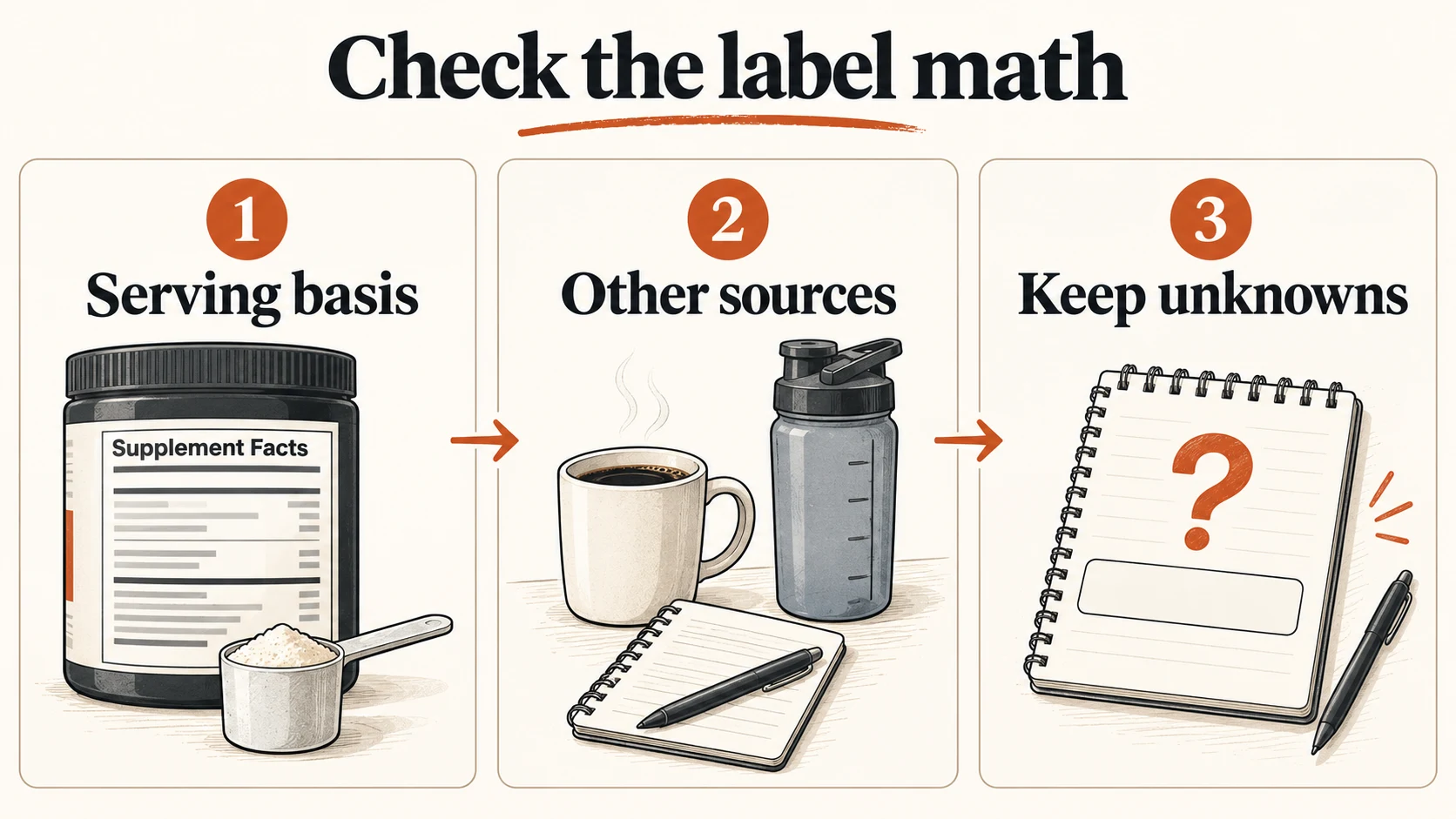
Read these three parts of the label together
1. The exact product and serving basis
Record the full name, flavor or variant, serving-size unit and date you checked it. An online photograph may show an older formula. If the panel states two scoops per serving, the amount printed beside caffeine applies to those two scoops unless the label explicitly says otherwise. A ready-to-drink bottle can also contain more than one labeled serving.
Keep the package directions beside the Supplement Facts panel. An arithmetic conversion does not authorize changing those directions. Scoops and partially mixed powders introduce measurement and mixing uncertainty; this page does not certify that a fraction of a scoop contains a proportional share of every ingredient.
2. The amount you can actually identify
Look for a declared caffeine quantity and its basis. If the only available information is a blend weight, you cannot calculate the caffeine amount from that number. Guarana and other caffeine-containing ingredients may complicate the calculation. Ask whether a declared total already includes all caffeine sources in that formula before adding separate amounts and accidentally counting them twice.
The NIH ODS consumer fact sheet identifies caffeine in drinks, herbs and supplements. An ingredient name alone does not provide a measured caffeine value for the product in your hand.
3. Other products used the same day
List coffee, tea, energy drinks, other supplements and any caffeine-containing medicines. For a medicine, check its label and ask a pharmacist about the whole combination; do not alter prescribed treatment to fit a supplement. Use a declared amount when available. Mark brewed-drink estimates separately, and leave unverified quantities unknown.
What the ingredients can and cannot tell you
The timing printed on a tub can obscure how an ingredient was studied. Taking several ingredients together before exercise does not make them all immediate stimulants.
| Ingredient | Research context | What to check |
|---|---|---|
| Caffeine | Acute exercise-performance studies; findings vary with the task and person. Alertness and perceived effort are different outcomes from muscle growth. | Total declared caffeine, serving basis, other sources, timing and adverse effects. |
| Creatine monohydrate | Repeated supplementation increases muscle creatine stores; research includes repeated high-intensity performance and training adaptations. | Exact form and amount, other creatine products, and whether the claimed result matches a repeated-use study. |
| Beta-alanine | Repeated use increases muscle carnosine. Evidence is most relevant to particular high-intensity tasks; results are not uniform. | Amount and duration studied. Tingling during a single session is not a performance measurement. |
| Citrulline or citrulline malate | Exercise findings are mixed and protocols differ. The two ingredient descriptions are not interchangeable quantities. | Exact form, disclosed amount and the actual exercise endpoint in the cited study. |
| BCAAs and vitamins | A presence on the label does not establish an extra performance benefit when nutritional needs are already met. | What dietary gap or documented outcome is being addressed, and whether other products duplicate it. |
Sources: ISSN caffeine position stand, ISSN creatine position stand, ISSN beta-alanine position stand and NIH ODS ingredient evidence review.
For example, the beta-alanine position stand discusses daily supplementation over at least two to four weeks and benefits concentrated in certain demanding exercise tests. That finding cannot be reduced to “tingling means it works.” Creatine also has a repeated-use context; its inclusion in a pre-workout does not establish that taking the blend immediately before training is essential. Study protocols describe research, not an individualized instruction for you.
Read the endpoint before accepting the headline
A result for repetitions, a timed endurance test, perceived fatigue or lean mass answers a different question. Look for the comparison group and study duration, then ask whether the participants and exercise resemble your situation. A change within a supplement group alone does not establish that the supplement caused it.
A small trial with a specific result
A 2024 randomized basketball study compared a daily multi-ingredient pre-workout with placebo over four weeks in 18 well-trained players. The formula included caffeine, creatine, beta-alanine, citrulline malate and BCAAs. The supplement group improved more on the Yo-Yo intermittent recovery test. The study did not find significant between-group improvements across the other reported performance tests or body-composition measures.
This small, short study concerns that formula and athletic context. It does not prove that every pre-workout builds muscle, identify which ingredient produced the result, or establish long-term safety for older recreational lifters.
Compare labels without inventing a winner
These fictional examples show how transparency changes the questions you can answer. Neither is a purchase recommendation.
| Check | Example A | Example B |
|---|---|---|
| Serving size | Two scoops | One scoop |
| Caffeine statement | 180 mg per serving | “Energy blend” with caffeine listed, amount undisclosed |
| Other ingredient quantities | Individual amounts listed | Only total blend weight listed |
| What can be calculated? | Declared caffeine for a labeled serving; keep actual-use uncertainty separate | Caffeine remains unknown; the blend weight cannot substitute for it |
| What is still unresolved? | Personal suitability, formula efficacy and independent quality verification | Those questions, plus the undisclosed quantities |
More disclosure makes comparison possible. It does not establish efficacy or safety. The FDA does not approve dietary supplements or their labeling before sale. Check any third-party certification in the certifier’s own current directory and match the exact product or batch where relevant. The USADA Supplement Connect resource explains why quality certification reduces some supplement risks without eliminating them. Athletes also need to consider their governing body’s rules.
Worked caffeine examples
A bottle with two servings
Suppose a fictional drink declares 80 mg caffeine per serving and the bottle contains two servings. Consuming the full bottle corresponds to 80 × 2 = 160 mg according to that label. Enter 80 in the helper’s caffeine field and 2 in its servings field. Do not enter 160 and 2, which would count the bottle twice.
A declared source plus an estimate
Add a fictional pre-workout declaring 150 mg per serving, with one serving recorded, and a coffee estimated at 90 mg. The arithmetic is 150 + 90 = 240 mg. Keep the 150 mg label subtotal and 90 mg estimate subtotal distinct. The result is not a laboratory measurement, a recommended intake or confirmation that the combination is suitable.
A missing amount
If another product contains caffeine but its quantity is unknown, the entered subtotal stays 240 mg and the record must also state that one source is unknown. Calling that a complete daily total would hide the missing information. The helper never treats an unknown source as confirmed zero.
Add the entries and keep the uncertainty
The animation uses the fictional 150 mg label entry and 90 mg estimate above. It displays their 240 mg sum, then keeps an unknown source beside it. There is no safe zone or suitability verdict.
All essential arithmetic and limitations are also written above. Manual playback is available with reduced motion.
Caffeine label helper
Enter up to four sources. Choose a declared-label amount, an estimate, an unknown amount or not included. The helper multiplies caffeine per labeled serving by recorded servings. It cannot verify the panel, mixing uniformity or your actual intake.
If a bottle contains two servings, a whole bottle is two in the servings field. Include all recorded use of that source. Keep the same serving basis in both fields. This is arithmetic, not permission to alter product directions.
Technical entry limits: 0 to 2000 mg per serving and 0 to 20 servings, up to two decimals. These prevent input errors; they are not safe intake boundaries. Unknown rows do not contribute a numeric zero. Entries stay in this page’s memory; the helper does not save or send them.
Without the helper, multiply declared caffeine per serving by recorded servings for each source. Add those amounts, keep estimates separate and list unknown sources beside the subtotal. Example: 150 mg × 1 serving plus a 90 mg coffee estimate gives 240 mg in entered amounts, with any unknown source still unresolved.
Arithmetic cannot establish a personal dose or safety. Use the blank fillable PDF below for notes. The helper’s print button prints current valid entries; the PDF does not import them.
Caffeine timing and symptoms need context
The FDA caffeine guidance cites 400 mg a day as an amount generally not associated with negative effects for most adults. This population reference is not a target, a personal allowance or a guarantee below that number. Individual sensitivity, medicines and medical conditions affect the picture. The helper does not compare your entries with a safety threshold.
The ISSN caffeine review describes benefits in many, but not all, exercise studies and highlights individual variation and sleep concerns. A universal “take it 30 minutes before” rule cannot resolve differences in formulation, response, workout time and bedtime. More caffeine does not reliably mean more benefit. A supplement that leaves you awake can create a problem beyond the session itself.
Being over 40 or over 50 does not automatically make a formula suitable or unsuitable. Discuss the exact ingredients with a healthcare professional when you have cardiovascular concerns, sleep or anxiety problems, other health conditions, medicines or a history of reactions. A caffeine-free claim also leaves the other ingredients and their interactions to review.
When to stop and get help
Stop the supplement and exercise if concerning symptoms develop. Chest pain, fainting, severe breathing difficulty or seizures need emergency help: call 911 in the US or your local emergency number. For a suspected overdose or dosing mistake, contact US Poison Control at poison.org or 1-800-222-1222; do not wait for this calculator to assess it. It cannot do so.
New palpitations, persistent sleep disruption or other troublesome effects warrant professional advice before further use. Do not diagnose the cause from timing alone or try to overcome symptoms with another stimulant.
Do not dry-scoop pre-workout powder. Cleveland Clinic’s dietitian guidance explains the choking and stimulant risks. Follow product mixing directions if use has been judged appropriate. Also avoid pure or highly concentrated caffeine products: the FDA warns about their serious overdose risk. An ordinary kitchen scoop, shaker or scale is not a safe way to portion concentrated caffeine.
You can prepare for a workout without a powder
Before shopping, identify the problem: you missed a meal, the workout is late, or you want evidence for a specific performance goal. Those lead to different decisions. Persistent unexplained fatigue deserves attention rather than an escalating stimulant habit. Our caffeine alternatives guide considers the non-caffeine question separately.
Watch: food before exercise
Mayo Clinic wellness dietitian Angie Murad explains ordinary pre-exercise food choices and timing. This short video offers food context; it does not establish supplement efficacy or prescribe a personal caffeine dose. Adjust food choices to your tolerance and any dietary advice you have received.
The hydration supplements guide addresses fluids and electrolytes; the post-workout supplements guide addresses recovery products. A pre-workout label does not replace either assessment, or a workable strength-training routine.
Download a label-comparison record
The one-page PDF has eight fillable fields for the exact product, serving basis, quantities, other sources, unknowns and questions. Fill and save it in a PDF reader that supports forms, then reopen your saved copy to check the entries. The download starts blank; it does not import the helper’s current entries.
Optional tools for mixing and keeping notes
Affiliate disclosure: As an Amazon Associate, we earn from qualifying purchases. These are practical equipment options, not supplement recommendations. Use a bottle or notebook you already own if it serves the task.
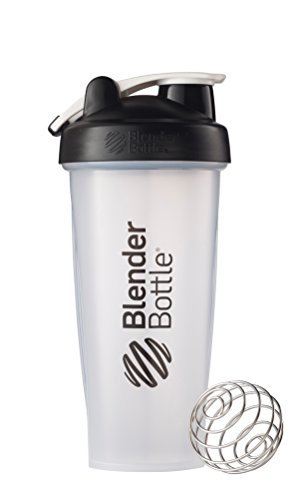
BlenderBottle Classic V1, 28 oz
Useful for mixing a product you have already chosen to use according to its directions. Skip it if your existing bottle mixes and closes properly.
- Catalog variant: 28 oz, clear/black/white.
- Check usable fill space and the product’s mixing instructions.
- The bottle does not measure caffeine or validate a dose.

A paper training journal
The Ultimate Workout Journal is an optional place to keep session notes beside product and caffeine records. Skip it if the free worksheet, an ordinary notebook or your existing log is enough.
- Record the product variant and date checked.
- Keep estimates and unknown amounts visibly marked.
- Notes cannot diagnose a reaction or establish product safety.
Conclusion
Photograph the current panel, write down the serving basis and collect the quantities you can verify. Use the helper to expose the arithmetic and missing entries, then review the actual ingredient evidence and any personal health questions before buying. An undisclosed caffeine amount is a question to resolve, not a number to fill with a guess.
Frequently asked questions
Do I need a pre-workout supplement?
No product is required simply because you exercise. Decide which specific problem you are trying to solve and whether ordinary food, timing or your training routine addresses it. Evidence for an ingredient does not mean everyone needs a blend containing it.
Does 400 mg of caffeine mean my daily total is safe?
No. The FDA reference applies broadly to most adults and cannot determine individual suitability. Medicines, conditions and sensitivity matter. This page’s helper performs arithmetic without issuing a safe-intake verdict.
Does beta-alanine tingling mean the pre-workout is working?
Tingling is a known effect and does not measure exercise improvement. Beta-alanine performance studies involve repeated use and particular exercise tasks. Troublesome or unusual symptoms should not be dismissed as proof a product is effective.
Can I combine a pre-workout with coffee?
First account for both quantities, the serving basis and any uncertainty. That arithmetic cannot decide whether the combination suits you. Ask a pharmacist or clinician about relevant medicines, health conditions or previous effects, and do not use the total as permission to add another source.
Is a caffeine-free pre-workout automatically safer?
It avoids caffeine only if that claim accurately describes the selected product. Other ingredients, amounts and interactions still need review. A stimulant-free label is not evidence that the blend works or is suitable for every person.
Medical disclaimer
This article provides general educational information for adults. It cannot prescribe supplements, diagnose symptoms or determine personal suitability. Consult a qualified healthcare professional about your health, medicines and supplements. Do not change prescribed treatment based on this article or its arithmetic helper.