

If you were lifting weights in the late 2000s, you probably remember the “wild west” era of pre-workout supplements. We were throwing back neon-colored powders loaded with DMAA and enough mystery stimulants to make your teeth vibrate.
You didn’t just feel energized; you felt like you could headbutt a medicine ball through a brick wall—right before the inevitable, soul-crushing crash. Then the FDA stepped in, the formulas changed, and the golden age of borderline-legal energy blends came to a screeching halt.
TL;DR: The Pre-Workout Reality Check
- Caffeine is king, but more isn’t always better: The sweet spot for strength and power output is 3–6 mg per kilogram of body weight. Anything more just spikes anxiety and ruins your sleep.
- Beware of “Fairy Dusting”: If a label says “Proprietary Pump Blend,” put it back. You need specific, clinical doses (like 6-8g of pure L-Citrulline) to see an actual physiological change.
- Acute vs. Chronic Ingredients: Things like caffeine work today. Ingredients like beta-alanine and creatine monohydrate require weeks of daily saturation to work. Sticking them in a pre-workout is a marketing trick.
- The “Tingle” doesn’t mean it’s working: That skin-crawling feeling (paresthesia) from beta-alanine is just a harmless side effect, not an indicator of a great workout.
Today, the landscape is different. The market is flooded with “science-backed” multi-ingredient pre-workout supplements (MIPS). The tubs look sleeker, the labels have more scientific jargon, and every fitness influencer has their own custom flavor.
But here is the hard truth: the vast majority of what sits on the shelves at your local supplement shop is underdosed, overhyped garbage. They are relying on cheap stimulants and “proprietary blends” to give you a buzz while shortchanging you on the actual ingredients that build muscle and improve performance.
As a guy who has spent decades analyzing fitness trends, reading the PubMed data, and mixing my own powders when the commercial stuff fell short, I’m tired of seeing guys waste forty bucks a month on flavored caffeine.
In this guide, we are going to strip away the marketing BS. We’ll break down exactly what your body needs to fight central nervous system (CNS) fatigue, trigger vasodilation, and push through those final, grueling reps. No fluff. Just the clinical dosing thresholds, the biochemistry, and the math you need to know before you ever dry-scoop another powder.
🏃♂️ The Prime Perspective
Years ago, I hit a massive plateau on my deadlift. I thought the answer was a stronger, more aggressive pre-workout. I switched to a brand with 400mg of caffeine per scoop. Within a week, my sleep was wrecked, my resting heart rate was up, and my lifts actually went down.
I was confusing nervous system anxiety with actual muscular readiness. When I finally ditched the mega-dosed stimulants and focused on clinical doses of nitric oxide precursors and proper hydration, my numbers started moving again. The lesson? You can’t out-stimulate poor recovery.
The Anatomy of a Pre-Workout Supplement
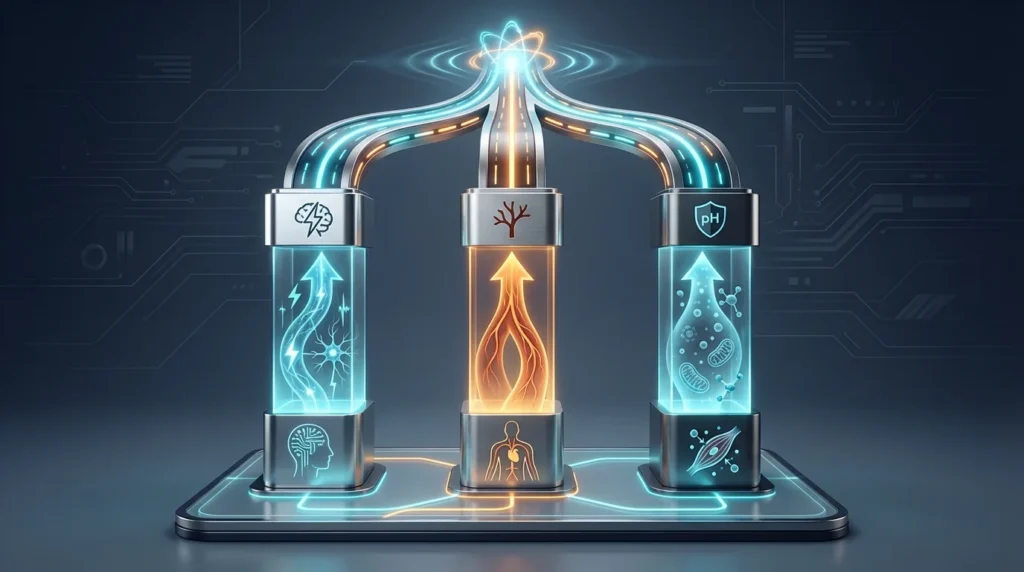
To understand what you’re actually swallowing, you need to understand the anatomy of a multi-ingredient pre-workout supplement. When sports scientists analyze MIPS, they generally categorize the active ingredients into three distinct biochemical pathways:
- The Stimulants & Nootropics: Ingredients designed to wake up your brain, fight CNS fatigue, and increase pain tolerance.
- The Vasodilators (The “Pump”): Ingredients that increase blood flow and nutrient delivery to the working muscles.
- The Buffers & Builders: Ingredients that delay muscular failure or help regenerate energy at the cellular level.
The problem with most commercial formulas is that they completely misunderstand the difference between acute and chronic ergogenic aids.
An acute ingredient does its job within 30 to 60 minutes of ingestion. Caffeine is acute. L-Citrulline is acute.
A chronic ingredient requires weeks of daily, consistent dosing to build up in your system before it provides a performance benefit.
Putting a chronic ingredient into a product you only take 3 or 4 days a week (on training days) is mathematically flawed. Yet, supplement companies do it constantly to make their labels look more impressive.
Let’s break down the heavy hitters in each category.
1. The Stimulants: Waking Up Your Central Nervous System
If we are being completely honest, 80% of the reason you take a pre-workout is for the stimulant kick. You had a long day at the office, your cortisol is high (hello, cortisol belly), your testosterone might be dragging, and you need a spark.
Caffeine: The Undisputed Champion
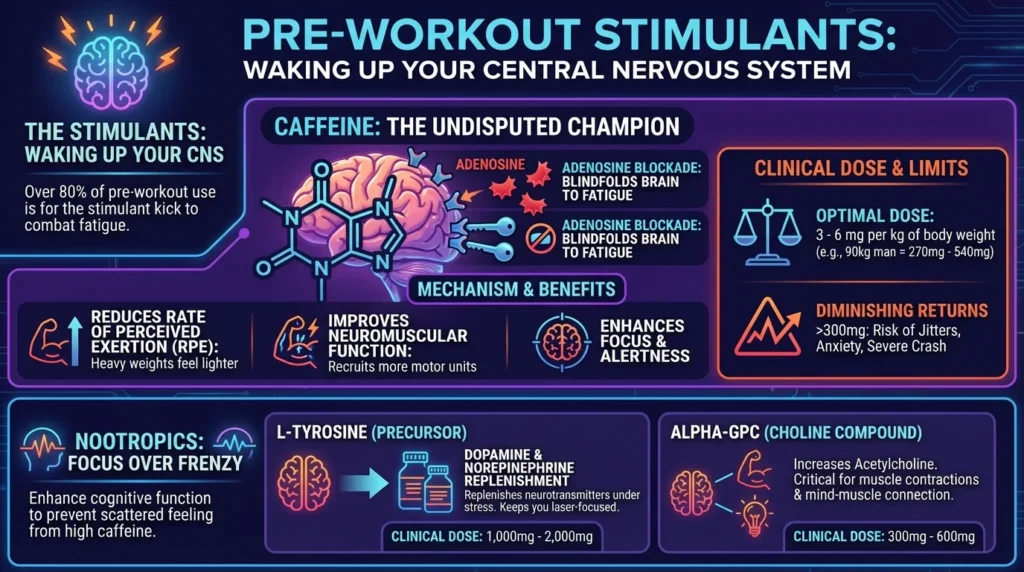
Caffeine is the most widely researched and proven performance-enhancing drug on the planet. Its primary mechanism of action is adenosine receptor antagonism. Throughout the day, a neurotransmitter called adenosine builds up in your brain, binding to receptors and signaling that you are tired.
Caffeine molecule structures are remarkably similar to adenosine. They slide into those receptors, block the adenosine from attaching, and effectively blindfold your brain to the fact that you are fatigued.
But it does more than just wake you up. Caffeine reduces your rate of perceived exertion (RPE). It makes heavy weights feel just a little bit lighter, allowing you to recruit more motor units and improve neuromuscular function.
The Clinical Dose: Research consistently shows that the optimal dose for resistance training is between 3 to 6 mg per kilogram of body weight. For a 200-pound man (90 kg), that is roughly 270mg to 540mg of caffeine.
However, most guys hit a point of diminishing returns around the 300mg mark. Anything above that often leads to jitters, anxiety, and a severe crash that requires heavy importance of rest and recovery protocols to fix.
Nootropics: Focus Over Frenzy
Because massive doses of caffeine can leave you feeling scattered, high-end pre-workouts have started incorporating nootropics—compounds that enhance cognitive function and focus.
- L-Tyrosine: An amino acid that serves as a precursor to dopamine and norepinephrine. Under heavy physical stress, your brain depletes these neurotransmitters rapidly. Supplementing with L-Tyrosine (clinical dose: 1,000mg – 2,000mg) helps replenish them, keeping you laser-focused during intense sets.
- Alpha-GPC: A choline compound that increases the production of acetylcholine, a neurotransmitter critical for muscle contractions and mind-muscle connection. Clinical dose sits around 300mg – 600mg.
2. The Vasodilators: Chasing the “Pump”
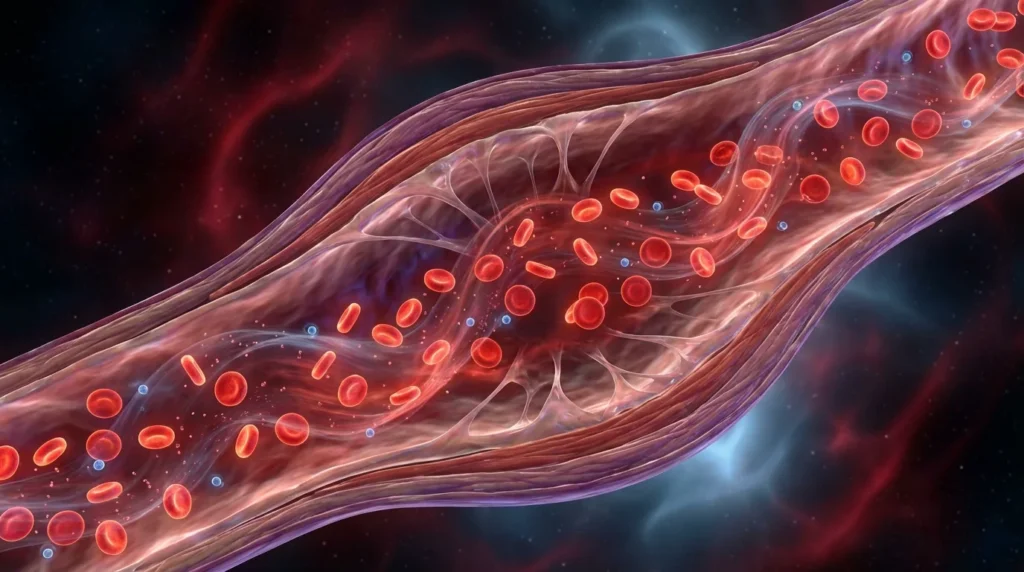
Arnold Schwarzenegger famously compared the “pump” to a religious experience. While he was being dramatic, there is a legitimate physiological benefit to exercise-induced hyperemia (the scientific term for the pump). Pushing more blood into the muscle belly delivers more oxygen, more nutrients, and helps clear out metabolic waste products quicker.
To achieve this, pre-workouts use nitric oxide precursors. Nitric oxide (NO) is a signaling molecule that tells your blood vessels to relax and widen (vasodilation).
L-Citrulline vs. L-Arginine: The Great Deception
For years, supplement companies packed their pre-workouts with L-Arginine, claiming it would boost nitric oxide. It made sense on paper; L-Arginine is the amino acid your body uses to produce NO.
There was just one massive problem: L-Arginine has terrible oral bioavailability. When you swallow it, your liver and intestines break down the vast majority of it before it ever reaches your bloodstream. You were essentially paying for expensive urine.
Enter L-Citrulline. L-Citrulline bypasses the liver, enters the kidneys, and is then smoothly converted into L-Arginine inside the body. Studies show that supplementing with L-Citrulline actually raises blood Arginine levels significantly higher than taking L-Arginine itself.
💡 What Most Guys Miss: The Malate Ratio
You will often see “Citrulline Malate 2:1” on a label. Malate (malic acid) is added to citrulline to help with energy production. But here is the catch: if a product has 6 grams of Citrulline Malate at a 2:1 ratio, you are only getting 4 grams of actual L-Citrulline and 2 grams of malic acid. The clinical dosing threshold for pure L-Citrulline is 6 to 8 grams. If your pre-workout uses Citrulline Malate, you need 9 to 12 grams total to hit the clinical threshold for a massive pump. Most brands severely underdose this to save money.
3. The Buffers & Builders: Chronic Ingredients Hiding in Plain Sight
This is where the supplement industry plays its sneakiest tricks. They include ingredients that are incredibly effective, but they put them in a pre-workout format where they simply cannot do their job optimally.
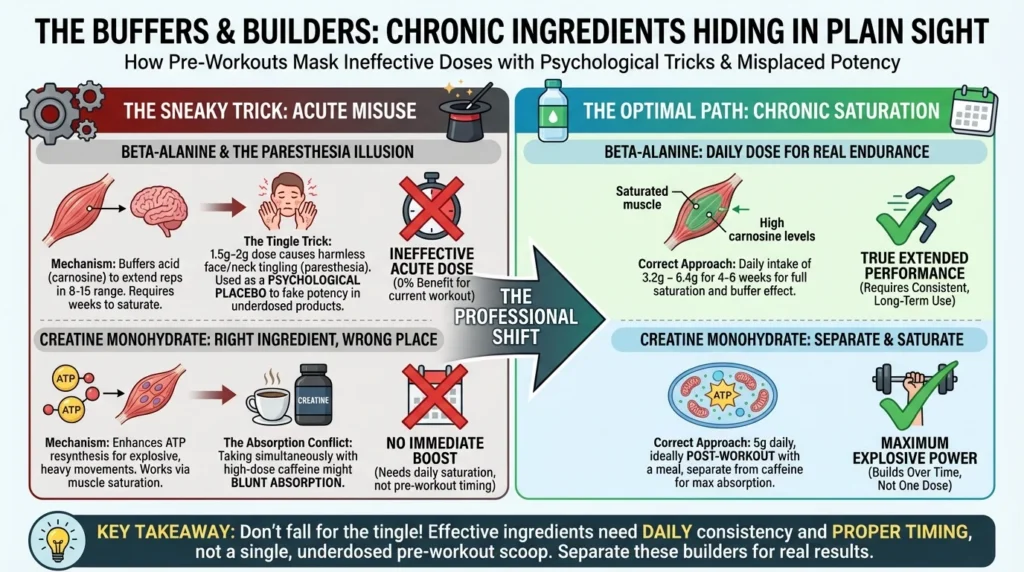
Beta-Alanine and the Paresthesia Illusion
Beta-alanine is an amino acid that bonds with histidine in your muscles to create carnosine. Carnosine acts as a buffer against blood lactate accumulation.
When you lift in higher rep ranges (8-15 reps), your muscles produce hydrogen ions, lowering your pH level and causing that intense burning sensation that eventually forces you to drop the weight. High carnosine levels buffer that acid, allowing you to grind out an extra rep or two.
So why is it a problem in pre-workouts?
- It takes time: Muscle carnosine saturation requires a daily intake of 3.2g to 6.4g for roughly 4 to 6 weeks. Taking it right before you lift does absolutely nothing for that specific workout.
- The Tingle Trick: A harmless side effect of beta-alanine is paresthesia—a tingling or itching sensation on your face, neck, and hands. Supplement companies put just enough beta-alanine in their pre-workouts (usually 1.5g – 2g) to trigger the tingle. Why? Because when you feel your face tingling, you think, “Wow, this stuff is really kicking in!” It is a psychological placebo effect used to mask an underdosed product.
Creatine Monohydrate: Right Ingredient, Wrong Place
We’ve covered the immense benefits of this compound in our dedicated creatine guide. Creatine enhances adenosine triphosphate (ATP) resynthesis, giving your muscles the raw cellular energy needed for explosive, heavy movements.
However, just like beta-alanine, creatine is a chronic supplement. It works via muscle saturation. Taking 3 grams of creatine in your pre-workout on a Tuesday will not help your bench press on that Tuesday.
Furthermore, some studies suggest that taking creatine simultaneously with high doses of caffeine might slightly blunt the absorption of the creatine. You are much better off taking your 5g of creatine separately, ideally post-workout with a meal.
Deep Dive Tables: The PrimeForMen Data Matrices
To make this simple, we’ve compiled the clinical data into two comprehensive tables. Bookmark these and use them the next time you are standing in the supplement aisle.
Table 1: The Clinical Dose Checklist
If your pre-workout doesn’t hit these numbers, you are paying for flavored water.
| Ingredient | Primary Target & Benefit | Mechanism of Action | Clinical Dose (Minimum) | The Common Pitfall |
| L-Citrulline | Vasodilation (The Pump) | Boosts Nitric Oxide levels, relaxing blood vessels. | 6,000mg – 8,000mg | Hidden in proprietary blends at 2g; or confused with Citrulline Malate. |
| Caffeine Anhydrous | CNS Stimulation | Adenosine receptor antagonism; blunts fatigue perception. | 200mg – 400mg | Overdosed (400mg+) causing anxiety, vasoconstriction, and crash. |
| L-Tyrosine | Cognitive Focus | Precursor to dopamine; prevents neurotransmitter depletion. | 1,000mg – 2,000mg | Severely underdosed (often 250mg) to save manufacturing costs. |
| Alpha-GPC | Neuromuscular Function | Increases acetylcholine for harder muscle contractions. | 300mg – 600mg | Uses cheap Choline Bitartrate instead of highly bioavailable Alpha-GPC. |
| Betaine Anhydrous | Cellular Hydration | Osmolyte that draws water into muscle cells for power. | 2,500mg | Tastes incredibly bitter, so manufacturers reduce the dose to improve flavor. |
Table 2: The Pre-Workout Myth vs. Reality Matrix
| The Claim | The Origin of the Myth | What the Data Actually Says | Practical Adjustment |
| “Our Proprietary Blend is optimal.” | Brands hiding their formulas to “protect trade secrets.” | It is a legal loophole used to hide the fact that expensive ingredients are underdosed (“fairy dusting”). | Never buy proprietary blends. If they don’t list exact milligrams, do not give them your money. |
| “Beta-Alanine tingles mean it’s working.” | The immediate paresthesia effect felt after ingestion. | Paresthesia is just a harmless nervous system reaction. Beta-alanine requires 4 weeks of daily use to work. | Buy bulk beta-alanine and take 3.2g every single day, regardless of training schedule. |
| “More caffeine equals more strength.” | The more wired you feel, the stronger you must be. | Caffeine follows a bell curve. Past 400mg, vasoconstriction occurs (ruining your pump), and cortisol spikes. | Stick to the 3-6mg/kg rule. If you feel exhausted, look at testosterone boosters or sleep quality, not more caffeine. |
| “You need creatine in your pre-workout.” | Creatine provides energy, so take it before you lift. | Creatine works through cellular saturation over time. Acute timing is largely irrelevant. | Buy plain creatine monohydrate and take 5g daily with a carbohydrate source for better absorption. |
How to Build Your Own (Or Buy the Right One)
You have two options if you want to apply the concept of progressive overload efficiently without wasting money on bad supplements.
Option 1: The Mad Scientist Method (DIY)
Buy the ingredients in bulk. It is infinitely cheaper in the long run.
- The Recipe: 8g pure L-Citrulline, 2g L-Tyrosine, a 200mg caffeine pill, and a pinch of pink Himalayan salt for hydration and cell volumization. Mix the powders in water with a sugar-free flavor packet. You now have a clinically dosed, world-class pre-workout for about $0.60 per serving.
Option 2: Buy a Transparent Label
If you value convenience, you need to buy a product from a brand that believes in full transparency. Look for labels that list every single ingredient with its exact milligram count. If it says “Pump Matrix: 5g” and lists four different ingredients underneath it, run away.
✅ Your 24-Hour Action Plan
- Step 1: Go to your pantry right now and look at your pre-workout label. If you see the words “Proprietary Blend” or “Matrix,” prepare to throw it out when it’s empty.
- Step 2: Check the L-Citrulline content. If it is under 6 grams, add a 1/2 teaspoon of pink Himalayan salt to your shaker tomorrow to artificially boost your blood volume and salvage the pump.
- Step 3: Separate your chronic supplements. Buy standalone creatine monohydrate and beta-alanine, and start taking them daily regardless of whether you are lifting that day.
Conclusion: Stop Paying for Tingles and Start Training
The fitness industry thrives on making things seem more complicated than they are. They want you to believe that the secret to a 400-pound squat or a sub-10-percent body fat is locked away in a $50 tub of glowing blue powder.
It isn’t.
A pre-workout is a tool. When formulated correctly with clinical doses of nitric oxide precursors, sensible levels of adenosine receptor antagonists, and quality nootropics, it can absolutely help you squeeze an extra 5% of effort out of your central nervous system. You can’t out-supplement a bad routine.
Demand transparency. Do the math on the dosages. And remember that no powder in the world can do the heavy lifting for you.
Frequently Asked Questions About Pre-Workout Supplements
Should I take Pre-Workout Supplements on my rest days?
No. MIPS are designed to provide acute benefits (energy, focus, vasodilation) specifically for the demands of resistance training. Taking massive doses of caffeine on a rest day will only elevate your cortisol and disrupt your recovery cycle. However, chronic ingredients often found in them (like creatine) should be taken daily.
Do Pre-Workout Supplements cause erectile dysfunction?
Directly, no. In fact, clinical doses of L-Citrulline are often used as natural treatments for mild ED because they promote vasodilation. However, severe abuse of heavy stimulants (caffeine/DMAA analogues) can cause intense vasoconstriction and elevate stress hormones, which can temporarily negatively affect libido and blood flow.
Why does my pre-workout get hard and clumpy?
Many effective ingredients, particularly L-Citrulline and certain pump agents, are highly hygroscopic—meaning they pull moisture out of the air. If you live in a humid environment or leave the lid off, the powder will absorb water and clump. It is perfectly safe to break apart and consume, though it is annoying. Keep the silica packet inside the tub.
Is it safe to “dry scoop” Pre-Workout Supplements?
Absolutely not. Dry scooping (dumping the powder directly into your mouth without water) poses a massive choking hazard and can cause accidental inhalation into the lungs. Furthermore, the massive, instantaneous hit of undiluted caffeine to your system can cause dangerous spikes in blood pressure and heart arrhythmias. Mix it with 8-12 ounces of water as intended.
How long does it take for a pre-workout to kick in?
Peak blood concentration for caffeine and L-Citrulline usually occurs between 30 to 45 minutes after ingestion. If you drink your pre-workout in the locker room right before your first set, you are wasting the peak effects during your warm-up. Drink it on the drive to the gym.
Disclaimer: The information provided in this article is for educational purposes only and is not intended as a substitute for advice from your physician or other health care professional.
Visual Asset Prompts
1. Featured Image
Prompt: A hyper-realistic, professional editorial photograph, 16:9 ratio. A muscular man’s hand tightly gripping a matte black shaker bottle in a dimly lit, gritty, industrial-style gym. Chalk dust floats in the dramatic rim lighting. To the side, a spilled scoop of white supplement powder on a heavy rubber gym mat. High contrast, masculine aesthetic, moody lighting, no text overlays, 8k resolution.
2. Infographic 1: The Macro Overview (Big Picture)
Prompt: A clean, modern conceptual visualization, 16:9 ratio. A sleek, metallic three-pillar infographic design representing the three pathways of a pre-workout: “CNS Stimulation,” “Vasodilation,” and “Cellular Buffering.” Dark navy blue and slate grey background with glowing amber and cyan accents showing energy flow. Minimalist, highly professional, scientific aesthetic, no text overlays.
3. Infographic 2: The Micro Breakdown (Section Specific)
Prompt: A highly detailed 3D scientific rendering, 16:9 ratio. Zoomed-in microscopic view of a blood vessel expanding (vasodilation) surrounded by glowing red blood cells and muscular fibers. Subtle visual cues indicating increased blood flow and oxygen delivery. Dark background with vibrant crimson, deep red, and soft blue lighting. Medical-grade 3D rendering, incredibly detailed, no text overlays.
4. Infographic 3: The Action Matrix (Section Specific)
Prompt: A visual matrix and flowchart design, 16:9 ratio. A side-by-side comparative graphic showing two distinct supplement pathways: one glowing red representing “Acute Response” (lightning bolts, immediate energy) and one glowing blue representing “Chronic Saturation” (a battery slowly charging over time). Arranged in a sleek, dark-mode dashboard style with neon highlights. Masculine, high-tech fitness aesthetic, no text overlays.