

Compare multivitamins for men by diet gaps, full servings, duplicate nutrients, trial findings and medication questions before buying.
- Age alone does not establish a nutrient deficiency or need for a multi.
- Full servings and overlapping nutrients change the label comparison.
- Symptoms, medication and absorption questions need individual review.
Bottom line Bring current labels and a clear dietary or clinical question to the review, then choose a format only if it fits the agreed need.

Multivitamins for men can help cover nutrients missing from a person’s diet, but being male or turning 50 does not automatically create a need for a daily multi. The useful question is which gap the product addresses, how its full serving fits alongside food and other supplements, and whether medications or a medical condition change the decision.
Read the back panel before the promises on the front. A basic formula, a smaller tablet, a gummy and a high-potency pack can have very different ingredients and serving sizes. None should be chosen from a fatigue symptom alone.
Quick Summary: Multivitamins for men
- Identify a dietary or clinician-assessed need before adding a multi. There is no single standard multivitamin formula.
- Read nutrient amounts per complete serving. Two smaller tablets may be one serving, not two days’ supply.
- Add overlapping nutrients from other products using matching units and forms. A percentage Daily Value is not a personal deficiency test or an upper limit.
- Disease-prevention and memory findings have different outcomes and populations. They do not establish a universal health or testosterone benefit.
- Review medication, absorption and laboratory-test questions with a clinician or pharmacist before changing a supplement plan.
The Prime Perspective
A multi earns its place when you can explain what it adds and what it overlaps with. We look for a readable formula and a serving that is practical to use. If the concern is persistent tiredness, a restricted diet, digestive disease or an abnormal test, a bottle comparison is only part of the work.
We have not independently tested the recommended products. Manufacturer labels establish the listed specifications; clinical trials address particular research questions. Our editorial policy explains that distinction.
Who might have a useful reason to consider a multivitamin?
A person who regularly avoids whole food groups, has limited appetite or struggles to obtain varied meals may have nutrients to review. Someone with a diagnosed deficiency or an absorption problem needs a plan tailored to that problem. The NIH Office of Dietary Supplements notes that formulas vary widely and can both increase nutrient intake and create excessive intake when combined with other products.
Write the actual dietary pattern down. “I want more energy” is a goal; “I do not eat animal foods or use B12-fortified alternatives” is information a dietitian can assess. “I am over 50” gives age context; “my clinician identified an absorption issue” gives a specific reason to discuss formulation and monitoring.
| Situation | Useful first step | What a multi cannot establish |
|---|---|---|
| Varied meals and no identified gap | Review the purpose before buying; keep the food routine that works. | That more vitamins will add energy, strength or disease protection. |
| Limited food variety or access | Describe what is missing and what affordable foods or fortified options you can use. | That it replaces calories, protein, fiber and all other parts of a meal. |
| Vegan diet | Check a reliable B12 source and the wider diet with qualified guidance. | That every vegan-labeled product supplies an appropriate amount of every relevant nutrient. |
| Diagnosed deficiency or malabsorption | Follow the clinician’s nutrient-specific plan and review date. | That a general formula provides the treatment amount, route or monitoring you need. |
| Persistent symptoms | Discuss the symptoms and medication history before guessing the cause. | A diagnosis of vitamin deficiency, low testosterone or another condition. |
Our vegan supplement guide helps frame diet-specific questions. For ordinary meal planning, start with the nutrition and supplements guide.
What trials say about prevention, memory and longevity
It is possible for a trial to find a benefit in one outcome without demonstrating a benefit in another. Keep the study population, formula and endpoint beside the headline. A nutrient’s normal biological role also does not establish that supplementing it improves that function when intake is already sufficient.
| Evidence | What was studied | What the result means here |
|---|---|---|
| USPSTF recommendation, 2022 | Vitamin/mineral supplementation to prevent cardiovascular disease or cancer in community-dwelling, nonpregnant adults. | Evidence was insufficient to determine the benefit-harm balance of multivitamins for those purposes. The recommendation does not address treatment of known deficiency. It recommends against beta-carotene or vitamin E supplementation for this prevention purpose. |
| Physicians’ Health Study II | 14,641 male physicians aged at least 50, randomized to a daily multivitamin or placebo; median follow-up 11.2 years. | Total cancer incidence, excluding nonmelanoma skin cancer, was modestly lower in the multivitamin group; cancer mortality was not significantly reduced. A result in this population and formulation does not rank today’s retail men’s formulas. |
| COSMOS cognitive research, 2024 | A clinic substudy with 573 baseline participants, plus a meta-analysis of three nonoverlapping cognitive substudies in older adults. | The clinic study found a favorable change in episodic memory over two years; the pooled studies found modest benefits in global cognition and episodic memory. These test results do not prove that every multi prevents dementia or benefits all ages. |
| NCI-led cohort analysis, 2024 | Regular multivitamin use in 390,124 generally healthy US adults followed for more than 20 years. | Use was not associated with a lower risk of death. This observational analysis cannot prove that the supplements caused harm or that treating a deficiency has no value. |
A memory finding does not promise a longer life, and an inconclusive prevention recommendation does not rule out correcting a specific nutrient gap. None of these sources provides a personal nutrient assessment from your age or a web checklist.
Nutrients worth checking after 50
Vitamin B12: intake and absorption are separate questions
Older adults can have difficulty absorbing food-bound B12. Vegan diets, some gastrointestinal conditions and certain medications also belong in a B12 review. The NIH B12 fact sheet describes these contexts. A multi’s B12 line does not determine whether your symptoms need testing or whether a diagnosed deficiency requires a different treatment.
Bring information about fortified foods, dietary restrictions and current medicines to the appointment. Do not infer that a high percentage Daily Value means the rest of the formula is unnecessary or harmful; percentage alone does not describe absorption or treatment needs.
Iron: include it for a reason
Men’s 50+ formulas often omit iron, but “men never need iron” is also too broad. A confirmed need should be assessed along with its cause. Do not treat persistent fatigue by adding iron without advice. People with iron overload or hereditary hemochromatosis need specific precautions; the NIH iron overview describes both excess-intake concerns and interactions.
Vitamin D and zinc: count the whole routine
A multi can duplicate vitamin D or zinc in a separate product. For adults, the US tolerable upper intake levels are 100 mcg (4,000 IU) daily for vitamin D and 40 mg daily for zinc, counting food, drinks and supplements. These are upper limits for generally healthy people, not targets or proof that a lower intake suits you; clinician-directed treatment can differ. See the vitamin D and zinc fact sheets.
Our vitamin D and testosterone guide separates treatment of a nutrient problem from hormone claims. A men’s multi should not be bought as a testosterone treatment because its ingredients appear in hormone marketing.
Read the serving and check duplicate nutrients
Count tablets per serving before counting days
A 280-tablet bottle with a two-tablet serving contains 140 servings. A 200-tablet bottle with a one-tablet serving contains 200. Smaller tablets may be useful if a large tablet is inconvenient, but tablet count alone cannot compare duration or value.
Use the current package, including any directions that differ from the panel’s serving basis. Do not break, crush or split a tablet unless the manufacturer or pharmacist says that is appropriate. Difficulty swallowing itself may need assessment; a mini tablet is not a treatment for it.
Review the whole routine
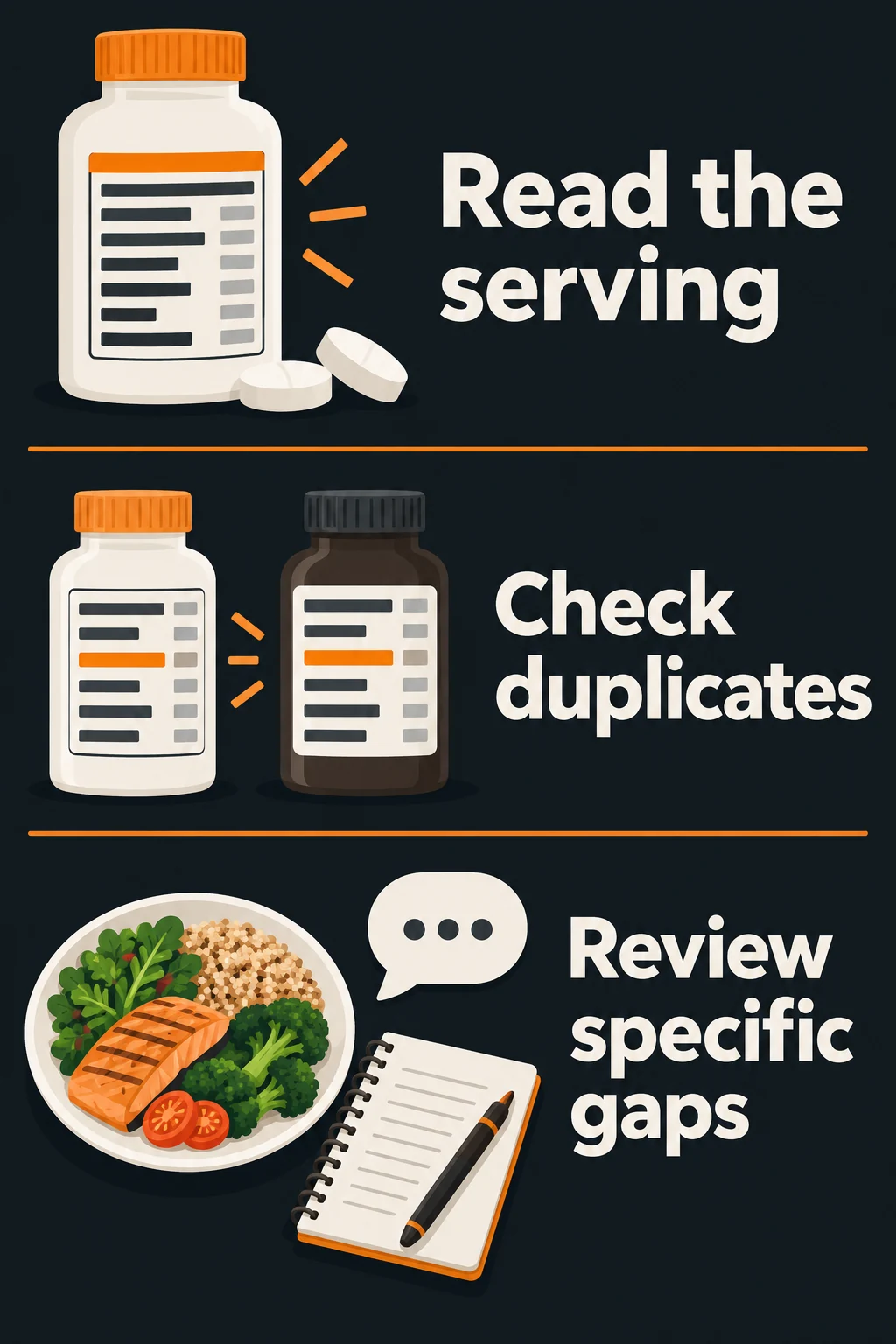
Read quantities per full serving, list overlapping nutrients from other products, and bring unresolved diet, medication or absorption questions to a qualified professional. This is a review sequence, not a deficiency assessment.
Silent, 8.5 seconds. Open the animation directly. Playback pauses offscreen; reduced-motion preferences keep playback manual. Essential explanations remain in readable text.
Add like units, keeping the source visible
For an illustrative daily routine, a multi with 25 mcg vitamin D and a separate product with 50 mcg supplies 75 mcg from those two products. Because 1 mcg vitamin D equals 40 IU, that total is 3,000 IU. The calculation does not include food, prove need or provide safety clearance.
A fictional multi with 15 mg zinc plus a separate 30 mg zinc product supplies 45 mg from supplements alone. That exceeds the US adult upper limit before food is counted, so the combination deserves review rather than an automatic refill. Do not alter clinician-prescribed treatment based only on this example.
| Label detail | What to record | Common comparison error |
|---|---|---|
| Serving size | Tablets, capsules or gummies in a full serving | Comparing one tablet with another product’s two-tablet nutrient amount. |
| Amount and unit | The actual amount, such as mg, mcg or vitamin D IU | Adding a milligram number to a microgram number without conversion. |
| Nutrient form | The named form and any conversion already shown on the label | Treating folate DFE, folic acid, vitamin A forms or vitamin E IU as universally interchangeable. |
| Other products | Separately supplied nutrients, fortified drinks and blends | Looking only at the multi while a second product supplies the same nutrient. |
| Percentage Daily Value | Its contribution to the label reference value | Using 100% as a personal diagnosis, an upper limit or a reason to add more. |
If forms or units differ and you cannot reliably compare them, leave the total unresolved and ask a pharmacist or dietitian. Keep a photograph of both panels. An accurate question is more useful than a guessed total.
Medication, symptoms and blood-test review
Vitamin K can affect warfarin management, while minerals such as iron can interfere with absorption of some medicines, including levothyroxine. Do not stop prescribed medication or invent a spacing schedule. Ask the pharmacist about the exact product and drug; a rule for one combination may not apply to another.
Tell the healthcare team and laboratory about all supplements before testing. The FDA warns that biotin can interfere with some laboratory assays, including certain troponin tests. Not every assay is affected. Follow the testing team’s instructions instead of applying a universal stop period from a blog.
Bring the bottles
Include the multi, separate vitamins, powders, gummies and herbal blends. List how much you actually use, not just the manufacturer’s suggested serving.
Explain the concern
Write down persistent symptoms, diet changes, absorption diagnoses and medication changes. A questionnaire cannot determine their cause.
Keep the agreed plan
Record whether a product is needed, which amount and schedule were agreed, any testing instructions and when the decision should be reviewed.
The FDA’s medication and supplement guidance recommends discussing the full routine with your healthcare team. A supplement’s availability does not establish that it is compatible with every medicine or condition.
Make a label and appointment record
Check the label and the whole routine
Choose the reason for considering a multi and what you know about other products. The result identifies a review task. It does not diagnose deficiency, total every nutrient, select a dose or clear a product for use.
Read quantities per full serving. List repeated nutrients from all products using matching units and forms, and leave uncertain totals unresolved. Symptoms, medication, absorption and testing questions need individual guidance. Use the written examples and review sheet.
Keep your review with you
The eight-field review sheet keeps serving sizes, duplicate nutrients and appointment questions together. Fill and save it with your label photos, or print a copy for a refill or healthcare discussion.
Download my multivitamin and nutrient review (fillable PDF). The helper print button creates a separate record with your current choices, notes and checkmarks.
Use the record when buying a refill or changing format. A new version of the same brand can change nutrient quantities, tablet count or ingredients. Recheck the label instead of transferring an old calculation to the new bottle.
Watch: what nutrient-dense foods provide
Mayo Clinic: what nutrient-dense foods provide
Mayo Clinic dietitian Kate Zeratsky explains nutrient density and why portions still matter for foods such as fish, nuts and seeds. This clip gives food context for the supplement decision. It does not recommend a multivitamin formula or prove a memory, disease-prevention or testosterone effect.
Watch the original video on YouTube if the embed does not play.
Optional standard and smaller-tablet choices
These two formats offer different tablet sizes for men over 50. Compare the complete current panel with your diet and existing supplements before choosing either; they are alternatives to each other. We have not independently tested either formula or verified a specific batch, and these current retail versions are not shown to reproduce a trial result. The worksheet is useful even if you decide against buying a supplement.
* As an Amazon Associate, PrimeForMen earns from qualifying purchases. Check the exact selected product, current label and suitability before ordering.
Best for: Men over 50 comparing a standard once-daily format against a specific diet or clinician-reviewed need. Skip if a broad multi adds no useful gap coverage, tablet swallowing is difficult or individual suitability questions remain unresolved. Current Amazon listing: Centrum Silver Men's 50+ Multivitamin with Vitamin D3, B-Vitamins, Zinc for Memory and Cognition - 200 Tablets Best for: Men over 50 who prefer smaller tablets and can manage the complete labeled serving. Skip if two tablets are inconvenient or if swallowing problems need assessment. Smaller tablets do not remove interaction or nutrient-overlap questions. Current Amazon listing: Centrum Minis Silver Men's Multivitamin for Men 50 and Over, 280 Tablets * As an Amazon Associate, PrimeForMen earns from qualifying purchases.Recommended Products

Centrum Silver Men's 50+: standard-tablet format
View on Amazon

Centrum Minis Silver Men: smaller-tablet format
View on Amazon
What to do before the next refill
- Photograph every nutrient panel you use, including fortified shakes and separate products.
- Mark the full serving and the amount you actually take. Keep daily use separate from occasional use.
- List repeated nutrients. Add comparable quantities, and flag units or forms you cannot reconcile.
- Write the dietary gap or clinician-assessed reason. If the only reason is a persistent symptom, arrange an appropriate assessment.
- Ask whether food changes or a targeted product would fit better than a broad formula. Record the review date and keep the original labels.
For example, a man who already uses several separate nutrients may have more to review before adding a multi than someone who uses none. A man following a restricted diet may need a specific nutrient plan that a generic multi does not supply. Their supplement questions differ even if both men are 55.
Conclusion
Choose multivitamins for men around a specific diet or clinical question, a readable full-serving label and an inventory of overlapping nutrients. Check medication and test instructions before changing the routine. A smaller tablet can improve practicality; a larger dose does not establish a larger benefit.
Continue with our supplement selection guide for men over 50 or the nutrition and supplements category. If your unresolved question is about fish or algae oil, the omega-3 label guide uses a separate EPA+DHA comparison.
Frequently asked questions
Should every man over 50 take a multivitamin?
No. Age gives context but does not establish a deficiency or select a formula. Review dietary variety, existing products and any clinical reason before adding one.
Should a men’s multivitamin contain iron?
Choose supplemental iron for an assessed reason. Many men’s 50+ formulas omit it, but some men have a confirmed need. Fatigue alone cannot establish that need or its cause.
Are gummies and smaller tablets equivalent to standard tablets?
Check the complete panel and serving. Gummies may omit some minerals or add sugar, and two minis may be one serving. A convenient format does not establish identical nutrients or clinical effects.
Can a multivitamin boost testosterone or cure fatigue?
Do not use it as a hormone treatment or assume a symptom means deficiency. Correcting an identified nutrient problem and treating persistent symptoms require the appropriate assessment.
Does 100% Daily Value mean the amount is right for me?
It describes a label reference, not your measured intake, deficiency status or upper limit. Consider food and other supplements, and ask for help when forms, units or medical context complicate the comparison.
Medical disclaimer: This article and its helper provide educational label-reading support. They do not diagnose deficiency, determine a personal dose or clear a product for use. Discuss symptoms, medicines, absorption problems and testing instructions with an appropriate healthcare professional. Do not alter prescribed treatment from an example calculation.
Affiliate disclosure: Product links can earn PrimeForMen a commission at no extra cost to you. Selection reflects the stated format and comparison task, not a guarantee of safety, effectiveness or disease prevention.