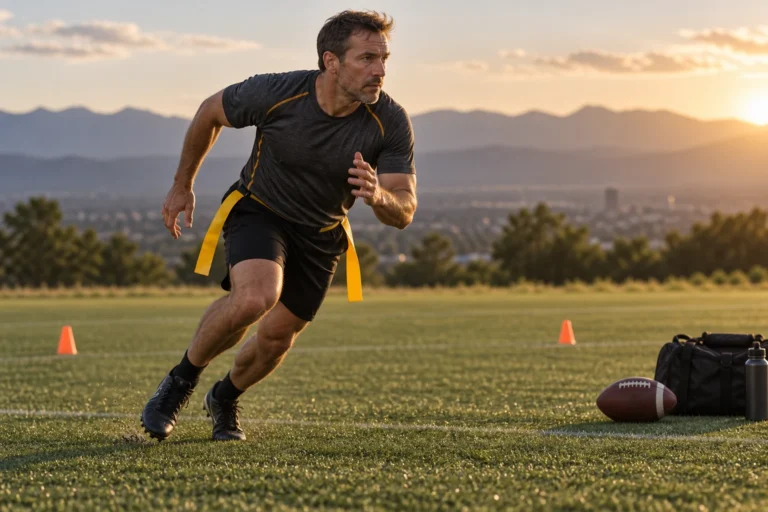
Build an American football training week with two strength sessions, gradual speed work and practical recovery adjustments.
- Combine strength, speed, skill and recovery.
- Start with manageable work and progress one variable.
- Adapt gym sessions around practices and games.
Bottom line Choose two recoverable gym days before adding extra sprints or conditioning.
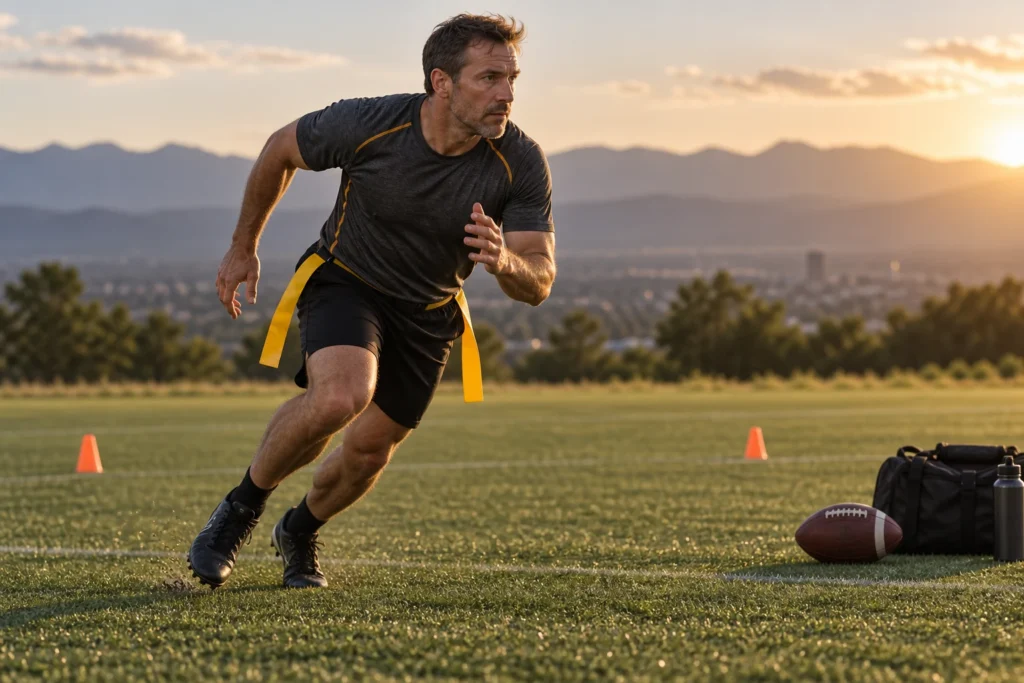
Football-specific workouts combine general strength, acceleration, controlled changes of direction and enough conditioning to repeat efforts. This guide concerns American football, including adult recreational flag football. It offers an adaptable two-day gym framework, not a college tackle-football program or permission to train through injury.
The Prime Perspective
A useful session has a purpose you can explain: improve a movement, build strength or practice a specific skill. It does not need to look like a tackle to support football. Equally, muscle-building work is not automatically slow or “non-functional.” Exercise choice, training volume, sprint practice and recovery all affect what a player can do.
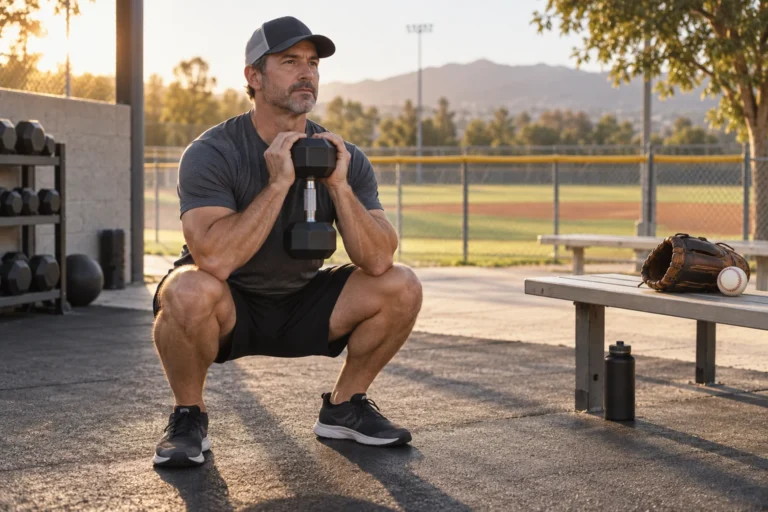
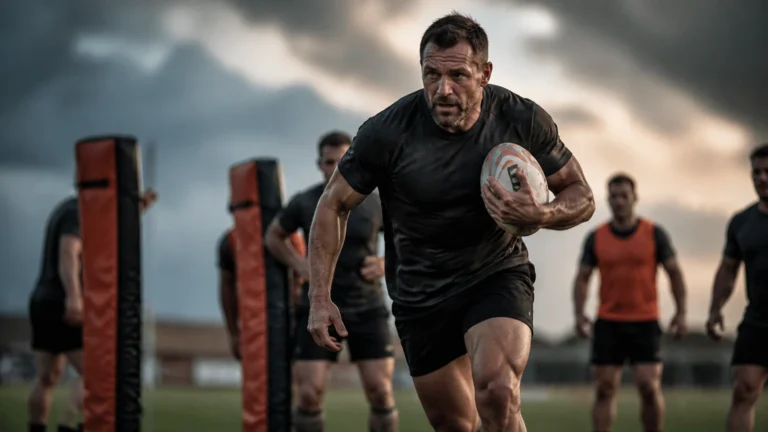
The examples below are editorial training templates, not an individually assessed or independently tested training program. The pictures are AI-generated illustrations. For the broader approach, see sport-specific training for men.
Choose the Right Starting Version
On a small screen, swipe the table sideways to read every column.
| Player | Starting emphasis | What needs individual coaching |
|---|---|---|
| Adult flag football player with lifting experience | Two strength days and short planned acceleration practice. | Sprint mechanics, cutting and workload around games. |
| Returning player or new lifter | Basic lifts, comfortable aerobic work and gradual running exposure. | Readiness for faster running or impact; do not start with maximal sprints. |
| Experienced tackle-football player | Coordinate this framework with the team plan. | Contact preparation, positional demands and practice/game workload. |
| Youth player or athlete returning from injury | Use a supervised age-appropriate or rehabilitation plan. | This article is not the relevant stand-alone prescription. |
If you are over 50, do not use age as a reason to avoid all strength work or as permission to copy a younger athlete’s sprint volume. Start from what you have recently tolerated. Our fitness guide for men over 50 offers a more general starting point for someone returning to regular exercise.
Sudden increases in unfamiliar exercise can be a serious problem. The NSCA inter-association recommendations on conditioning safety emphasize the dangers of excessive or abruptly introduced conditioning. Do not use an exhausting test session to prove you are ready to train.
A Week You Can Actually Organize
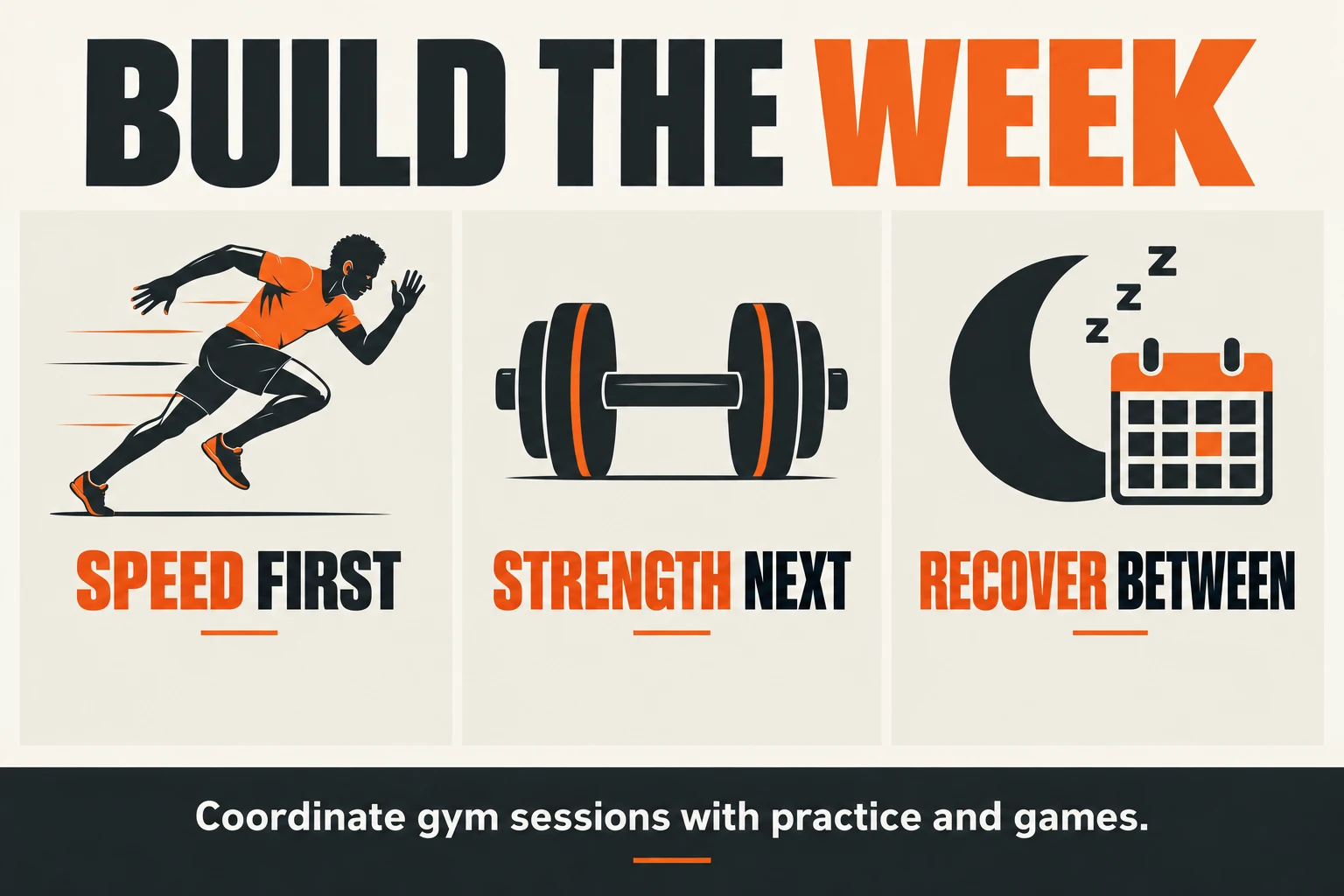
For an off-season recreational player without several team practices, try Monday acceleration plus Workout A, Thursday controlled direction-change practice plus Workout B, and an optional easy aerobic session on another day. Leave room for skill practice. If a weekend game or demanding practice is added, adjust the gym plan rather than stacking every session unchanged.
In season, fewer sets may be appropriate while familiar strength exercises remain. There is no single correct weekly split for a lineman, a receiver and a flag-football player. Ask which session matters most that week, then reduce less important work if recovery becomes a problem.
Football Strength Workouts A and B
Begin with 8–10 minutes of easy movement and progressively lighter rehearsal sets. Choose a load that leaves about two or three technically sound repetitions available. Rest roughly two minutes between challenging sets, and longer when needed. The goal is repeatable work, not exhaustion.
On a small screen, swipe the table sideways to read every column.
| Movement | Workout A | Workout B | Starting amount |
|---|---|---|---|
| Lower-body strength | Goblet squat | Dumbbell Romanian deadlift; familiar trap-bar deadlift is another option | 2 × 6–8 |
| Upper-body push | Incline push-up or dumbbell bench press | Comfortable-grip dumbbell press | 2 × 6–10 |
| Upper-body pull | Supported row | Cable row or assisted pull-up | 2 × 8–10 |
| Single-leg strength | Supported split squat | Low step-up | 2 × 6 per side |
| Trunk / carry | Suitcase carry | Pallof press | 2 × 20 seconds per side / 2 × 8 per side |
For the first two weeks, keep these amounts steady and learn what they cost you the next day. After two comfortable sessions at the top of a rep range, add the smallest practical load increase and return to the lower end. A third set can be added later if recovery and practice quality remain good. Change one variable at a time.
No exercise is mandatory for every player. The trap bar is an option, not a uniquely protective device or a guaranteed route to better tackles. If comparing equipment, use our trap bar buying guide. The single-leg training guide explains another useful category without requiring it to occupy a fixed percentage of every athlete’s volume.
Acceleration and Direction Changes
Running fast is a skill and a demanding exposure. Someone who has not sprinted recently should first build comfortable running tolerance and get help assessing readiness. Do not begin with all-out efforts, weighted jumps or an arbitrary speed threshold.
For a healthy player already accustomed to sprinting, a small practice example is four 10-yard accelerations after the warm-up, with about two minutes of recovery between attempts. Use a clear, level surface and appropriate footwear. Keep the first repetitions controlled, and stop before technique becomes ragged. Do not chase the example count when you feel pain or cannot recover between attempts.
On a second day, rehearse slowing down over several steps before adding a planned low-speed direction change. Only progress to sharper or reactive cuts once those movements are controlled. Flag football still demands deceleration; avoiding contact does not remove the need for gradual preparation.
A Complete Session: From Arrival to Training Log
The following is a roughly 50–60-minute version of Workout A for a healthy adult who already lifts and has recent running exposure. It is a worked example, not a deadline. If equipment changes or longer rests take more time, shorten accessory work rather than rushing the strength or speed sets. A returning player can omit the acceleration block and finish earlier.
On a small screen, swipe the table sideways to read every column.
| Time | What to do | How to check it |
|---|---|---|
| 0–5 min | Comfortable walk, cycle or easy jog. | You can talk comfortably; this should not be conditioning. |
| 5–10 min | Rehearse unloaded squats, supported split stances and hip hinges; then lighter sets of your first lift. | Find comfortable range and consistent control before increasing load. |
| 10–20 min | If already accustomed to sprinting: four 10-yard accelerations with full walk-back/rest recovery. | Use the lane below. Keep the first attempt controlled and allow about two minutes between efforts. |
| 20–35 min | Goblet squat 2 × 6–8, then incline push-up 2 × 6–10. | Rest about two minutes between challenging sets; keep two or three good reps available. |
| 35–45 min | Supported row 2 × 8–10 and supported split squat 2 × 6 per side. | Both sides get the same planned repetitions. Reduce load if balance limits the task. |
| 45–55 min | Suitcase carry 2 × 20 seconds per side. Record loads, reps and how the session felt. | Walk upright without leaning toward or away from the weight. |
| Final minutes | Easy movement and check the next practice on your calendar. | You should not need another hard finisher to make the session count. |
Set Up a Clear Acceleration Lane
Put a start marker at zero and an acceleration marker at 10 yards. Leave a generous clear area beyond it to slow down. The diagram shows another 10 yards as an example, not a stopping-distance rule: faster runners or different surfaces may require more. Do not aim to stop abruptly at the second cone. Walk back outside the lane so the next person has a clear path.
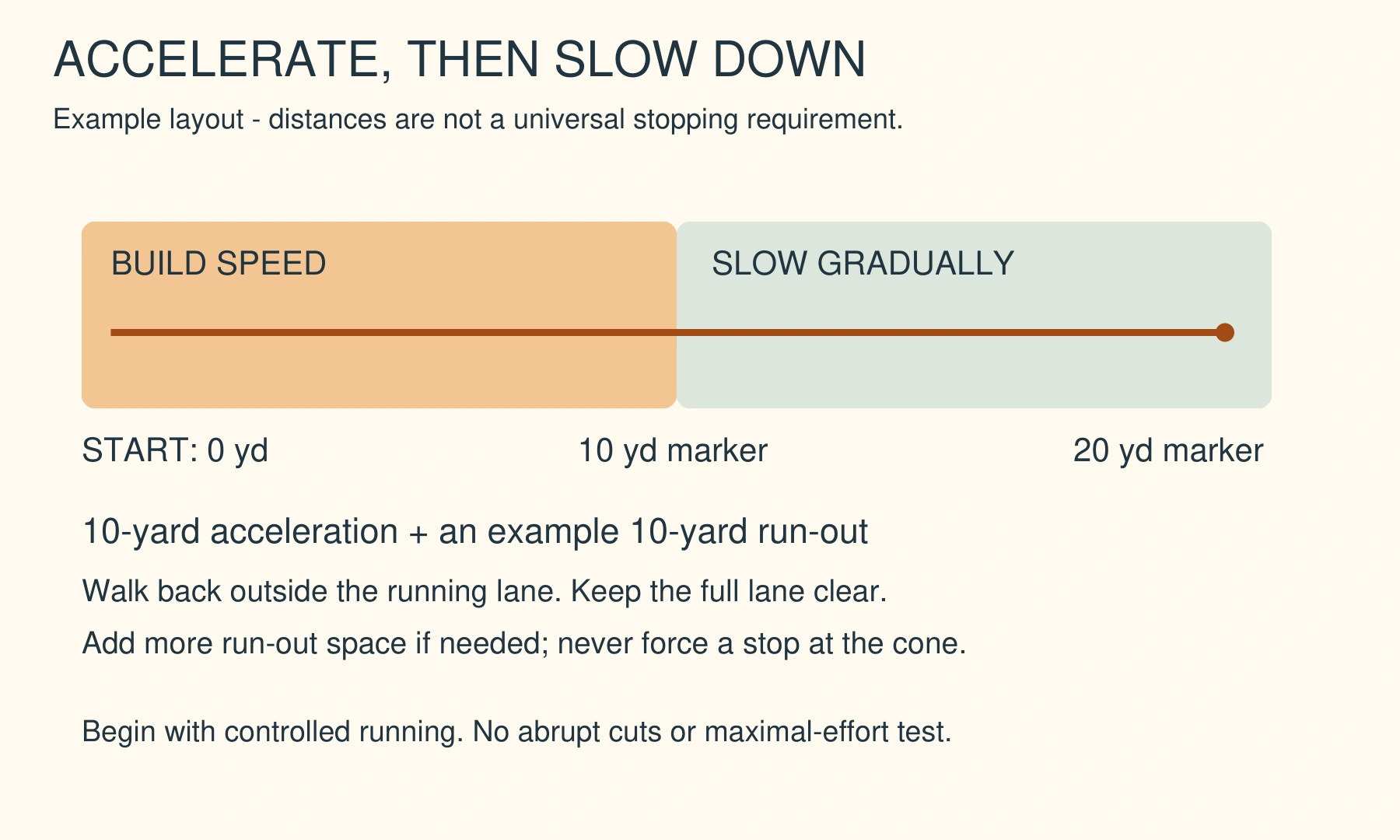
For deceleration practice, begin below sprint speed, shorten the steps gradually and come to a comfortable stop. Rehearse this before adding a planned change of direction; sharp reactive cuts are a later progression. USA Football’s coaching discussion of acceleration and deceleration explains why braking deserves its own practice and why fatigue changes the task. These lane dimensions are our illustrative setup, not a prescription from that source.
Movement Cues and Easier Alternatives
On a small screen, swipe the table sideways to read every column.
| Exercise | Useful cue | If the starting version is too demanding |
|---|---|---|
| Goblet squat | Hold the load close to your chest; keep your feet planted and descend only as far as you can control. | Rehearse bodyweight squats to a stable seat; reduce depth or load. |
| Dumbbell Romanian deadlift | Move the hips back while keeping the weights close. Stop before you lose trunk control. | Practice an unloaded hip hinge with a coach before adding weight. |
| Incline push-up | Use a fixed, stable support and move the body as one unit. | Use a higher support and fewer controlled repetitions. |
| Supported row | Keep the support stable and avoid rotating the trunk to lift the weight. | Choose a lighter dumbbell or a seated cable row. |
| Split squat / step-up | Use support when needed and control the lowering phase. | Reduce depth or step height before increasing repetitions. |
The NASM demonstration below shows the goblet-squat movement used in Workout A. Watch the setup and controlled repetition, then practice with an easy load. Its presence here does not make this whole football program NASM-approved; use the article’s sample volume rather than adding every prescription from the video.
Four Weeks of Progression Without Changing Everything
On a small screen, swipe the table sideways to read every column.
| Week | Strength decision | Field decision |
|---|---|---|
| 1 | Use the lower end of each rep range; record a comfortable starting load. | Experienced runners rehearse the lane with controlled efforts; returning players omit speed work. |
| 2 | Repeat the loads. Add a rep only where technique and recovery support it. | Keep the number of efforts steady; seek consistency rather than a record. |
| 3 | After two good sessions at the top of the rep range, add the smallest practical load increase. | If lifting load increased, keep running exposure steady. |
| 4 | Repeat or consolidate. If next-day limitations are accumulating, reduce sets and review the schedule. | A new practice or game replaces some optional work; do not simply add it. |
For example, two squat sets of six become two sets of seven and then eight before a small weight increase. Those steps need not occur every week. If the second set loses control, repeat the load or reduce it. Improvement is not a requirement to make every session harder.
Download the two-session training card (fillable PDF)
Save a local copy and use a PDF reader that supports form fields. Your entries are not sent to PrimeForMen.
Conditioning Without the Myths
Short high-intensity efforts are important in football, but aerobic training is not automatically the enemy of strength or speed. A systematic review of concurrent aerobic and strength training found no overall impairment of maximal strength or muscle growth compared with strength training alone, while explosive-strength adaptations warrant attention to how sessions are combined. That is a programming question, not a reason to declare all jogging harmful.
For general capacity, a comfortable walk, cycle or easy jog on a separate day may fit. Choose a duration you already tolerate, such as 15–20 minutes initially, and finish able to speak in sentences. Hard conditioning intervals require their own progression and should not be added automatically after every speed session. Our cardio workout guide provides general options.
Injury Reduction Is Not Injury Immunity
Appropriately progressed hamstring, hip and trunk work can be part of preparation. A particular exercise cannot guarantee protection, and a sudden large dose of unfamiliar Nordic curls can be too much. Start with movements you can control and use a coach to choose suitable progressions.
Do not treat shrugs or a stronger neck as protection against concussion. If a hit is followed by possible concussion symptoms, stop playing and obtain assessment; do not return the same day. The CDC response guidance explains this decision. Lifting performance cannot clear someone to return.
For sharp or increasing musculoskeletal pain, stop the aggravating activity and get appropriate help. Chest pain, fainting or severe unexplained breathlessness require urgent medical attention. These are not signals to finish the last set.
Make Next Week More Useful
- Mark practice and games first. Count them as demanding training where appropriate.
- Choose two manageable gym sessions. Keep the same main movements long enough to compare performance.
- Record load, reps and recovery. Include what happened in the following field session.
- Progress one thing. Do not increase sprint volume, lifting load and cutting intensity simultaneously.
Use our warm-up builder for general preparation ideas and the home gym equipment guide if you need practical equipment options. You can begin with a small setup rather than a complete performance facility.
Conclusion
Football-specific training is a coordinated week of strength, speed, skill and recovery. Start with work you can execute well, adapt it around the field schedule and build gradually. A plan that preserves your ability to practice is more useful than one that wins a fatigue contest.
Frequently Asked Questions
Is this American football or soccer?
American football, with a recreational flag-football starting context. Soccer has different match demands and needs its own conditioning plan.
Do I need Olympic lifts?
No. They are technical options that require coaching. A useful recreational program can use familiar strength movements and appropriately progressed running or throws.
Does bodybuilding make football players slow?
Muscle-building training does not automatically make someone slow. The overall program must also address the speed, movement skills and recovery needed for the sport.
Should I lift through the season?
Strength work can remain, but volume and timing should fit games and practice. Coordinate with your coach and reduce work when it compromises field readiness.
Can I start with this after years away from sport?
Use the basic strength version and gradual aerobic activity first. Do not jump straight to sprinting or sharp cuts; obtain appropriate guidance for your health, history and present capacity.
Training and medical boundary: This editorial guide is not individualized coaching, rehabilitation or medical clearance. A qualified coach and healthcare professional can adapt decisions to your circumstances. Evidence checked September 12, 2026.