Compare testosterone ingredient studies by exact extract, amount, population and endpoint, including null findings, safety limits and label examples.
- Match the exact preparation, not just the ingredient name.
- Study amounts describe research, not personal doses.
- A positive endpoint does not settle symptom benefit or safety.
Bottom line Record the plant part, extract, amount basis, population and endpoint; mark missing details unknown rather than assuming a match.
There is no ingredient list that reliably boosts testosterone for every man. Some named extracts have changed a hormone endpoint in selected trials; others have produced null results, or changed sexual desire without changing testosterone. A nutrient’s normal role in the body also does not establish that taking extra will raise testosterone.
This reference records what was actually studied: the people, preparation, amount, duration and outcome. Research amounts below are descriptions of trials, not a supplement schedule or a personal dose recommendation. For the broader interpretation of efficacy claims, read what testosterone booster evidence can establish. Use the selection hub for purchase and label checks.
Quick summary: read ingredients as specific interventions
- A plant name, an extract and a standardized marker are different label details.
- Population and measured endpoint determine what a trial can answer.
- Positive hormone findings can coexist with null symptom results or safety concerns.
- Vitamin D, zinc and magnesium are not a universal testosterone stack. Nutrient correction needs its own reason.
Prime Perspective: the ingredient name is only the first line
“Fenugreek, 600 mg” sounds precise until you ask whether it means seed powder, a particular extract or an undisclosed mixture. The same problem occurs when a label gives withanolide content without identifying the preparation, or a paper reports an amount using a different basis. Do not silently fill in those missing details.
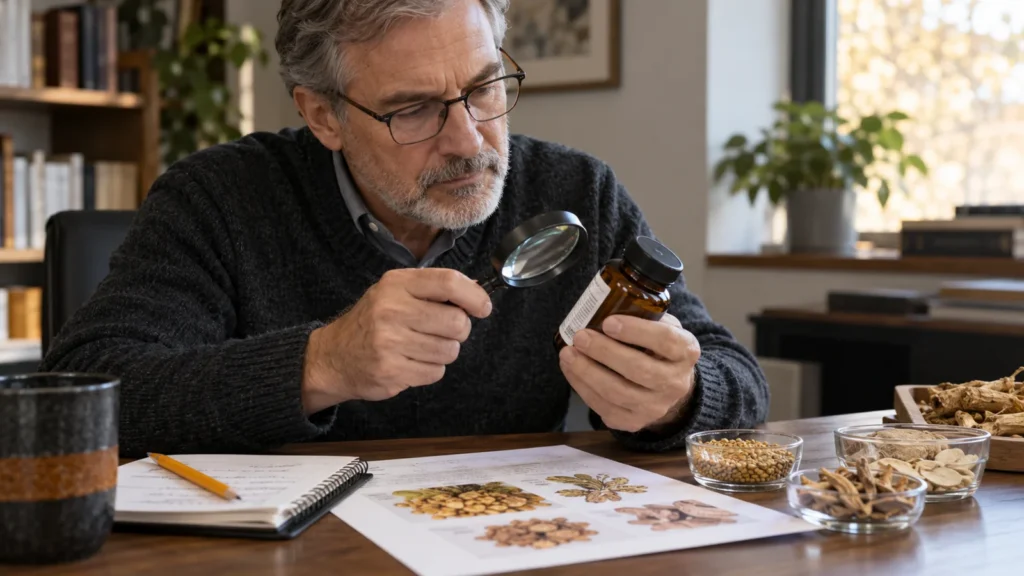
We keep promising and negative findings together so that the table cannot be mistaken for a ranked shopping list. We have not tested these products. Generated images illustrate reading labels and papers; the pictured botanical material does not establish the composition of any studied extract.
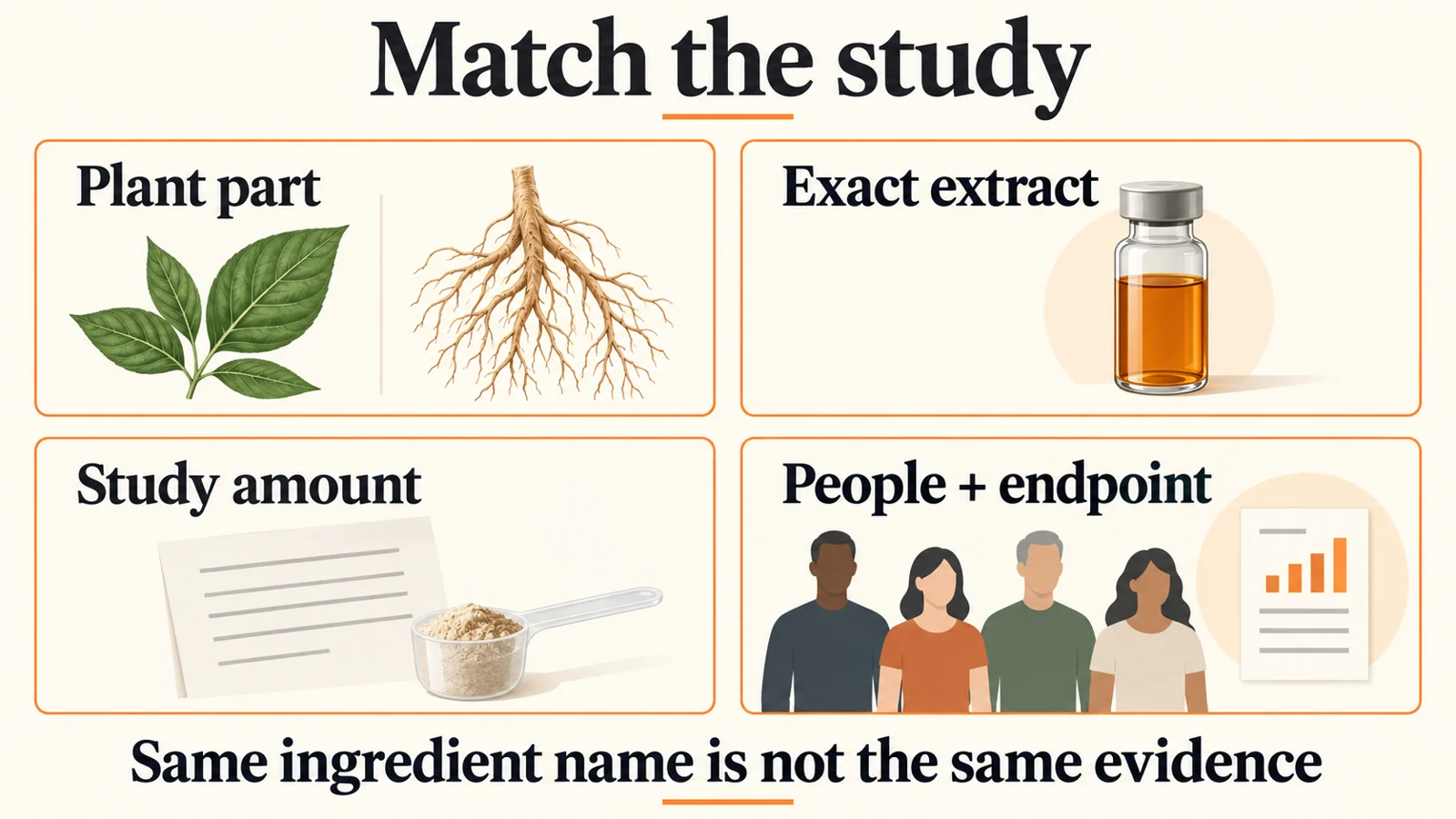
The study reference: what was tested and in whom?
This is a selection of human studies that illustrates the important differences. It is not an exhaustive inventory or an estimate of your likely response. The amount column is deliberately tied to each paper’s preparation and reporting basis.
| Ingredient and primary source | Population and design | Preparation, reported amount and duration | Measured outcome and limit |
|---|---|---|---|
| Ashwagandha: Lopresti 2019 | 57 overweight men aged 40 to 70 with mild fatigue; randomized crossover, 43 completed both periods. | Shoden bead preparation delivering 21 mg withanolide glycosides daily; eight weeks per period. This marker amount is not the weight of generic root powder. | Salivary testosterone differed from placebo; fatigue, vigor and sexual/psychological wellbeing did not significantly differ. No washout between periods. |
| Fenugreek: Rao 2016 | 120 healthy men aged 43 to 70; randomized placebo-controlled trial. | Testofen standardized seed extract, 600 mg/day for 12 weeks. | Serum total and free testosterone findings favored the extract. The primary outcome was an aging-male symptom questionnaire. This does not test generic seed powder or every fenugreek blend. |
| Tongkat ali: Chinnappan 2021 | 105 men aged 50 to 70 with baseline total testosterone below 300 ng/dL; randomized placebo-controlled trial. | Physta standardized aqueous root extract, 100 or 200 mg/day for 12 weeks. | Total testosterone differed from placebo at reported time points; free testosterone did not significantly differ between groups. Manufacturer funded; two authors were employees. |
| Vitamin D: Lerchbaum 2019 | 100 men selected for low total testosterone and vitamin D below the entry cutoff; randomized placebo-controlled trial. | Vitamin D3, 20,000 IU/week for 12 weeks. | No significant effect on the primary testosterone outcome. Participants were not all severely vitamin D deficient. This research exposure is not a self-treatment instruction. |
| Zinc: Prasad 1996 | Small restriction and repletion experiments, including nine marginally zinc-deficient older men; not a large placebo-controlled trial. | Older repletion group: oral zinc gluconate, reported as 459 micromoles zinc/day for three to six months. | Testosterone increased after repletion in that selected group. This cannot establish a benefit from extra zinc in adequately nourished men. |
| Magnesium: Cinar 2011 | Sedentary participants and taekwondo athletes in three groups; exercise-related measurements. | Four weeks; abstract reports magnesium at 10 mg/kg/day. Do not interpret this as a recommended or safe personal amount. | Resting and post-exhaustion hormone findings arose in a specific exercise protocol. This is not evidence of treatment for testosterone deficiency in men over 50. |
| D-aspartic acid: Melville 2015 | 24 resistance-trained men aged 18 to 36; placebo-controlled, eight per group. | 3 or 6 g/day for two weeks. | 3 g did not significantly alter testosterone; 6 g reduced total and free testosterone from baseline. These young trained participants do not represent all older men. |
| Maca: Gonzales 2002 | Men aged 21 to 56; randomized placebo-controlled trial. | Gelatinized maca, 1.5 or 3 g/day for 12 weeks. | Reported sexual desire improved; serum testosterone and estradiol did not differ from placebo. Desire is a different endpoint from a hormone increase. |
Percentage changes from different assays, populations and trials cannot rank ingredients against each other. Nor can the published amounts simply be combined into a stack. Combining interventions creates a new exposure with separate uncertainty.
What counts as a match to an extract study?
Record the plant’s scientific name when available, the plant part, extraction method, named preparation and standardized marker. Then record whether the amount describes whole powder, extract mass, a marker compound or an elemental nutrient. If the abstract only reports a marker amount, do not convert it into a generic powder serving.
A named extract makes the question more specific, but it does not remove the need to read the study. Check the comparator, the preplanned endpoint and the enrolled population. A paper’s author conclusion may be broader than its measurements. Describe the outcome as the researchers measured it.
A worked label comparison: what the details establish
The following labels are fictional teaching examples. They are not real product recommendations.
| Example | What the fictional label tells you | What you can conclude |
|---|---|---|
| Label A | “Fenugreek seed powder, 600 mg.” | The plant part and powder amount are stated. It is not identified as the Testofen extract in the cited trial. |
| Label B | “Testofen standardized seed extract, 300 mg per capsule; two capsules per labeled serving.” | 300 × 2 = 600 mg per labeled serving. The named preparation and amount appear comparable; the actual label, formulation and study still need checking. |
| Label C | “Performance blend, 900 mg,” with fenugreek among several ingredients. | The total blend mass does not reveal the fenugreek amount or preparation. Do not divide equally between listed ingredients. |
Label B’s arithmetic is a description of the invented label, not advice to take two capsules. Even a confirmed match does not predict an individual’s hormone result, establish suitability with medications or make the finished formula identical to the tested intervention.
Write “not stated” where information is missing. Asking the manufacturer for the exact preparation and source is more useful than assigning an evidence grade to an assumption.
Watch: an ingredient name does not finish the comparison
The animation opens a generic ingredient label into the details needed to compare it with a study.
Matching the preparation is one question. Whether the trial’s findings apply to you and whether use is appropriate are separate questions.
How to interpret the promising herb findings
Ashwagandha: specify the preparation and the assay
The Shoden study above measured salivary testosterone. Calling that a demonstrated serum testosterone effect would change the finding. Its null wellbeing comparisons also prevent a hormone difference from becoming a promise of better energy or sexual function. Short follow-up and incomplete crossover participation leave further uncertainty. Keep the marker amount attached to the named preparation.
Safety is a separate question. NCCIH notes limited longer-term safety information, reported liver injury and concerns involving thyroid or autoimmune conditions and medication interactions. A favorable hormone endpoint does not resolve those issues. NCCIH ashwagandha evidence and safety.
Fenugreek: a specific extract is narrower than a plant-wide claim
The Testofen result concerns a particular standardized seed extract and a selected healthy male population. A bag of culinary seeds, generic powder and a multi-ingredient capsule are different interventions. Our Testodren review covers another named fenugreek extract, Furosap; evidence for one preparation cannot silently stand in for the other.
Fenugreek can cause gastrointestinal effects and allergic reactions and may lower blood sugar. Discuss relevant medications and conditions rather than treating its use in food as proof that a concentrated supplement is suitable. NCCIH fenugreek safety information.
Tongkat ali: positive efficacy data does not settle safety
The trial’s selected baseline testosterone and manufacturer involvement deserve to remain visible. The absence of a significant between-group free-testosterone result is also part of the finding, even when a headline emphasizes total testosterone.
Separately, EFSA assessed a standardized aqueous root extract and concluded that safety had not been established under its proposed use conditions because of potential DNA damage. This is an assessment of the submitted extract and conditions, not a claim that the United States bans all tongkat ali or that every preparation is identical. It is a reason to avoid presenting one positive trial as safety clearance. EFSA assessment of a tongkat ali root extract.
Why vitamin D, zinc and magnesium need their own decision
Nutrient adequacy and a reliable testosterone intervention are different goals. The null vitamin D trial does not tell people to ignore a clinical deficiency. The small zinc repletion experiment does not tell adequately nourished people to add zinc. The magnesium exercise study does not establish a routine hormone treatment for an older population.
The wider vitamin D literature is mixed. A 2024 meta-analysis reported a possible increase in total testosterone, without significant effects on the other reproductive hormone measures it pooled. A newer June 2026 meta-analysis found no statistically clear or reproducible effect on total testosterone or androgen bioavailability markers; certainty was low or very low. Differences in included comparisons and methods matter. Neither synthesis supports promising a personal hormone response or copying high-dose subgroup findings. 2024 meta-analysis; 2026 meta-analysis.
Start with the reason a nutrient is being considered: food intake, a documented clinical issue or an existing professional recommendation. Record overlapping products, because a multivitamin, mineral supplement and “booster” may contain the same nutrient. A label’s total serving can hide how much you are already taking from another bottle.
Excess zinc can interfere with copper status. Magnesium supplements can cause gastrointestinal problems, and kidney function and medications can change their appropriateness. Check the NIH zinc fact sheet and NIH magnesium fact sheet with a clinician or pharmacist when relevant. These are reasons for individual review, not a universal supplement stack.
The same discipline applies to products marketed for recovery. The creatine and protein guide separates protein-gap arithmetic from a creatine decision. A nutritional or training role should not be renamed a testosterone benefit without an appropriate outcome.
For another example of keeping sexual experience and hormone measurements separate, see our sex and testosterone evidence guide.
Read null findings without discarding their context
A negative trial is useful information. It can challenge a broad marketing claim, especially when the tested population resembles the advertised audience. But it remains a result for the tested intervention, duration and measurements. It does not prove that every amount or population behaves identically.
Likewise, an observational association does not establish what supplementation does. A magnesium study in 399 men aged 65 and older found an association between serum magnesium and testosterone. It did not randomize men to magnesium or demonstrate a testosterone treatment effect. Older-men magnesium observational study.
When a supplement page jumps from a biological mechanism to a clinical promise, look for the missing human comparison. A plausible role in hormone physiology still needs testing in a suitable human comparison.
Record the gaps between a label and a study
Compare preparation, population and endpoint explicitly. These questions do not predict your response, select a dose or determine whether an ingredient is safe for you.
Without the helper, write the exact claim, preparation, participants, measured endpoint and comparator on the PDF. Mark missing details unknown. This record does not diagnose a condition, prescribe a dose or authorize supplement use.
Keep the preparation and result on one sheet
The eight editable fields capture the label, plant part, standardization, amount, population, endpoint, limits and questions. Unknown details stay visible rather than becoming an implied match.
Download the fillable ingredient comparison (PDF)
Open a downloaded copy in a PDF reader with form support, fill it and save your copy. Printing a blank sheet also works.
Before treating symptoms as an ingredient problem
Persistent fatigue, sexual symptoms or unexplained changes need assessment. They cannot identify which nutrient or herb you “need.” Clinical evaluation of suspected testosterone deficiency uses symptoms, appropriate repeated hormone testing and the broader context. Do not use this table as a diagnostic checklist or stop prescribed medication to try a supplement. Endocrine Society clinical guideline.
Bring the actual label and all current products to a clinician or pharmacist. Mention fertility plans, relevant conditions, medications and any reaction. Serious symptoms such as chest pain, fainting or severe breathing difficulty require urgent help; jaundice, dark urine or severe abdominal pain need prompt medical attention.
FDA video: separate supplement claims from approval
The FDA’s official overview covers supplement regulation, interactions and adverse reactions. It is context for reading labels, not a recommendation of the ingredients in this reference.
Dietary supplements do not receive FDA premarket approval for safety and effectiveness. A marketed label is therefore not proof of clinical benefit. FDA consumer explanation.
Watch Dietary Supplements Overview on the official FDA YouTube channel.
Optional tools for reading and recording
You do not need a new supplement to use this guide. These two tools serve specific record and label-reading jobs; an existing notebook or phone may be enough.
As an Amazon Associate, we earn from qualifying purchases. These are affiliate links; they do not change our interpretation of the studies.

Amazon Basics blank hardcover notebook
Use: Useful if you want a paper record that travels with you. Skip: Skip it if the free worksheet or a notebook you own does the job.
- Blank pages let you keep the claim beside the cited source.
- Record dates and changes without turning observations into a hormone result.
- Keep your questions together for a clinician or pharmacist.

CRAFTSMAN CMMT14118 magnifying glass
Use: Useful if fine label print is difficult to read. Skip: Skip it if your phone camera or an existing magnifier is sufficient.
- Enlarge fine print while recording the exact preparation and serving basis.
- Compare the label in your hand with the study rather than guessing.
- Reading help does not verify contents, purity or clinical effectiveness.
Conclusion: preserve the details that change the answer
The useful unit is the studied preparation in a defined population with a stated endpoint. That is more precise than a list of “best ingredients.” Keep null results, symptom outcomes, funding and safety questions beside favorable findings. Do not convert study amounts into a personal stack.
For your next comparison, choose one claim and one cited study. Record each detail you can verify and mark the rest unknown. Continue to our efficacy guide to interpret the result, or the selection hub for the buying process.
Frequently asked questions
Which ingredient is the best testosterone booster?
The studies do not establish a universal winner. Different preparations, populations and outcomes prevent a simple ranking, and a favorable hormone finding does not settle symptom benefit or safety.
Is the same number of milligrams enough to match a study?
No. Powder, extract, standardized marker and elemental nutrient amounts describe different things. Check the preparation and reporting basis before comparing numbers.
Does a deficiency mean supplements will raise testosterone?
Appropriate deficiency care can be important for health, but a hormone response is not guaranteed. Evidence from selected deficient participants cannot establish a benefit from extra nutrients for everyone.
Can I combine all the positively studied ingredients?
The table does not test that combination or establish its suitability. Combining substances changes the intervention and can create overlapping exposures and interactions. Discuss an actual product list rather than adding study amounts together.
Does a libido improvement prove testosterone increased?
No. The maca trial illustrates this: reported desire improved without a corresponding testosterone difference from placebo. A symptom outcome and a hormone outcome need separate evidence.
Educational study reference, not diagnosis or individualized medical advice. Reported research amounts are not recommended doses. Seek individual advice about symptoms, medications, existing conditions and supplement use.