
Do testosterone boosters work? Separate hormone results, energy claims and finished-product evidence with worked examples and an evidence record.
- Feeling better and a hormone change are different outcomes.
- An ingredient trial does not prove a finished blend works.
- Persistent symptoms need assessment, not a supplement test.
Bottom line Write the exact claim beside its measured outcome, comparator and tested preparation before treating it as evidence for a product.

Testosterone boosters are dietary supplements sold with hormone, energy, libido or muscle claims. The evidence does not support treating this category as a reliable way to raise testosterone. Some specific preparations have produced a hormone change in selected study populations. Others have not. Neither a promising ingredient trial nor a better week of energy establishes that the bottle you buy will raise your testosterone or improve your health.
This guide explains how to read that evidence. For product labels, purchase checks and the route through our supplement guides, use the testosterone booster selection hub. For the exact preparations and populations in individual trials, see our ingredient study reference.
Quick summary: what testosterone booster evidence can tell you
- Hormone concentration, sexual desire and perceived energy are separate outcomes.
- Compare the supplement group with its control group; a change from baseline alone cannot isolate the supplement’s effect.
- Evidence for an ingredient does not automatically apply to a finished blend, a different extract or a different population.
- Persistent symptoms deserve clinical assessment. An over-the-counter product is not a diagnostic test or a substitute for prescribed treatment.
Prime Perspective: start with the claim you actually want answered
A bottle that promises “vitality” leaves a lot unspecified. Does the manufacturer mean a change in a blood test, less fatigue, greater sexual desire, better erections or more muscle? Each requires a different measurement. A review can report that a customer felt better without showing any hormone result. A laboratory study can detect a hormone difference without showing that participants felt or functioned better.
Our approach is to keep the claim beside the measurement, then ask whether the sold product was tested. We have not tested these supplements ourselves. The generated illustrations on this page explain the reading process; they do not depict participants, a laboratory result or an endorsement.
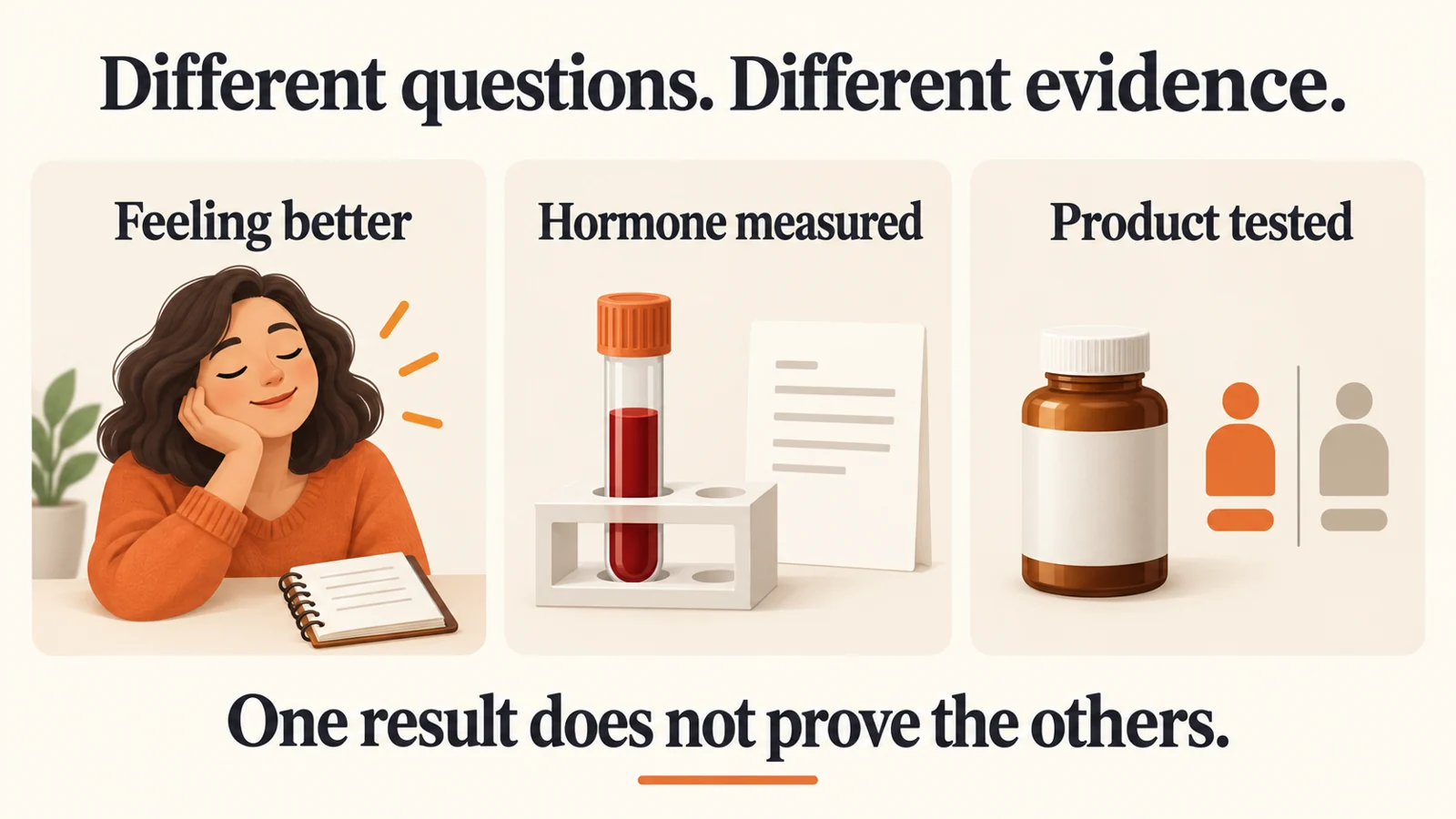
Four different meanings of “does it work?”
| Question | Relevant evidence | What would remain uncertain? |
|---|---|---|
| Did testosterone change? | Clearly identified hormone measurements, collection conditions and a suitable comparison group. | Whether the difference matters clinically, lasts or improves symptoms. |
| Did the person feel better? | A defined symptom or wellbeing measure compared with control. | Whether testosterone changed or caused that improvement. |
| Did correcting a nutrient shortage help? | Documented nutrient status and an intervention in an appropriate population. | Whether people without that shortage benefit, or whether hormone concentration changes. |
| Does this marketed formula work? | A trial of the same formulation, preparation and relevant exposure. | Whether its findings transfer to another formula, population or period of use. |
These distinctions matter after 50 because several concerns can coexist. Poor sleep, a new medication, low food intake and a health condition can affect how you feel. Writing “low T” beside fatigue skips the work of finding the cause. Our sex and testosterone guide also separates sexual activity, desire and hormone measurements rather than treating them as interchangeable.
What the research says about the category
A systematic review published online in 2023 examined 52 studies of 27 proposed testosterone boosters across several male populations. Most did not increase total testosterone versus placebo; findings for selected substances depended on the population and intervention. That supports caution about category-wide promises, rather than a claim that every possible preparation has been disproved. Systematic review of proposed testosterone boosters.
Whole-product evidence is a separate issue. A historical review of sampled testosterone and erectile-dysfunction products found no published randomized trial for the complete sampled products at that review’s time. Its ingredient literature cannot establish the current performance of every product sold today. Review of marketed products and ingredient trials.
Be especially careful with percentages from label audits. “This share of ingredients had supporting literature” is not the share of customers who benefited, nor the share of bottles proved effective. The unit being counted may be ingredients, studies, products or participants. Before repeating a number, find its denominator and the outcome it describes.
Two trials that show why the endpoint matters
In a 12-week placebo-controlled maca trial in men aged 21 to 56, reported sexual desire improved while serum testosterone and estradiol did not differ from placebo. The preparation was gelatinized maca at 1.5 or 3 grams daily. The desire outcome did not establish a testosterone increase. These research amounts are not personal dosing recommendations. Maca trial: desire and hormone outcomes.
An ashwagandha crossover study in overweight men aged 40 to 70 with mild fatigue found a salivary testosterone difference for a specific Shoden preparation. It did not find significant between-group differences in fatigue, vigor or sexual and psychological wellbeing. The small study and lack of a washout between periods further limit interpretation. A hormone result and a symptom result can point in different directions. Ashwagandha trial: measured and reported outcomes.
Read the result, not just the headline
Start with the methods and the result that matches the claim. “Testosterone” may refer to total or free testosterone, measured in serum or saliva. Those are not interchangeable labels. Note when samples were collected, what assay was used and whether the relevant analysis was planned. If those details are absent from the advertising, follow its citation rather than guessing.
Then look for the comparison. In a controlled trial, the informative question is how the intervention differed from control under the study’s analysis. “Our group improved from its starting value” is not enough when the control group also changed. Sleep, illness, training, measurement variation and participants’ expectations can change during a study.
Finally, examine the size and uncertainty of the result. A statistically significant difference does not by itself establish a worthwhile symptom improvement. A small trial can miss a real difference or produce an unstable estimate. A null result is a finding about that study and its precision, not proof that all preparations and populations are identical.
A worked reading example: what can you conclude?
This example is fictional. The values are invented to demonstrate interpretation, not taken from a study or patient.
| Illustrative record | Start | Later measurement | Change |
|---|---|---|---|
| Supplement group mean total testosterone | 400 ng/dL | 440 ng/dL | +40 ng/dL |
| Control group mean total testosterone | 400 ng/dL | 430 ng/dL | +30 ng/dL |
The supplement group’s increase is 40 ÷ 400 = 10%. The control group’s increase is 30 ÷ 400 = 7.5%. The difference between those changes is 10 ng/dL. Those calculations describe these invented means. Without the actual design, sample size, variability, uncertainty and analysis, they cannot establish a treatment effect or clinical importance.
Now imagine a testimonial saying “I slept better and felt more motivated.” That statement adds an observation about the person’s experience. It supplies no missing hormone measurement and cannot tell us whether the supplement caused the change. Record it honestly as an observation; do not relabel it as a testosterone result.
Watch: keep the three evidence questions separate
The animation groups the claim, its measurement and product evidence without turning them into a score.
Feeling better does not demonstrate a hormone increase. An ingredient result does not establish a finished blend’s effect.
When an ingredient study applies to a different preparation
Suppose a paper tested a named standardized seed extract and the label lists only the plant name inside a proprietary blend. You do not yet know whether the plant part, extract, marker content or amount matches. Equal milligrams of two preparations can mean different chemical exposures. “Contains the studied ingredient” leaves those questions unanswered.
Even an apparently matching preparation does not reproduce the trial. The study may have enrolled younger trained men, men with selected laboratory values or participants without the conditions and medications relevant to you. Its duration may tell us little about longer use. Multiple ingredients also create a different formulation; adding more names does not add together their published results.
Our Testodren review shows how to distinguish a marketed product from research on its named extract. Use the ingredient reference for study populations and exact preparation details, then return to the selection hub for the purchase checks. These pages answer different parts of the decision.
Does a vitamin or mineral deficiency change the answer?
A confirmed nutrient shortage is a reason to discuss correction for health. It does not make a testosterone increase inevitable. In a 12-week randomized vitamin D trial of 100 men selected for low testosterone and vitamin D below the entry cutoff, supplementation did not significantly improve the primary testosterone outcome. The participants were not all severely vitamin D deficient. Vitamin D and testosterone randomized trial.
The wider vitamin D literature is mixed. A 2024 meta-analysis reported a possible increase in total testosterone, without significant effects on the other reproductive hormone measures it pooled. A newer June 2026 meta-analysis found no statistically clear or reproducible effect on total testosterone or androgen bioavailability markers; certainty was low or very low. Differences in included comparisons and methods matter. Neither synthesis supports promising a personal hormone response or copying high-dose subgroup findings. 2024 meta-analysis; 2026 meta-analysis.
Appropriate vitamin D care remains a separate clinical question. A nutrient label cannot promise a hormone response. Likewise, findings in zinc-restricted or marginally zinc-deficient participants do not establish a benefit from extra zinc for everyone. More is not a substitute for knowing the reason for supplementation. Keep food, clinical advice and all overlapping products in the same record.
Exercise belongs in its own discussion too. A transient response after activity is different from a lasting resting hormone change. See running and testosterone for that distinction. A supplement trial cannot replace a practical review of sleep, training, nutrition and symptoms.
Turn a claim into three evidence questions
Choose what the claim and citation actually say. The helper organizes questions; it does not rate your health, prove efficacy or clear a purchase.
Without the helper, write the exact claim, preparation, participants, measured endpoint and comparator on the PDF. Mark missing details unknown. This record does not diagnose a condition, prescribe a dose or authorize supplement use.
Save the claim and its unanswered questions
The eight-field worksheet keeps the exact claim, study details, observations and questions together. It does not calculate a hormone target, diagnose low testosterone or authorize a supplement.
Download the fillable evidence record (PDF)
Download and open it in a PDF reader that supports forms. Save a copy after filling it; you can also print a blank copy.
When symptoms need a clinical conversation
Persistent fatigue, sexual symptoms or unexplained changes deserve assessment rather than a self-directed booster trial. The Endocrine Society’s current statement describes diagnosis using compatible symptoms and at least two appropriately measured early-morning fasting testosterone results in clinical context. A single number or online symptom checklist is not that assessment. Endocrine Society statement on testosterone evaluation.
Bring a list of prescriptions, nonprescription products, actual use and symptom timing. Mention fertility plans and existing conditions. Do not stop prescribed treatment to create a cleaner supplement experiment. Prescription testosterone and dietary supplements are different interventions; whether medical treatment is appropriate requires an individual clinical decision.
Do not wait to complete a worksheet if a serious reaction occurs. Seek urgent medical help for chest pain, severe breathing difficulty or fainting. Jaundice, dark urine or severe abdominal pain also need prompt medical attention. Some products marketed for bodybuilding have contained hidden steroid or steroid-like substances; this does not establish that every testosterone supplement is contaminated. FDA warning about risky bodybuilding products.
FDA video: how dietary supplements are regulated
This official FDA overview explains supplement regulation, interactions and adverse reactions. It does not demonstrate that a testosterone booster works or recommend an ingredient.
The FDA does not approve dietary supplements for safety and effectiveness before marketing. Supplements are regulated under a different framework from drugs; “not preapproved” does not mean “unregulated.” FDA consumer guide to dietary supplements.
Watch Dietary Supplements Overview on the official FDA YouTube channel.
Optional tools for reading and recording
You do not need a new supplement to use this guide. These two tools serve specific record and label-reading jobs; an existing notebook or phone may be enough.
As an Amazon Associate, we earn from qualifying purchases. These are affiliate links; they do not change our interpretation of the studies.

Amazon Basics blank hardcover notebook
Use: Useful if you want a paper record that travels with you. Skip: Skip it if the free worksheet or a notebook you own does the job.
- Blank pages let you keep the claim beside the cited source.
- Record dates and changes without turning observations into a hormone result.
- Keep your questions together for a clinician or pharmacist.

CRAFTSMAN CMMT14118 magnifying glass
Use: Useful if fine label print is difficult to read. Skip: Skip it if your phone camera or an existing magnifier is sufficient.
- Enlarge fine print while recording the exact preparation and serving basis.
- Compare the label in your hand with the study rather than guessing.
- Reading help does not verify contents, purity or clinical effectiveness.
Conclusion: keep the claim within the evidence
A useful answer to “do testosterone boosters work?” names the intervention, population and outcome. For this category, dependable results cannot be assumed. A positive result for one preparation remains narrower than a promise about a shelf of products. A better feeling, a changed hormone measurement and a demonstrated finished-product benefit each need their own evidence.
Write down the exact claim and one unanswered question before making a purchase decision. If symptoms are the reason you started searching, prioritize a clinical conversation. If you are comparing labels, continue to the testosterone booster hub with those questions in hand.
Frequently asked questions
Do over-the-counter testosterone boosters reliably work?
Category-wide reliability is not established. Some particular preparations have positive findings in selected populations, while many studied substances do not improve total testosterone versus placebo. Check the exact intervention and outcome rather than assuming a product inherits the category’s most favorable finding.
Does feeling more energetic mean testosterone increased?
No. Energy is a reported experience; testosterone requires an appropriate hormone measurement. Either can change without proving the other changed or caused it. Persistent fatigue warrants assessment rather than a hormone conclusion from a testimonial.
Can an ingredient trial prove a proprietary blend works?
It cannot establish that by itself. An undisclosed amount, different extract or added ingredients can create a different intervention. Ask for a trial of the actual formula and keep any uncertainty visible.
Should I try a booster before asking about low testosterone?
Persistent symptoms are a reason to seek assessment, not a requirement to try a supplement first. Bring your symptoms and product list to a clinician. A response to a supplement cannot diagnose or exclude testosterone deficiency.
Does third-party testing prove a hormone benefit?
Quality testing and clinical efficacy answer different questions. Check what the named certification actually covers. An identity, contaminant or label-content check does not by itself demonstrate that a product raises testosterone or improves symptoms.
Educational information, not medical diagnosis or individualized treatment advice. Study amounts describe research exposures, not recommended doses. Seek individual advice about symptoms, medications, existing conditions and supplement use.