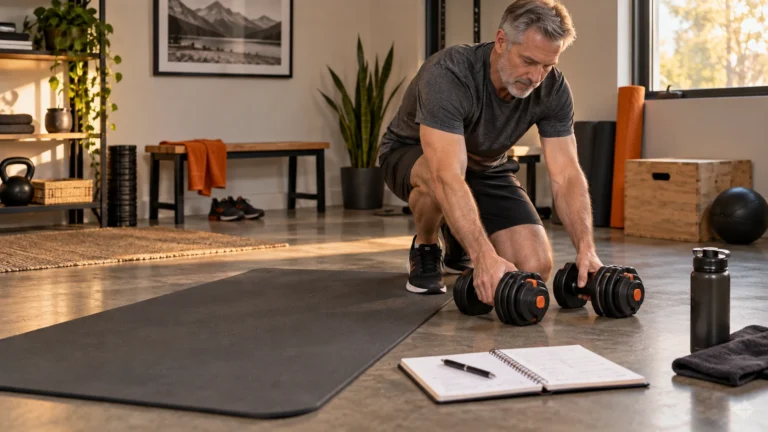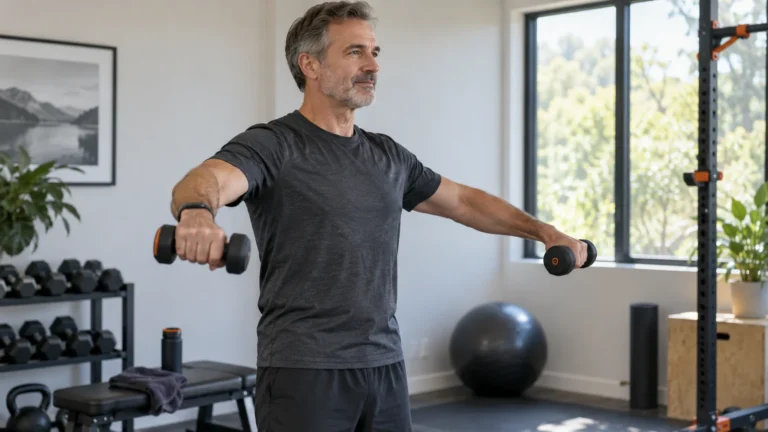

Prepare a usable dumbbell session after 50 with standing options, support and floor-transfer checks, both-side timing and a printable setup record.
- Resolve the pickup, support and put-down before working sets.
- Count both row sides, rest and equipment changes.
- Choose suitable variations; age does not set your dumbbell load.
Bottom line Prepare the complete exercise setup, then record the completed work with the same load units and left/right convention.

A dumbbell workout for men over 50 works best when the setup is as repeatable as the exercise. Choose movements you can enter, perform and finish without awkward floor transfers, unstable support or hurried weight changes. Choose load for the movement and your current ability. A smaller dumbbell does not make a painful movement suitable.
This guide focuses on adapting a home session: chair height, row support, load settings, both sides and the time spent handling equipment. For a general training calendar, use our dumbbell-only home workout plan. You do not need to add this session to that plan; suitable movements here can replace its movements after you account for the workload.
Quick Summary: Dumbbell Workout for Men Over 50
- Prepare the chair, support, floor and weight settings before working sets.
- The standing example uses chair rises, dumbbell hinges, supported rows and wall presses; the press is bodyweight.
- Eight rows on each side are sixteen repetitions in total. Include both sides in the time and load record.
- One set per movement has an illustrative 16:25 time budget; two sets have a 24:20 budget. Extend these estimates when needed.
- Repeat suitable work until the record supports a change. Pain, new symptoms and unresolved handling questions take priority.
The Prime Perspective
A workout can look simple on paper and still be impractical at home. The chair may slide. A low dumbbell rack may require a lift you have not practiced. The floor press may feel manageable once you are lying down, while getting there with weights is the harder part.
Choose the complete movement, including its start and finish. A standing session with a wall press can be more usable than a nominally dumbbell-only session that demands an unfamiliar floor transfer. Different options change exercise demand; none is universally kinder to joints.
What age changes, and what it cannot tell you
Training experience, conditions, medications, balance, grip, movement familiarity and current recovery all affect exercise selection. A trained 62-year-old and someone restarting at 52 can need different work. There is no single pair of starting dumbbells for everyone over 50.
The CDC adult activity guidance includes muscle strengthening on at least two days weekly across the major muscle groups. Its guidance for adults 65 and older also includes balance activity and adapting activity to abilities and conditions. Those recommendations do not validate this exercise list, its loads or a particular number of sets for you.
Stop an exercise that causes pain or makes you feel unwell. Persistent, worsening or unexplained symptoms need appropriate medical advice. Chest pain, fainting or severe unusual breathlessness require urgent care. An old injury, recent surgery, falls or a condition affecting exercise may need individual guidance before you attempt new loaded movements.
Knowing the repetitions does not resolve how to handle the weight. If you cannot explain where the dumbbells start, how you reach the exercise position and where they finish, resolve that question before a working set.
Prepare a repeatable space
| Situation | Usable option to consider | Question to resolve |
|---|---|---|
| Floor transfers are difficult or unfamiliar | Keep the session standing or seated; use a suitable wall press | Can you enter and leave every movement without holding weights while changing level? |
| A row needs hand support | A purpose-built bench or another individually suitable stable support | Will it remain stable under the direction of force? A chair back is not automatically suitable. |
| A chair rise needs a target | Firm armless chair, no wheels, back against a solid wall | Does the seat height allow the chosen range without rocking, sliding or relying on the wall as a lifting aid? |
| Adjustable dumbbells require changes | Complete one exercise before changing settings | Have you followed the exact model’s locking and adjustment instructions? |
| Walking space is limited | Omit carries or use an individually suitable stationary option | Are the exercise area and route to put down the weights clear? |
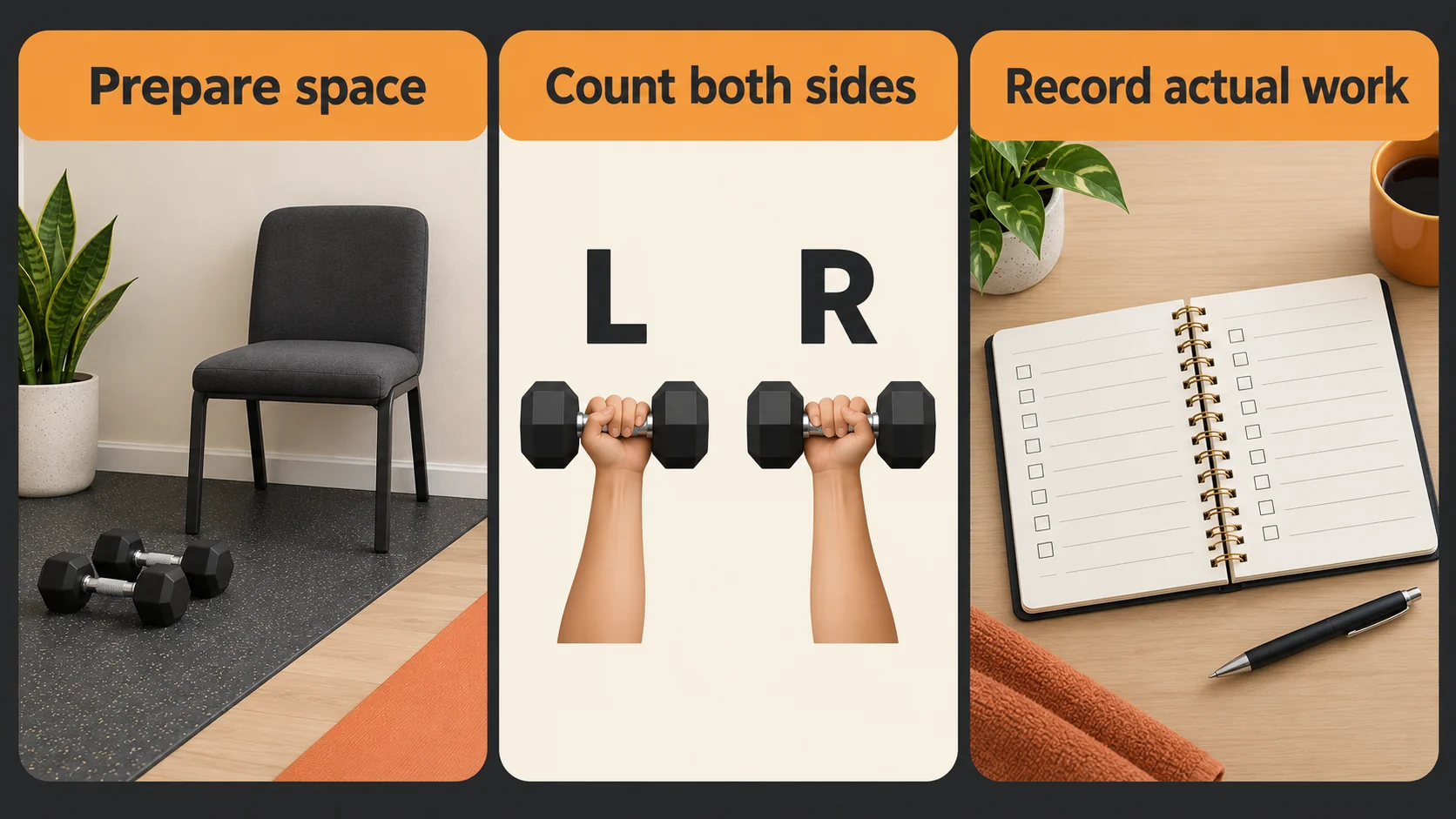
Put unused weights outside your feet and your exit route. Keep rugs, loose mat edges, pets and cables away from the working area. A mat can provide a useful surface, but softness or cushioning does not establish stability. Our home gym layout guide helps distinguish storage space from the space needed while exercising.
Equipment for the setup you actually use
Affiliate Disclosure: As an Amazon Associate, we earn from qualifying purchases. Links marked * are affiliate links. We have not hands-on tested these products. Your existing equipment or the free record may already be sufficient.
Best for: A pair of adjustable dumbbells when the exact load range and handle format fit your movements. Skip if the minimum load, load gaps or adjustment process do not suit you, or if existing weights already work. Current Amazon listing: PowerBlock Elite EXP 90 Adjustable Dumbbells, Stage 1, Set of 2, 5 lb-50 lb Best for: An optional fixed light pair for a movement that needs this specific load. Skip if 2 lb per hand does not fit the task. Color and a light mass do not establish exercise suitability. Current Amazon listing: Amazon Basics Neoprene Dumbbell Hand Weights for Workout and Exercise, 2 Pounds, Pink, Pair Best for: A paper record for setup, load units and completed left and right sets. Skip if the free PDF, an ordinary notebook or your existing app is easier. Current Amazon listing: Ultimate Workout Journal - Fitness Training Planner for Men and Women * As an Amazon Associate, PrimeForMen earns from qualifying purchases.Recommended Products

PowerBlock Elite EXP Stage 1 pair
View on Amazon

Amazon Basics 2 lb neoprene dumbbell pair
View on Amazon

Ultimate Workout Journal
View on Amazon
Choose movements before choosing heavier weights
Begin with a familiar variation and a manageable range. Practice the entry and exit without a working load. When the movement and equipment handling are uncertain, a qualified trainer can observe what a written guide cannot. Reducing the range or resistance can change demand, but it is not automatic permission to train through pain.
Chair rise: keep the target stable
Sit on the front portion of a firm chair with feet placed for a controlled rise. Stand without throwing your torso forward, then lower with control until you reach the seat. Use an individually appropriate amount of hand assistance if needed; that is a different variation to record. Keep the chair in place and avoid collapsing onto it.
The example starts without an external load. Holding a dumbbell near the chest is a later option only when that movement and the pickup are suitable. Some adjustable dumbbells have a shape or manufacturer limitation that makes a goblet hold unsuitable. Do not improvise by gripping detachable plates.
Dumbbell hinge: move at the hips
With an individually suitable pair at your sides or in front of your thighs, soften the knees and move the hips back. Let the torso incline while you maintain a controlled trunk position; stand by bringing the hips forward, without leaning back at the top. The distance the weights travel depends on your range, not on a requirement to touch the floor.
Practice with empty hands first. Keep the weights near the legs and lower only as far as the chosen variation allows. Do not use a stack of books or an unstable stool to raise the starting weights. If picking them up from the floor is unsuitable, a trainer can help arrange an appropriate starting height and handling method.
Supported row: count the left and right sets
Use a stable support that can withstand the direction of your hand pressure. Arrange the feet, hinge and support hand before moving the dumbbell. Draw the elbow back with a controlled shoulder position, then lower the weight without twisting the torso or jerking to finish.
Finish and park the weight before changing sides. The Mayo Clinic dumbbell-row demonstration explains controlled movement and trunk position in an unsupported row. Our supported option adds a support surface; its stability needs a separate check.
Wall press: a standing pushing option
Use a solid wall, hands comfortably placed, feet arranged so you can lower and press away under control. Keep a comfortable body line and avoid reaching with the head or shrugging through the shoulders. Moving closer usually reduces the lever demand, but a comfortable distance is individual.
This is a bodyweight exercise in a dumbbell-based session. It avoids a floor transfer and still provides a pushing movement. If no pushing variation is suitable, omit it and seek help with the choice; do not label the remaining work a complete plan for every muscle group.
A complete standing session example
These repetitions and rests are editorial programming examples for suitable familiar movements. They are not an age-specific prescription. Start with a load you can handle and control for your chosen exercise, leaving room to end the set before you need to grind, swing or hold your breath to finish. A difficult grip or breathlessness can end a set before the target muscle does.
| Order | Work | Rest and handling | Record |
|---|---|---|---|
| Warm-up and rehearsal | 5 minutes of easy movement and unloaded versions of the chosen exercises | Use longer if needed; do not fatigue yourself with practice | Any change to the selected variation |
| Chair rise | 2 sets of 8, initially without external load | 60 seconds between sets; 30 seconds extra to prepare the next exercise | Seat height and hand assistance |
| Dumbbell hinge | 2 sets of 8 | 60 seconds between sets and after the final set; 30 seconds extra for the row setup | Load per hand, range and pickup |
| Supported row | 2 sets of 8 per side: left, right, left, right | 60 seconds between every work bout; add 15 seconds when changing from left to right | Both sides and support used |
| Wall press | 2 sets of 8 | 60 seconds before starting and between sets; 30 seconds extra to leave the row station and set up | Hand and foot placement |
| Finish and notes | 3 minutes to put equipment away, move easily and record the session | Extend as needed; do not rush the final put-down | Actual duration, symptoms and next question |
Use a 60-second pause after the last chair-rise set before the hinge begins as well. Across the ten work bouts, the example therefore contains nine 60-second pauses. Extra handling time is separate from those pauses; if you combine them in practice, record the actual total rather than adding them twice.
The time budget includes both sides
For arithmetic only, allow four seconds per repetition including the controlled return. That is not a tempo instruction. Ten work bouts of eight repetitions take 320 seconds, or 5:20. Add 5:00 warm-up, 9:00 for nine rests, 1:30 for three exercise changes, 0:30 for two left-to-right changes and 3:00 to finish: 24:20 total.
With one set per movement there are five work bouts, including two row sides. The corresponding arithmetic is 5:00 + 2:40 work + 4:00 rest + 1:30 changes + 0:15 side change + 3:00 finish = 16:25. Real practice may take longer. If a session needs more rest, setup or explanation, extend it or remove suitable work; do not compress the movement to satisfy the estimate.
One row set includes two sides
The example uses 8 left and 8 right repetitions, then records both: 16 in total. The animation is a counting illustration, not an exercise demonstration or mandatory dose. Open the silent MP4.
When a floor or bench press is an option
A floor press or bench press can replace the wall press when the movement, support and transfer are individually suitable. The replacement changes the setup and time allowance. Do not carry dumbbells in both hands while lowering yourself to the floor or standing back up. Keep weights parked until you are in the intended position, and resolve how you will receive, lift and return them before starting.
A heavier press may need an appropriate handoff or spotting arrangement. A bench needs the correct adjustment locks, floor contact and combined user-plus-load limit for its model. A cushion, bed or ordinary dining chair is not a substitute for a weight bench. Our home gym equipment guide covers equipment format choices; instruction still needs to match the actual press and transfer.
Never use the standing time estimate as a promise for a floor version. Compare the full session you can perform consistently, including transfers and handling.
Watch controlled dumbbell technique
Mayo Clinic Health System’s exercise collection shows the row and several other dumbbell movements. Watch the starting position, return and breathing, rather than copying every exercise into this session. Some demonstrations use a bench or other positions; they do not verify your support surface or transfer ability.
Watch the Mayo Clinic video on YouTube or read its official exercise list. The video is technique context, not a personalized session or medical clearance.
Adjustable dumbbells: the setting is not the whole setup
Read the instructions for your exact edition. For example, PowerBlock’s Elite EXP guide specifies a 5 lb empty handle and 2.5 lb micro weights. It describes removing the handle, opening and closing the lock for those weights, returning the handle and selecting the correct rail. The combination determines the load; the rail alone does not always do so.
That example does not apply to every PowerBlock edition or every adjustable dumbbell. Follow the model’s checks before lifting, inspect for damage and do not improvise plates or attachments. Put the weight fully down in its proper base before a setting change. Stop if a selector, collar or lock does not work as instructed. The manufacturer’s load range is product information, not a starting-weight recommendation.
Use the record to decide what changes
For example, a record might read: “Supported row, bench support, 10 lb in working hand; left 8 + 8, right 8 + 7; stopped final right set when I began rotating; no extra set.” This is a fictional example. It supports reviewing that side’s control and workload, not automatically adding weight next Tuesday.
Keep the same variation long enough to compare like with like. If the setup, range or support changes, write that down before interpreting a larger repetition count as strength improvement. When the planned work becomes comfortably repeatable, consider one change with appropriate instruction: a repetition, a suitable small load step or a different variation. Another week on the calendar does not demand another set.
Our strength training guide after 50 explains progression decisions. For a broader schedule, use the complete A/B/C workout week; count replacement rows, hinges and presses within it instead of adding this session on top. Persistent fatigue belongs in an appropriate review, not a race to recover missed sets.
Prepare my dumbbell setup
Choose the setup and intended work, then keep an actual record. This helper organizes an example; it cannot assess your technique, symptoms or exercise suitability.
Stop painful movement or exercise that makes you unwell. Persistent, worsening or unexplained symptoms need appropriate advice. Chest pain, fainting or severe unusual breathlessness require urgent care. A selected answer does not establish exercise suitability. Standing example: one set budgets 16:25; two sets 24:20 including both row sides. Individually instructed floor/bench replacements need their own transfer and handling allowance.
Use the fillable PDF or write your chosen setup and completed work in a notebook. The interactive result needs JavaScript.
Keep the setup beside your completed sets
The one-page record has eight editable fields for setup, load units, both sides, handling and the next question. You can fill it on screen or print it blank. An ordinary notebook works too.
Conclusion
Prepare one suitable session before buying more equipment or adding more work. Resolve the support and weight changes, record left and right sets separately, and reserve time for the entry and exit. Keep that setup in the record so you can compare the next session.
See our editorial policy for how we handle evidence and product recommendations.
Dumbbell setup questions after 50
What weight should a man over 50 start with?
There is no universal age-based weight. Choose separately for the movement, grip, handling and current ability. Practice unfamiliar movement without working load and seek instruction when needed. A product’s minimum setting can still be too demanding.
Can I do this without getting on the floor?
The worked session stays standing or seated and uses a wall press. That avoids a floor transfer, but it does not establish suitability for every reader. Record any omitted movement and seek help if no pushing or pulling variation fits.
Does eight rows mean eight total or eight each side?
Here it means eight per side, sixteen total for the pair of sides. The two-set example includes four separate row work bouts, with rests and side-change handling.
Are dumbbells automatically joint friendly?
No. Load, range, exercise choice, technique and your condition affect demand. A neutral grip or smaller weight can be a useful option, but neither makes a painful movement safe to continue.
Should I add this to the dumbbell-only plan?
Use the setup guidance to adapt suitable existing sessions. Count any replacement work in that plan. Adding another full workout can duplicate rows, hinges and presses without a reason.
Medical Disclaimer: This is general editorial exercise information, not diagnosis, rehabilitation, a personalized prescription or exercise clearance. Individual conditions and symptoms may require a healthcare professional; a qualified trainer can help with movement and equipment handling.