Follow a practical A/B/C workout week after 50 with exercise setup, sets, rest, time estimates, substitutions and a printable session record.
- Use A/B/C on separate days or alternate A/B twice weekly.
- Session estimates include rests, side changes and setup.
- Shorten a suitable session when time is tight; do not rush it.
Bottom line Choose two or three realistic training slots, prepare the exercise setup, and record what you actually complete.
A useful workout plan for men over 50 tells you how to start the session, set up each exercise, rest, change sides and finish. The A/B/C example below uses five movement slots per session on separate days. It suits readers who already understand suitable basic exercises and want an organized week; it is not a rehabilitation plan or an individual exercise assessment.
Choose the two-day route if three sessions are unrealistic or you need a simpler entry. Use the strength training progression guide for deciding when to repeat work or change a load. Choose the session sequence and reserve its place in your calendar.
Quick Summary: Workout Plan for Men Over 50
- Three-day example: A, B and C on separate days, with the equipment prepared before starting.
- Two-day example: alternate A and B across the weeks; neither requires a third catch-up session.
- Each exercise has a working-set target, rest allowance and a simpler option. A side-specific set includes both sides.
- Time estimates include warm-up, rests, transitions and notes. Longer rests are allowed.
- Stop for pain or feeling unwell; symptoms and existing restrictions take priority over the plan.
The Prime Perspective
A table that lists “2 sets of rows” can hide twice as much work when each arm needs its own set. A “30-minute workout” can omit every equipment adjustment and rest. Those details decide whether a plan fits between work, dinner and the rest of your day.
This example counts the work honestly and leaves room to learn. Keep the same chosen variation for comparison. If the session requires more time, extend the appointment or use the shorter route. Rushing between unfamiliar exercises is a poor way to meet a deadline.
Check suitability and prepare the space
The CDC adult guidelines include strengthening the major muscle groups on at least two days a week, alongside aerobic activity. The ACSM 2026 update supports individualizing the routine and using accessible equipment. Neither source validates this exact A/B/C sequence for every man over 50.
Our sets, repetition ranges and times are editorial planning examples. They assume familiar controlled movements and manageable effort. If you have a relevant condition, recent surgery or injury, an existing restriction, symptoms or uncertainty about your current exercise suitability, get appropriate individual advice before using an unfamiliar routine.
Use a level floor, stable shoes and clear space around the exercise station. A chair should be sturdy, secured against sliding and free of wheels. An adjustable bench must be assembled and locked as its instructions require. A kitchen counter must be fixed and suitable for supporting the intended force; use the wall version if you cannot verify the surface. Do not assume a folding table or sofa is a secure exercise support.
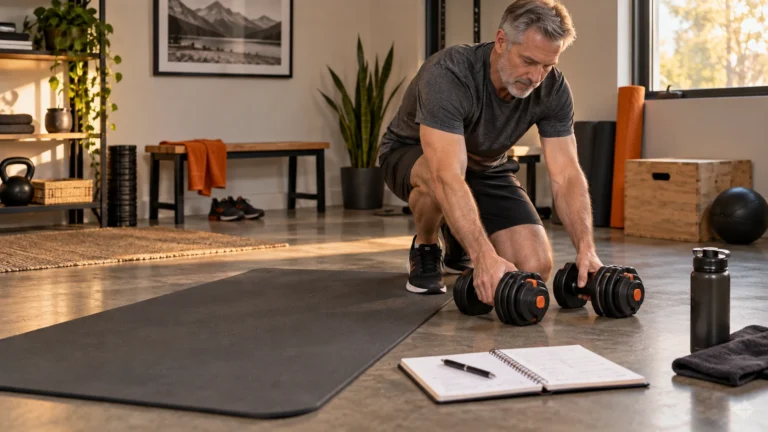
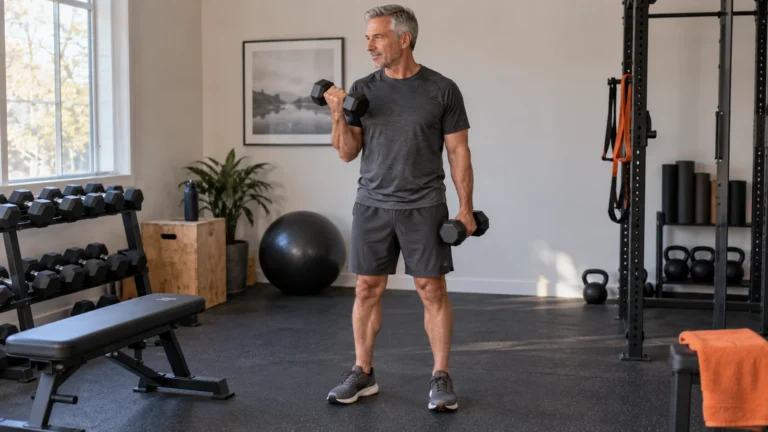
For the listed dumbbell option, choose a load you can position and return safely. Bodyweight versions are valid. Check that a bench-supported row does not require a painful or awkward transfer. Our home gym layout guide covers movement area and storage; the full-body home workout guide offers other equipment routes.
Optional equipment for your chosen routine
Buy only for a specific exercise or recording need. Existing suitable equipment may be enough. We have not independently tested these products; check the exact selected model and instructions before ordering.
* As an Amazon Associate, PrimeForMen earns from qualifying purchases.
Best for: For the example plan when a pair and the listed load range fit your current training. Skip if you are still learning unloaded movements or the minimum setting is too demanding. Current Amazon listing: PowerBlock Elite EXP 90 Adjustable Dumbbells, Stage 1, Set of 2, 5 lb-50 lb Best for: For a suitable floor surface when optional floor exercises are comfortable. Skip if you keep the standing alternatives or already have a suitable surface. Current Amazon listing: Gorilla Mats Large Exercise Mat - 6x4/7x4/7x5/8x4/10x4 ft - Home Gym Mat * As an Amazon Associate, PrimeForMen earns from qualifying purchases.Recommended Products

PowerBlock Elite EXP adjustable dumbbells, Stage 1 pair
View on Amazon

Gorilla Mats large exercise mat
View on Amazon
Choose two or three realistic training slots
| Route | Example arrangement | How to continue |
|---|---|---|
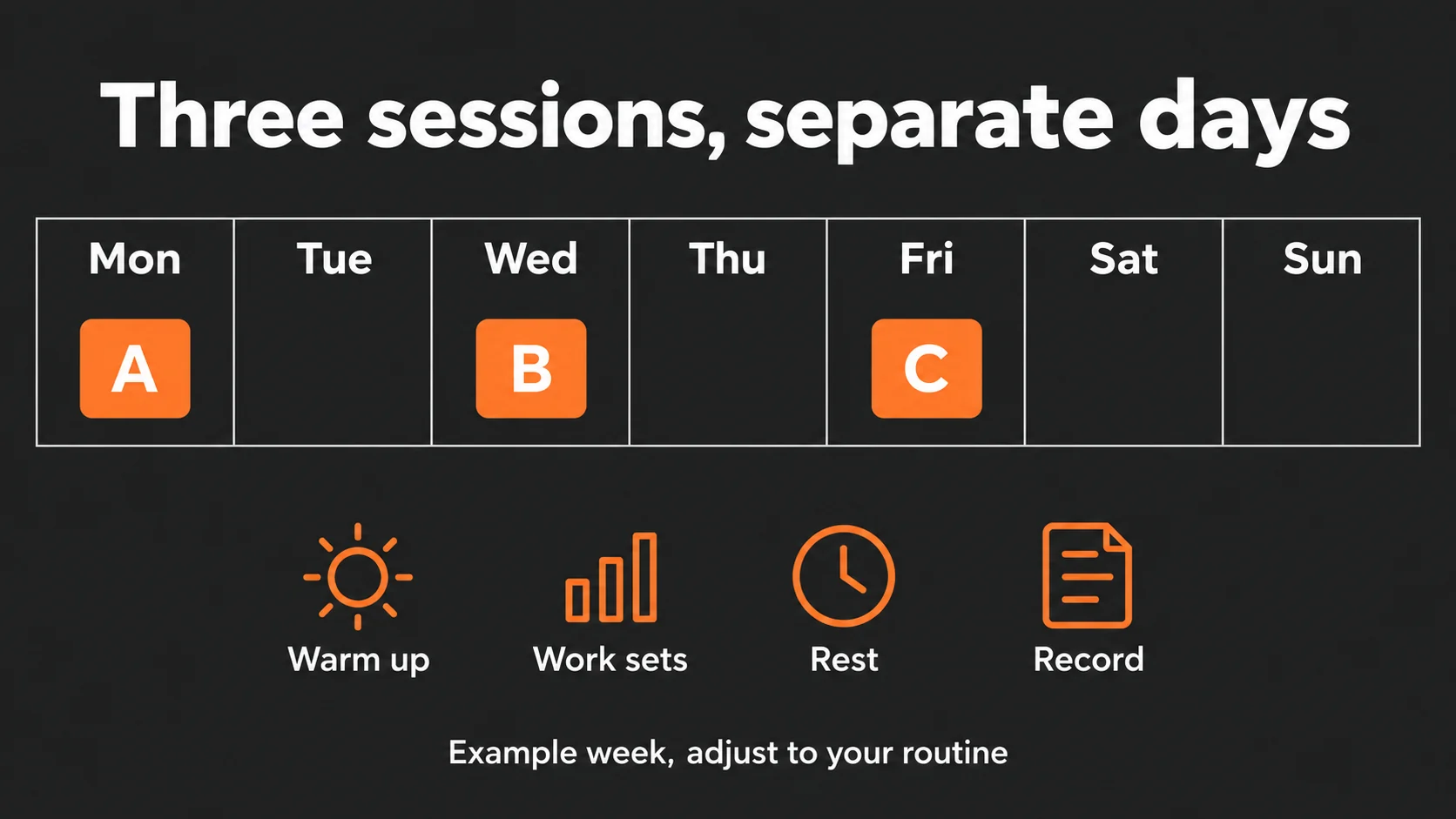
| Three strength days | Monday A, Wednesday B, Friday C | Repeat the arrangement while it fits your routine. Review other demanding exercise and work. |
| Two strength days | Tuesday A, Friday B | Next week Tuesday A, Friday B again, or alternate B/A if that better balances your exercise choices. Do not add a compulsory C catch-up. |
| Changing work schedule | Two or three separated slots you can actually attend | Continue with the next planned session, leaving enough time for your current recovery needs. |
These examples put at least a day between strength sessions for convenience. A calendar gap does not prove recovered performance. If heavy gardening, hill running or manual work leaves substantial leg demands between A and B, include those in the week rather than labeling them automatic rest.
Keep suitable aerobic activity on the calendar, but do not treat this plan as a complete aerobic prescription. Our cardio guide for men over 50 covers that part of the week. Put any demanding interval session where it does not create an unplanned run of hard leg days.
Start every session with preparation
Allow about six minutes for an example warm-up: three minutes of easy walking or marching, two minutes of comfortable unloaded squat and hinge practice, and a minute setting up and rehearsing the first movement. Add practice or time when an exercise or machine is unfamiliar. The six-minute allowance is a planning estimate, not a test you must pass.
For each listed exercise, complete one set, rest, then perform the second. The example allowance is 60 to 90 seconds between working sets. Take longer when needed for controlled breathing, stable position and repeatable technique. Between exercise stations, allow about a minute to change equipment and rehearse the setup. You can extend that time without “failing” the workout.
Use controlled repetitions and breathe freely. Aim to stop before you need to grind, strain or change position to finish. If an effort number is unfamiliar, record “manageable,” “demanding but controlled,” or “stopped because form changed.” The companion strength progression guide explains effort and load changes.
Session A: squat, push, pull, hinge and calf raise
| Exercise and setup | Example working target | Execution and simpler route |
|---|---|---|
| Sit-to-stand or familiar goblet squat | 2 sets of 8 to 12 | Feet stable, chair secured if used. Lean forward as needed to stand, then return under control. Use hand assistance when suitable and record it. Goblet load is optional. |
| Wall push-up or suitable incline push-up | 2 sets of 8 to 12 | Hands on a stable surface, feet secure. Bend the elbows without collapsing through the trunk, then press away. Use the wall or a more upright angle when needed. |
| Supported one-arm dumbbell row | 2 sets of 8 to 12 per side | Support on a locked purpose-built bench when suitable. Keep the trunk controlled, draw the elbow back without twisting, lower smoothly. Use a familiar gym row machine if support/position is unsuitable. |
| Unloaded hinge or dumbbell Romanian deadlift | 2 sets of 8 to 10 | Soft knees, hips move back, load stays close. Use only the range you control. Practise unloaded and stop before the back position changes. |
| Supported standing calf raise | 2 sets of 10 to 15 | Use a fixed support for balance, rise smoothly and lower to the level floor. Keep both feet down together; do not start from an unstable edge. |
For the one-arm row, one complete set means the left and right sides. Allow about 15 seconds to reposition between them, then rest 60 to 90 seconds after both. Use the same side order and record each side separately if repetitions differ. Do not double the weaker side’s work to “catch up.”
Allow roughly 29 to 34 minutes including preparation and notes. That estimate counts 12 physical working bouts: eight bilateral sets plus four arm-specific row bouts. At about 30 to 45 seconds per bout, work takes 6 to 9 minutes. Five between-set rests total about 5 to 7.5 minutes; row side changes about 30 seconds; four station changes about four minutes; warm-up six minutes; finishing and notes four minutes. These components total about 25.5 to 31 minutes before extra rehearsal or longer rests, so reserve a little more time.
Session B: hinge, supported split stance, push, pull and carry
| Exercise and setup | Example working target | Execution and simpler route |
|---|---|---|
| Unloaded hinge or familiar dumbbell Romanian deadlift | 2 sets of 8 to 10 | Repeat the A-session setup. Begin unloaded if you need practice; a larger load is not required because the hinge comes first. |
| Supported floor split squat | 2 sets of 6 to 10 per side | Both feet on the floor, comfortable staggered stance, fixed hand support. Lower through a controlled comfortable range. Replace with sit-to-stand when the stance or balance is unsuitable. |
| Wall push-up or a familiar chest press | 2 sets of 8 to 12 | Use the same recorded wall setup, or a machine/bench press you already understand. Do not add an unfamiliar press solely for variety. |
| Supported row or familiar cable/machine row | 2 sets of 8 to 12; per side if one-arm | Keep the same setup as A or record the alternative. Band pulling needs a verified manufacturer-approved anchor. |
| Light two-hand carry or stationary hold | 2 bouts of 20 to 30 seconds | Clear route, loads held comfortably, upright controlled position and continuous breathing. Use a stationary hold if walking with loads is unsuitable; skip loaded holding if it needs individual advice. |
Keep the split-squat rear foot on the floor. Elevating it is unnecessary for this example. Our split-squat guide explains the floor and elevated routes. Follow the same side-change rule as A and allow more setup time if needed.
If both the split squat and row use separate sides, B contains 14 physical working bouts, not 10. Allow about 7 to 10.5 minutes for those bouts, 5 to 7.5 for between-set rests, one minute for four side changes, four for station changes, six for warm-up and four for finishing. The arithmetic gives roughly 27 to 33 minutes before extra practice. Reserve about 31 to 37 minutes. Replacing a side-specific movement with a bilateral one changes the estimate.
Session C: repeat the basics with a trunk-control option
| Exercise and setup | Example working target | Execution and simpler route |
|---|---|---|
| Sit-to-stand or familiar goblet squat | 2 sets of 8 to 12 | Use the recorded A setup. Keep a suitable load; Friday is not automatically a heavier day. |
| Wall or suitable incline push-up | 2 sets of 8 to 12 | Repeat the chosen angle and comfortable range. Record any change in support height. |
| Supported row or familiar machine row | 2 sets of 8 to 12; per side if one-arm | Use the same side order and controlled trunk position. Avoid rushing the second side. |
| Unloaded hinge or familiar dumbbell Romanian deadlift | 2 sets of 8 to 10 | Keep the hinge in the session so the week is not built entirely around squatting. Stop before control changes. |
| Standing trunk-control hold, or familiar dead bug when floor access is comfortable | 2 holds of 15 to 25 seconds, or 2 sets of 4 to 6 reaches per side | For standing work, use a light comfortable two-hand hold without leaning or breath holding. For the dead bug, keep reaches short and controlled; choose the standing option if floor transfers are awkward. |
Choose one trunk-control route for C. The core workouts at home guide gives fuller movement instructions and appropriate alternatives. C takes roughly the A-session allowance, about 29 to 35 minutes, but floor transfers and alternating reaches may extend it. Keep essential rest even when the clock runs longer.
Watch an older-adult sample session from the National Institute on Aging
The National Institute on Aging sample shows an unhurried exercise session with warm-up and movement demonstrations. Its 15-minute sequence is separate from our A/B/C example. Use it to see pacing and setup, rather than adding it on top of the listed work sets or treating it as individual clearance.
Watch the original video on YouTube if the embed does not play.
Stop rules belong inside the session
Stop a set when the movement loses control or you have to strain and hold your breath to finish. Stop the exercise if it causes pain or you feel unwell. Persistent, worsening or unexplained symptoms need an appropriate assessment. Chest pain, fainting or severe unusual breathlessness require urgent medical care, not a shorter workout.
Use a shorter route when time is the issue
If the exercises remain suitable but you only have a shorter appointment, perform the warm-up and one working set of each chosen movement. Keep both sides for side-specific work. Keep rest and setup as needed; do not turn the session into a race. For A, an example allowance is 6 minutes warm-up, 3 to 4.5 minutes of work, about 15 seconds changing row sides, 4 minutes station changes and 4 minutes finishing and notes: roughly 17 to 19 minutes before additional rest or practice. The helper reserves 17 to 22 minutes to leave an allowance for extra rest and setup; extend it further when needed.
For B, count both the split-squat and row sides. One set of each gives seven physical bouts, or about 3.5 to 5.25 minutes work, plus two side changes. With the same other allowances, reserve about 19 to 24 minutes when extra rest and practice are included. This is a reduced-work example, not proof that every reader needs this amount.
Shortening for time is different from exercising despite symptoms. If something feels wrong, use the stop rules and seek advice when needed. Do not use the shorter route as automatic medical permission.
Count the whole session, including rest
For the example A session, the illustration allocates 6 minutes to warm-up, 9 to working sets, 11 to rests and changes, and 4 to finishing and notes: 30 minutes. Actual repetitions, side changes and longer rests can change the total.
Silent, 8.5 seconds. Open the animation directly. Essential instructions remain in the readable text.
Choose the session and time allowance
Select A, B or C and the full or shorter route. The result repeats the example workload and time allowance; it does not judge personal suitability.
Stop a painful movement or exercise that makes you unwell. Persistent, worsening or unexplained symptoms need appropriate advice. Chest pain, fainting or severe unusual breathlessness require urgent care. Selecting no concern does not establish exercise suitability. Count both sides, rest and transitions. Extend the time or shorten suitable work rather than rushing.
Use the printable PDF or record the chosen exercises and completed work in an ordinary notebook. The interactive result needs JavaScript.
Adjust from the sessions you actually complete
In the first exposures, keep the work manageable enough to learn the sequence and record the setup. When the chosen variation becomes familiar, review each exercise independently. A row may be ready for another repetition while the squat stays unchanged. The calendar does not require a simultaneous increase across the session.
If the next available load step makes an exercise unmanageable, return to a suitable option. If several sessions become harder, review total demands, rest, setup and set count before adding work. The worked progression examples show how to make those decisions without a compulsory weekly increase or fixed deload percentage.
Missed Monday? Continue with the next suitable slot rather than doubling Wednesday. After a long break, use familiar manageable movements and practice again. A prior best load is not a current starting instruction. Readers learning the movements for the first time should begin with the beginner home workout route or qualified instruction.
Keep a record beside your exercises
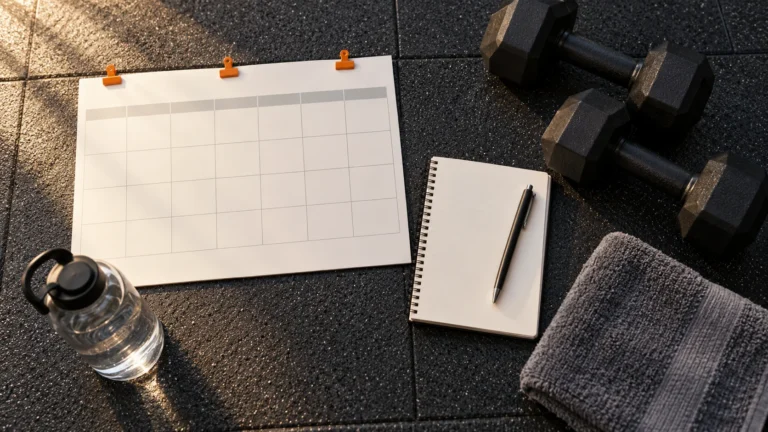
Use the eight-field fillable PDF to record your chosen A/B/C exercises, actual sets, rest, substitutions and finish time. Save a completed copy or print it for handwritten notes. The helper print button creates a separate record with your current choices, notes and checkmarks.
Download the A/B/C session record (fillable PDF). An ordinary notebook is also sufficient.
Conclusion
Choose two or three appointments that fit your actual week. Prepare the equipment, keep the listed side changes and rest, and record the completed work. Let the next exercise decision come from that record, rather than an automatic increase when a new week begins.
Frequently Asked Questions About Workout Plans for Men Over 50
Do I need all three sessions every week?
No. The two-day A/B route is a practical alternative. Keep suitable regular strength work in the week and review the total demands. The C session is not a debt you must repay by doubling another workout.
How much weight should I start with?
Choose a load you can set up, move and return with controlled technique and manageable effort. Start unloaded when learning. The plan cannot select a safe personal weight from your age or bodyweight.
Does one set per side mean two sets?
It means two physical bouts, one for each side, within one complete side-specific set. Two sets per side produce four physical bouts. Count the side changes and record differing repetitions rather than hiding them.
Can I do cardio between these sessions?
Suitable aerobic activity belongs in the week. Include its actual demands when placing strength sessions, especially hills or hard intervals that also challenge the legs. A day without weights is not necessarily a low-demand day.
What if the session takes longer than the estimate?
Keep the rest and setup you need. Extend the appointment or use the shorter suitable route next time. The estimates use example bout durations; they are not deadlines or requirements to reduce necessary rest.