

Collagen supplements explained: realistic benefits for joints, skin, and tendons, plus limits, safety, and buying logic.
- Best fit: collagen peptides as an add-on for joints, tendons, skin elasticity, or connective-tissue support.
- Not a replacement: collagen is low in essential amino acids and should not replace whey, casein, egg, soy, or other complete protein sources.
- Most realistic expectation: subtle support over weeks, not a fast pain solution.
Bottom line Use collagen supplements as a targeted support choice: match the reason, evidence, and safety fit before buying.

Supplement Guide
Collagen supplements can be useful when your goal is connective-tissue support, but they are not a complete protein replacement, not a guaranteed joint fix, and not a shortcut around smart training, sleep, or total nutrition.
The best use case is narrow: men who already cover their protein basics and want a low-risk add-on for joints, tendons, or skin may consider collagen peptides. The weakest use case is using collagen as your main protein powder or expecting it to rebuild damaged joints on its own.
Quick Summary: Collagen supplements
- Best fit: collagen peptides as an add-on for joints, tendons, skin elasticity, or connective-tissue support.
- Not a replacement: collagen is low in essential amino acids and should not replace whey, casein, egg, soy, or other complete protein sources.
- Most realistic expectation: subtle support over weeks, not a fast pain solution.
- Useful pairing: vitamin C and consistent loading work may make more sense than collagen alone.
- Skip or ask first: men with allergies to the source animal, kidney disease, complex medication plans, upcoming surgery, or active medical conditions should get clinician guidance.
The Prime Perspective
Collagen is not magic, but it is also not automatically useless. The right question is not, “Does collagen work?” The better question is, “What job am I hiring this supplement to do?”
If you want more total daily protein, start with complete protein and use our guide to protein timing for men over 40. If you want a practical supplement shortlist, compare it against broader supplement recommendations instead of treating one powder as the whole plan.
Not a complete protein
Best with training context
Conservative expectations
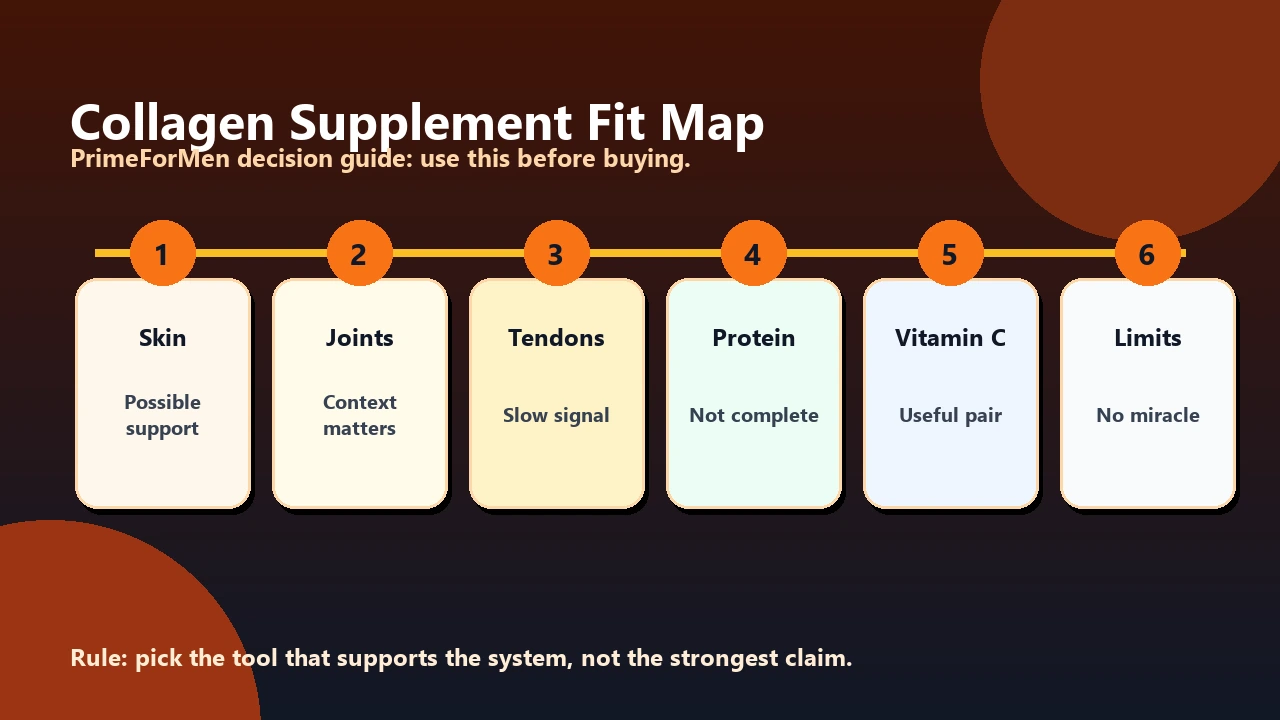
Smart Collagen Stack: What Actually Fits the Job
Use this as a buying framework, not a promise. The sensible stack is collagen for connective tissue, vitamin C for collagen-synthesis support, and complete protein for muscle protein needs.
- Choose collagen peptides when you want easy mixing and a measured daily dose.
- Pair with vitamin C if your diet is inconsistent or you take collagen around training.
- Keep a complete protein powder in the plan if muscle retention, strength, or satiety is the priority.
Amazon Product Shortlist
These are practical product starting points, not medical or performance guarantees. Use the images, sizing, labels, reviews, and return policy to compare the real item before buying.

Collagen Peptides
A targeted add-on for connective-tissue goals, not a complete protein replacement.
- Fits joint, tendon, and skin-support expectations best.
- Works better when paired with loading and enough total protein.
- Easy to compare by peptides, servings, and mixability.

Collagen Peptides
A practical buying option for the vitamin c supplements use case in this article.
- Matches the article's specific vitamin c supplements recommendation.
- Gives readers a concrete product page and image to compare.
- Worth checking for size, dose, fit, reviews, and return policy before buying.

Vitamin C Supplements
Useful when the real gap is daily protein consistency, not another complicated supplement.
- Makes higher-protein days easier when meals are rushed.
- Fits post-workout or low-prep meal routines.
- Pairs well with strength, recovery, and weight-management goals.
*Affiliate disclosure: PrimeForMen may earn from qualifying purchases. Product images are loaded from Amazon media URLs and product availability can change.
* As an Amazon Associate, PrimeForMen may earn from qualifying purchases. Product fit matters more than buying more supplements.
What Collagen May Help
Collagen is the main structural protein in connective tissues. Supplemental collagen peptides are broken down during digestion, but they still provide amino acids and peptide fragments that may be relevant to connective-tissue remodeling. That does not mean collagen goes straight to your knee, shoulder, or skin. It means it may be one input in a larger system.
Joints
Some men report less discomfort with consistent use, especially when joint stress is related to training volume or age. The evidence is more supportive than definitive.
Tendons
Tendon support is most plausible when collagen is paired with loading work, patience, and enough total nutrition. It is not a stand-alone rehab plan.
Skin
Skin hydration and elasticity are common claims. The realistic expectation is subtle change, not a visible reversal of aging.
Recovery Context
Collagen is not a strong soreness or recovery supplement. For recovery habits, start with sleep, protein, total calories, and proven muscle recovery techniques.
Benefit-vs-Hype Collagen Meter
This meter reflects practical confidence, not a medical score. Higher means the use case is more plausible for a healthy adult with the basics already covered.
Where Collagen Falls Short
The biggest collagen mistake is treating it like a muscle-building protein powder. Collagen is not a complete protein because it is low in several essential amino acids, especially leucine compared with high-quality muscle protein sources. That matters if your goal is strength, lean mass, or appetite control.
If your diet is short on protein, compare complete options in our guide to the best protein powders before spending money on collagen. Collagen can sit beside those options; it should not push them out.
| Goal | Collagen Fit | Better Primary Tool | Practical Verdict |
|---|---|---|---|
| More daily protein | Weak as the main source | Complete protein powder or food protein | Use collagen only after protein basics are covered. |
| Joint comfort | Possible support | Load management, strength work, body-weight control, clinician input when needed | Worth considering if expectations are modest. |
| Tendon resilience | Possible support with loading | Progressive tendon loading and recovery management | Collagen alone is incomplete. |
| Skin appearance | Possible modest support | Sun protection, sleep, total diet, hydration, dermatologist guidance when needed | Do not expect dramatic cosmetic change. |
| Post-workout recovery | Limited | Complete protein, carbs if needed, sleep, training plan control | Not the first recovery supplement to buy. |
The Knowledge Gap Most Collagen Advice Misses
The missing detail is protein context. A scoop of collagen can look like a protein serving on the label, but it does not behave like a complete protein serving for muscle. That is why two men can both take collagen and get different value from it:
- The man already eating enough complete protein may use collagen as a targeted add-on.
- The man under-eating protein may waste money because collagen is filling the wrong gap.
- The man with persistent pain may delay proper assessment if he treats collagen as treatment.
The National Institutes of Health Office of Dietary Supplements notes that supplements can help in some contexts, but they cannot replace the range of foods needed in a healthy routine and can carry safety considerations, interactions, and quality differences. Read their consumer guide on what to know about dietary supplements before stacking products casually.
Who Should Consider Collagen
Men with joint wear from training
If you lift, run, play sports, or do repetitive work, collagen may be a reasonable add-on once your training load is sane.
Men doing tendon-focused rehab
If a qualified professional has you doing tendon loading, collagen plus vitamin C may be worth discussing as part of the nutrition layer.
Men focused on skin aging
Collagen may be worth a trial if the basics are already in place: sun protection, sleep, protein, and a diet that is not chaotic.
Men who tolerate powders well
Collagen peptides are easy to mix and often simple to dose. That convenience is a real advantage if the product is third-party tested.
Who Should Skip or Ask First
- Skip if you expect a guaranteed fix: collagen is not treatment for arthritis, tendon rupture, chronic pain, or injury.
- Ask first if you have kidney disease: protein and amino-acid intake should be discussed with your clinician.
- Ask first if you take multiple medications: supplement routines can complicate care, especially before procedures.
- Check the source if you have allergies: bovine, marine, chicken, and porcine sources are not interchangeable for everyone.
- Avoid using collagen to mask pain: if pain changes your gait, sleep, strength, or daily function, get assessed.
A recent umbrella review of collagen meta-analyses found potential benefits across several skin and musculoskeletal outcomes, but also showed that certainty and results vary by domain. The review reported tendon morphology findings as low-certainty and did not show consistent recovery or soreness effects, which is why the practical stance should stay cautious: collagen may support some outcomes, but it should not be sold as a guaranteed repair tool. See the collagen supplementation umbrella review for the broader evidence map.
Practical Buying Block
Use this checklist before you buy:
- Choose hydrolyzed collagen peptides if you want a powder that mixes easily.
- Look for third-party testing from a credible program when available.
- Check serving size honestly: many products land around 10 to 20 grams per day, but more is not automatically better.
- Match source to tolerance: marine collagen is not a fit for fish allergy; bovine collagen may not fit every dietary preference.
- Do not buy proprietary hype: avoid products that promise cartilage regrowth, instant pain relief, or anti-aging certainty.
- Use a trial window: 8 to 12 weeks is more rational than judging it after three days.
How to Use Collagen Without Overthinking It
If you decide to try it, keep the protocol boring. Take a consistent serving, pair it with vitamin C from food or a supplement, and place it near a training or rehab session if that helps you remember. Then track the outcome that matters: joint comfort during a specific lift, tendon tolerance during a specific drill, or skin dryness over a consistent period.
- Do not chase five products at once. You will not know what helped.
- Keep protein separate. Collagen does not replace a complete protein serving.
- Keep training honest. No supplement offsets reckless volume jumps.
- Use recovery basics first. Sleep, calories, and programming beat supplement stacking.
- Consider manual recovery as support, not growth magic. For context, see our breakdown of whether massages help muscle growth.
Bottom Line
Collagen supplements make the most sense as a targeted add-on for men who already cover complete protein, training quality, and recovery basics. They may support skin, joints, or tendons for some people, but the effect is not guaranteed and it is not the same job as whey, casein, meat, eggs, dairy, soy, or a balanced protein powder.
If the real problem is low protein, buy complete protein first. If the real problem is persistent pain, get assessed. If the basics are handled and you want a low-drama connective-tissue experiment, collagen peptides plus vitamin C can be a reasonable trial.
Medical and Safety Disclaimer: This article is editorial information only and does not diagnose, treat, cure, or prevent any disease. Talk with a qualified health professional before using collagen supplements if you have a medical condition, use prescription medication, have kidney disease, are preparing for surgery, have allergies, or have persistent joint or tendon pain.
Affiliate Disclosure: This article includes affiliate links. If you buy through qualifying links, PrimeForMen may earn a commission at no extra cost to you. Recommendations are based on fit, not on a promise that a supplement will solve a medical or performance problem.
Frequently Asked Questions About Collagen Supplements
Are collagen supplements worth it for men?
They can be worth a trial if you want connective-tissue support and already cover protein, training, and recovery basics. They are less worthwhile if you expect rapid pain relief or use them instead of complete protein.
Can collagen replace protein powder?
No. Collagen is not a complete protein and is not ideal as the main protein source for muscle building, muscle retention, or post-workout protein needs.
How long does collagen take to work?
Most men should think in weeks, not days. If you try it, use a consistent 8 to 12 week window and track one specific outcome instead of relying on vague impressions.
Should collagen be taken with vitamin C?
Vitamin C is involved in collagen synthesis, so pairing collagen with vitamin C from food or a supplement is reasonable. It does not guarantee results, but it is a practical pairing.
Who should not take collagen supplements?
Men with source-specific allergies, kidney disease, complex medication plans, upcoming surgery, or persistent unexplained pain should ask a qualified clinician first. Anyone expecting collagen to treat an injury should skip self-treatment and get assessed.