
Plan HIIT workouts for men over 50 with moderate and vigorous examples, complete session timings, recovery checks and a printable interval record.
- Moderate intervals and vigorous HIIT have different effort targets.
- Count warm-up, every recovery, cooldown and setup.
- Fit the session around demanding leg training.
Bottom line Choose a familiar movement, write the full session and leave room to shorten it if your usual response changes.

HIIT workouts for men over 50 can be one way to improve conditioning when vigorous exercise fits your health, experience and current training. An interval session can also stay moderate: alternate a purposeful pace with easier movement while keeping conversation possible. Choose the effort first, then set the timing around it.
Quick Summary: HIIT workouts for men over 50
- Moderate intervals and vigorous HIIT have different breathing and effort targets.
- Use a familiar movement and learn its controls before increasing effort.
- Count setup, warm-up, work, every recovery and cooldown.
- Place demanding intervals around your actual leg-training schedule and response.
- A timer or heart-rate reading cannot decide whether HIIT is medically appropriate.
The Prime Perspective
A useful interval plan tells you what to do during the easy part, what to change when the next effort deteriorates, and how the session fits your week. Record whether the rounds stayed controlled and what happened at your next strength session.
Use our cardio guide for men over 50 to choose an aerobic activity and plan weekly volume. Use the examples below to write the work and recovery periods for one session.
Decide whether you want moderate intervals or vigorous HIIT
The CDC describes relative effort on a 0–10 scale: moderate activity is roughly 5–6, while vigorous activity begins around 7–8. At moderate effort you can talk but singing is difficult. At vigorous effort you manage only a few words before taking another breath. The same walking speed or bike setting can feel different to two people.
| Format | What the work period means | What to record |
|---|---|---|
| Moderate intervals | Purposeful movement with conversation still possible; easier movement between efforts. | Pace or resistance, talk response, completed rounds and recovery. |
| Vigorous HIIT | A controlled effort where speaking is limited to a few words; a genuine easier period follows. | The same observations, plus whether later efforts and subsequent training remain manageable. |
| All-out sprint training | Near-maximal effort. It is a separate demanding choice, with different technical and recovery needs. | A specific coached plan if this format serves an established goal. |
| Strength circuit | Several resistance exercises performed in sequence. Local muscle fatigue can limit the session. | Load, repetitions and movement quality, using the strength-training progression guide. |
A 30-second interval is a duration, not an intensity. It can be an easy practice period, moderate work or a sprint. Keep the effort description beside the seconds on your written plan.
If you have been inactive, are returning after illness or surgery, have a condition or medication that may affect exercise, or have unexplained symptoms, discuss a suitable starting intensity with a qualified healthcare professional. A comfortable warm-up does not resolve those questions. You can choose easier familiar activity while an appropriate plan is established.
Optional tools for timing and recording
A phone timer, existing notebook and familiar exercise equipment may be enough. These products solve separate recording jobs; none makes vigorous exercise suitable for you. We have not independently tested them.
* As an Amazon Associate, PrimeForMen earns from qualifying purchases.
Recommended Products
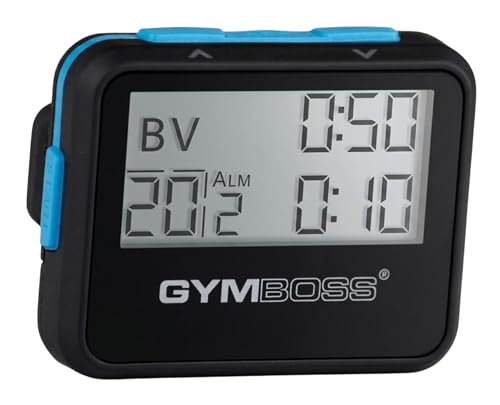
Gymboss interval timer: separate work and recovery alerts
Best for: Timing alternating efforts without looking at a phone during movement. Skip if your existing timer already gives usable interval alerts.
Current Amazon listing: Gymboss Interval Timer and Stopwatch - Black/Blue SOFTCOAT
- The checked listing is the Black/Blue SOFTCOAT timer.
- Program both work and recovery, then test a complete cycle before training.
- Manufacturer instructions describe beep and vibration alerts; choose an alert you can notice.

Ultimate Workout Journal: keep the actual session
Best for: A paper record beside your existing strength and cardio schedule. Skip if the free PDF or your existing notebook is easier to use.
Current Amazon listing: Ultimate Workout Journal - Fitness Training Planner for Men and Women
- Record completed rounds and changes to recovery time.
- Keep the nearest demanding leg sessions on the same page.
- Use the notes for your response and next review, without converting them into a medical score.
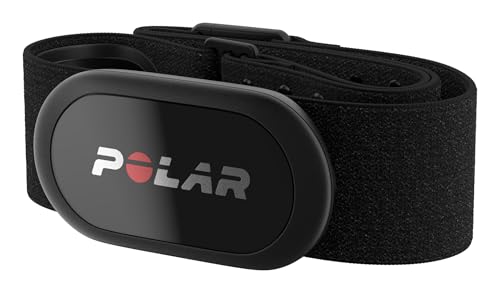
Polar H10: optional heart-rate recording
Best for: Readers who already use an individually appropriate heart-rate plan and compatible display. Skip if a strap adds no useful information or your target and device compatibility are unresolved.
Current Amazon listing: Polar H10 Heart Rate Monitor Chest Strap - ANT + Bluetooth, Waterproof HR Sensor for Men and Women, Black, M-XXL
- The checked catalog listing is Black, M-XXL; confirm the current strap fit.
- Polar documents Bluetooth, ANT+ and GymLink connections to compatible receivers.
- A sensor records heart rate; it does not clear you for HIIT or diagnose symptoms.
* As an Amazon Associate, PrimeForMen earns from qualifying purchases.
Check the Gymboss setup instructions and Polar compatibility guide before choosing those formats.
Choose a movement you can control as effort increases
Start with a mode you already use comfortably. A stationary bike avoids foot strikes, but mounting, seat position and resistance changes still matter. Treadmill walking needs reliable belt control and sufficient balance. Rowing needs a repeatable stroke. None is universally the safest option or automatically comfortable for painful knees.
Walking
Use a clear, even route with room to slow down. Choose turns and crossings outside the work interval. On a treadmill, read its manual, locate the stop control and use its safety device as directed. Rehearse a gradual speed change at easy effort. Do not step onto a fast-moving belt or jump off it between rounds.
Stationary bike
Adjust the seat and secure feet as the manufacturer directs. Confirm the bike is stable and that you can reach the resistance control without changing your posture. During an easy rehearsal, learn how its pedals slow and how its brake works if fitted. Keep pedaling gently during recovery rather than dismounting after every work period.
Rower or elliptical
Use these when the movement is already familiar. Rehearse getting on, slowing down and getting off at an easy pace. If fatigue changes your stroke, balance or ability to reach the controls, reduce the effort or end the interval block. Technical practice belongs outside a hard timed set.
If you need a support, equipment adjustment or movement modification, settle that before adding vigorous work. Our beginner home-workout guide covers familiarizing yourself with accessible movements; a fast multi-exercise circuit is not required here.
Two complete interval examples
These are planning examples to adapt, not age-based prescriptions or a test you must pass. The vigorous example borrows the 30-second work and 90-second easier cycling format described by Hospital for Special Surgery. We include a full timeline so the advertised time reflects the whole session.
Example A: 24-minute moderate walking session
For a person already comfortable walking at a moderate pace, with an appropriate activity plan. Keep the work periods conversational. You may need fewer rounds, more recovery or a shorter outing.
| Elapsed time | Action | What you check |
|---|---|---|
| 0:00–2:00 | Set up your route and timer; check the surface and footwear. | You can walk and slow without obstacles or rushing. |
| 2:00–7:00 | Five minutes of easy walking, gradually becoming more purposeful. | Movement feels familiar; do not force a brisk pace if it does not. |
| 7:00–19:00 | Six rounds: 60 seconds moderate walking, then 60 seconds easier walking. | Conversation remains possible during work; pace settles during recovery. |
| 19:00–24:00 | Five minutes of easy walking to finish. | Reduce pace gradually; extend the easy finish when your plan requires it. |
The six recoveries include one after the final work interval. Total: 2 minutes setup + 5 minutes warm-up + 6 minutes work + 6 minutes recovery + 5 minutes cooldown = 24 minutes. If you add a crossing, water break or extra recovery, add that time to your record.
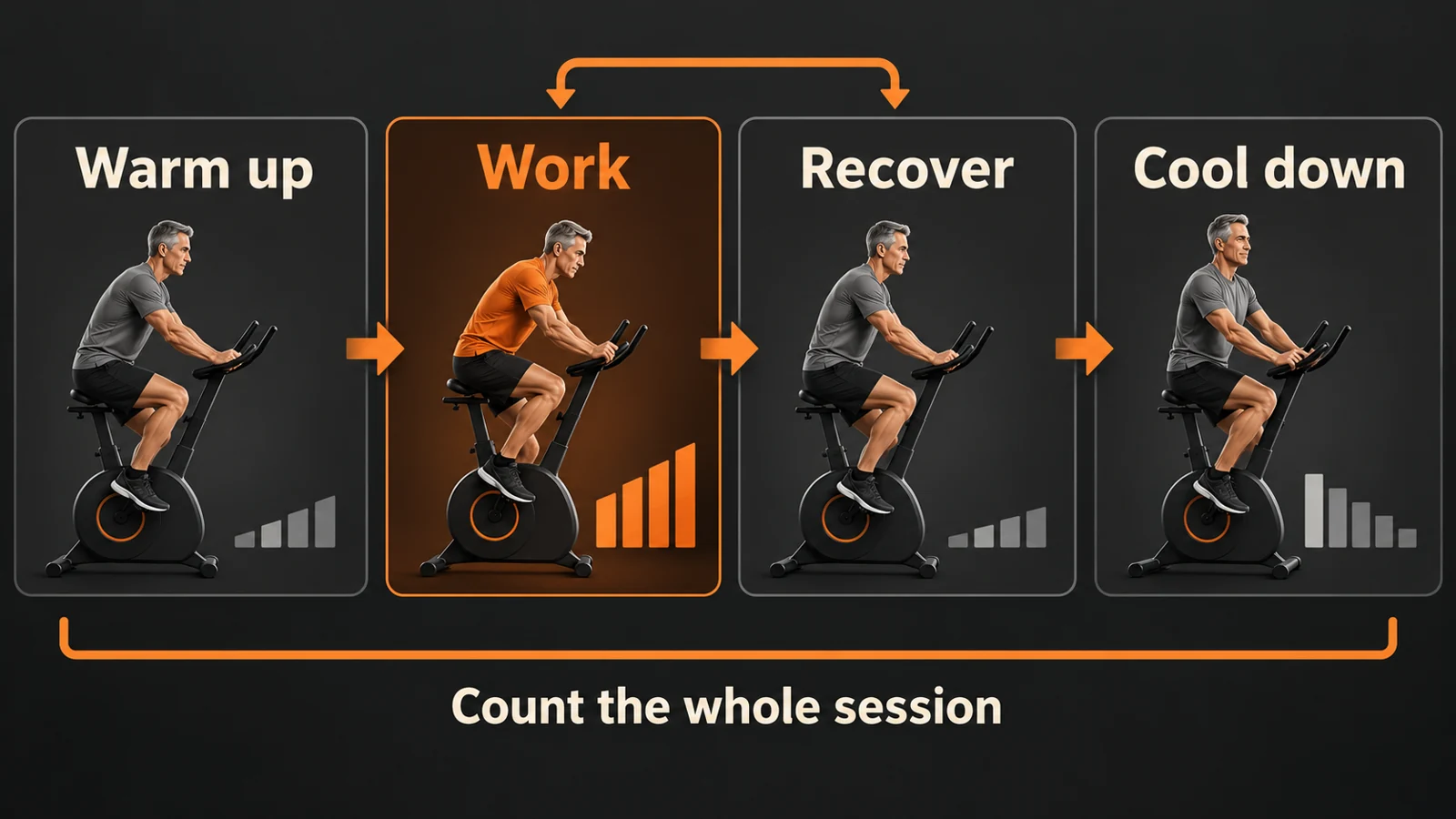
Count every minute
Illustrative timing for Example A: 5 minutes warm-up, 12 minutes alternating work and recovery, 5 minutes cooldown and 2 minutes setup. The animation compresses time; it is not a workout timer.
Silent, 8.5 seconds. Open the animation directly. Essential timing remains readable above.
Example B: 27-minute vigorous bike session
For a person already accustomed to the bike and to vigorous activity, whose individual circumstances allow it. Use controlled hard pedaling, not an all-out sprint. A comfortable moderate session does not automatically establish readiness for this example.
| Elapsed time | Action | What you check |
|---|---|---|
| 0:00–2:00 | Set the seat, feet, timer and resistance controls. | The bike is stable and the controls are familiar. |
| 2:00–10:00 | Eight minutes of easy pedaling, gradually increasing effort. | Posture and pedal control stay steady. |
| 10:00–22:00 | Six rounds: 30 seconds controlled vigorous work, then 90 seconds easy pedaling. | Work limits speech to a few words; recovery noticeably eases breathing and effort. |
| 22:00–27:00 | Five minutes of easy pedaling. | Slow gradually and dismount only when the pedals have stopped as the manual directs. |
All six 90-second recoveries are included. Total: 2 minutes setup + 8 minutes warm-up + 3 minutes work + 9 minutes recovery + 5 minutes cooldown = 27 minutes. Three minutes of vigorous work does not make the whole 27-minute visit vigorous exercise.
Use longer recovery or fewer rounds if needed; neither adjustment is a failure. If the next effort requires bouncing on the saddle, holding your breath or a large unplanned drop in pace, make it easier or finish the hard block. Concerning symptoms follow the stop guidance below.
The American Heart Association recommends gradual warm-up and cooldown, commonly 5–10 minutes each. The examples use specific durations for arithmetic; extend them when your activity and individual plan need more time. Do not cut them to squeeze a session into a short break.
The final recovery changes the total
Six work periods can have six recoveries if the timer completes every work/easy pair. They can have five if the final work period leads directly into a continuous easy cooldown. Both conventions need explicit labels. If you omit the sixth 90-second recovery from Example B, its total becomes 25 minutes 30 seconds, with the five-minute cooldown still included. Do not accidentally omit the cooldown as well.
Count your complete interval session
Calculate the duration of a plan you have chosen. This helper does not recommend an intensity, check medical suitability or tell you when you have recovered. Input limits keep the calculator manageable; they are not exercise guidelines.
Without JavaScript, use this calculation: setup + warm-up + (rounds × work seconds + recovery count × recovery seconds) ÷ 60 + cooldown. Recovery count equals the rounds when every work/easy pair is completed, or rounds minus one when the final work period leads into the cooldown. Example A totals 24 minutes; Example B totals 27 minutes. Use the fillable PDF below to keep your plan.
What the 4×4 research can tell you
NTNU’s CERG uses four four-minute work periods with three-minute active recoveries between them in its published 4×4 example. With 10 minutes warm-up, 16 minutes work, three recoveries totaling 9 minutes, and 5 minutes cooldown, the exercise time is 40 minutes. Two minutes of setup would make the visit 42 minutes. That protocol is a longer and more demanding choice than the examples above.
The Generation 100 randomized trial followed 1,567 adults aged 70–77 in Norway for five years. Participants received HIIT, moderate continuous training or national activity advice. Many were already active, and medical exclusions limited participation. The combined exercise groups did not have significantly different all-cause mortality from the advice group; the HIIT-versus-control estimate was uncertain.
This trial supports discussing structured exercise in older adults. It does not show that every man over 50 should copy a research intensity, that our shorter examples produce the same results, or that HIIT reverses aging.
Watch CERG explain the Generation 100 study
NTNU’s Cardiac Exercise Research Group hosts this animated explanation on its official study page. Watch it for the study design and research context. It is not a follow-along workout, a medical screening tool or evidence that your own interval session has a guaranteed outcome.
Watch the original CERG video on YouTube if the embed does not play.
Fit intervals around demanding leg training
Place the interval session using the actual workload of your week. A full-body lifting day can contain substantial leg work, even if the calendar calls it general strength. Cycling intervals can also load tired legs. Calendar spacing helps you plan; it does not certify recovery.
| Existing strength pattern | Possible interval placement | Adjustment when it does not fit |
|---|---|---|
| Monday and Thursday strength | Saturday intervals, with easier activity Friday and Sunday. | Keep Saturday easier if Thursday still affects normal movement; avoid carrying interval fatigue into Monday. |
| Monday, Wednesday and Friday strength | Saturday moderate walking intervals, if ordinary walking feels normal. | Vigorous intervals may fit poorly. Keep the moderate option or reorganize training rather than forcing another hard day. |
| Variable shifts or sport sessions | Place the chosen session after reviewing the nearest demanding leg work in both directions. | Count sport and physical work too; shorten or move the session when the week is already demanding. |
These are scheduling examples, not fixed recovery rules. Use the workout plan for men over 50 to organize your strength sessions. If you want to add vigorous intervals, decide which workload changes to make with an appropriate trainer or clinician when relevant, instead of automatically adding them to every available gap.
Use the actual session to decide what happens next
Record planned and completed rounds, changes in recovery, approximate effort and the nearest hard leg sessions. If the session was controlled and usual activity and subsequent training remain manageable, repeating the same plan gives you a useful comparison. There is no requirement to progress every week.
If you and your trainer decide to increase the challenge, change one variable first: a round, work duration, resistance or recovery duration. Keep the other settings identifiable. Longer work plus higher resistance plus shorter recovery makes it hard to know which change caused a problem. This gradual approach is consistent with ACE’s guidance for older clients.
Keep an interval record beside your training plan
The worksheet records your mode, full timing, completed rounds, actual effort and nearby leg training. Fill it electronically and save it, or print it for handwritten notes. The helper’s print button separately preserves your current on-page choices and notes.
Download the interval session record (fillable PDF). It records observations and questions; it does not determine medical suitability or assign a recovery score.
When to ease back, stop or seek help
Ordinary hard breathing should become easier when you lower the effort. If you cannot recover enough to control the next planned interval, take more easy time, reduce the effort or end the work block. Sharp pain, unusual dizziness, loss of balance or symptoms that are new for you are reasons to stop and seek appropriate assessment, rather than finish the round count.
Chest pressure, fainting, severe unexpected breathlessness or possible heart-attack symptoms need urgent attention. Stop exercising and call 911 in the US when heart-attack warning signs are present. Do not try to finish a cooldown or use a watch reading to dismiss them. The American Heart Association lists the warning signs, including chest discomfort, shortness of breath and lightheadedness.
Medication and health conditions can change heart-rate responses. An age-predicted maximum, a wearable zone or the heart-rate zone calculator is an estimate or training aid, not an exercise-clearance decision. Use individually agreed guidance when heart-rate targets are appropriate.
Conclusion
Choose the effort you intend, write a complete session and rehearse its movement and controls. Moderate intervals are a useful option when vigorous work does not fit. If HIIT is appropriate, judge the plan by controlled efforts, adequate recovery and how it fits your other training. Keep your session record to help decide whether to repeat or change the plan.
Connect conditioning with the rest of your training
The fitness for men over 50 guide brings strength, cardio and movement practice together. Use its broader plan when an interval session would crowd out another priority.
Frequently Asked Questions About HIIT Workouts for Men Over 50
Can men over 50 do HIIT?
Some can, when health, current conditioning and the chosen activity allow vigorous exercise. Age alone does not decide suitability. Returning after inactivity, medical conditions, relevant medication and exercise symptoms deserve individual guidance.
Does a 30/90 workout count as HIIT?
Only when the 30-second work period is genuinely vigorous for you. If conversation stays comfortable, it may be moderate interval training. The 90-second recovery and round count describe timing, not the work intensity.
How many HIIT sessions should I do each week?
There is no universal number for every man over 50. Begin with the amount established for your circumstances and fit it around strength, sport and everyday demands. The two weekly research sessions in Generation 100 are not a personal prescription.
Is a bike the best choice for painful knees?
A bike avoids running impact, but seat position, joint range and resistance can still provoke symptoms. Choose an appropriate mode and adjustment with professional guidance when pain persists. Low impact does not mean universally pain-free.
Can I shorten the session by skipping the last recovery?
You can explicitly transition from the last work period into an easy cooldown if that fits your plan. Recalculate the total and keep the cooldown. Do not stop abruptly after hard work merely to match an advertised session time.