

Build muscle after 50 with clear training and food records, worked examples, evidence limits and a printable observation sheet.
- Suitable resistance training can increase muscle size after 50.
- Count actual work and food before adding more.
- Performance and scale changes do not measure new muscle tissue.
Bottom line Bring a comparable exercise entry and a few ordinary food records to your next review, then choose one question to investigate.

You can build muscle after 50. Resistance training provides a stimulus, food supplies protein and energy, and a repeatable routine gives those inputs time to matter. Your training history, health, starting point and consistency affect the response. A heavier scale reading or an improved set of curls cannot tell you how much new muscle you have built.
This guide helps you choose what to record and what to review before adding more work or food. For exercise execution and a complete schedule, use our strength-training progression guide and A/B/C workout plan. The examples below are fictional teaching records, not results from a client or a tested PrimeForMen program.
Quick Summary: Build Muscle After 50
- Resistance training can increase muscle size in older adults; results vary.
- Count completed working sets with consistent exercise and load definitions.
- Review food intake against an appropriate protein target before buying powder.
- Performance, weight and waist records provide context; none measures hypertrophy by itself.
- A review date is a reminder to look at the evidence, not a deadline to increase sets or calories.
The Prime Perspective
A useful muscle-building routine is one you can describe clearly: which exercises you actually did, how challenging the sets were, and how you felt afterwards. If the record is vague, a plateau is difficult to interpret. Adding a supplement, a lifting day and a larger lunch together makes it even harder to know what helped.
Start by separating three questions: Am I repeating suitable training? Does my food cover my needs? What do my observations actually show? You may need a coach to answer the first, a dietitian for the second, or a clinician when symptoms or unexplained changes are involved. A notebook supports those conversations.
What the evidence supports after 50
Age does not prevent a training response. A 2020 systematic review of randomized trials in adults aged 75 and older found improvements in strength and whole-muscle size with resistance training. It included 22 studies, although not every study contributed to every outcome. That supports the possibility of adaptation even later in life; it does not predict your rate of growth or establish that one home routine suits every older adult.
The 2026 ACSM summary for healthy adults recommends training the major muscle groups at least twice weekly and building gradually. For hypertrophy it highlights higher weekly volume, around ten sets per muscle group. This is a population-level programming direction, not a compulsory starting dose for a deconditioned reader or a return after surgery.
Interpret each set in its exercise context. Two controlled sets of a suitable exercise cannot be compared fairly with two rushed sets using a shortened movement. You also need enough rest to repeat the planned work. Training to momentary failure is not a requirement for every set; the same ACSM summary reports that failure training did not consistently change outcomes for the average healthy adult.
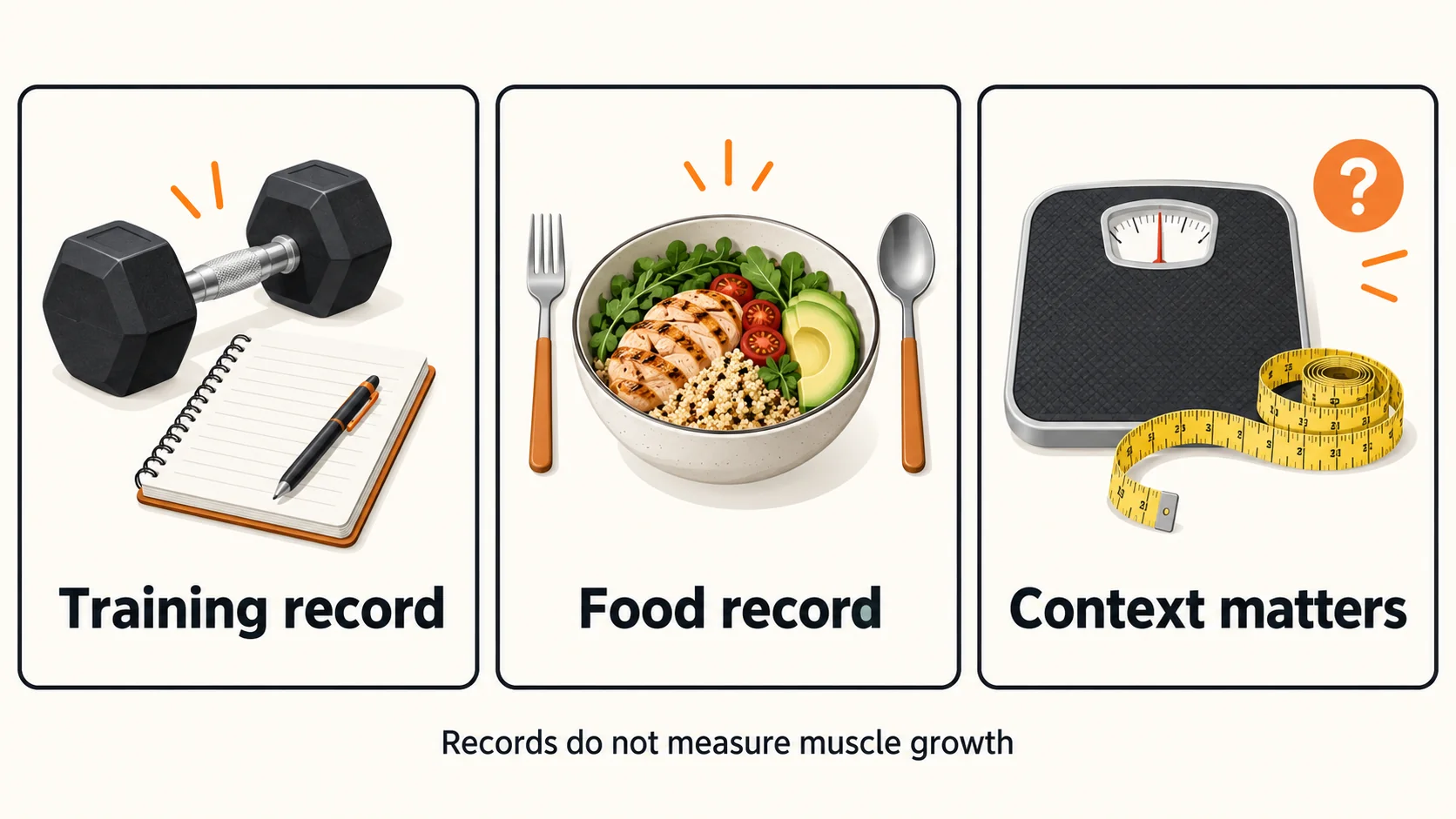
Strength, muscle size and body weight are different outcomes
| Observation | What it tells you | What it cannot establish |
|---|---|---|
| More repetitions with the same setup | Your performance on that task improved. | The amount of new muscle, or whether you should add another training day. |
| A heavier working weight | You handled that load under the recorded conditions. | That strength rose only because muscle size increased; skill and coordination also matter. |
| Higher average body weight | Total body mass changed. | How much is muscle, fat, water or digestive contents. |
| A changing waist measurement | Circumference changed under your measuring method. | An exact body-fat percentage or a diagnosis. |
| A body-composition estimate | An estimate from that method and its assumptions. | A precise muscle-gain total; even lean mass includes more than muscle. |
For home tracking, choose a few observations that you can repeat without turning every meal and workout into an examination. Use the same scale, similar clothing and a similar time of day if you choose to weigh yourself. For waist measurements, use the same landmark and tape tension. Keep the units visible. Skip body measurements if they increase anxiety or conflict with advice from your healthcare team.
Count training work before deciding to add it
Use an established routine that fits your current abilities. Our fitness system for men over 50 connects the strength, conditioning and recovery guides. You do not need to turn this article into a second workout layered onto that plan.
Separate warm-up sets from working sets in your record. Write the exercise variation, equipment, completed repetitions, and load per hand or total. A supported row and an unsupported bent-over row are different setups. If you change the variation, start a new entry rather than pretending it is a continuation of the same test.
| Illustrative weekly record | Completed work | How to count it |
|---|---|---|
| Monday supported row | 2 working sets on each side | Two sets per side, with both sides documented; not four sets for each side. |
| Thursday supported row | 2 working sets on each side | Four weekly row sets per side across the two sessions. |
| Monday and Thursday curl | 1 working set each day | Two direct curl sets for the week. |
| Light row rehearsal | 1 easier practice set before each session | Record separately as warm-up; do not silently add it to working-set totals. |
The row also involves the elbow flexors, so the direct curl count is not the entire training exposure of the arms. There is no universally agreed exact fraction that turns every compound set into an isolation-set equivalent. Keep the exercise list rather than manufacturing a precise muscle-volume total.
This small example explains counting, not a complete hypertrophy prescription. A coach may adjust exercise selection, effort and weekly volume together. Do not move straight from learning an exercise to a ten-set quota because a population summary mentions that number.
Make the comparison fair
Record rests when they change materially. If last time you rested two minutes and today you rushed after thirty seconds, fewer repetitions do not necessarily mean you lost strength. Similarly, a newly longer range of motion may reduce repetitions while making the movement more useful. These changes belong beside the number.
An effort note can help: comfortable, challenging but controlled, or form deteriorated. Experienced lifters sometimes estimate repetitions in reserve, meaning how many additional repetitions they think they could complete. That estimate is imperfect, especially when learning. Do not use it as a safety test or keep lifting through pain to prove the estimate.
A fictional record: what improves, and what remains unknown
Consider a fictional returning lifter using one supported dumbbell row. These entries represent separate sessions at unspecified dates; there is no promised weekly progression.
| Entry | Same exercise setup | Food and context note | Reasonable interpretation |
|---|---|---|---|
| 1 | 20 lb in the working hand; 10 and 9 repetitions on each side | Breakfast often skipped; unfamiliar setup | Establish a clear baseline and check technique. |
| 2 | 20 lb; 11 and 10 repetitions on each side | Breakfast recorded; similar rest | Task performance improved. Do not assign the change to breakfast alone. |
| 3 | 20 lb; 12 and 12 repetitions on each side | Similar setup; started creatine between entries | Useful performance record, with a new supplement affecting interpretation of weight. |
| 4 | 20 lb; 11 and 10 repetitions on each side | Shorter rests after poor sleep | Comparison conditions changed. Review them before adding work. |
Suppose the average scale reading also rose by 1 lb. You still cannot conclude that 1 lb of muscle appeared. The person changed food intake, started creatine, and had varying sleep and rest. The record suggests questions to investigate, rather than proving a mechanism or a muscle-gain rate.
Read the observation before interpreting it
The row entries show improved repetitions at a fixed load, followed by a change in rest and sleep. The animation keeps performance and body-mass observations separate. It illustrates the fictional record above; it does not show measured hypertrophy.
Optional tools for keeping a useful record
A notebook you already own may be enough. A food scale is useful only when portion uncertainty makes your food record difficult to interpret. Neither product measures muscle growth, and we have not hands-on tested these models.
* As an Amazon Associate, PrimeForMen earns from qualifying purchases.
Best for: For completed sets, exercise setup and questions in one place. Skip if your notebook, app or free worksheet already does the job. Current Amazon listing: Ultimate Workout Journal - Fitness Training Planner for Men and Women Best for: For checking ordinary food portions when your record needs grams. Skip if weighing food causes distress or conflicts with your care plan. Current Amazon listing: Etekcity Food Kitchen Scale, Digital Grams and Ounces, 11lb * As an Amazon Associate, PrimeForMen earns from qualifying purchases.Recommended Products

Ultimate Workout Journal
View on Amazon

Etekcity digital kitchen scale
View on Amazon
Review protein and energy intake
Protein intake matters, but a powder is not automatically required. The Stanford Lifestyle Medicine overview for adults 50+ discusses an orientation of 1.2 to 1.6 g/kg/day alongside resistance training. Requirements differ with body size, activity, energy intake and clinical circumstances. Kidney disease or a prescribed diet can change the appropriate approach.
Use our existing protein calculator to explore its assumptions, or bring an agreed target from your dietitian. Then compare it with several ordinary food days. Record portions and actual label values. A rushed day can reveal a practical problem, but one incomplete entry is not evidence of chronic deficiency.
For an illustrative target of 120 g, a food record of 30 g at breakfast, 35 g at lunch, 35 g at dinner and 20 g in snacks totals 120 g. These assumed totals illustrate the addition; they are not nutrient values for unspecified portions or a personal recommendation. A different reader may need a different target and distribution. The food, powder and creatine decision guide shows how to calculate a gap from labels.
Energy intake: avoid automatic bulking rules
Protein is only one part of the diet. Keep enough food to support daily life and your training, including carbohydrate, fat, fiber and varied foods. A deliberate large calorie surplus is not a prerequisite that every reader should adopt. Someone losing weight under clinical guidance has a different problem from an experienced lean lifter trying to gain size.
Our calorie calculator offers an estimate and a food-and-weight logging approach. The estimate may differ from your actual energy expenditure. If you use it, compare the estimate with your observations before treating it as exact. Unintentional weight loss, poor appetite or a diet made difficult by illness deserves professional assessment.
A flat performance record alone does not prove that you need more calories. First check whether training comparisons are fair, sessions were completed, and the food record is reasonably complete. If nutrition needs adjustment, change something specific and practical, such as a meal you routinely miss, rather than assuming that a larger surplus will fix every problem.
Recovery and return to training
Rest, sleep, other exercise, demanding work and illness all affect what you can repeat. The National Institute on Aging advises seven to nine hours of sleep for older adults and recommends discussing persistent sleep problems with a doctor. A poor night is context to record, not a percentage that automatically decides your next workout.
If you are returning after a long break, use your current capacity rather than remembered weights. This guide does not prescribe 50% to 70% of an old workload: the length and reason for the break, equipment, symptoms and previous program all matter. After injury, surgery or illness, follow the relevant healthcare advice. A suitable coach can help rebuild the exercise routine within those limits.
Persistent pain, worsening fatigue or a repeated fall in function needs attention. Our fatigue and overtraining guide explains why a log cannot diagnose overtraining syndrome. Stop exercise and seek urgent help for chest pain, fainting, severe unusual breathlessness or new neurological symptoms.
Choose a question to investigate
This observation helper organizes review questions. It cannot measure muscle gain, diagnose symptoms or tell you to increase training or calories.
Use the article worked example and the fillable PDF when the helper is unavailable. Keep the source of your target, units and uncertainty visible. This record does not diagnose symptoms, determine supplement safety or clear exercise.
Keep an observation sheet beside your training log
The eight-field PDF brings together exercise conditions, food notes and questions. Type into it or print a blank copy. It does not calculate muscle gain or clear you to increase training.
See controlled upper-body movement
The National Institute on Aging Go4Life video demonstrates upper-body exercises, positioning and pace. Watch how the setup is established and the movement controlled. It is not a hypertrophy trial, a personal technique assessment, or a requirement to add six exercises to your existing routine.
What to review this week
- Keep one comparable exercise entry. Include setup, units, completed work and rests. Do not replace the whole routine just to get a new number.
- Write down a few ordinary food days. Include missed meals and uncertain portions; honesty is more useful than a perfect-looking total.
- Choose a review question. For example: Were rests comparable? Is breakfast consistently missing? Does this load step fit the equipment?
- Keep symptoms separate from performance ambition. Seek the right professional help when symptoms persist or affect everyday function.
A review in several weeks can help organize records, but four weeks is not a validated diagnostic threshold or a compulsory adjustment date. If conditions are stable and the routine remains suitable, repeating it may be reasonable. If observations disagree, gather context before changing multiple variables.
Conclusion
To build muscle after 50, establish suitable resistance training and food intake, then keep a record you can interpret honestly. Better exercise performance is useful; it is not a measurement of new muscle tissue. Bring one clear question to your next review instead of automatically adding sets, calories and supplements together.
For a connected training and nutrition overview, return to the fitness guide for men over 50. Our editorial policy explains how we distinguish research, illustrations and product recommendations.
Questions about muscle building after 50
Can a beginner build muscle after 50?
Yes, resistance training can produce muscle-size gains in older adults. Current abilities, health, nutrition and consistency affect the response. Start with a suitable routine rather than copying an experienced lifter’s workload.
How quickly should I expect visible growth?
There is no reliable universal timetable. Coordination and task performance may change before visible size. Photos, scale readings and tape measurements are influenced by many factors and do not establish exact muscle gain.
Should I start with ten sets per muscle each week?
ACSM’s healthy-adult summary highlights roughly ten weekly sets as a hypertrophy programming direction. It is not a mandatory starting point. Learning, returning after a break and clinical restrictions require individual adjustment.
Do I need protein powder or creatine?
Both are optional. Powder can help with a documented protein gap; creatine is a separate training-support decision. Food, a suitable routine and clinical guidance come first. Neither product replaces resistance training.
What if my repetitions do not improve for four weeks?
Check whether exercises, rests, effort, attendance and record quality were comparable. Review food and recovery, and seek help for symptoms or unexplained decline. A calendar alone does not decide that you need more sets or calories.