Plan a dumbbell shoulder workout with separate loads for presses, lateral raises and rear delts. Get technique cues, a session helper and training log.
- Choose a separate load for each movement.
- Your chest and back sessions also involve the shoulders.
- Overhead work is an option, not a requirement to force.
Bottom line Record the load and comfortable range for each movement before deciding whether the next session needs more work.
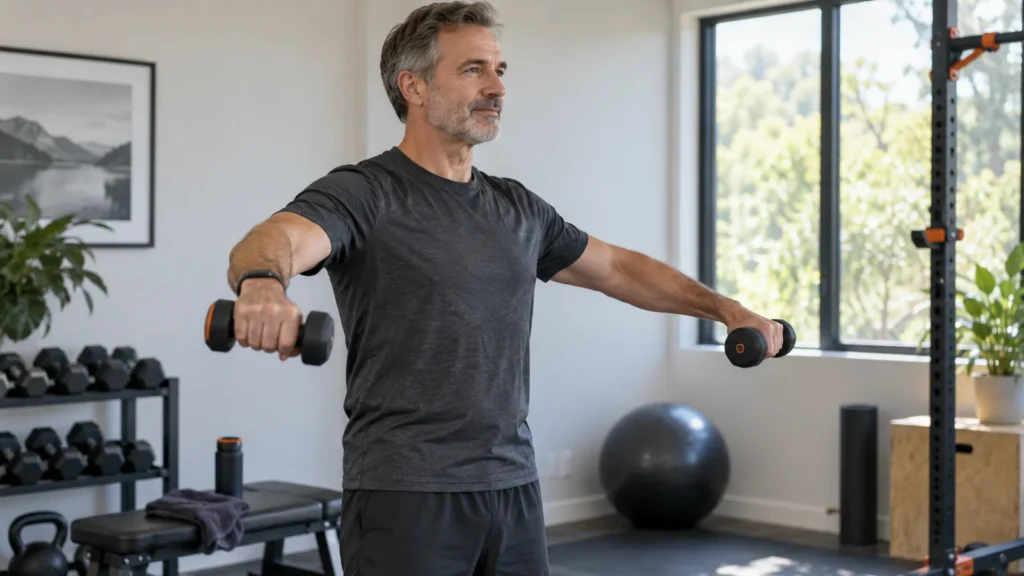
A dumbbell shoulder workout can combine a comfortable press, a lateral raise and rear-shoulder work. Choose the load separately for each exercise. A pair that suits pressing may be much too demanding for a controlled raise, and you do not have to force overhead work to complete the session.
Quick Summary: Dumbbell Shoulder Workout
- Choose a separate load for each movement.
- Your chest and back sessions also involve the shoulders.
- Overhead work is an option, not a requirement to force.
The Prime Perspective
Shoulder training is already present in many chest presses, push-ups and rows. Use a separate shoulder block for work your current week needs, accounting for that overlap. Start by listing what your current program contains.
Use this guide for a focused block within a weekly workout plan. If you are still learning basic pushing and pulling, the first-session home guide gives you a smaller starting task. Age alone does not decide whether overhead pressing is appropriate.
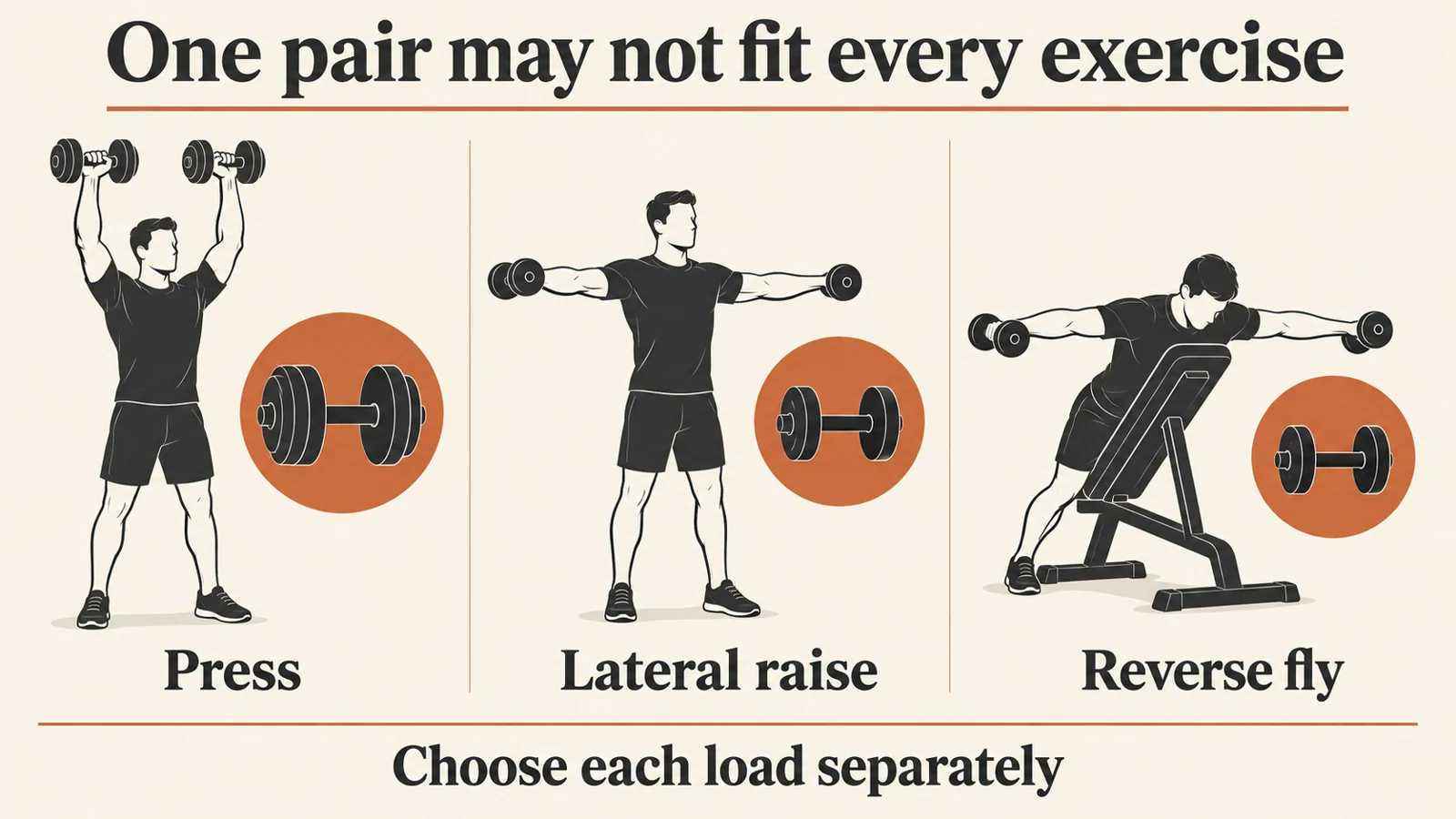
Three movement choices, three load decisions
An overhead press moves the load above you; a lateral raise moves the arm outward; a reverse fly uses a hinged or supported torso while the arms move outward behind the body line. These are different tasks, with different levers and setup demands. They should have separate entries in the log.
The press also involves the triceps. Rows and reverse flies overlap with upper-back and rear-shoulder work. Exercise names do not neatly divide the body into isolated compartments, so avoid treating each body-part page as an extra day you must add.
| Movement | Starting decision | Reason to change the version |
|---|---|---|
| Dumbbell overhead press | Standing or a suitable supported seat, with comfortable overhead movement | You cannot keep a controlled torso or manage the weights into position. |
| Lateral raise | Light weights, a small elbow bend and a controlled comfortable arc | You must swing, shrug markedly or chase a predetermined height. |
| Reverse fly | Chest support on a suitable bench or a familiar steady hinge | Holding the torso becomes the limiting task. |
| No press today | Omit overhead work when it is not part of your comfortable plan | Do not use a raise or the helper as treatment for shoulder symptoms. |
Optional equipment for this setup
Use the equipment you already have when it meets the plan. We have not hands-on tested these models. The current catalog and product images were checked on October 7, 2026; specifications and variants can change.
As an Amazon Associate, PrimeForMen earns from qualifying purchases. The links below are affiliate links. Check the selected variant and current instructions before buying.

PowerBlock Elite EXP Stage 1 pair
A selectable pair for recording the same load on repeated sessions.
- The catalog lists two dumbbells with 5–50 lb settings per hand.
- Check the exact edition and selector instructions before handling weights.
- Compare the minimum load and increments with your lightest exercise.
Skip it: Keep your current dumbbells if their load and increments already suit the movements.

YOLEO adjustable bench
An optional support for the bench-based variations in this guide.
- Read the exact manual for permitted positions, locks and loading.
- Check stability, floor contact and space around the moving weight.
- A catalog load headline does not establish suitability for every supported exercise.
Skip it: Skip a bench purchase when the floor, standing or suitable existing support option meets your plan.

Ultimate Workout Journal
A paper record for loads, repetitions and the setup that produced them.
- Record the exact movement and load unit rather than a vague workout score.
- Keep left and right results separate when the movement is unilateral.
- Use a new page to compare repeated conditions and planned changes.
Skip it: An ordinary notebook or the free worksheet below does the same recording job.
A complete starting shoulder block
For adults already comfortable with the selected exercises, rehearse for about five minutes: easy movement, gentle shoulder motion and light practice repetitions. The work below is an editorial example. Begin with one set of each familiar exercise after a long break, then review your response before using the full block.
Allow roughly 20–35 minutes, depending on support changes and rest. Leave about two or three controlled repetitions available. If you cannot hold the intended position, reduce the demand or stop rather than rushing the final repetitions.
| Exercise | Work sets | Rest |
|---|---|---|
| Comfortable dumbbell press, if included | 2 × 8–12 | 90–120 seconds, longer when handling needs it. |
| Lateral raise | 2 × 10–15 | 60–90 seconds. |
| Familiar supported or hinged reverse fly | 2 × 10–15 | 60–90 seconds; omit if the setup is not repeatable. |
Choose one position for each movement and keep it for comparison. The two raise exercises can be the whole accessory block when you already press elsewhere; they are not a complete replacement for every function of the press.
Press without turning it into a backbend
Start with a light load you can place at shoulder level under control. Use a comfortable grip and let the elbows follow a path that feels repeatable, without forcing them into a single universal angle. Press overhead while keeping your trunk steady, then lower under control to your chosen comfortable starting level.
For a seated version, use a purpose-built stable bench with the adjustment locked and both feet supported. A backrest changes support; it does not remove all effort from the trunk or prove that the movement will suit a painful shoulder. The ACE overhead press reference is another technique resource, not a personal clearance test.
If you cannot control the entry, exit or overhead path, omit the loaded press for now. You can still maintain other comfortable work while a qualified coach helps with technique. Symptoms, recent injury or medical restrictions require the relevant professional guidance.
Raise the arms without swinging the torso
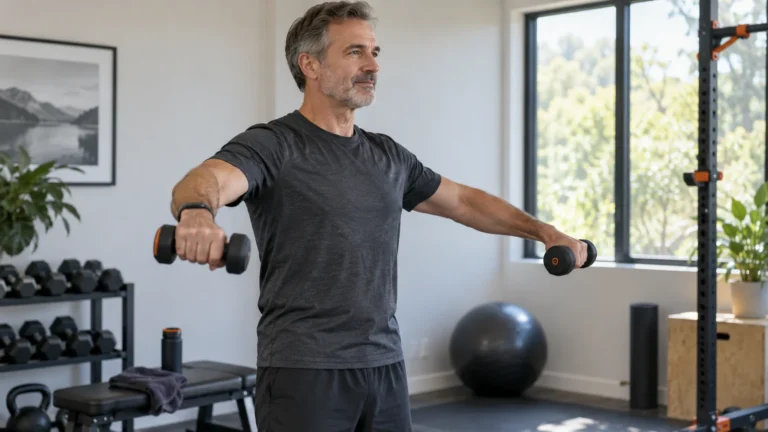
For a lateral raise, hold light dumbbells beside you with a slight elbow bend. Move the arms outward through a comfortable arc, often slightly forward of the body rather than forced directly sideways. Stop the upward movement before you need to lean, swing or shrug to keep lifting. Lower with the same control.
Shoulder height is not a pass/fail target. A smaller comfortable range can be recorded as the version you used, but changing range to hide a weight that is too heavy makes progression hard to interpret. Keep the load and range visible together.
For a reverse fly, establish the chest-supported or familiar hinged position first. Let the weights hang, keep a small elbow bend and move the arms outward without throwing the torso upward. Choose the load again; do not copy the row or press setting. If the support limits breathing or the bench is unsuitable, use another familiar version or omit it.
Choose a load for each movement
Press, lateral raise and reverse fly branch into separate load choices. No weight ranking is implied.
Silent 8.5-second schematic. Motion pauses outside the viewport. Reduced-motion settings keep manual playback. Open the MP4 directly.
Make small load changes without inventing progress
Suppose a lateral raise record is 12 and 11 controlled repetitions with the same range. Repeat the load and work toward 15/15 over comfortable exposures. If the smallest available increase makes the first repetition a swing, keep the previous load. A light fixed pair may suit this movement better than a large adjustable increment.
The press can progress at a different rate from the raise. Keep separate entries instead of applying a heavier setting to all three exercises on the same date. Slower lowering, shorter rest and a heavier dumbbell change different aspects of the task. Our progression examples help you decide which variable to change.
A training log should include how the weights were positioned and any meaningful range change. Repetition totals alone cannot tell whether a movement is appropriate or whether a shoulder problem has resolved.
Account for chest and back sessions
If Monday has chest pressing and Wednesday has rows, a Friday shoulder block may repeat work that is already demanding. Start by replacing existing shoulder accessories with this block. You can omit the press and use the two raise movements when your program already contains enough pressing for your current plan.
The chest guide explains floor and bench options; the back guide includes rear-delt work. Do not automatically combine both rear-delt prescriptions with this one. The right amount depends on your training history, recovery and the whole program, not on how many articles you want to follow.
Technique demonstration: NASM dumbbell overhead press
Watch the controlled overhead path and torso position. Use this only as a reference for a comfortable press; it is not an assessment of shoulder pain.
What to do when a movement is uncomfortable
Ordinary muscular effort is different from sharp, catching or increasing joint pain. Stop the affected exercise when symptoms change the movement. Do not repeatedly test the same painful arc with different weights in one session. Seek assessment for persistent pain, symptoms after injury, notable weakness or numbness.
A warm-up or mobility routine can prepare a familiar movement but does not diagnose the reason for pain. Avoid adding an unrelated rotator-cuff rehabilitation program just because a general workout feels difficult. Keep comfortable training and medical advice as separate decisions.
If several lifts are declining, review the week’s recovery and workload before buying different equipment. A new bench or band cannot compensate for repeatedly stacking hard sessions you have not recovered from.
Separate-load shoulder record
This helper organizes your choices; it cannot assess technique, symptoms, equipment safety or personal suitability. Entries stay in this page’s memory and are not saved or sent. Print the current record before leaving.
Record your selected setup, loads, repetitions, rest and other work in a notebook or the blank PDF below. For unilateral work, three sets of eight on each side means 24 left and 24 right repetitions. Keep unknown attachment or handling details unresolved until checked.
The helper printout includes current choices and notes. The downloadable PDF is a separate blank fillable record and does not import your entries.
Download the fillable training record
The one-page PDF has eight editable fields for your setup, work and next session. It starts blank; it does not receive the helper entries. Save a copy after filling it in a PDF reader, or print it and write by hand.
What a workout table cannot decide
The repetitions describe an example session. They cannot establish whether a movement, load or attachment suits you. Record the unresolved detail, reduce the task when needed and get qualified help for persistent symptoms or an unfamiliar setup.
Your next session
Use this dumbbell shoulder workout guide to choose a repeatable setup and a manageable amount of work. Record the load and comfortable range for each movement before deciding whether the next session needs more work.
The 2026 ACSM resistance-training overview supports regular work across the major muscle groups and gradual progression. The detailed sessions on this page are editorial examples; they are not ACSM protocols or individually prescribed plans.
Frequently asked questions
Can I use one pair for all three exercises?
Only if it suits each movement. The same pair may be manageable for a press but too demanding for a controlled raise. Record each exercise separately.
Do I have to include overhead pressing?
No. You can omit it when it is not part of your comfortable familiar plan. The remaining accessories do not replace every task of a press or treat a shoulder problem.
Should every lateral raise reach shoulder height?
Use a controlled comfortable range. Do not swing or shrug just to reach a fixed height. Record the range so later repetition totals remain comparable.
Can I add this after chest and back days?
Count the pressing and rear-shoulder work already present. Begin by replacing overlapping accessories; an additional hard day is not automatically needed.
Will this fix shoulder pain or posture?
This is a general training example, not a diagnosis or rehabilitation program. Stop painful movements and seek assessment for persistent, injury-related or neurological symptoms.
General fitness education for adults, not a diagnosis, rehabilitation plan or medical clearance. Follow any restrictions from your clinician. Stop for sharp or worsening pain, dizziness, unusual breathlessness or loss of control. Seek urgent care for severe or sudden symptoms.